
The huge statue of Stalin in Budapest, which was toppled during the revolution, was on October 23, 1956. The inscription on the statue reads: “Murderer of 25 million people!”
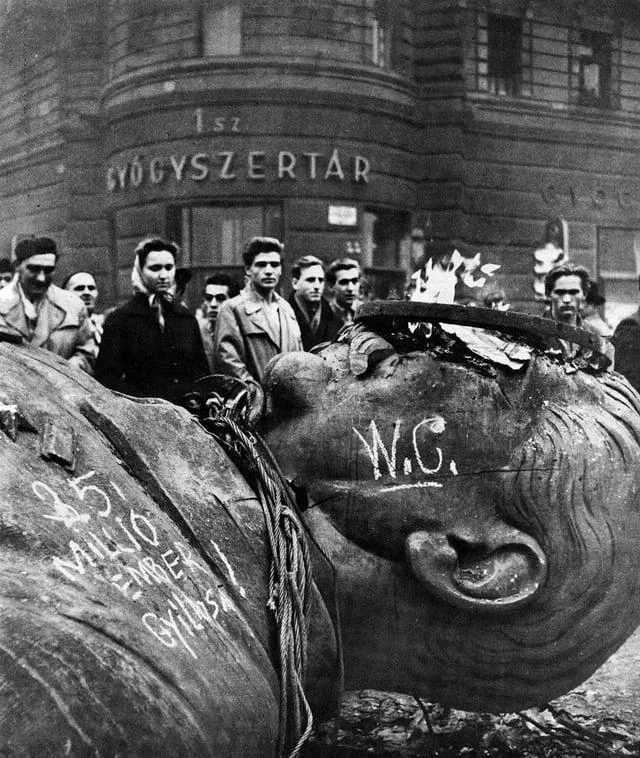
On the evening of October 23, 1956, thousands of Hungarians gathered around an enormous bronze statue of Joseph Stalin in Budapest. The monument stood eight meters tall, elevated on a massive pedestal, its figure gazing confidently over the city. Erected in 1951, it was intended as a tribute to the Soviet leader and a permanent reminder of the political order imposed on Hungary after the Second World War. That evening, the crowd brought steel cables and trucks. After hours of effort, the statue came crashing to the ground.
For nearly a decade, Hungary had lived under a Stalinist dictatorship modeled on the Soviet Union. The secret police monitored conversations, imprisoned political opponents, and cultivated a society in which an ill-considered remark could have devastating consequences. Political trials, forced collectivization, censorship, and the persecution of supposed enemies of the state had transformed everyday life. Stalin himself had died three years earlier, but the machinery of repression he helped establish remained. His statue was more than a monument. It represented a system that demanded public loyalty while governing through fear.
The destruction of the statue was one of the defining moments of the Hungarian Revolution. What began as student demonstrations demanding political reform and greater independence from Moscow had grown into a nationwide uprising. Protesters tore the Soviet emblem from Hungarian flags, confronted the security forces, and demanded the withdrawal of Soviet troops. In Budapest, Stalin’s bronze figure was dragged through the streets and broken apart. Only his enormous boots remained attached to the pedestal, an unintentionally comic monument to a dictatorship whose authority was suddenly being openly challenged.
For a brief period, the revolution appeared capable of succeeding. A new government under Imre Nagy announced sweeping reforms and declared Hungary’s intention to leave the Warsaw Pact. But on November 4, Soviet tanks entered Budapest in overwhelming force. The uprising was crushed after days of fierce fighting. Thousands were killed, roughly 200,000 Hungarians fled the country, and the authorities subsequently imprisoned or executed many of those involved. Nagy himself was executed in 1958.
The photograph captures the exhilaration of a moment whose tragic consequences were still unknown. Bringing down Stalin’s statue did not bring down Soviet power. That would take another three decades. But the people who dismantled the monument had demonstrated something that authoritarian governments work relentlessly to conceal: the appearance of universal obedience can survive long after genuine loyalty has disappeared. On that October evening, the bronze giant fell, and for a few extraordinary days, Hungarians dared to imagine that the system standing behind him might fall as well.
A German prisoner of war receives a meal aboard an American transport ship, 1944.
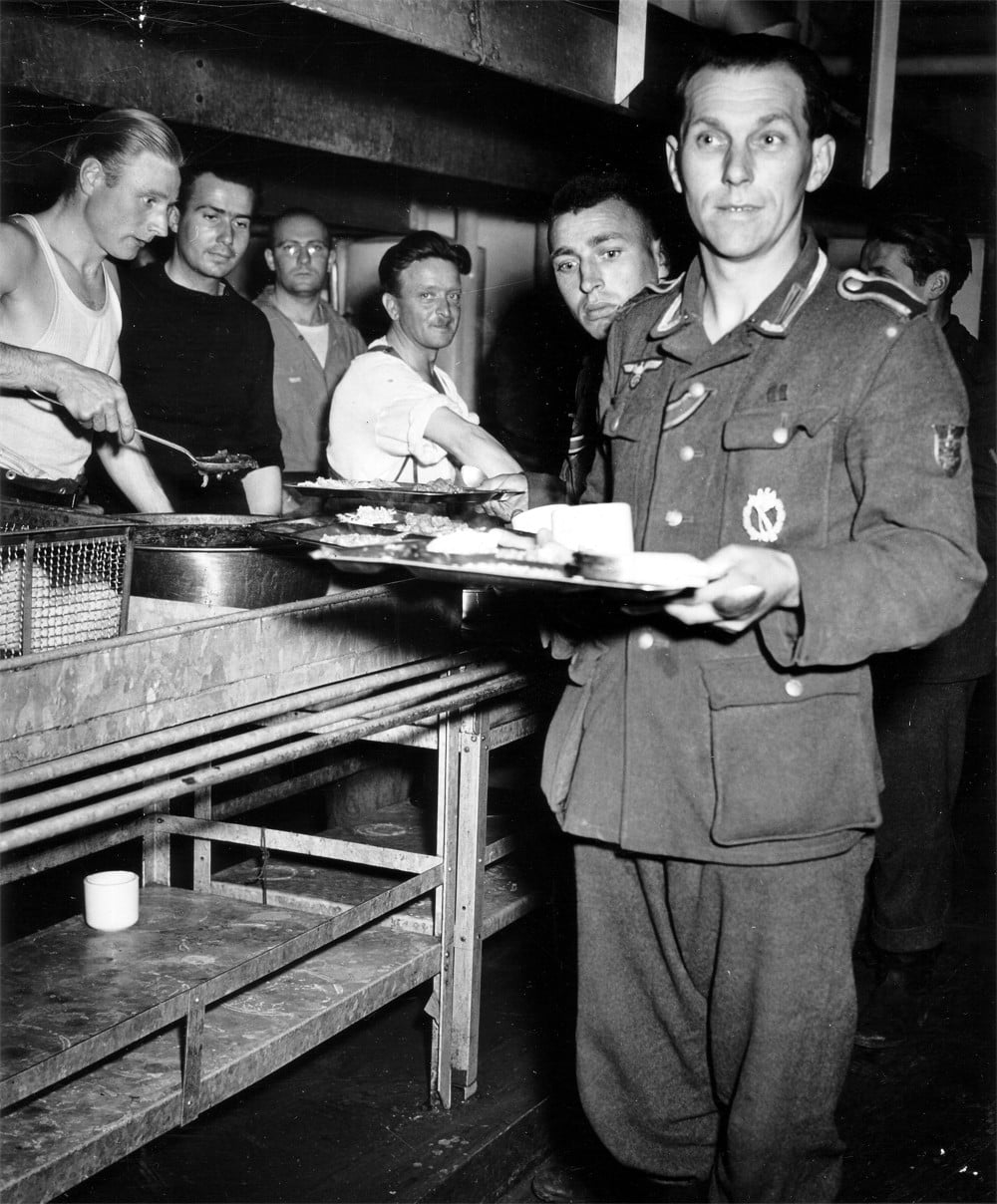
The German soldier had survived the Allied invasion of Normandy, only to find himself aboard an American ship, bound for a prison camp in a country he had been taught to regard as his enemy. Before him sat a tray piled with food. There was more than enough to eat, a small luxury that had become increasingly unfamiliar to men serving in Hitler’s army.
By the summer of 1944, Germany was fighting a war it could scarcely afford to sustain. Its armies were stretched across Europe, its supply lines under constant attack, and its soldiers increasingly accustomed to shortages. Yet here, aboard an enemy vessel in the middle of the Atlantic, an American crew could provide its captives with meals that many German soldiers might have considered extravagant.
There was something quietly revealing about this abundance. The United States was producing weapons, aircraft, ships, and ammunition on a scale that Germany could no longer hope to match. Its factories worked around the clock, its farms supplied armies across oceans, and its merchant fleet carried the enormous weight of a global war. That same machinery of abundance extended, in this instance, even to the feeding of captured enemies.
The soldier in the photograph could not have known how the war would end, nor when he would see his homeland again. But the meal before him offered a small, tangible glimpse of the immense resources arrayed against Germany. The Americans, it seemed, possessed enough to feed their enemies well, even while fighting them.
Queen Victoria, the “grandmother of Europe”, with Kaiser Wilhelm II, Tsar Nicholas II, and future King Edward VII in one large royal family snapshot, 1894
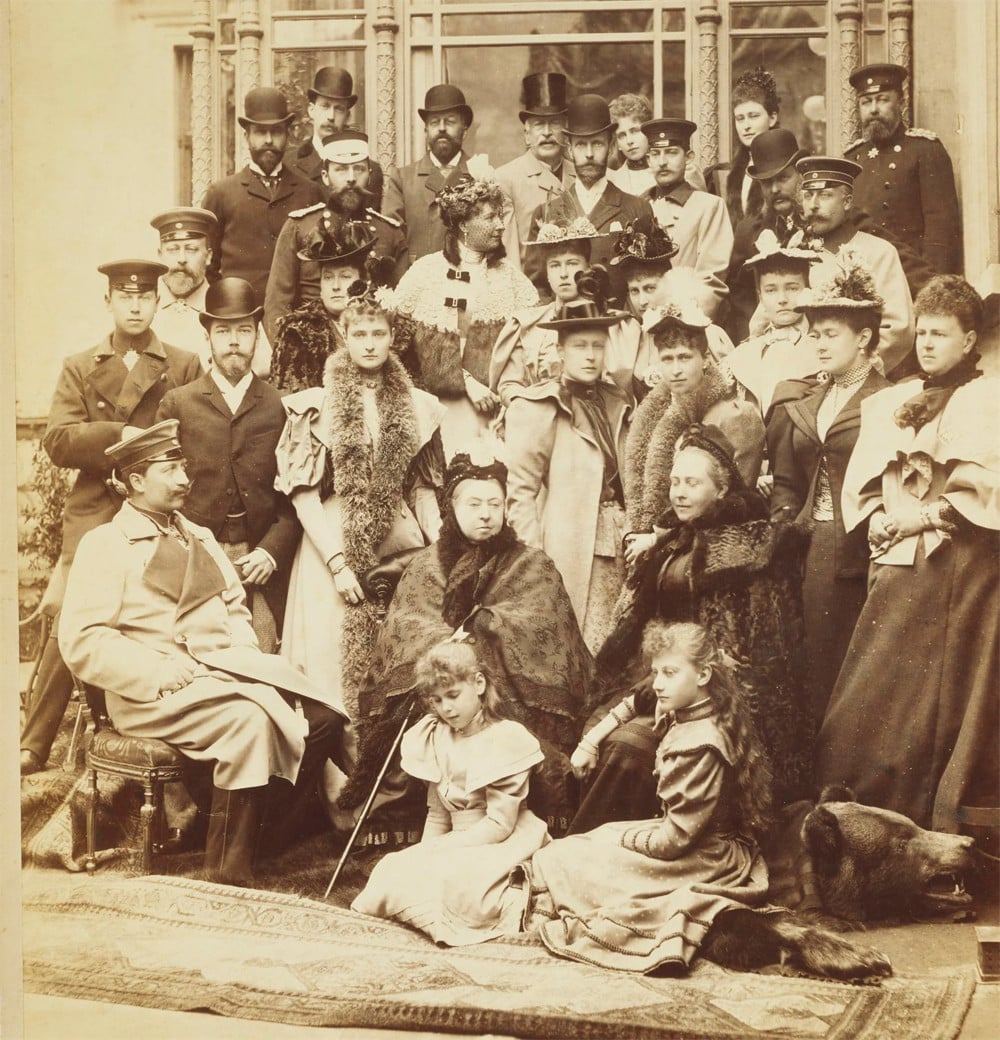
In April 1894, the royal families of Europe gathered at Coburg, Germany, to celebrate a wedding. Queen Victoria, then seventy-four and approaching the end of her long reign, presided over a gathering of relatives whose titles and territories stretched across the continent. Among them were her grandson Kaiser Wilhelm II of Germany, the future Tsar Nicholas II of Russia, and her eldest son, the future King Edward VII of Britain. It was a family occasion, complete with the elaborate uniforms, decorations, and ceremonial grandeur that European royalty regarded as the natural order of things.
Yet beneath the apparent unity of this extended family lay the competing ambitions of nations. Royal marriages had long served as instruments of diplomacy, binding dynasties together in the expectation that family loyalty might reinforce political stability. But by the closing years of the nineteenth century, the forces determining Europe’s future were increasingly beyond the control of its monarchs. Nationalism, imperial rivalries, military expansion, and an intricate system of alliances were dividing the continent along lines that no amount of royal kinship could erase.
Twenty years after this photograph was taken, Britain, Germany, and Russia would find themselves at war. The British king and German emperor would stand on opposite sides of a conflict that consumed millions of lives. Nicholas II, who had not yet ascended the Russian throne when the picture was taken, would lose first his empire and then his life. Wilhelm II would be forced into exile, and the German monarchy would disappear. The familial connections that had once seemed to offer Europe a measure of stability would prove remarkably powerless against the machinery of modern war.
Emma Gatewood who, at age 67, became the first solo female thru-hiker of the Appalachian Trail (1955). She wore Keds sneakers, and carried an army blanket, a raincoat, a plastic shower curtain for shelter in a homemade bag.
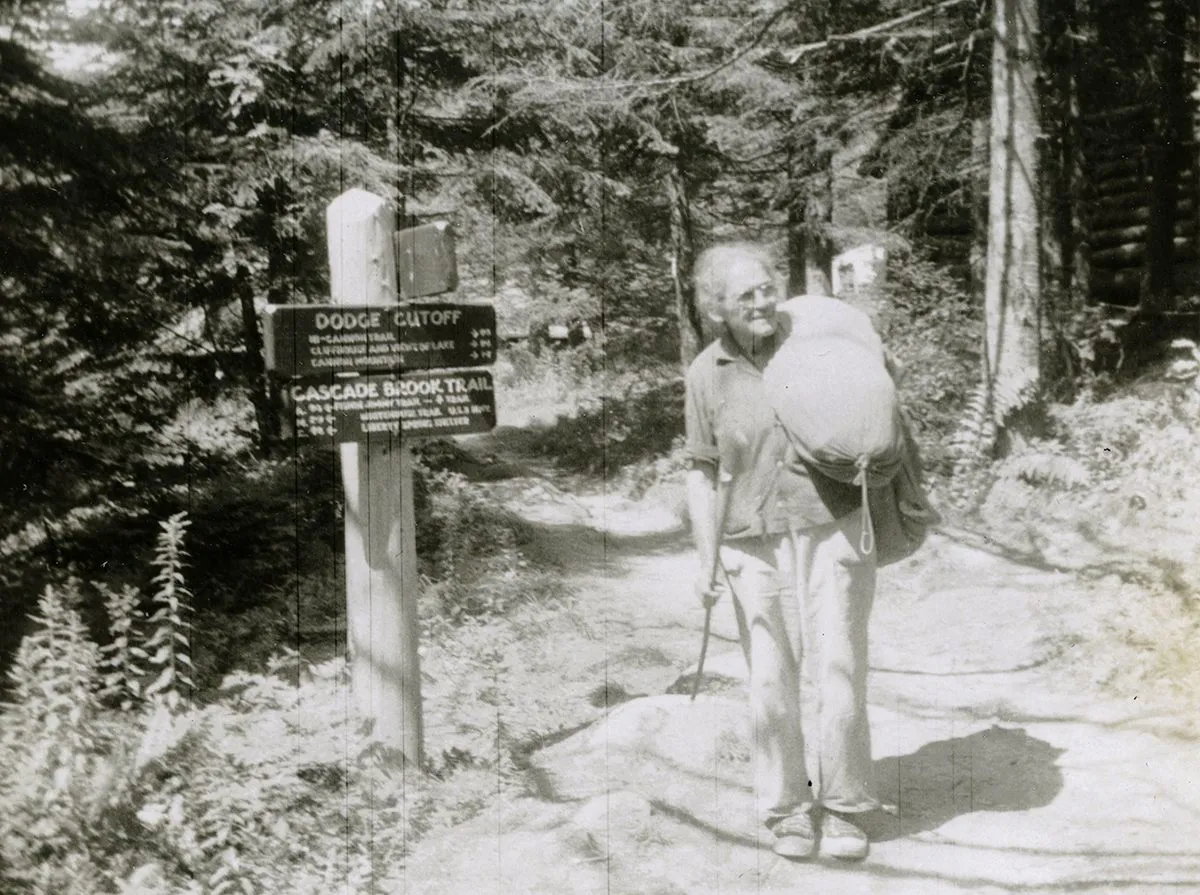
At 67, She Walked 2,000 Miles Alone With a Pair of Sneakers and a Shower Curtain
On May 3, 1955, a 67-year-old grandmother from Ohio stood at the southern end of the Appalachian Trail in Georgia. Her name was Emma Gatewood. She wore a pair of ordinary Keds sneakers and carried a homemade denim sack containing an army blanket, a raincoat, a plastic shower curtain, and a few other necessities. She had no tent, no sleeping bag, and no map. Ahead of her lay more than 2,000 miles of mountains, forests, rivers, and unforgiving terrain. She intended to walk all of it.
Gatewood was no stranger to suffering. She had raised eleven children on an Ohio farm and endured more than thirty years of abuse at the hands of her husband. Much of her life had been spent working, raising children, and surviving circumstances over which she had little control. Now, with her children grown, she had decided to do something for herself. She had read about the Appalachian Trail in National Geographic and thought it sounded pleasant. Two years earlier, an attempt to hike it had ended when she became lost and had to abandon the journey. Most people might have taken that as a warning. Gatewood took it as a reason to try again.
The trail was far worse than she had imagined. Rain soaked her clothing, rocks punished her feet, and poorly marked paths sent her wandering in the wrong direction. She slept wherever she could find shelter, sometimes relying on the kindness of strangers who offered meals or a place to spend the night. Her sneakers wore out repeatedly. But each morning, she got up and continued north. There was no elaborate philosophy behind her determination, no audience waiting to applaud her progress. She simply kept walking.
On September 25, after 146 days and more than 2,000 miles, Emma Gatewood reached Mount Katahdin in Maine. She had crossed fourteen states and become the first woman to complete a solo thru-hike of the Appalachian Trail. She was 67 years old, an age when many people were expected to settle into a quiet retirement. Gatewood wasn’t finished. She would walk the entire trail again in 1957 and complete it a third time in sections in 1964.
Her achievement was extraordinary, but perhaps the most remarkable thing about Emma Gatewood was how little importance she attached to the reasons others thought she needed. After a lifetime of obligations and hardship, she had finally found something that belonged entirely to her. When people asked why she had walked so far, her answer was wonderfully simple: “Because I wanted to.”
Japanese troops bury Chinese civilians alive in 1937–38.
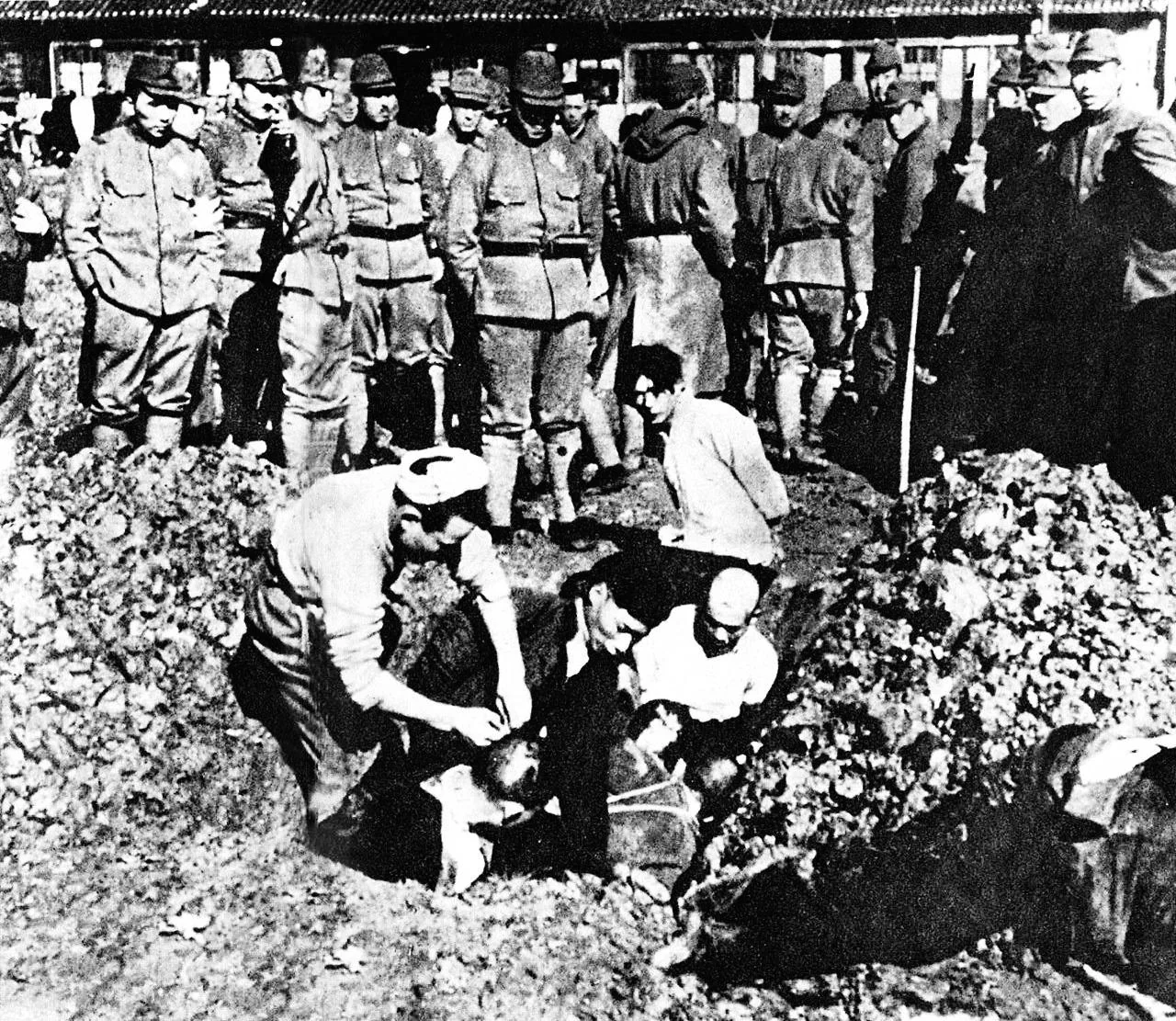
In December 1937, the Imperial Japanese Army entered Nanjing, then the capital of China. What followed was not simply the brutality that accompanies warfare, but a sustained campaign of killing, rape, looting, and terror against a largely defenseless population. Chinese soldiers who had surrendered were executed in groups. Civilians were dragged from their homes, shot, bayoneted, or buried alive. Photographs associated with the massacre preserve scenes of extraordinary cruelty, including Chinese captives facing death at the hands of Japanese soldiers. These were not casualties caught in the crossfire of battle. They were people who had been placed entirely at the mercy of their captors.
The atrocities unfolded over approximately six weeks, leaving Nanjing devastated. Estimates of the death toll vary considerably, with some historical accounts placing the number of victims as high as 300,000. Tens of thousands of women were raped, families were destroyed, and entire neighborhoods were looted and burned. Foreign missionaries, doctors, and businessmen who remained in the city recorded what they witnessed in diaries, letters, photographs, and diplomatic reports. Their testimony provides a contemporaneous record of a catastrophe that might otherwise have been easier to deny or diminish.
What makes the Nanjing Massacre particularly disturbing is the degree to which violence against defenseless people became commonplace. The victims were no longer treated as individuals with names, families, and lives of their own, but as enemies whose suffering carried no consequence. The massacre demonstrated how military conquest, dehumanization, and the absence of accountability could transform an occupied city into a place where the most basic restraints on human behavior had collapsed.
Nearly ninety years later, the photographs remain difficult to look at. Yet their historical importance lies precisely in what they refuse to conceal. Behind every image was a human being who had lived an ordinary life before war arrived: someone who had parents, children, friends, ambitions, and a future that was violently taken away. Remembering Nanjing is not merely an exercise in documenting the crimes of the past. It is a recognition that atrocities on this scale were carried out by human beings, against other human beings, and that forgetting the victims would compound the injustice they suffered.