
‘At Eternity’s Gate’ by Vincent van Gogh

Vincent van Gogh’s painting “At Eternity’s Gate”, also known as “Sorrowing Old Man”, was completed in 1890 just weeks before his tragic death. The work is often seen as a meditation on the artist’s own struggles with mental illness, poverty and feelings of failure at the end of his life.
The painting depicts a solitary figure, head bowed and face buried in his hands, sitting in a simple wooden chair. The man’s posture exudes despair and exhaustion. His clothes are plain and worn, suggesting a life of hardship. The background is empty and undefined, further emphasizing the figure’s isolation and disconnection from the world around him.
As with many of Van Gogh’s late works, the brushwork in “At Eternity’s Gate” is frantic and agitated, with swirling, heavy strokes and thick impasto in shades of dark blue and green adding to the work’s emotional turbulence. The loose, almost unfinished edges and lack of detail lend an air of haste and urgency, as if the painting itself is unraveling along with the sitter’s psyche.
While the identity of the figure is unknown, the work is widely understood as a self-portrait of sorts, with Van Gogh projecting his own suffering and sense of mortality onto the anonymous sitter. Having grappled with mental illness throughout his life, Van Gogh had committed himself to an asylum in Saint-Rémy the previous year after mutilating his own ear. Though he continued to work prolifically, he found little relief from his anguish and paranoia.
“At Eternity’s Gate” is a deeply introspective and psychological work, a rare figural painting from an artist known primarily for his vivid landscapes and still lifes. In it, we see Van Gogh confronting the specter of death and reflecting on a life of perpetual struggle and unrealized dreams. The work is a poignant glimpse into the artist’s tortured psyche and a harbinger of his impending fate.
Despite its dark subject matter, “At Eternity’s Gate” showcases Van Gogh’s singular ability to convey raw, unfiltered emotion through bold color and expressive brushwork. It stands as a testament to his unwavering commitment to his art, even in the face of immense personal hardship, and a powerful reminder of the human capacity for both suffering and resilience. In the final weeks of his life, Van Gogh created a haunting portrait of a man on the brink of despair, forever frozen on the threshold of eternity.
‘Government Bureau’ by George Tooker

George Tooker’s “Government Bureau” is a haunting masterpiece that captures the alienation and bureaucratic nightmare of mid-20th century America. Painted in 1956, it’s a work that feels eerily prescient, reflecting anxieties that have only intensified in our modern era.
Tooker, like Edward Hopper before him, understood the profound loneliness that can exist in the midst of a crowded urban environment. But where Hopper’s characters often seem lost in quiet contemplation, Tooker’s figures are trapped in a Kafkaesque maze of impersonal interactions and endless paperwork.
The painting’s composition is meticulously planned, like a stage set designed to induce claustrophobia. The repetitive grid of cubicles creates a sense of infinity, as if this purgatorial waiting room extends far beyond the edges of the canvas. The sickly green walls and harsh fluorescent lighting contribute to the oppressive atmosphere, draining the life and individuality from everyone present.
Tooker’s use of egg tempera gives the painting a smooth, almost plastic quality that enhances its surreal nature. The faces of the government workers are eerily alike, their features simplified to the point of becoming masks. This dehumanization is reflected in their interactions with the public, or rather, their lack thereof. The workers peer out at us through small windows, their eyes averted or hidden, creating an unbridgeable distance between them and those they supposedly serve.
The citizens seeking help are equally anonymized, their backs turned to us, their faces hidden. They stand in rigid, unnatural poses, as if frozen in their frustration and powerlessness. The only figure whose face we can fully see is a woman in the foreground, her expression a mix of resignation and despair that seems to sum up the entire mood of the painting.
Like Andy Warhol’s repetitions of Marilyn Monroe, Tooker’s repetitive figures speak to a loss of individuality in the face of bureaucratic systems. But where Warhol’s work often feels coolly detached, Tooker’s painting is charged with a quiet, desperate emotion.
“Government Bureau” is not just a critique of inefficient bureaucracy; it’s a deeply felt exploration of modern alienation. Tooker, like so many great artists, had the ability to take his personal anxieties and transform them into something universal. The painting speaks to anyone who has ever felt lost in a system too vast and impersonal to navigate, anyone who has ever felt reduced to a number or a form to be processed.
‘Les Demoiselles d’Avignon’ by Pablo Picasso

Completed in 1907, this monumental work marks a radical departure from traditional Western art and is often considered the starting point of Cubism. The painting depicts five naked female figures in a brothel, but Picasso’s treatment of the subject is far from conventional.
The women’s bodies are angular, distorted, and fragmented. Their faces, particularly those on the right, are inspired by African masks, reflecting Picasso’s growing interest in non-Western art. This incorporation of African influence was a shocking move in the early 1900s and challenged the established norms of beauty in European art.
The composition is also unconventional. The figures are flattened and the space is compressed, creating a sense of claustrophobia and intensity. There’s no attempt at creating illusionistic depth; instead, Picasso emphasizes the two-dimensionality of the canvas.
The title “Les Demoiselles d’Avignon” (The Young Ladies of Avignon) is a bit of a misnomer. Picasso originally titled it “The Brothel of Avignon,” referring to a street in Barcelona known for its brothel. However, his friend André Salmon retitled it when it was first exhibited in 1916, perhaps to make it more palatable to the public.
When Picasso first showed the painting to his friends and fellow artists, they were shocked and even appalled. The painting’s raw, aggressive energy and its challenge to conventional notions of beauty were hard to accept, even for the avant-garde.
However, “Les Demoiselles d’Avignon” would go on to change the course of art history. It heralded the birth of Cubism, a movement that Picasso and Georges Braque would develop in the following years. The painting’s influence can be seen in the works of countless artists who followed, from the Cubists to the Abstract Expressionists and beyond.
In many ways, “Les Demoiselles d’Avignon” encapsulates the spirit of modernism. It’s a work that breaks with tradition, that challenges the viewer, and that opens up new possibilities for what art can be. It’s a testament to Picasso’s genius and his uncompromising vision.
‘The Raft of the Medusa’ by Théodore Géricault
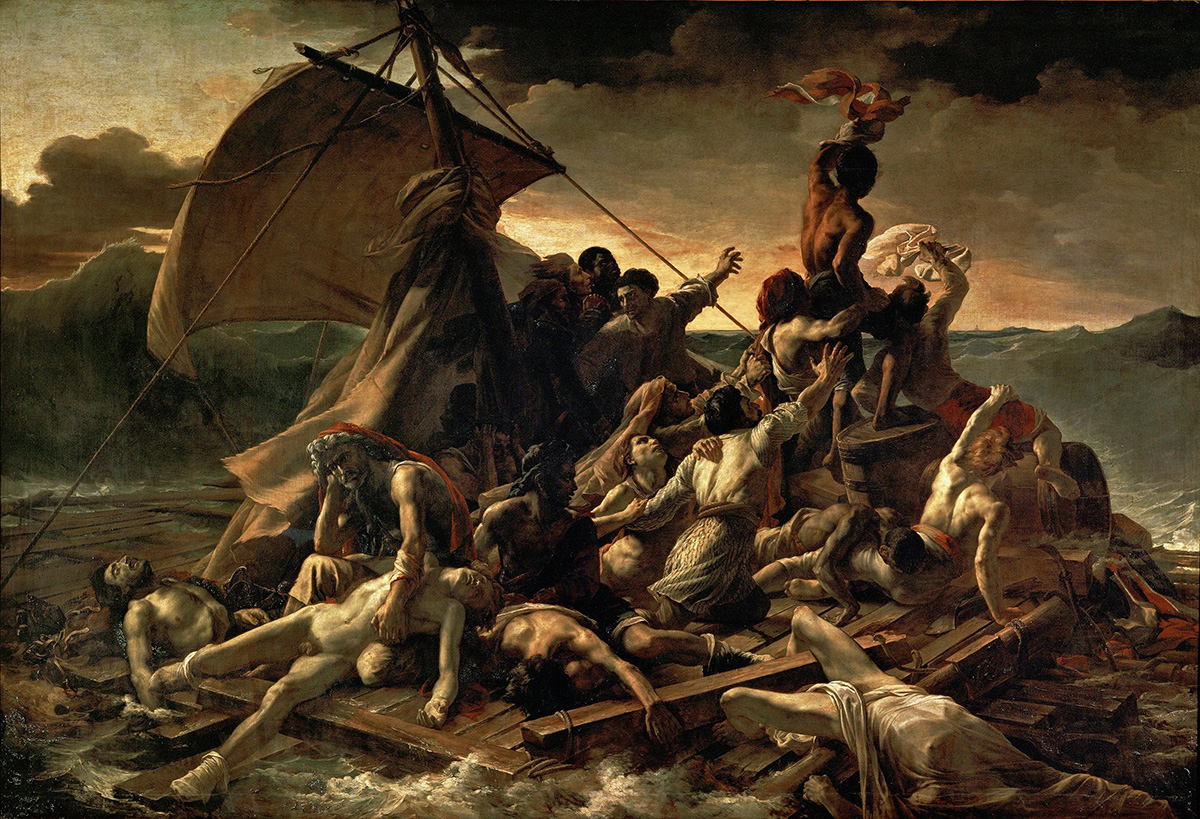
Théodore Géricault’s monumental painting “The Raft of the Medusa” is a masterpiece that captures the horror and desperation of a real-life tragedy at sea. Completed in 1819, the work depicts the aftermath of the wreck of the French naval frigate Méduse, which ran aground off the coast of Senegal in 1816. The painting is a testament to Géricault’s skill as an artist and his ability to convey powerful emotions through his work.
The story behind “The Raft of the Medusa” is one of incompetence, suffering, and survival. The Méduse was carrying over 400 passengers and crew when it struck a sandbank and began to sink. Due to a shortage of lifeboats, a makeshift raft was constructed to hold the remaining 150 people. The raft was soon cut loose by the other lifeboats, leaving the passengers to fend for themselves in the open sea. Over the course of 13 days, they faced starvation, dehydration, and even cannibalism. When the raft was finally rescued, only 15 people remained alive.
Géricault was deeply moved by the accounts of the survivors and decided to create a painting that would capture the raw emotions of the event. He spent months researching the incident, interviewing survivors, and even building a model of the raft in his studio. The resulting work is a massive canvas, measuring 16 feet by 23 feet, that depicts the moment when the survivors first spot a ship on the horizon.
The painting is a study in contrasts, with the raft occupying the bottom half of the canvas and the distant ship appearing as a tiny speck on the horizon. The figures on the raft are arranged in a pyramidal composition, with the most prominent figure, a black man, waving a cloth to signal the ship. The other figures are in various states of despair, with some clinging to the raft, others reaching out for help, and still others lying dead or dying.
Géricault’s use of light and shadow adds to the drama of the scene, with the raft cast in deep shadow while the distant ship is illuminated by a break in the clouds. The dark, turbulent sea and the stormy sky create a sense of chaos and danger, while the pale, emaciated bodies of the survivors convey a sense of suffering and desperation.
Despite the horrors depicted in the painting, Géricault also includes a sense of hope and resilience. The figure waving the cloth represents the survivors’ determination to live, while the distant ship symbolizes the possibility of rescue and salvation. The painting is a testament to the human spirit and the will to survive even in the face of overwhelming odds.
“The Raft of the Medusa” was a sensation when it was first exhibited at the Paris Salon in 1819. It was praised for its powerful composition, its emotional intensity, and its technical mastery. However, it was also criticized by some for its graphic depiction of suffering and death, which was seen as inappropriate for a public exhibition.
Today, “The Raft of the Medusa” is considered a masterpiece of Romantic art and a powerful commentary on the human condition. It remains one of the most iconic images in the history of art, and a testament to Géricault’s skill as an artist and his ability to capture the emotional depths of the human experience.
Géricault’s own life was marked by tragedy and suffering, and he died at the young age of 32, just a few years after completing “The Raft of the Medusa.” However, his legacy lives on through his art, which continues to inspire and move audiences to this day. “The Raft of the Medusa” remains a powerful reminder of the resilience of the human spirit and the enduring power of art to capture the most profound emotions and experiences of the human condition.
‘The Colourful Life’ by Wassily Kandinsky
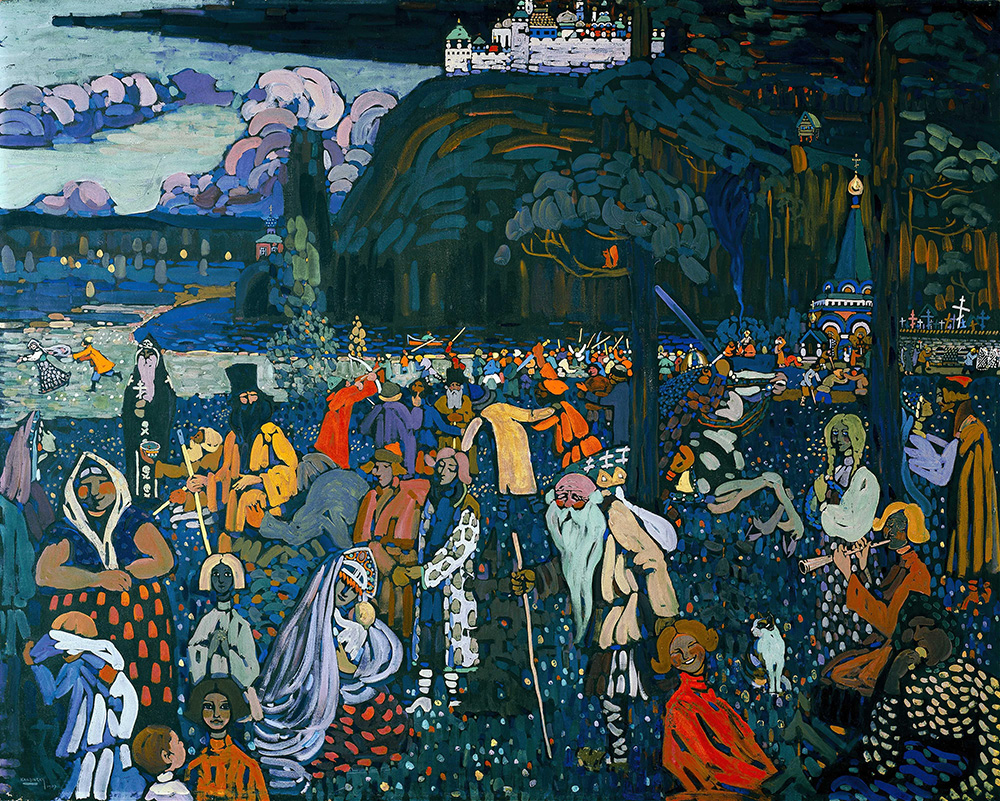
Wassily Kandinsky’s “The Colourful Life” is a joyful explosion of hues and shapes that dances across the canvas, inviting the viewer into a world of playful abstraction. Painted in 1907, during a transformative period in Kandinsky’s artistic journey, this whimsical watercolor is a testament to the Russian painter’s lifelong fascination with the expressive power of color.
At first glance, “The Colourful Life” appears to be a chaotic jumble of forms and colors, lacking any discernible subject matter. Circles, triangles, and lines in vivid shades of yellow, red, blue, and green seem to float and overlap in a dreamlike space. But as we linger on the painting, a sense of harmony emerges from the apparent disarray.
Kandinsky believed that colors and forms could evoke deep emotional responses in the viewer, much like musical notes in a symphony. He sought to create a visual language that transcended the limitations of representational art, tapping into a spiritual realm of pure sensation and feeling.
In “The Colourful Life,” we can see Kandinsky experimenting with this idea of synesthesia – the blending of senses. The dynamic arrangement of shapes suggests movement and rhythm, as if the colors are dancing to an unheard melody. The bold, unmodulated hues vibrate against each other, creating a sense of energy and vitality that seems to pulse with a life of its own.
The title of the painting, “The Colourful Life,” hints at Kandinsky’s belief in the transformative power of art. For him, color was not merely a decorative element, but a means of expressing the inner life of the soul. By immersing ourselves in the joyous interplay of hues and forms, we are invited to experience a sense of spiritual awakening and emotional liberation.
Kandinsky’s journey towards abstraction was a gradual one, and “The Colourful Life” represents an important milestone in his artistic development. While the painting still contains recognizable elements such as the horse and rider motif, which would reappear in his later works, the emphasis is clearly on the abstract interplay of colors and shapes.
In the years following the creation of “The Colourful Life,” Kandinsky would continue to push the boundaries of abstraction, eventually abandoning representational elements altogether in favor of pure, non-objective compositions. His groundbreaking theories on the spiritual nature of art, outlined in his treatise “Concerning the Spiritual in Art,” would have a profound influence on the development of abstract art in the 20th century.
Today, “The Colourful Life” stands as a joyful celebration of the boundless potential of color and form. Its exuberant energy and playful spirit remind us of the transformative power of art to uplift the soul and awaken us to the beauty and mystery of the world around us. In Kandinsky’s vibrant canvas, we find an invitation to embrace the fullness of life in all its colorful complexity.