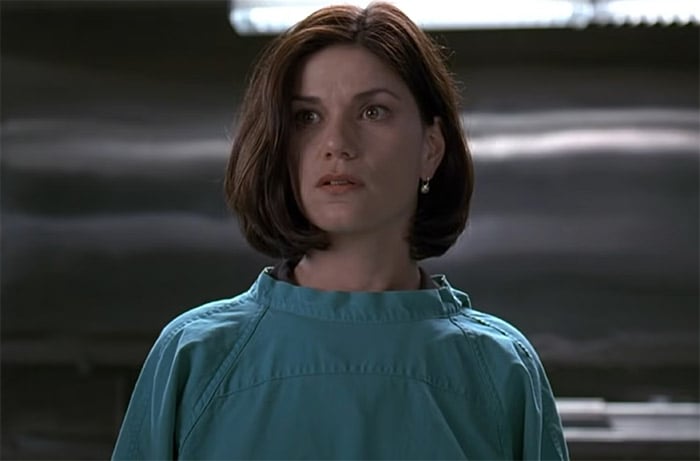
Linda Fiorentino’s career arc feels like a movie where someone accidentally left out the last twenty minutes. Most Hollywood narratives end with either a triumphant comeback montage or a public implosion. Hers just stops. One minute she is the razor-sharp femme fatale in The Last Seduction or the sardonic coroner in Men in Black. The next she is gone. Not dead, not disgraced, just absent. As if someone hit the mute button on her public existence.
She was never exactly a household name, but she had the rare kind of screen presence that made her seem like she should be. The smoky voice, the no-nonsense delivery, the way she could seem ten steps ahead of everyone else in the scene. In the 1990s, that translated into the kind of roles people still remember decades later. By the time Dogma came out in 1999, she appeared to be on a straight-line trajectory to becoming one of those actors whose name alone could greenlight a mid-budget thriller.
And then nothing.
The “Difficult to Work With” Label
Officially, the industry explanation was that she was “difficult to work with.” This is a phrase Hollywood uses the way high school yearbooks use “has a big personality.” It is vague, semi-derogatory, and can mean anything from “is actually a monster” to “did not laugh at the producer’s bad joke.” In Fiorentino’s case, it became the accepted shorthand for why she was written out of Men in Black 2 and why she never got another shot at a big studio role.
Tommy Lee Jones reportedly would not return for the sequel if she was involved, and Kevin Smith, who directed her in Dogma, was not shy about suggesting she was tough to manage on set. Yet neither man ever provided the kind of specific incident that would make the label feel justified. In the absence of details, “difficult” becomes a catch-all term, one that can stick to a person forever without anyone really remembering why.
The Weinstein Era Question Mark
There is another theory, one that lives in the overlap between Hollywood rumor and the revelations of the MeToo movement. Fiorentino’s career stall happened when Harvey Weinstein’s power was at its peak. The speculation, never confirmed, is that she may have refused Weinstein’s advances and wound up on the wrong side of his blacklist. This is the same pattern later confirmed to have happened to other actresses during that era. The “difficult” label could easily have been code for “stood up to someone untouchable.”
The timeline fits. The players fit. The suddenness fits. Considering Fiorentino’s reputation for being assertive and unwilling to play Hollywood politics, it is not a stretch to imagine she might have been punished for it. If that is true, then her disappearance was not an accident. It was a quiet and deliberate erasure.
A Vanishing Act That Stuck
After a straight-to-video comedy in 2009, she stopped appearing in films entirely. Her last public appearance was at a gala in 2010. Since then there have been no interviews, no red carpets, and no strategically staged sightings at coffee shops. The only hint of public contact came in 2018, when she emailed Kevin Smith after his heart attack, prompting him to express regret about their rocky working relationship.
Her absence has only deepened her mystique. She is one of the rare actors who either resisted or was forced out of the cycle of reinvention that keeps most careers limping along. There is no podcast tour, no ironic cameo in a streaming series, no “where are they now” tell-all. Just silence.
And maybe that is why her story still lingers in people’s minds. In Hollywood, disappearing completely is almost as hard as becoming famous in the first place.