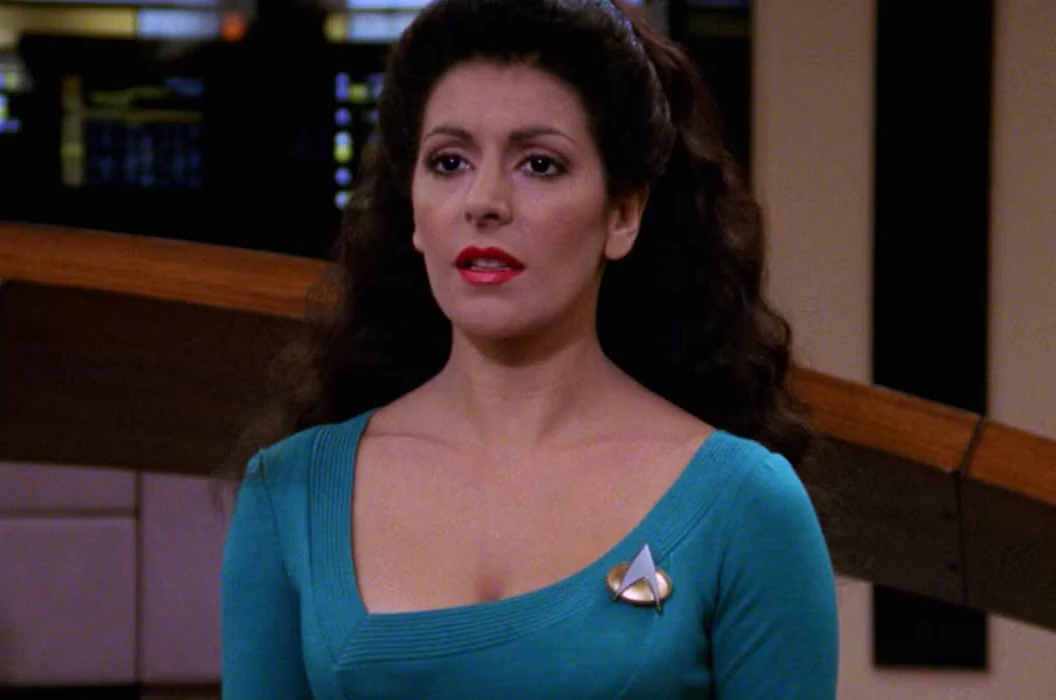
For generations of Star Trek The Next Generation fans, Deanna Troi’s wardrobe has always stood out.
While Captain Picard, Riker, Data and the rest of the Enterprise crew wore crisp Starfleet uniforms that visually reinforced their authority and rank, Troi spent most of the early series in flowing civilian outfits. Deep necklines, draped fabrics and jewel toned gowns became as much a part of her on screen identity as her empathic abilities.
For years, the explanation seemed simple. It was a stylistic choice meant to make Troi feel softer, more approachable and emotionally intuitive. She visually contrasted the structured military look of Starfleet.
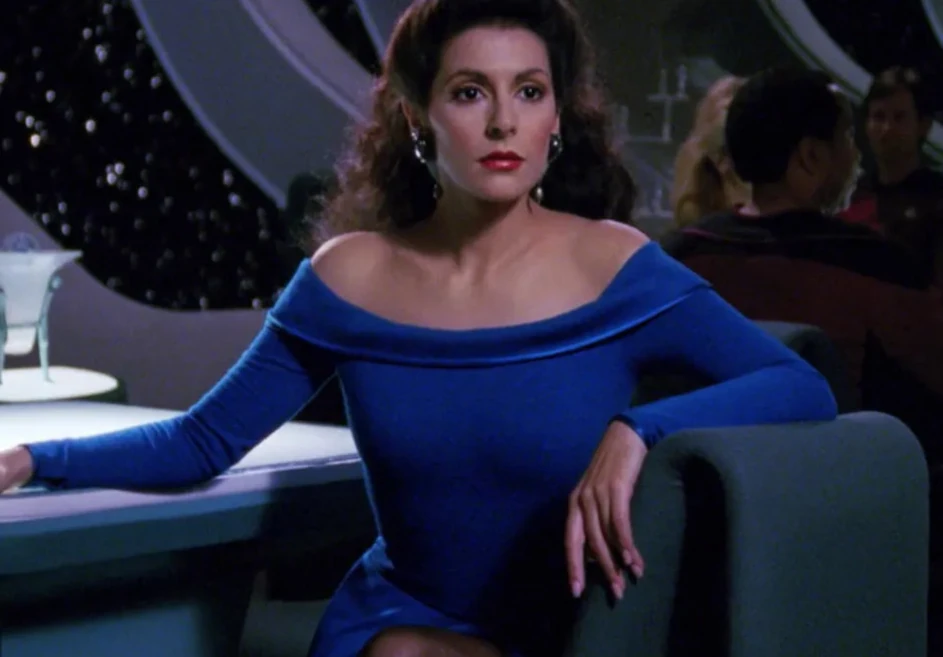
But according to Marina Sirtis, the real reason had far less to do with character psychology and far more to do with Hollywood’s unspoken rules about women’s bodies.
A Design Choice That Was Not Really a Choice
Over the years Sirtis has spoken often with her trademark blunt honesty about the behind the scenes frustrations she experienced with Troi’s wardrobe. In convention panels, interviews and DVD commentaries she has acknowledged that the original Starfleet uniform simply was not considered flattering on her body by studio standards.
In the late nineteen eighties Hollywood had a narrow and unforgiving idea of what a television body was supposed to look like. Even though she was the same size she remains today she was considered big by industry expectations. The uniform design was tight, structured and unforgiving. It was deemed unworkable.
Rather than adjusting the costume to fit the performer, production chose the easier solution. They redesigned the character.
Troi’s civilian wardrobe was not a creative flourish. It was a workaround.
How Clothing Quietly Shapes Power
The impact of that decision went far beyond fabric.
In Star Trek uniforms are more than clothes. They are visual authority. They establish command, rank and belonging. When Troi was not in uniform she was not just visually different. She was symbolically separate.
She became the only bridge officer not fully of Starfleet in appearance even though canonically she held rank, sat on the bridge and advised the captain on critical decisions. The wardrobe unintentionally framed her as emotionally important but structurally peripheral. Present but not quite equal.
It is a subtle distinction but one that had consequences for how audiences perceived her role. Troi was frequently sexualized, sometimes underestimated and often framed more as emotional support than as a strategic authority even though her empathic abilities were crucial to countless missions.
Costuming in this case quietly rewrote a character’s perceived power.
A Pattern Not an Isolated Story
Sirtis’ experience was not unique. It reflected a broader pattern in nineteen eighties and nineteen nineties television.
Female performers across genres were routinely subjected to unspoken rules about weight, age and marketable body shapes. Instead of adapting costumes to fit performers, productions often adapted characters to fit costumes. The message was subtle but clear. The performer must fit the image not the other way around.
In Sirtis’ case that meant Troi’s role, her authority, her visual language and even her perceived seriousness were reshaped around a decision rooted in body standards rather than narrative logic.
The result was a character who despite being a Starfleet officer visually existed outside of Starfleet for years.
When Troi Finally Put On the Uniform
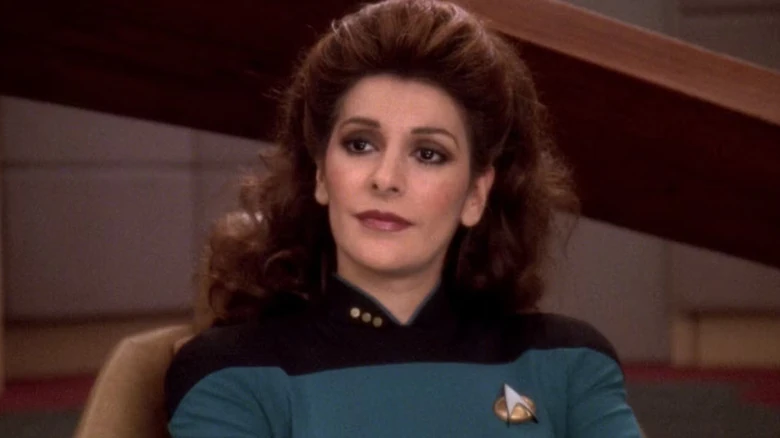
Troi eventually returned to wearing a Starfleet uniform in later seasons. Many fans remember this as a quiet but powerful shift. The uniform instantly reframed her presence. She looked like what she had always been. A commanding officer with authority, confidence and credibility.
The difference was not subtle. The uniform did not just change Troi’s look. It changed how she was perceived.
It also coincided with a noticeable shift in how the show wrote her. She became stronger, more assertive and more involved in command decisions. It was as if the visual language finally caught up to the character she had always been meant to be.
Speaking With Clarity Not Bitterness

Now in her late sixties Sirtis has become known for her refreshing candor. When she talks about these decisions today she does not frame them with bitterness but with clarity.
She speaks openly about the realities of working in Hollywood, about how casually women were evaluated, measured and quietly reshaped to fit industry ideals. Her story is not framed as an attack. It is framed as a truth that fans were never meant to see.
Troi’s wardrobe was never just about fashion.
It was about access, power and how easily a character’s identity can be altered by invisible standards that have nothing to do with storytelling.
A New Lens for a Familiar Character
For longtime fans Sirtis’ honesty adds new depth to a character they thought they understood. Troi’s flowing gowns now carry a second story. One about compromise, adaptation and the quiet pressures placed on women in genre television.
For new viewers it offers a window into how even the most progressive franchises can carry the fingerprints of the industries that produce them.
Behind every iconic look is a human being and sometimes a decision that had nothing to do with the story at all.