There was a very specific kind of disappointment that only existed in the 1990s, and it looked like this:
You’re in the backseat of a car. Maybe it’s a long drive, maybe it’s just a regular errand that feels long because you’re a kid and time moves slower when you’re not in control of it. You’re bored. You’ve already counted the streetlights. You’ve already pressed your face against the window and watched your reflection drift across the glass like you’re in a sad music video.
And then your mom or dad hands you something.
Not a Game Boy. Not the thing you actually wanted. Not the thing you asked for.
But something close enough.
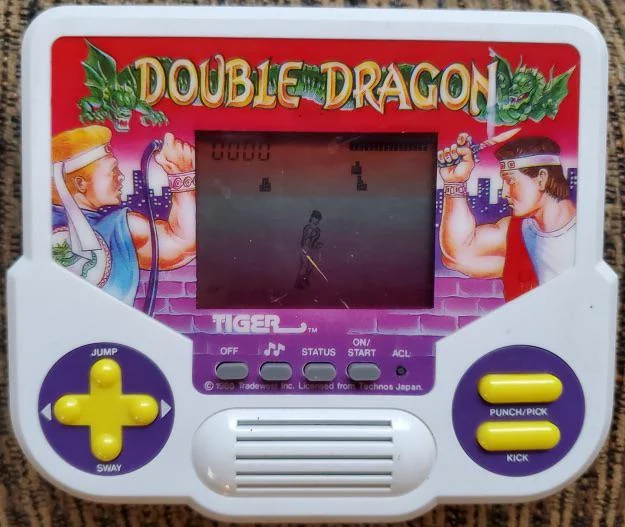
A Tiger handheld game.
And here’s the thing about those games: they were never good. Not in the way we talk about games being good now. There was no depth. No saving. No real sense of progression. Just a few static backgrounds and a character that moved in these stiff, predetermined positions like they were being controlled by someone who had never actually seen a human being run before.
But also, none of that mattered.
Because when you’re a kid, you don’t need perfection. You just need something.
Tiger understood that before anyone else did. They weren’t selling games. They were selling proximity to something you already loved. You liked Jurassic Park? Cool. Here’s a version of that you can hold in your hand. You like Batman Forever? Great. Here’s a little plastic rectangle that kind of, sort of, maybe feels like that if you don’t think too hard about it.
And you didn’t think too hard about it.
Because you were eight.
So you’d sit there, tapping the same button over and over, watching your character jump between the same three positions, and your brain would do the rest of the work. You filled in the gaps. You imagined the parts the game couldn’t show you. In a weird way, you were collaborating with the machine. It gave you the outline, and you colored it in.
That’s the part people forget.
We talk about Tiger games now like they were a joke. Like they were this punchline about bad design and cheap licensing. And yeah, okay, that’s fair. They were absolutely that.
But they were also something else.
They were what you got when your parents couldn’t, or wouldn’t, buy you the nicer thing. They were what showed up in your life unexpectedly, in the middle of a boring afternoon, and made that afternoon just a little less boring. They were the thing you played not because it was the best option, but because it was the available option.
And sometimes that’s enough.
There’s a version of this story where Tiger handhelds are the villains. Where they’re the cheap knockoffs, the lesser alternative, the thing you settled for.
But that’s not really how it felt at the time.
At the time, it felt like someone handed you a tiny piece of the world you wanted to be in and said, “Here. This is yours for now.”
And you took it.
And you played it.
And for a little while, long enough to get through the car ride, or the grocery trip, or the stretch of day that didn’t belong to you, it worked.