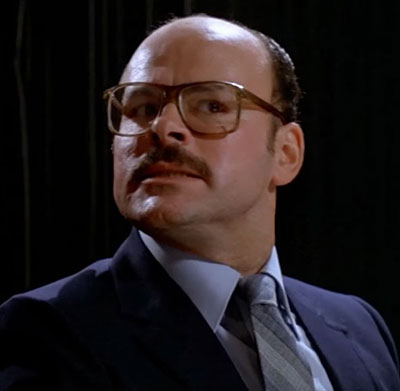
Dolly Parton and Carl Dean, her husband of 56 years, when they first met in 1964.
Now that Dolly Parton is gone, the photograph feels different.
It is no longer simply a picture of two young people at the beginning of a love story. It is a picture of two people who had almost the whole thing still ahead of them: the marriage, the fame, the private jokes, the arguments, the ordinary mornings, and all the quiet ways a person becomes part of another person’s life.
Dolly met Carl Dean outside a Nashville laundromat in 1964, the day after she arrived in the city. She was eighteen. He was twenty-one. Neither of them could have known that she would become one of the most recognizable women in the world, or that he would spend nearly six decades carefully avoiding that world.
Carl died in March 2025 after 58 years of marriage. Dolly followed on August 25, 2026, at the age of 80.
There is something almost unbearable about looking at young couples after both people are gone. They appear so unaware of time. They do not know which ordinary moments they will someday miss, which disagreements will stop mattering, or how quickly a lifetime will shrink into a handful of photographs.
The world knew Dolly as a performer, songwriter, businesswoman, and force of nature. Carl knew the woman who came home after the performance ended. He gave her a place where she did not have to be Dolly Parton for anyone else.
In the photograph, they are not yet an American icon and her famously private husband. They are simply Dolly and Carl, young and interested in each other, standing at the beginning of a life neither one could see.
Now we can see where the road ended.
They only knew they wanted to walk it together.
Scottish soldiers of the 7th Seaforth Highlanders advancing through tall grass in the morning fog during Operation “Epsom” in Normandy on June 26, 1944
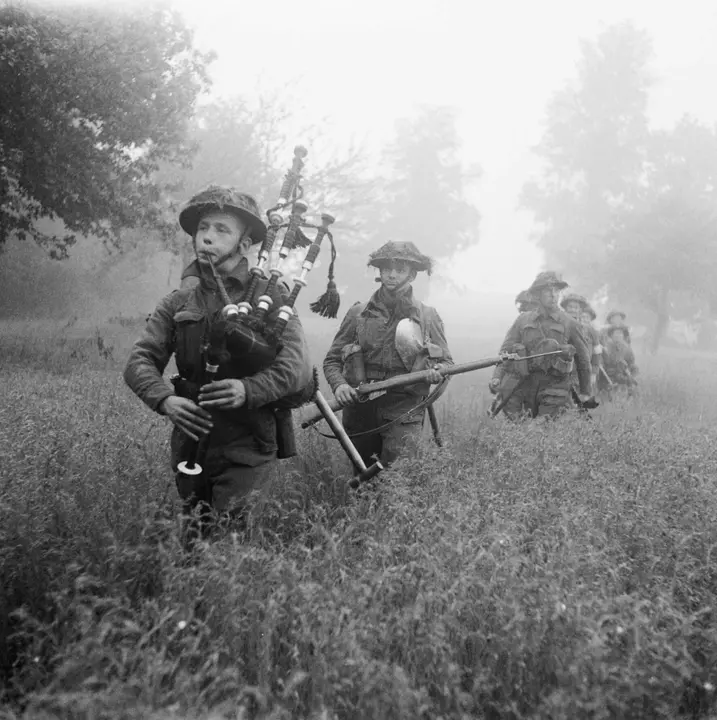
The man leading the soldiers is carrying no rifle. He is playing the bagpipes.
Behind him are men of the 7th Seaforth Highlanders advancing through the morning fog during Operation Epsom on June 26, 1944. They were part of a major British attempt to break through the German defenses west of Caen.
The piper was not there simply for the photograph.
Pipers had accompanied Scottish regiments into battle for centuries. Their music encouraged the men, strengthened the regiment’s identity, and provided something familiar to follow through smoke, fog, and gunfire.
By the Second World War, pipers were not normally expected to play during an attack. Modern weapons made that extremely dangerous. During combat, many served in other roles, including as stretcher-bearers, runners, and medical orderlies.
But on this morning, the piper walked at the head of the Seaforths as they moved into the fog. His music reminded the men that they were not scattered individuals crossing a field. They were Seaforth Highlanders, advancing together.
Operation Epsom was meant to carry British forces across the River Odon and threaten Caen from the west. Rain, mud, minefields, hedgerows, and fierce German resistance turned it into several days of brutal fighting. The 15th Scottish Division would suffer more than 2,000 casualties.
The piper could not make the German bullets less deadly. What he could do was give frightened men something stronger to listen to than their own fear.
They might not have been able to see where they were going.
But they could hear the pipes.
A family with their Covered Wagon which they lived and traveled in during their pursuit of a homestead – Loup Valley, Nebr, in Nebraska – during the Great Western Migration, c. 1886.

The wagon in this photograph was not simply transportation. It was this family’s bedroom, kitchen, storage room, and shelter while they searched for land in Nebraska’s Loup Valley in 1886.
Everything they believed they needed had to fit inside it: food, clothing, blankets, tools, cooking equipment, seed, and whatever personal belongings they could not bear to leave behind. There was little room for comfort and almost none for privacy.
The family was likely pursuing land under the Homestead Act, which allowed settlers to claim up to 160 acres if they lived on it, improved it, and farmed it for several years. On paper, it sounded like free land. In reality, it demanded years of labor and offered no guarantee of success.
When they reached their claim, the wagon’s job was not necessarily finished. It might remain their home while they built a sod house or dugout. Trees were scarce across much of Nebraska, so families often constructed shelters from blocks of prairie earth. They faced brutal winters, summer heat, grasshopper invasions, prairie fires, illness, isolation, and the constant possibility that one failed harvest could ruin everything.
The photograph shows the hopeful side of westward migration: a family carrying its entire life toward the possibility of owning land. But it also belongs to a larger and more painful story. Much of the territory opened to homesteaders had been taken from Native peoples through broken treaties, forced removal, and military violence. One family’s chance at a new beginning was often made possible by another people’s loss.
The people standing beside the wagon did not know whether they were posing at the beginning of a successful new life or in the middle of a terrible mistake.
They had brought what they could carry.
Everything else depended on the land, the weather, and whether they could endure what came next.
North Korean voters leaving a polling station in Pyongyang after casting their ballots in the Supreme People’s Assembly elections. State media reported a 99.78% turnout with 100% approval for the ruling coalition, securing all 687 seats and re-electing Kim Il Sung as President. (1990)
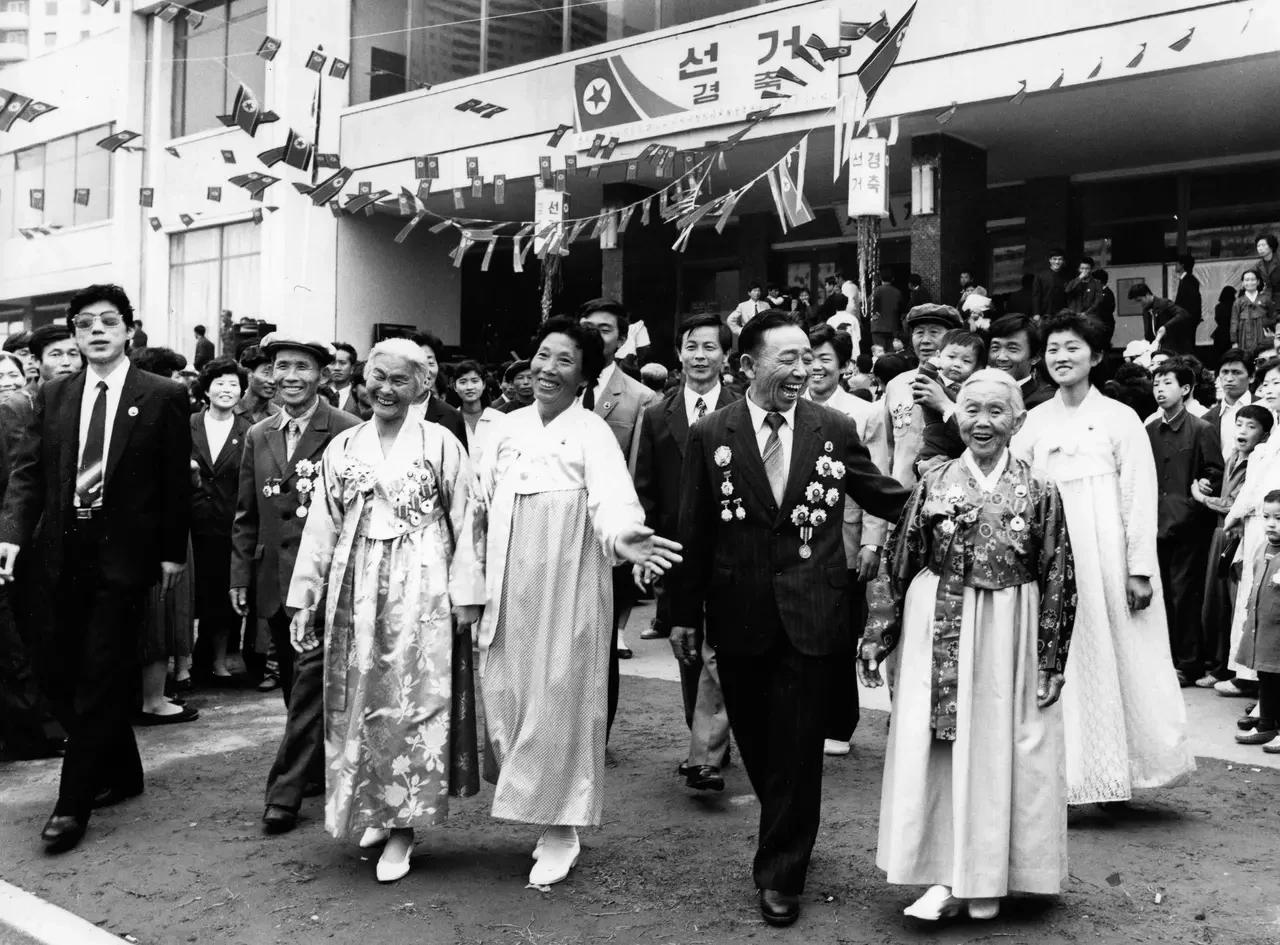
The people leaving this polling station in Pyongyang had technically participated in an election. But they had not been asked to choose between competing candidates, parties, or visions for the country.
In each district, voters were presented with one candidate already approved by the ruling Workers’ Party. That candidate belonged either to the party or to one of the smaller parties and organizations permitted to exist within the government-controlled Democratic Front for the Reunification of Korea.
The real purpose of voting was not to decide who would govern. That had already been decided. It was to demonstrate obedience.
According to North Korean state figures, 99.78 percent of eligible voters participated in the April 1990 election, and every approved candidate won. All 687 seats in the Supreme People’s Assembly were filled without a single competitive race.
Numbers like these were presented as proof that the population stood completely united behind Kim Il Sung. In reality, refusing to participate or openly rejecting the approved candidate could identify someone as politically unreliable. The polling station therefore functioned as both a place to vote and a way for the state to check who was present, who was absent, and who might be causing trouble.
The Supreme People’s Assembly was officially the country’s highest governing body, but it did not operate as an independent legislature. Its role was largely to approve decisions already made by the leadership of the Workers’ Party.
When the newly elected assembly met the following month, it reelected Kim Il Sung as president. He had ruled North Korea since its founding in 1948 and would remain in power until his death in 1994.
The photograph shows people calmly leaving a civic event. But the extraordinary results reveal what the event actually was: not a contest for political power, but a carefully organized public display of loyalty to a government that allowed no meaningful alternative.
A “Serbcutter” used by the Croatian Ustaše during the Holocaust, from 1941 to 1945.
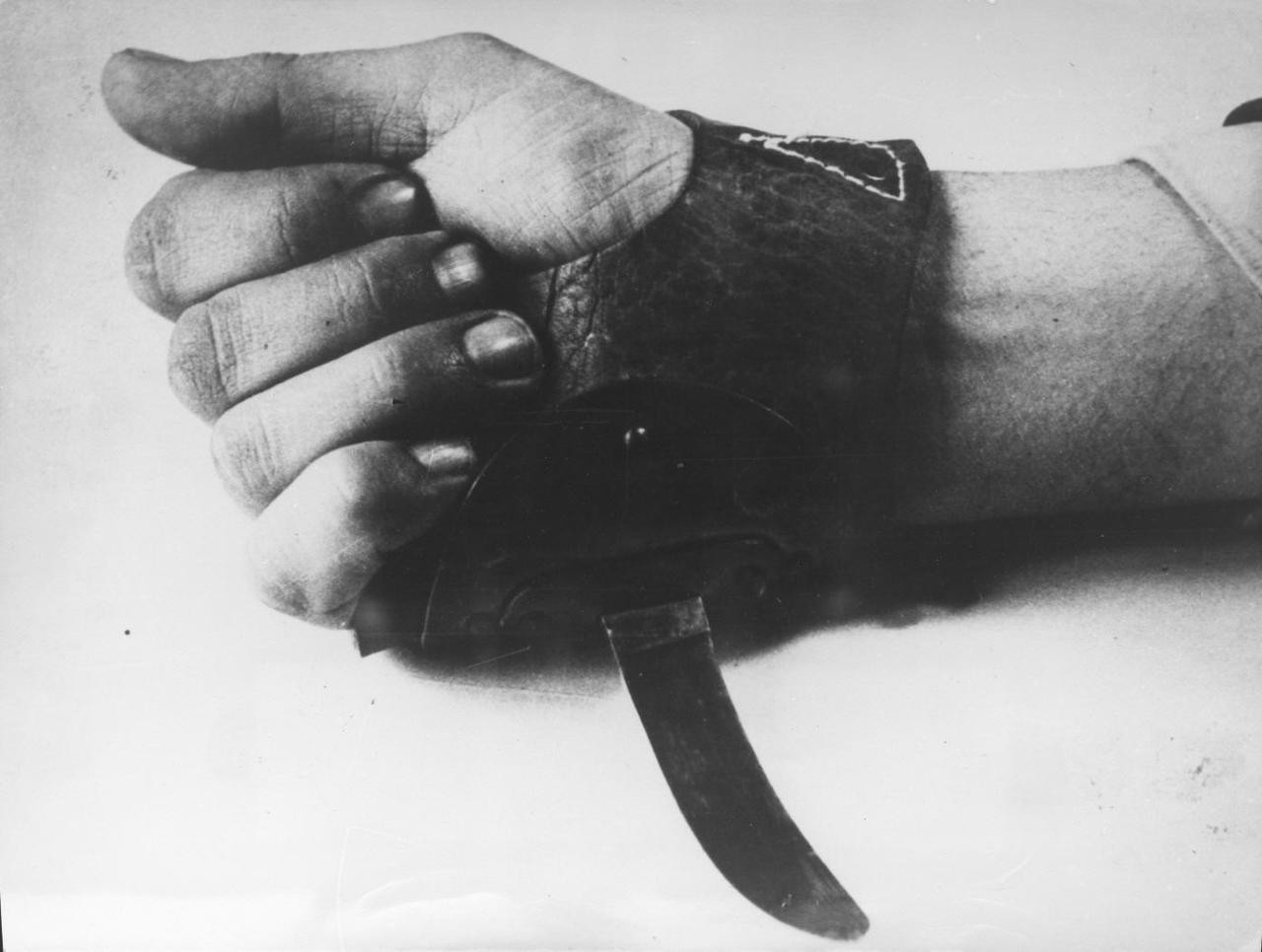
This object was not originally designed as a weapon. It was an agricultural knife made in Germany for cutting the cords around bundles of wheat. The leather strap secured it to a worker’s hand, leaving the fingers free while the curved blade did the cutting.
The Croatian Ustaše gave it a new purpose and a new name: the Srbosjek, meaning “Serb cutter.”
The Ustaše were a fascist and ultranationalist movement that ruled the Independent State of Croatia, a German and Italian puppet state created after the Axis invasion of Yugoslavia in 1941. Their government set out to remove those it considered racially, religiously, or politically undesirable.
Serbs were the largest group targeted, but the Ustaše also persecuted and murdered Jews, Roma, political opponents, and Croats who resisted the regime. People were expelled, forcibly converted, imprisoned, and killed across Ustaše-controlled territory.
The most infamous site was the Jasenovac concentration camp complex. Unlike the industrialized killing centers operated by Nazi Germany, Jasenovac relied heavily on direct, personal violence. Prisoners were murdered with firearms, axes, hammers, knives, and other hand tools.
The knife pictured here became associated with those killings. Its design allowed it to remain attached to the hand, turning an ordinary farming implement into a tool of mass murder. The name given to it made its intended victims explicit.
Genocide does not depend only on gas chambers, railways, or large bureaucracies. It also depends on people being taught that their neighbors are no longer human.
At least 83,000 victims of Jasenovac have been identified by name, including tens of thousands of Serbs, Roma, and Jews, as well as Croatian and Bosnian Muslim opponents of the regime. Behind each name was an individual life, reduced by the Ustaše to a category they believed could be eliminated.