
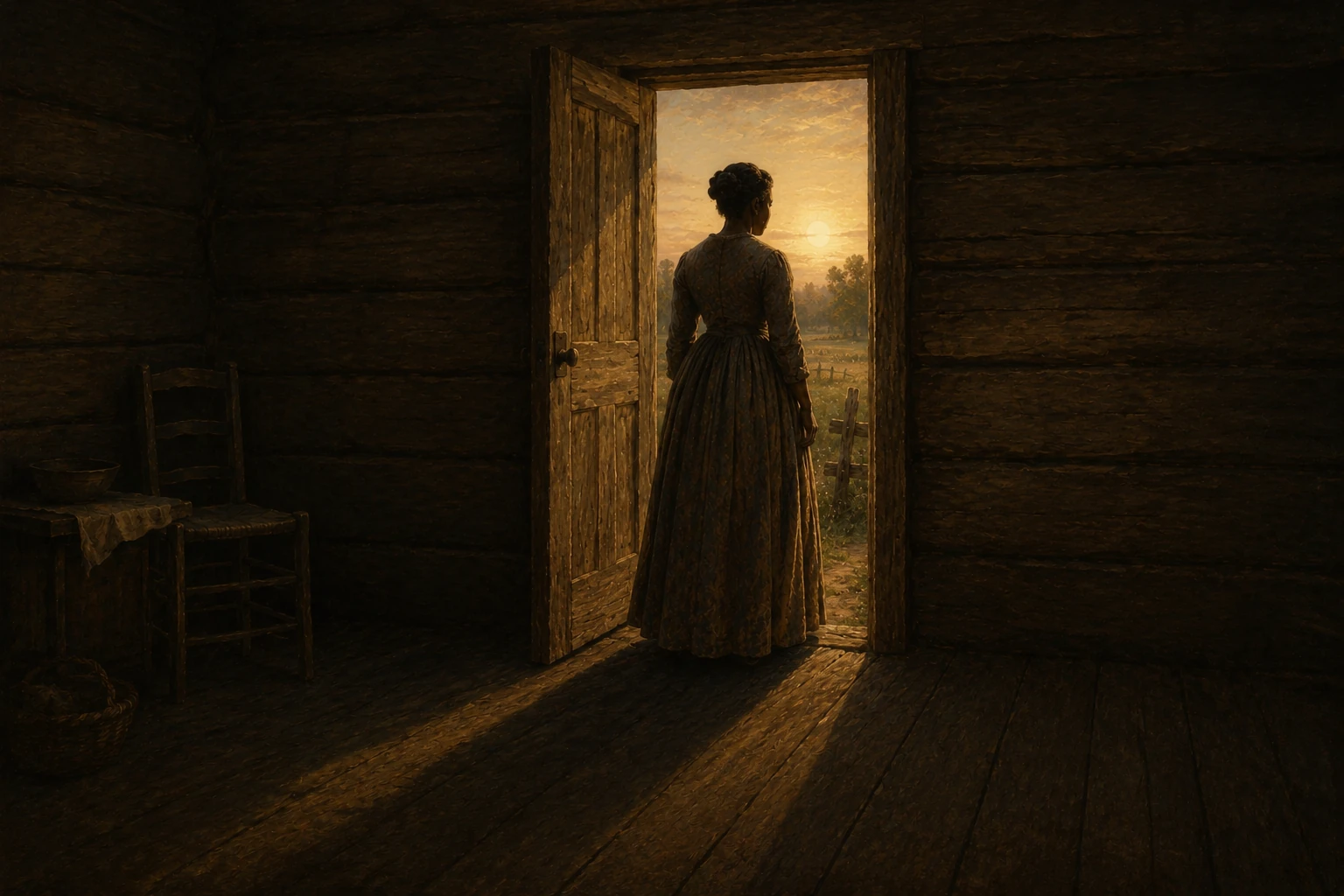
“Freeing yourself was one thing; claiming ownership of that freed self was another.”
—Toni Morrison, Beloved
We tend to imagine freedom as a door.
You open it, walk through, and there you are: free. The music swells. The old life recedes behind you. Perhaps there are birds, because apparently birds are contractually required whenever someone in a movie experiences liberation.
But real freedom is usually much less cinematic.
You walk through the door and discover that the old life has followed you. It has packed a small bag and climbed into your head. It tells you what you are allowed to want, how much space you may occupy, and what will happen if you disappoint anyone.
The door is open, but you are still asking permission to leave.
This is the distinction Toni Morrison makes in Beloved. Sethe has escaped slavery, but escape is not the same as ownership. Her body is legally her own, yet she must learn what it means to live inside that body as someone rather than something.
For twenty eight days, “the travel of one whole moon,” she experiences an unslaved life. And what does freedom look like during those days?
It looks almost ordinary.
She wakes at dawn and decides what to do with her day. She learns the alphabet. Someone teaches her a stitch. She comes to know other people, their names, habits, opinions, happiness, and sorrow. Her baby dribbles spit into her face.
This is freedom without trumpets.
It is the ability to wake up and ask, “What do I want to do today?” and believe the answer matters.
Most of us have never endured anything comparable to Sethe’s suffering, and it would be obscene to pretend otherwise. But Morrison’s distinction reaches into many kinds of human experience.
You can leave an abusive relationship and still apologize every time you have a need.
You can grow up and move away from a controlling family but continue hearing their judgments whenever you make a decision.
You can recover from poverty and still feel a small wave of panic when you buy something unnecessary.
You can quit the job that was destroying you and spend your first free Monday wondering whether you are lazy.
You can be released from the thing that controlled you and discover, rather inconveniently, that it left someone behind to continue the work.
That someone is often you.
We internalize the rules of our captivity. We learn to enforce them upon ourselves because doing so once helped us survive. If being quiet kept you safe, you may continue being quiet long after the danger has passed. If anticipating someone else’s moods protected you, you may become an adult who can sense everyone’s feelings except your own.
These habits are not evidence that you are weak. They are evidence that your mind is an excellent student. It learned the lesson required to keep you alive.
The trouble is that it does not automatically know when class has ended.
Claiming ownership of yourself means slowly teaching it something new.
It means noticing that you are allowed to rest before you have completely exhausted yourself. You are allowed to dislike someone who has been nice to you. You are allowed to change your mind. You are allowed to want a life that makes no sense to the people who knew an earlier version of you.
You may do all of this badly at first.
You may state a boundary and then spend three hours composing an apology for having stated it. You may take a day off and ruin half of it worrying that you should be accomplishing something. You may say what you really think, then lie awake replaying the conversation as if you had confessed to an international crime.
This is all part of it.
We want healing to feel like confidence. Often it feels like guilt followed by doing the healthy thing anyway.
Sethe’s twenty eight days matter because she is not merely beyond the physical boundaries of Sweet Home. She is beginning to experience herself as a person with a future. She has neighbors. She has choices. She participates in a community where people share knowledge and carry one another’s joy and sorrow.
She claims herself “bit by bit.”
Not all at once. Not through some shining act of willpower. Bit by bit.
This may be the kindest part of Morrison’s sentence. It reminds us that self possession is not a switch we fail to flip. It is something assembled from small decisions.
You claim yourself when you say no and allow the no to stand.
You claim yourself when you stop explaining a choice that requires no defense.
You claim yourself when you ask what you actually want instead of immediately calculating what would inconvenience the fewest people.
You claim yourself when you let yourself be loved without trying to earn every ounce of it.
Freedom may begin when the door opens. But claiming that freedom happens afterward, in quiet moments no one else sees.
It happens when you wake at dawn and realize the day belongs to you.
Then, perhaps nervously and imperfectly, you decide what to do with it.