
Most of us leave school with the impression that mathematics is a ladder of increasingly difficult calculations: arithmetic at the bottom, algebra in the middle, and pages of incomprehensible symbols at the top.
But professional mathematicians rarely spend their days multiplying enormous numbers or solving absurdly long equations. Computers can handle calculations faster than any person. At the highest levels, mathematics is about discovering patterns, exploring abstract worlds, and proving that something must always be true.
In that sense, advanced mathematics is closer to detective work than the math most of us encountered in school.
They Are Trying to Prove Things
A mathematical proof is a chain of reasoning showing that a statement is true in every possible case.
Testing a million examples is not enough. If a pattern supposedly applies to every whole number, it must also work for numbers so large that nobody could ever write them down. A proof explains why there cannot be an exception hiding somewhere beyond our ability to calculate.
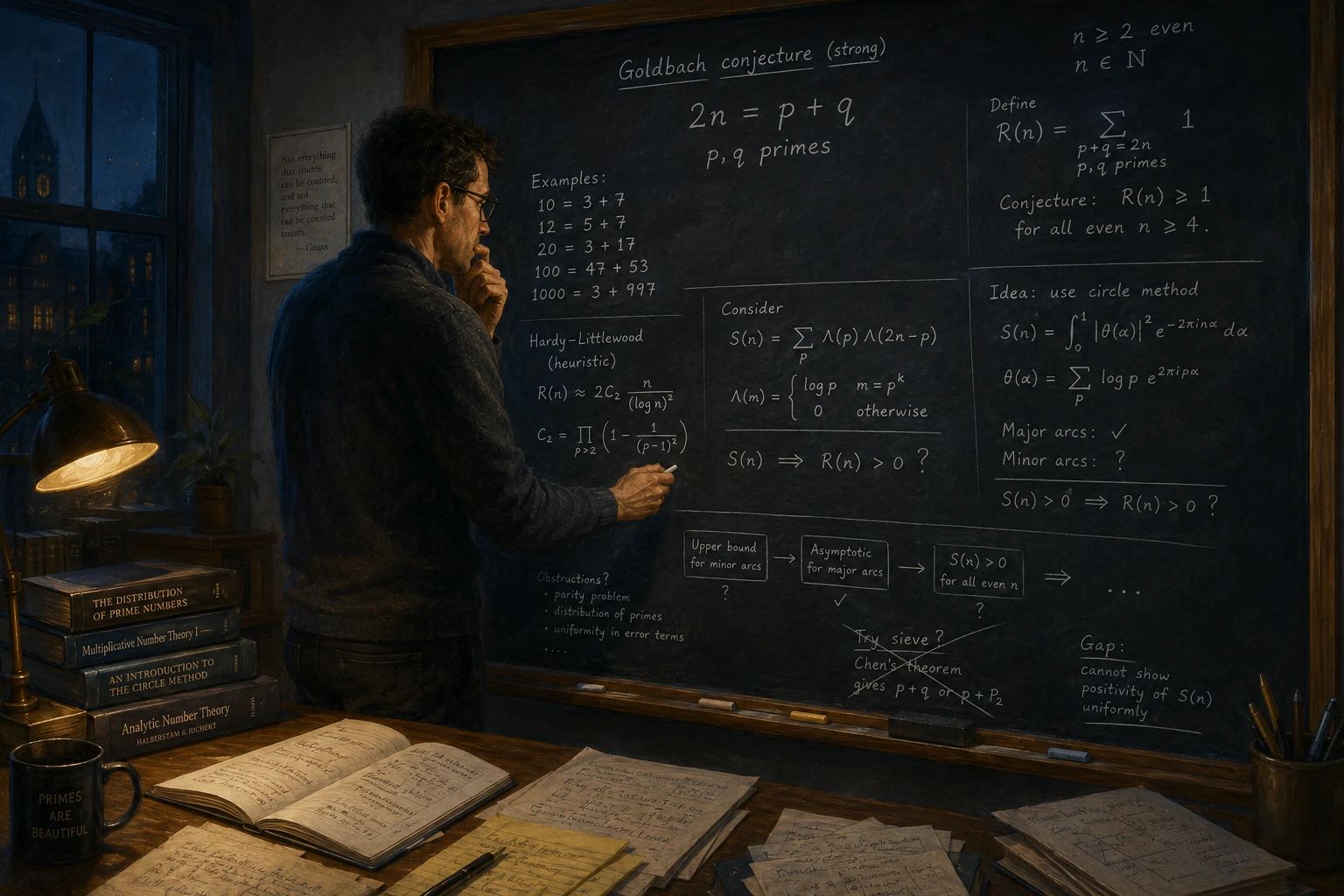
The Goldbach conjecture, for example, says every even number greater than two can be written as the sum of two prime numbers. Ten is 3 + 7. One hundred is 47 + 53. Computers have tested the idea across an enormous range, and it always works.
But “it has always worked so far” is not the same as “it must always work.” Nobody has managed to prove that final step.
They Are Exploring New Worlds
Mathematicians often begin with a few rules and ask what kind of world those rules create.
What happens if geometry takes place on a sphere rather than a flat surface? Triangles can contain more than 180 degrees, and lines that appear parallel may eventually meet.
What if an object can be stretched and bent but never torn? What if space has ten dimensions? What if infinity comes in more than one size?
These questions may sound like intellectual games, but abstract mathematics often becomes useful much later. Non-Euclidean geometry once seemed like a strange alternative to ordinary geometry. It eventually helped Albert Einstein describe gravity and curved spacetime.
Mathematicians are like explorers mapping countries before anyone knows what those countries might be useful for.
They Are Looking for Hidden Connections
Some of the greatest breakthroughs happen when two unrelated areas of mathematics turn out to be different versions of the same idea.
A difficult problem about numbers might become easier when translated into geometry. A question about shapes might be solved using algebra. Discoveries in one field can suddenly unlock problems in another.
It is like realizing that two civilizations have been mapping opposite sides of the same mountain. Once the connection is found, everything learned on one side becomes useful on the other.
They Are Studying Problems Computers Cannot Easily Solve
Mathematicians also investigate why some problems are much harder than others.
Imagine a delivery driver who must visit 100 cities using the shortest possible route. A computer can quickly check whether a proposed route works, but examining every possible route could take longer than the age of the universe.
This leads to one of the biggest unsolved questions in mathematics and computer science: If an answer can be checked quickly, can it also be found quickly?
Known as the P versus NP problem, its solution could transform computing, encryption, logistics, medicine, and artificial intelligence.
Why Does Any of This Matter?
Some advanced mathematics has immediate practical value. It helps us encrypt messages, predict weather, design aircraft, understand disease outbreaks, and build computer systems.
Other discoveries may not become useful for decades—or ever.
But usefulness is not the only reason humans explore. Mathematicians also want to know what is true, what is possible, and how much hidden order exists beneath the apparent chaos of the world.
Those chalkboards covered with mysterious symbols are not simply filled with harder calculations. They are maps of territories most of us have never learned how to see.