
A mountain of bison skulls, circa 1892
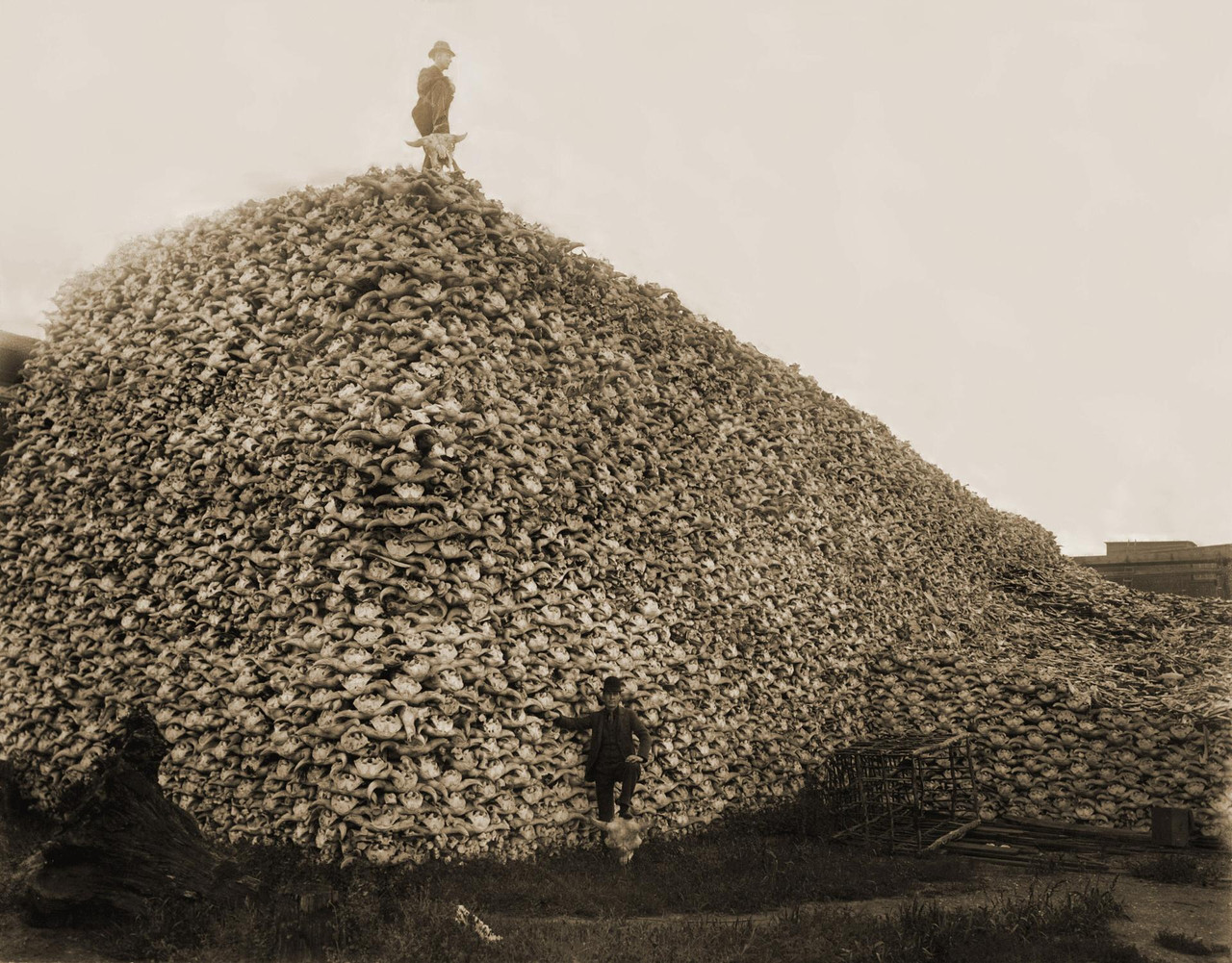
The photograph was taken in 1892 at the Michigan Carbon Works near Detroit. Two men stand among a mountain of bison skulls, one at its base and the other near its summit. They appear very small. The dead animals do not appear small at all.
Only a few decades earlier, tens of millions of bison had moved across the Great Plains. Their herds could darken the ground to the horizon. They fed and clothed Indigenous nations, provided tools and shelter, and occupied a central place in ceremonies and stories that had endured for generations.
Then came the railroads, the commercial hunters, and the market for hides. Men fired into the herds from horseback and from trains. The animals were skinned where they fell, and their bodies were left to decay beneath the open sky.
The slaughter also served the conquest of the Plains. American officials understood that destroying the bison would deprive Indigenous peoples of food and force them onto reservations, where survival depended upon government rations. General Philip Sheridan reportedly praised the hunters for doing more to defeat the Plains tribes than the Army had managed in years of warfare.
By the late 1880s, only about one thousand bison remained. The living herds were gone, but their bones still covered the plains. Settlers gathered them and shipped them east by rail to factories such as the Michigan Carbon Works. There the remains were ground and processed into fertilizer, glue, ceramics, and other commercial products.
Nothing was to be wasted, although nearly everything had been destroyed.
That is what the photograph records. It is not simply a picture of dead animals. It is the conversion of an entire world into raw material. The prairie became farmland. The bison became hides, buttons, glue, and fertilizer. The people who had depended upon them were confined to reservations, and the men standing on the skulls inherited a country that had been emptied for them.
The skulls form a pale hill against the sky. Each one once carried an animal across the plains. Each had followed the herd through heat, snow, grass, and river water. Now they have been gathered into a single monument awaiting the grinder.
The men pose without visible shame or triumph. They are workers standing beside inventory. Behind them there are no herds and no grasslands, only the accumulated remains of something too large to imagine until it was gone.
Women accused of being collaborators get their heads shaved after the liberation of Valognes, France. (June 1944)
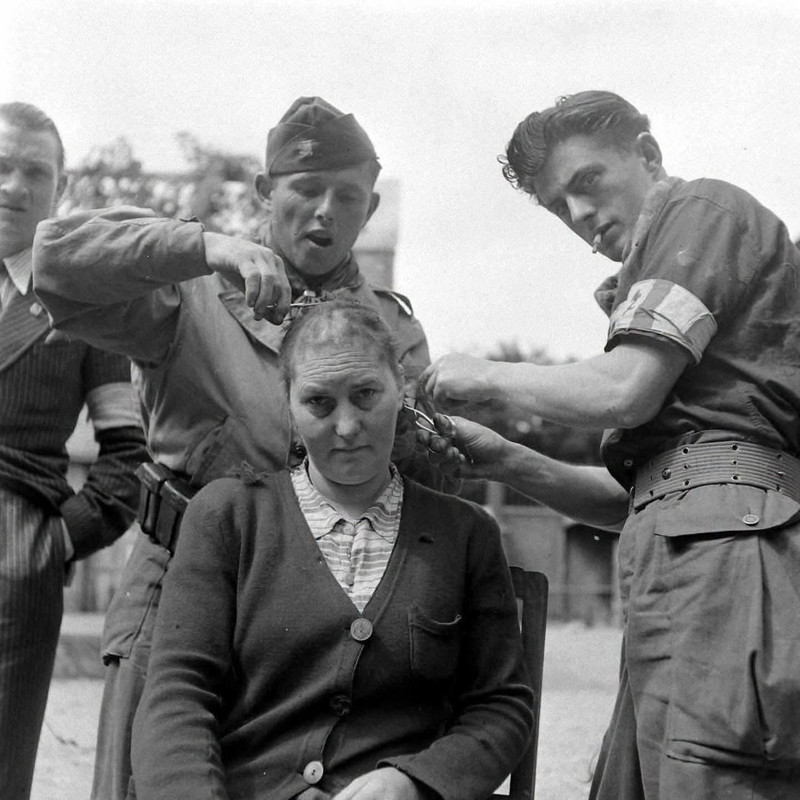
In June 1944, Valognes had been liberated, but the institutions responsible for determining guilt and punishment had not yet recovered. The Germans were retreating, Allied armies were advancing through Normandy, and local authority remained uncertain.
Women accused of collaborating with the Germans were brought before crowds and had their heads shaved. No trial or formal sentence was required. A pair of clippers, a chair, and an accusation were enough.
These women became known as the femmes tondues—the shorn women. Some had relationships with German soldiers, an alleged betrayal called collaboration horizontale. Others had cleaned German quarters, worked in German offices, or served German customers. A smaller number had informed on neighbors or actively assisted the occupation.
The shaving made little distinction among them. A woman who had denounced Resistance members might receive the same punishment as one who had fallen in love with a German conscript. Some accusations arose from jealousy, rumor, or old grievances.
Occupation had made morality complicated. People still needed food, jobs, shelter, and protection. Some resisted, some collaborated enthusiastically, and many tried to survive somewhere between the two.
Head-shaving offered a simple public verdict. A prison sentence could remain hidden; a shaved head could not. Every encounter with a neighbor continued the punishment long after the crowd had dispersed.
It was also distinctly gendered. Male collaborators were imprisoned, tried, or executed. Women faced those penalties too, but shaving attacked their femininity. Some were also stripped, painted with swastikas, or paraded through town.
France had been defeated and occupied by a foreign army. Relationships between French women and German soldiers therefore carried a meaning beyond the individuals involved. The woman’s body could be treated as occupied territory, and intimacy with a German as another symbol of national defeat.
For many participants, the punishment felt like justice. They had endured shortages, arrests, deportations, denunciations, and executions. Once German authority disappeared, years of anger could be released against highly visible targets.
Historians estimate that around 20,000 women were shorn across France in 1944 and 1945. Some had actively supported the occupation. Others had committed no crime that could have survived a serious investigation. The shaving reduced every form of alleged collaboration to the same public mark.
The photographs from Valognes capture a moment when the occupation had ended but normal justice had not yet returned. The Germans had left. The accused women remained, seated before their neighbors as their hair fell to the ground.
On April 14, 1994, the seven largest tobacco companies in the USA swore that nicotine is not addictive.

On April 14, 1994, the chief executives of America’s seven largest tobacco companies appeared before a congressional subcommittee. Each man raised his right hand and swore to tell the truth. When asked whether nicotine was addictive, they answered one after another: “I believe nicotine is not addictive.”
The moment became one of the most recognizable images in the history of American business. Seven executives sat in a row, giving nearly identical answers to a question scientists had largely settled years earlier.
Their testimony was not simply an isolated act of dishonesty. It was the product of a strategy the tobacco industry had refined over decades. Cigarette manufacturers did not need to prove that smoking was safe. They needed only to argue that the evidence remained uncertain. As long as doubt existed, regulation could be delayed, lawsuits resisted, and customers reassured.
By 1994, the dangers of smoking were no longer seriously disputed within medicine. The 1964 surgeon general’s report had established a strong connection between smoking and lung cancer. Evidence concerning nicotine dependence had also accumulated. Millions of smokers had discovered through personal experience how difficult quitting could be.
The tobacco companies nevertheless insisted that smoking was a matter of adult choice. This defense depended upon rejecting addiction. If nicotine compelled continued use, then the industry was not merely selling a risky product to informed consumers. It was selling a product that made leaving extraordinarily difficult.
Internal industry research made the public denials increasingly difficult to sustain. Company scientists had studied nicotine’s effects, examined how cigarettes delivered it to the brain, and discussed smoking as a means of administering the drug. Yet the companies continued to challenge the language of addiction in public, often relying on narrow definitions that compared nicotine with intoxicating drugs such as heroin.
The congressional hearing exposed the distance between scientific knowledge and corporate speech. The executives’ carefully phrased statements—“I believe”—allowed them to present a coordinated denial as personal opinion. It was an example of how uncertainty could be created not in the laboratory, but in the language surrounding the evidence.
Within weeks of the hearing, thousands of internal documents from Brown & Williamson began reaching researchers and journalists. They revealed that tobacco companies had privately understood far more about nicotine and smoking than their public statements suggested. Lawsuits brought further documents into view, weakening the industry’s defenses and contributing to the 1998 Master Settlement Agreement.
The image from the hearing endured because it condensed decades of corporate strategy into a few minutes. The executives did not need the public to believe cigarettes were harmless. They needed Americans to remain uncertain about how much the companies knew, what nicotine did, and whether smokers remained entirely free to stop.
For decades, that uncertainty had been one of the industry’s most profitable products.
Julius and Ethel Rosenberg, separated by a heavy wire screen as they leave a U.S. Courthouse after being found guilty by a jury of espionage in 1951. ]
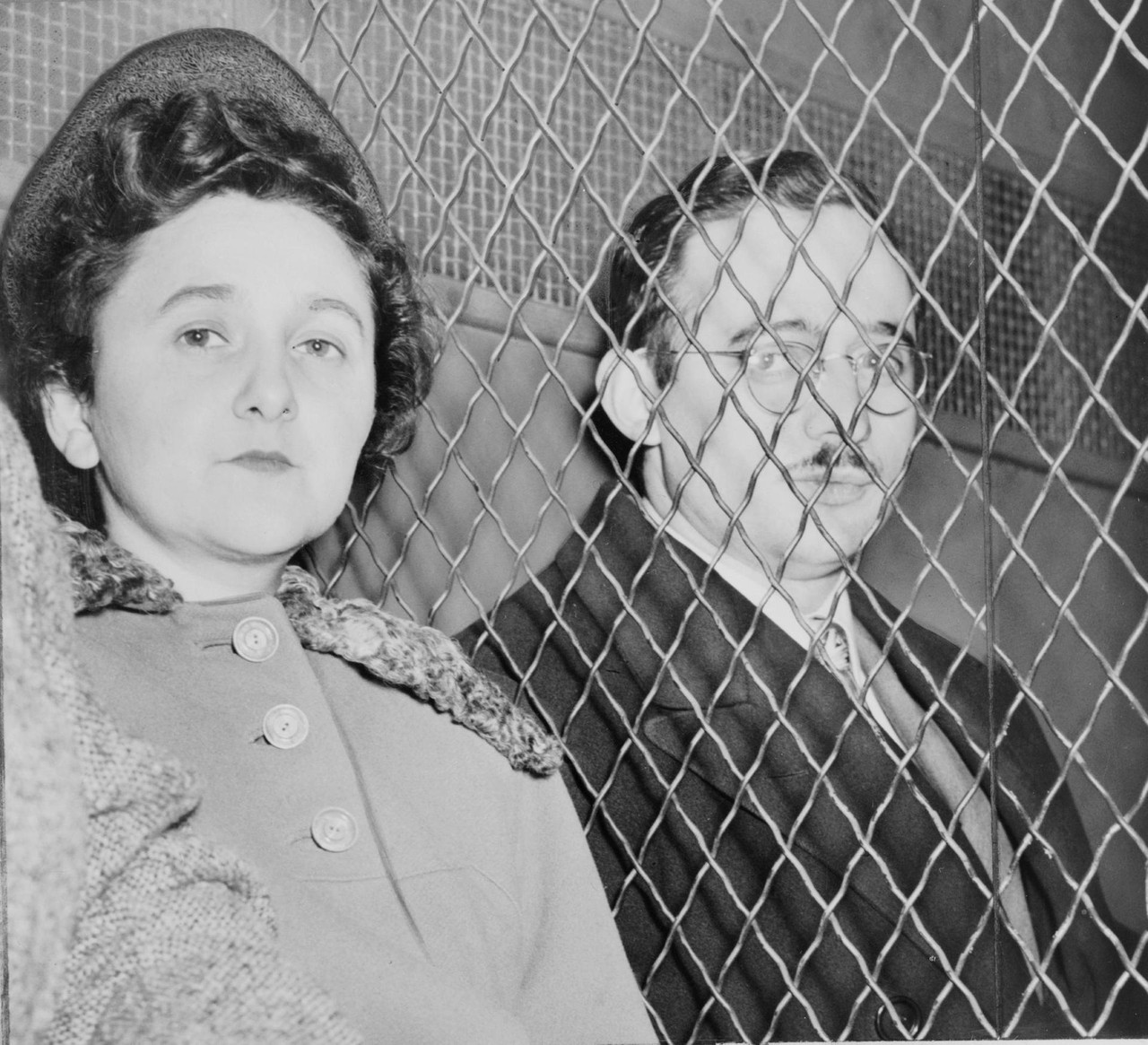
The heavy wire screen separating Julius and Ethel Rosenberg in this 1951 photograph seems almost too perfect a symbol. They stand only inches apart, yet they are already being pulled away from one another by the guards, the court, and the pressure placed upon them to betray each other.
The couple had just been convicted of conspiracy to commit espionage for the Soviet Union. Julius was not the innocent victim his defenders once claimed. Evidence released after the Cold War established that he had recruited agents and passed information to Soviet intelligence. Ethel’s role, however, was far less clear.
The prosecution’s most damaging claim was that Ethel had typed notes containing atomic information supplied by her brother, David Greenglass, who had worked at Los Alamos. That testimony helped transform her from the wife of a spy into an active participant in the conspiracy.
Years later, Greenglass admitted that he could not remember Ethel doing the typing and suggested that his own wife probably had. He had implicated his sister to protect his wife and children. Earlier grand jury testimony also showed that he had originally said he never discussed the matter with Ethel.
There is evidence that Ethel knew about Julius’s activities and shared his commitment to communism. But knowledge is not the same as operational involvement. A recently disclosed intelligence memo indicated that she knew of her husband’s espionage but did not participate in it herself. The government’s case against her had always been much weaker than its case against Julius.
That weakness may have been the point. Prosecutors hoped that arresting Ethel and threatening her with severe punishment would pressure Julius into confessing and identifying other Soviet agents. Instead, the couple refused to cooperate. The threat intended as leverage eventually became a death sentence.
Their silence left their two young sons, Michael and Robert, trapped inside a decision they had no part in making. If Julius confessed, he would betray comrades and destroy the identity around which he had built his life. If Ethel turned against him, she might save herself but abandon her husband. By remaining united, they preserved their loyalty to each other while placing their children at risk of becoming orphans.
On June 19, 1953, Julius and Ethel were executed at Sing Sing prison. Julius died after the first series of electric shocks. Ethel required additional shocks before she was pronounced dead.
A post-WWII sign amidst the ruins featuring a quote from Hitler: “Gebt mir fünf Jahre und ihr werdet Deutschland nicht wieder erkennen” (“Give me five years and you will not recognize Germany again”) in 1945.
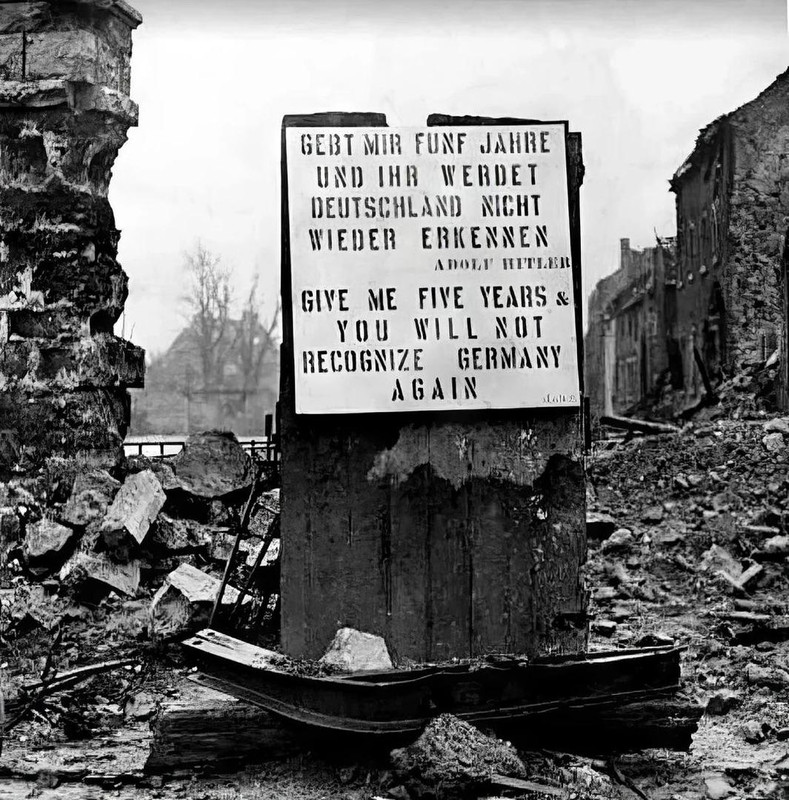
The sign bears one of Adolf Hitler’s promises to the German people: “Give me five years and you will not recognize Germany again.”
By 1945, the words had acquired a meaning entirely different from the one originally intended. Germany was indeed almost unrecognizable. Its major cities had been shattered by bombing, its armed forces destroyed, its government extinguished, and millions of its people killed, displaced, or left homeless. The sign remained standing amid the ruins like a surviving fragment of the political faith that had produced them.
When Hitler came to power in 1933, promises of national transformation formed a central part of his appeal. Germany was still suffering from mass unemployment, political violence, and the lingering humiliation of defeat in the First World War. The Nazis promised work, order, unity, and the restoration of German power.
These were not empty promises in the narrowest sense. Unemployment fell, public works expanded, and Germany rapidly rearmed. To many Germans, the regime appeared to be delivering the national revival it had promised.
But these achievements were inseparable from dictatorship, persecution, and preparation for war. Independent political parties disappeared. Trade unions were destroyed. Jews were progressively excluded from German economic and social life. Schools, newspapers, courts, and cultural institutions were brought under Nazi control. Rearmament consumed an increasing share of the economy, while foreign policy became steadily more aggressive.
Within six years, Germany had invaded Poland and begun a European war. Its early victories made the transformation seem complete. France had been defeated, much of the continent was under German control, and Nazi propaganda presented Hitler as a military genius who had overturned the settlement imposed after 1918.
The victories did not last. The invasion of the Soviet Union opened a war Germany could not win, while the declaration of war on the United States added another industrial power to its enemies. German cities came under sustained aerial attack. The regime responded to approaching defeat not by seeking peace, but by demanding greater sacrifices from the population and intensifying the murder of those it regarded as racial and political enemies.
By the spring of 1945, the state that had promised national rebirth had brought Germany to military occupation and physical destruction. Berlin was captured by the Red Army. Hitler killed himself beneath the ruins of the capital, and the country was divided among the victorious Allied powers.
The sign survived long enough to record the result. Hitler had transformed Germany—but into a country of bombed streets, displaced families, mass graves, and defeated armies. The promise was still legible. The Germany to which it had been addressed was not.