
One Nation Indivisible, San Francisco, by Doorthea Lange. 1942
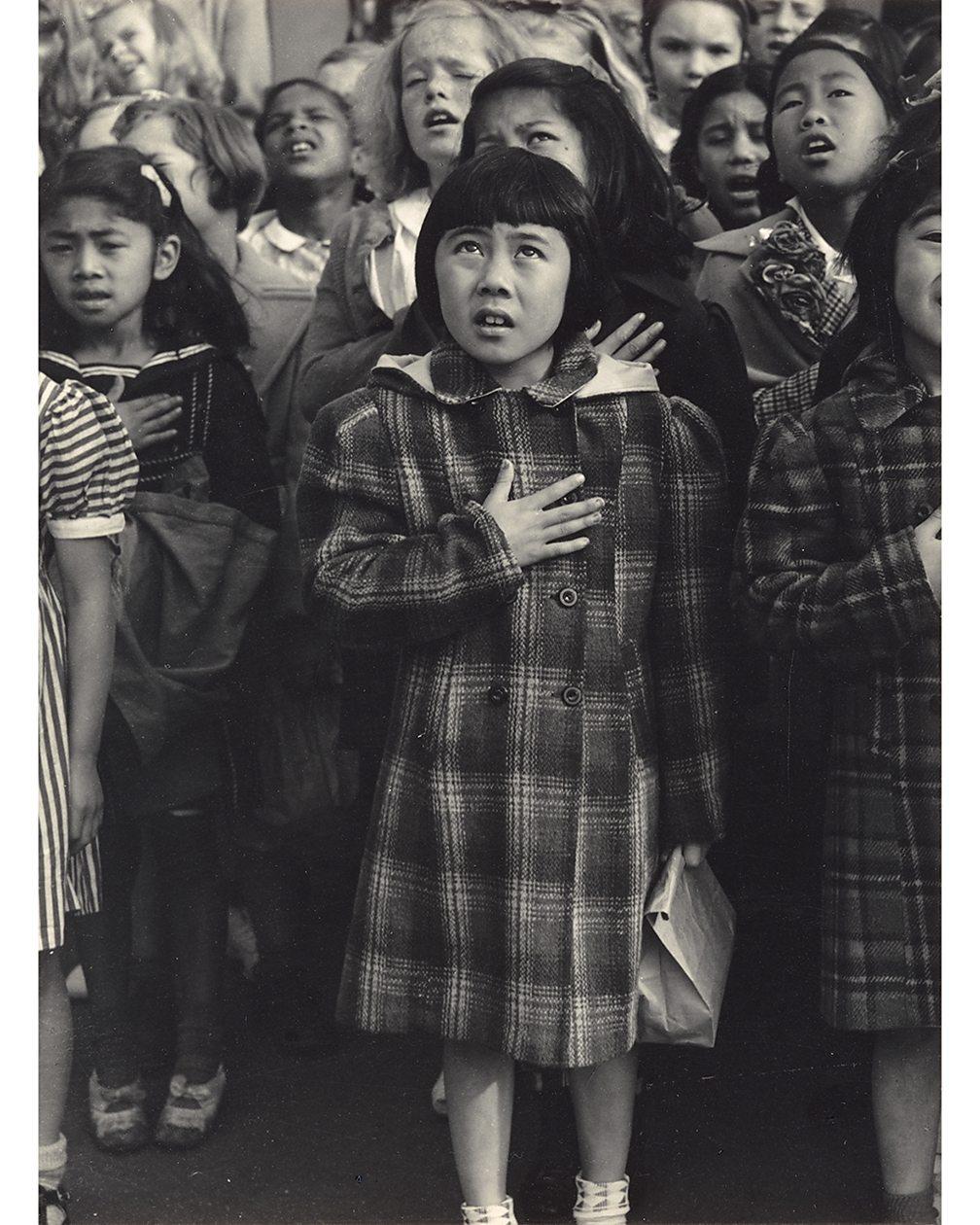
In April 1942, photographer Dorothea Lange visited Raphael Weill Public School in San Francisco, where she photographed a classroom of children pledging allegiance to the American flag.
It was a familiar scene in American schools. Children stood together, facing the flag, reciting words they had been taught since they were old enough to understand them.
But there was something extraordinary about this particular moment.
Among those children were Japanese Americans, some of whom would soon be removed from their homes and imprisoned by the very government to which they were pledging their loyalty.
On February 19, 1942, President Franklin D. Roosevelt had signed Executive Order 9066, authorizing the military to exclude people from designated areas. In practice, this became the mechanism for removing approximately 120,000 people of Japanese ancestry from the West Coast.
About two-thirds of them were American citizens.
They had not been charged with crimes. They had not been convicted of disloyalty. The government did not require evidence that they had done anything wrong.
Their ancestry was enough.
Families were ordered to leave their homes, often with only days or weeks to prepare. Businesses were sold at enormous losses. Farms were abandoned. Household possessions were given away, placed in storage, or simply left behind.
People were transported to temporary detention centers, some established at racetracks and fairgrounds, before being transferred to more permanent camps in remote parts of the country.
All of this was happening while the United States was fighting a war against governments that had made racial persecution and the destruction of individual liberties central features of their rule.
The contradiction was not lost on everyone at the time. Some Americans protested the policy, while others defended it as a military necessity. But wartime fear, racial prejudice, and the extraordinary authority granted to the government during a national emergency overwhelmed the constitutional protections that were supposed to apply to all citizens.
Lange herself had been hired by the federal government to document the removal of Japanese Americans. Her photographs frequently captured the dignity and ordinary humanity of the people being uprooted. Many of her images were restricted from public circulation during the war.
In 1944, the Supreme Court upheld the exclusion order challenged in Korematsu v. United States. It would take decades before the federal government formally acknowledged the injustice.
In 1988, President Ronald Reagan signed the Civil Liberties Act, which apologized for the incarceration and provided reparations to surviving victims. The legislation recognized that the policy had resulted from racial prejudice, wartime hysteria, and a failure of political leadership.
By then, many of the children in Lange’s photograph would have been in their fifties or sixties.
The words they were reciting that morning in San Francisco ended with a promise:
“One nation indivisible, with liberty and justice for all.”
In 1942, the government was preparing to deny that promise to some of the very children speaking it.
School Goes On Underground During the London Blitz, 1941
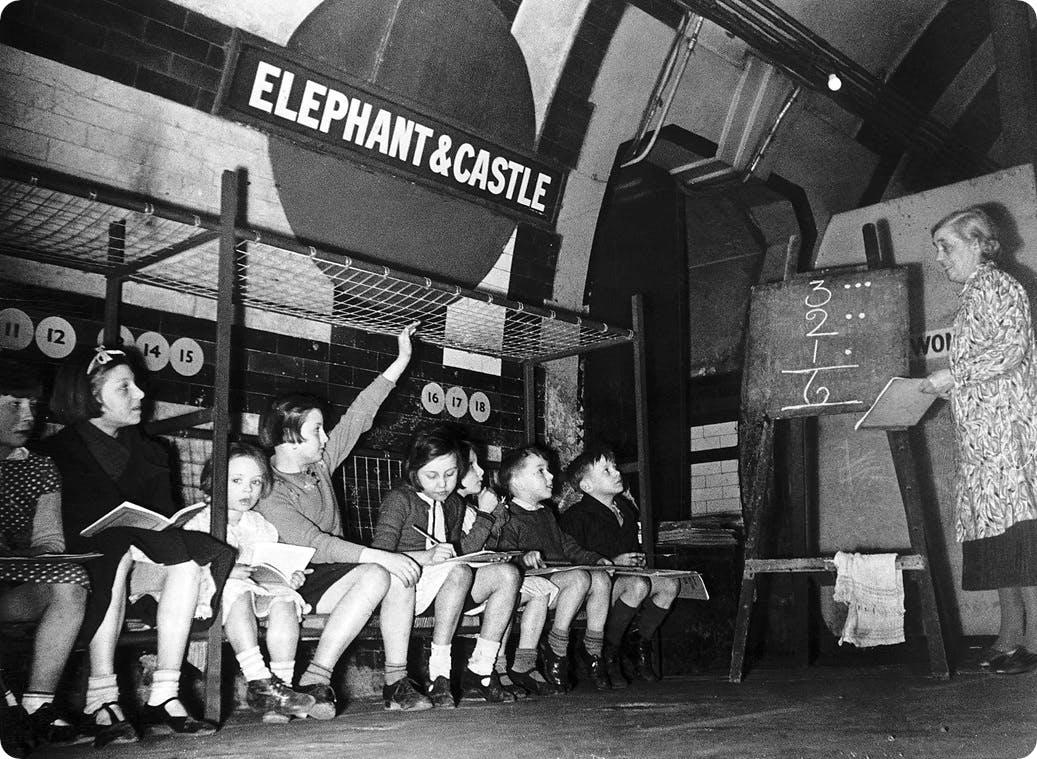
In March 1941, beneath the streets of London, a teacher named Miss Potter was conducting a mathematics lesson at Elephant & Castle Underground station. Her students sat gathered around her, their classroom temporarily relocated to a place designed for trains, not children.
Above them, London was a city at war.
For months, German bombers had been arriving after dark, dropping high explosives and incendiary bombs across the capital. Entire streets had been reduced to rubble. Churches, shops, schools, and family homes disappeared overnight. Londoners learned to recognize the rising and falling wail of the air-raid sirens, the distant thud of anti-aircraft guns, and the terrible uncertainty of waiting for the next explosion.
By the winter of 1940, the Underground had become one of the city’s most important refuges. Every evening, thousands of Londoners descended into the stations carrying blankets, food, and whatever possessions they could manage. Families established sleeping places along the platforms. Children played between the rows of bedding. Some people arrived early to secure a favored spot, then waited for morning before returning to whatever remained of their lives aboveground.
Conditions were hardly comfortable. The air could become hot and stale. Privacy was nonexistent. Toilets and washing facilities were strained by the crowds. The rumble of passing trains competed with conversations, crying babies, and the restless movements of people trying to sleep.
And yet, amid all this, ordinary life continued.
Teachers improvised lessons. Volunteers organized activities for children. People read newspapers, knitted, played cards, and celebrated birthdays. There were arguments, romances, friendships, and all the small dramas that occur whenever human beings are forced to live in close quarters.
Miss Potter’s mathematics lesson belonged to this strange underground society. While the Luftwaffe attempted to break Britain’s ability and willingness to continue the war, children were still being asked to concentrate on their sums.
The Blitz had begun on September 7, 1940, when German aircraft launched a massive attack on London’s docks and surrounding neighborhoods. London was bombed for 57 consecutive nights, and the attacks continued intermittently into the following spring. Across Britain, more than 40,000 civilians would die during the bombing campaign of 1940–41.
There was no guarantee that the Underground itself would remain safe. In October 1940, a bomb struck Balham station, killing dozens of people sheltering below. Other stations suffered direct hits, flooding, and structural damage.
Still, the platforms filled again the following evening.
By the time this photograph was taken, Londoners had spent half a year adjusting to a form of existence that would once have seemed unimaginable. Children who had known nothing but ordinary schoolrooms now understood that a classroom might be a railway platform, a church basement, or any corner where a teacher could gather a few pupils together.
At Elephant & Castle, Miss Potter continued her lesson. The children attended to their work, surrounded by the temporary sleeping quarters of a city that had learned to conduct much of its daily life beneath the ground.
Children Making Artificial Flowers in a New York Tenement, 1912
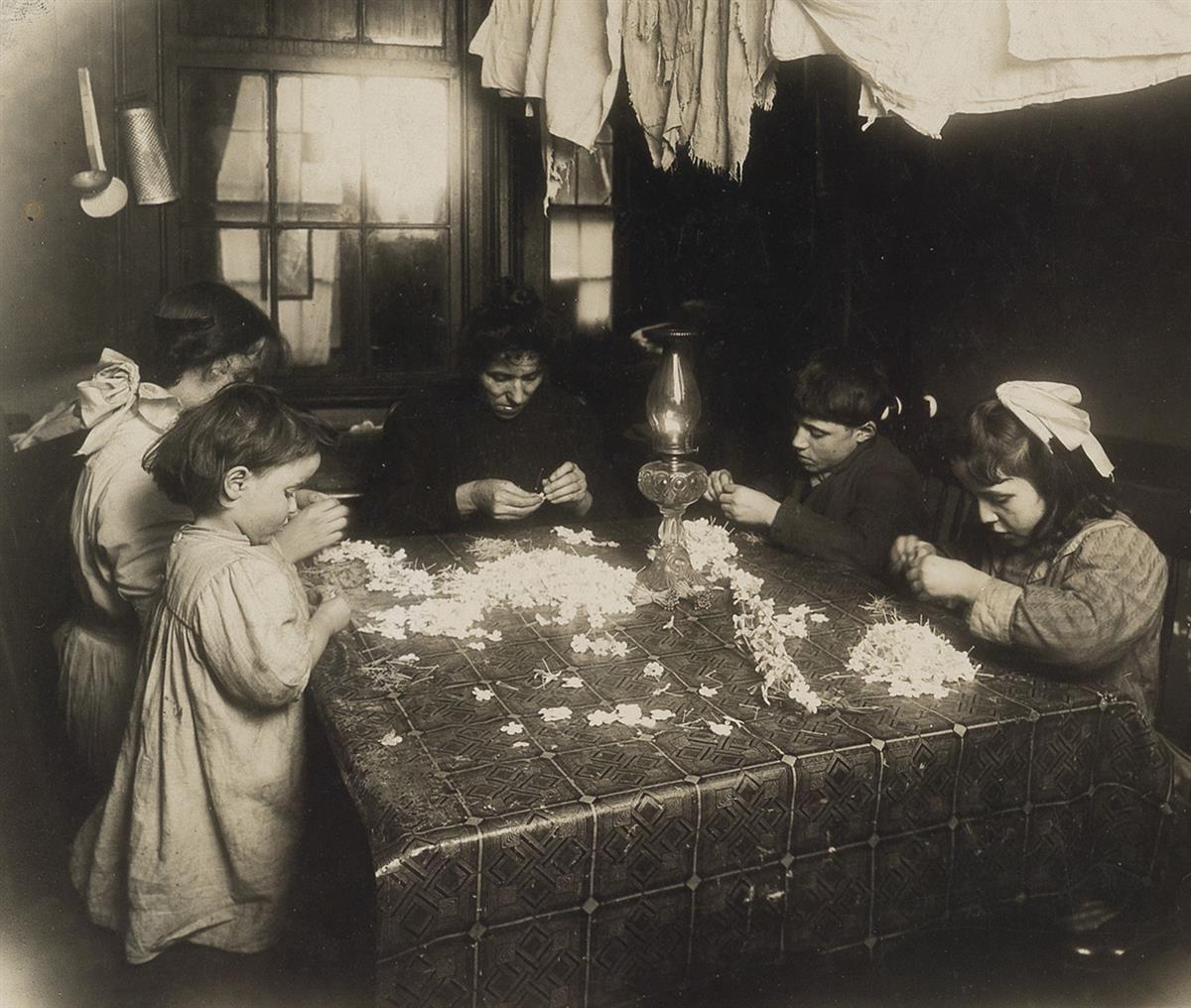
In January 1912, photographer Lewis Hine entered a tenement apartment at 134 Thompson Street in New York City and found a family making artificial flowers. The work was spread across the room, and everyone had a part in it. Even the smallest children, some only three or four years old, were expected to help.
The flowers were made of fabric and wire and paper, shaped by hand into things that looked alive. They would eventually find their way into shops, onto women’s hats, and into the windows of stores where people with money could admire them. The people who bought them would never know the room where they had been made.
For families like this one, the apartment was both a home and a workshop. There was no factory whistle to mark the beginning or end of the day. Work began when there was light enough to see and continued as long as there was something left to finish. A mother might prepare supper with unfinished flowers beside her. A child might stop working long enough to eat, then return to the same small task.
The children were not working because their parents believed childhood should be spent in labor. They were working because rent had to be paid, food had to be bought, and the money earned by the adults was not enough. In the tenements of New York, a few extra pennies could mean the difference between having bread and going without.
This was known as home work, or the sweating system. Manufacturers and contractors distributed materials to families, who assembled goods for payment by the piece. The arrangement allowed businesses to avoid the expense of maintaining a factory and shifted much of the burden onto the workers themselves. There were no guaranteed wages, no regular hours, and little protection against exploitation.
A family could work all day and still earn very little. And when the pay was counted by the number of finished flowers, every pair of hands mattered, no matter how small.
Hine had spent years photographing working children across America. He found them in coal mines, cotton mills, canneries, and city streets. His photographs were made for the National Child Labor Committee, which was campaigning to expose the conditions under which American children worked.
But there was another fact about this particular apartment that made the photograph especially troubling.
Three days after Hine’s visit, health authorities sealed and disinfected the apartment because of tuberculosis. The disease was a constant threat in overcrowded tenements, where families lived close together in rooms with poor ventilation and little sunlight.
After the apartment was disinfected, the family went back to making flowers.
There was rent to pay. The contractor would still expect the finished work. Whatever fear the family might have felt about the disease, it could not put food on the table.
And so the children returned to their little pieces of fabric and wire, making flowers that would be carried out of the tenement and sold to people who had never seen the hands that made them.
Sharecropping Families Evicted for Union Organizing, Arkansas, 1936
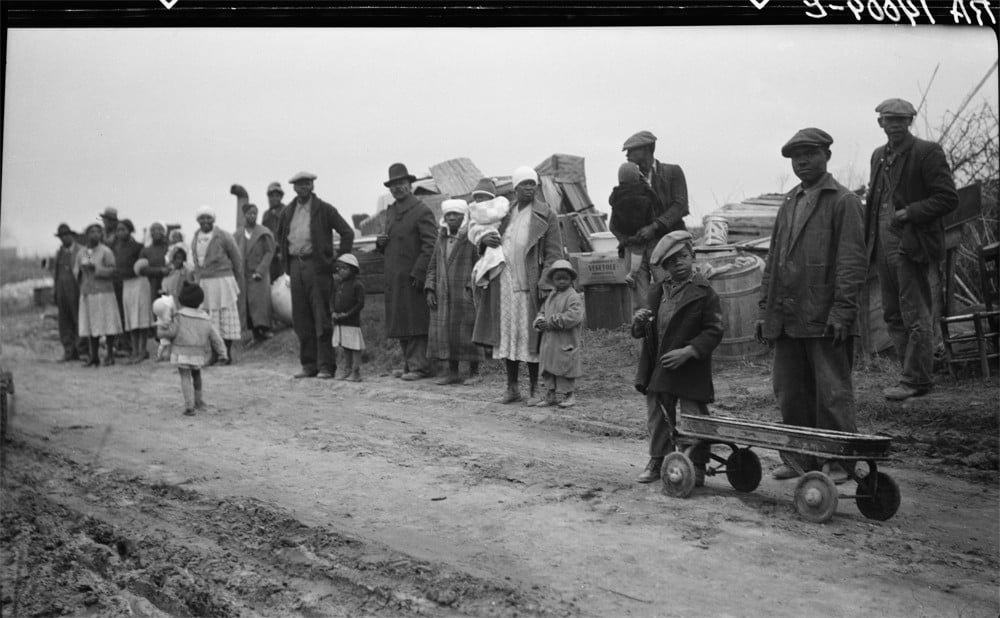
In 1936, in the cotton country of Arkansas, families were being put out of their homes for joining a union. Their belongings were carried into the open, and the houses they had lived in were taken from them. Some were driven off at gunpoint. They had worked the land, planted the cotton, picked it under the summer sun, and raised their children in houses that belonged to somebody else. And now they were being told to leave.
These were sharecroppers and tenant farmers, people who worked land they did not own in exchange for a portion of the crop or under rental arrangements. The landlord supplied the land and sometimes the seed, tools, and provisions. At harvest, the accounts were settled, or were supposed to be. But the arithmetic had a way of working against the people who did the planting. There were charges for food, for supplies, for advances made during the year. A family might work from one spring to the next and discover that it owed nearly as much as before.
The Great Depression had made a hard life harder. Cotton prices collapsed. Jobs disappeared. Then the federal government began paying landowners to reduce cotton production under the Agricultural Adjustment Act. The payments were intended to stabilize agricultural prices, but landlords often controlled the money, and many tenants and sharecroppers received little or none of what they believed was their share. Some were simply put off the land.
In 1934, Black and white agricultural workers in Arkansas formed the Southern Tenant Farmers’ Union. This was an extraordinary thing in the Jim Crow South, where racial divisions were enforced by law, custom, and violence. The union demanded fair settlements, better wages, and protection against arbitrary eviction. Its members held meetings in churches and small farm buildings, sometimes knowing that the wrong person learning of the gathering could mean a beating or worse.
The landowners did not take kindly to it. A man who joined the union might find himself without work. A family might be ordered out of its house. Organizers were threatened, assaulted, and driven from communities. The law offered little comfort to people whose livelihoods depended on the very men who held power over the land.
For a sharecropping family, eviction meant more than losing a roof. The house might be poor, with gaps in the walls and a floor that let in the winter cold, but it was where the children slept and where the family kept everything it owned. There was often no money saved, no other farm waiting, and no relative with enough room to take everyone in.
A wagon could carry the bedding, the cooking pots, a few chairs, and the clothes. It could not carry the year’s work already sunk into the soil. It could not carry the cotton that had not yet been picked, or the promise that the next harvest might finally leave something over.
The families in this photograph had joined together because they wanted a fairer accounting of their labor and some security in their homes. For that, they found themselves outside, with their possessions and their children, looking for another place to go.
The fields remained behind them. Someone else would plant them when spring came.
A Family Flees the Fighting During the Korean War, 1950
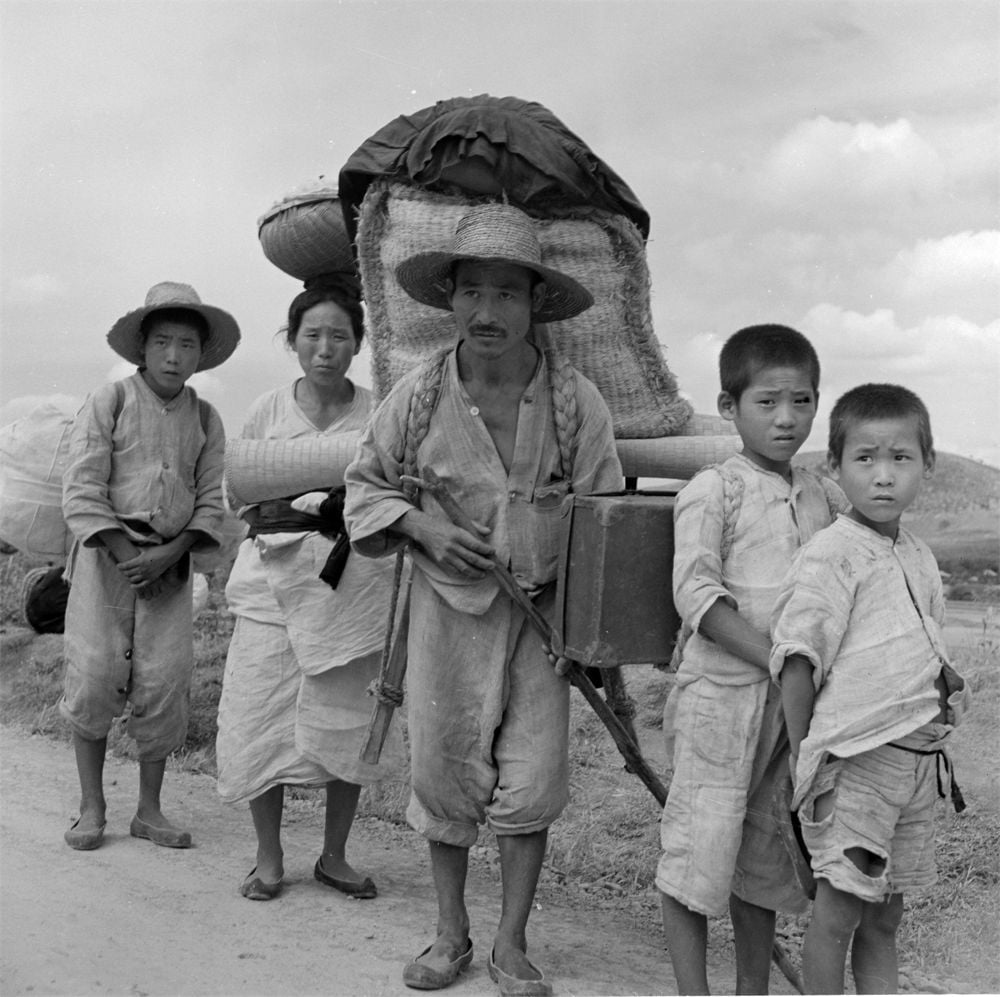
In 1950, somewhere along the road between Gimhae and Masan in southern Korea, a family was photographed fleeing the fighting. They were among the hundreds of thousands of civilians who had been forced to leave their homes as the war moved rapidly across the peninsula.
Only weeks earlier, many of these families had been living ordinary lives. Farmers tended their fields. Children attended school. Merchants opened their shops in the morning. Then, on June 25, North Korean troops crossed the 38th parallel, beginning a war that would transform the country almost overnight.
The North Korean army advanced with surprising speed. Seoul fell within three days. South Korean forces retreated southward, joined by American troops who had been hurried into the conflict. By August, the defenders had been pushed into a small area in the southeastern corner of the peninsula, around the port city of Busan, then commonly called Pusan.
For civilians, the movement of armies created a terrible problem. Staying in their villages meant risking bombardment, occupation, or being caught in the fighting. Leaving meant abandoning homes, crops, livestock, and nearly everything they owned.
Many families departed with little warning. They carried rice, blankets, cooking utensils, and clothing, whatever could be tied into bundles or loaded onto a cart. Parents carried infants. Older children helped younger ones walk. The elderly traveled as best they could. Those who could not keep up sometimes had to be left in the care of relatives or neighbors.
The roads were crowded with people moving south. Refugees traveled alongside retreating soldiers and military vehicles, often uncertain whether the next town would offer safety or another battlefield. Bridges became bottlenecks. Food grew scarce. In the summer heat, a journey of a few miles could consume an entire day.
There were dangers beyond the fighting itself. Soldiers on both sides sometimes regarded civilians with suspicion, fearing that enemy troops or infiltrators might be concealed among them. Refugees could be stopped, turned back, or prevented from crossing military lines. Some were killed in attacks on refugee columns. At No Gun Ri in July 1950, American soldiers killed an undetermined number of South Korean civilians, an atrocity that would not receive widespread international attention until decades later.
By late summer, the Pusan Perimeter had become the last major defensive position of South Korean and United Nations forces. The fighting around it was intense. Towns changed hands, artillery struck populated areas, and families who had already fled once sometimes found themselves moving again.
The people in this photograph were traveling through that landscape. Their names and their eventual destination are not established by the photograph’s caption. It does not tell us whether they had relatives waiting somewhere, whether their home survived, or whether they would ever return to it.
In September, United Nations forces landed at Incheon and broke out of the Pusan Perimeter. The front moved north again. Later that year, Chinese intervention sent armies and civilians southward once more. For many Korean families, displacement became a repeated experience rather than a single journey.
By the time an armistice was signed in July 1953, millions of Koreans had been displaced, and families had been separated by a heavily fortified border that would remain in place long after the fighting stopped.
The photograph preserves one moment on a road in 1950. The family was moving away from the fighting, carrying what it could. Beyond the edge of the picture, the road continued toward Masan.