Attorney General Robert Kennedy is comforted by two of his children on the lawn of his home, after he had been notified of the assassination of his brother, November 22, 1963
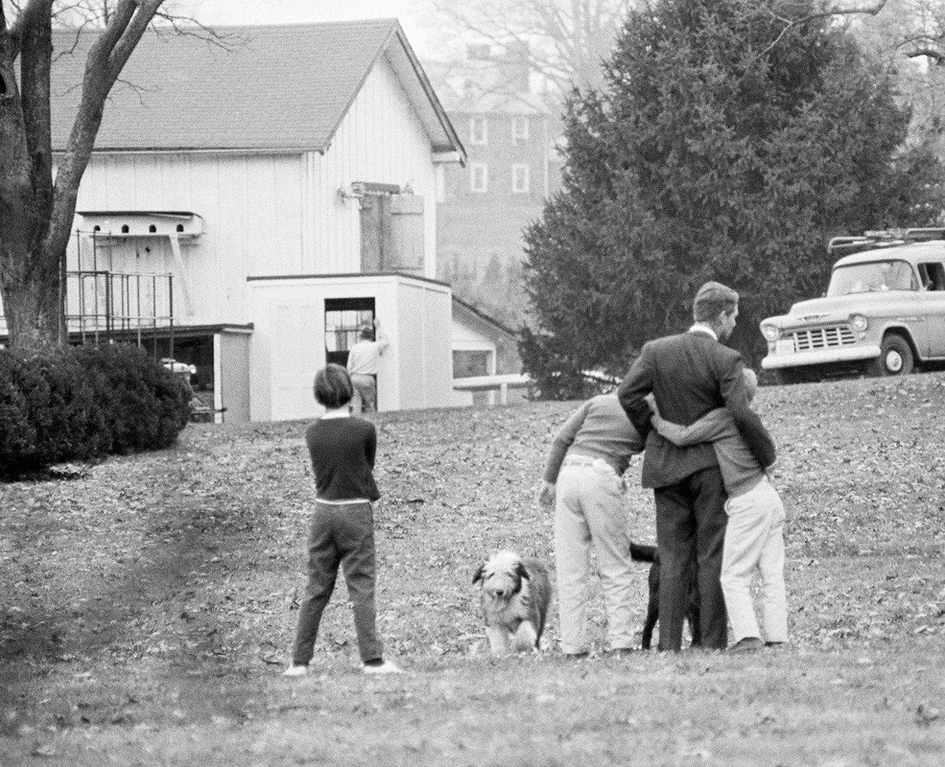
On the afternoon of November 22, 1963, Robert Francis Kennedy stood outside his home at Hickory Hill in McLean, Virginia, a man whose world had been destroyed in the space of a few hours. His brother, President John F. Kennedy, had been assassinated in Dallas. Robert was thirty-eight years old, the attorney general of the United States, and arguably the second most powerful man in the country. Yet in this photograph, with two of his young children beside him, there is nothing of the formidable political operator who had intimidated union bosses, confronted organized crime, and helped steer the nation through the Cuban Missile Crisis. There is only a younger brother who has lost his older brother.
To understand what had been taken from Robert Kennedy, one must understand the extraordinary relationship between the two men. Bobby had been Jack’s campaign manager, his closest political adviser, his fiercest defender, and, in many respects, the indispensable instrument of his presidency. Where Jack was charming and detached, Bobby was intense, suspicious, and relentless. He made enemies so his brother would not have to. Together they had navigated the most dangerous nuclear confrontation in human history. They had occupied the highest reaches of American power, where decisions made behind closed doors could determine the fate of millions. And now, suddenly, all that power was useless. There was no telephone call Bobby could make, no official he could summon, no adversary he could threaten who could change what had happened in Dallas.
The photograph captures something that the grand narratives of American history often overlook. The assassination of John F. Kennedy was a national catastrophe, an event that would be dissected by historians, investigated by commissions, and mourned by generations. But before it became history, it was a family tragedy. Two children stand close to their father, offering what comfort they can, perhaps too young to comprehend the enormity of what has happened. The man who had spent his adult life protecting his brother was now being comforted by his own children. There is a terrible helplessness in that reversal.
And there is something else that makes the photograph almost unbearable to look at today. Less than five years later, on June 5, 1968, Robert Kennedy himself would be shot in a Los Angeles hotel, dying the following morning at the age of forty-two. His children would endure the same devastating loss that had brought them to their father’s side on that November afternoon. But none of that was known in 1963. On the lawn at Hickory Hill, there was only a grieving father, his children, and the terrible realization that the brother around whom so much of his life had revolved was gone.
Sir Edmund Hillary and Tenzing Norgay, Everest, 1953
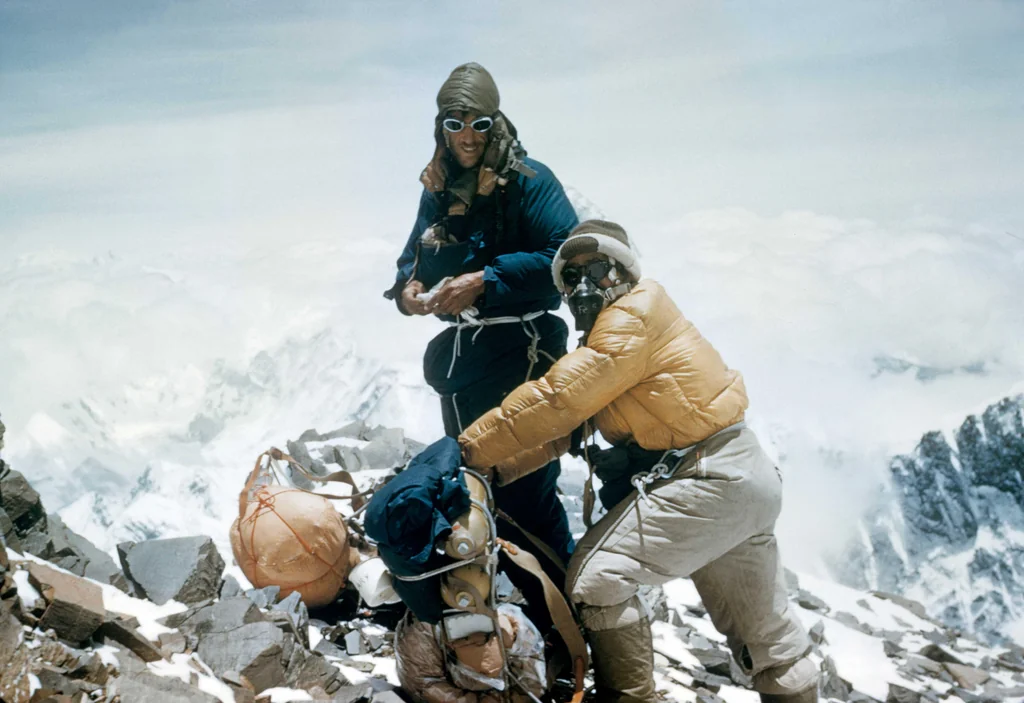
On the morning of May 29, 1953, Edmund Hillary and Tenzing Norgay stood on the summit of Mount Everest, 29,000 feet above sea level, in an environment where the human body was never meant to function. The air contained roughly a third of the oxygen available at sea level. Every movement demanded an extraordinary expenditure of energy. A misplaced foot, a failed oxygen apparatus, or an unexpected change in weather could have killed them. They had reached the highest point on Earth, but the achievement meant very little unless they could get back down alive.
This was long before Everest became a bucket-list destination for wealthy adventurers willing to pay tens of thousands of dollars for guided expeditions. There were no commercial outfitters ushering clients toward the summit, no traffic jams of climbers waiting to take selfies, no social media audiences expecting proof of the accomplishment. In 1953, no human being had ever been confirmed to stand on Everest’s summit. The mountain remained one of the last great unsolved challenges in exploration, and reaching its top required an enormous expedition, months of preparation, and a willingness to accept that you might never return.
Their success was the culmination of decades of failed expeditions, numerous deaths, and a logistical undertaking involving hundreds of people. Hillary, a New Zealand beekeeper, and Norgay, a Sherpa mountaineer who had already participated in six Everest expeditions, were the final pair selected from a British expedition led by John Hunt. Neither man could have succeeded alone. Their ascent required technical skill, remarkable endurance, and an almost absolute dependence on one another.
They spent approximately fifteen minutes on the summit. Hillary photographed Norgay holding his ice axe adorned with flags, while Norgay left small offerings in the snow. There was no photograph of Hillary standing on top; Norgay did not know how to operate the camera. Then they began descending. It was an appropriately brief celebration. At that altitude, the mountain offered no special consideration to men who had just made history.
Teddy Roosevelt Becomes the First US President to Fly in an Airplane, 1910
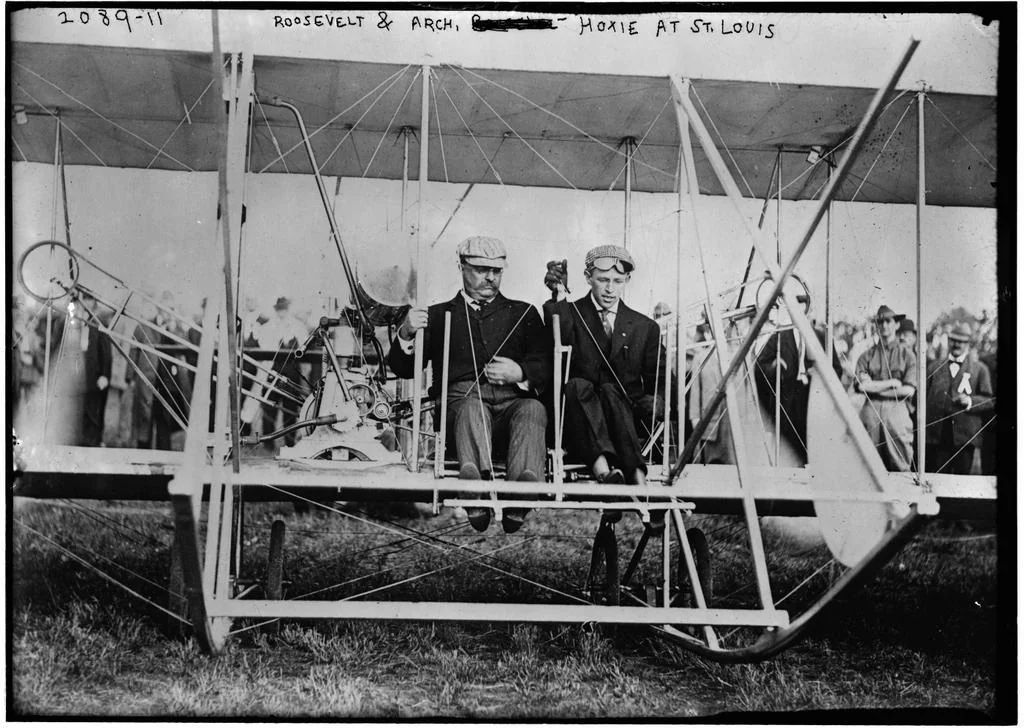
On October 11, 1910, at an airfield outside St. Louis, Missouri, Theodore Roosevelt climbed aboard a fragile flying machine piloted by a young aviator named Arch Hoxsey. Roosevelt had been out of the White House for a year and a half, but at fifty-one, his appetite for adventure remained undiminished. The airplane was a Wright Model B, a contraption of wood, canvas, and wire that looked scarcely capable of supporting its own weight, much less carrying a former president of the United States into the sky.
It is difficult now to appreciate just how extraordinary such a flight was. Only seven years had passed since the Wright brothers’ first powered flight at Kitty Hawk. Most Americans had never seen an airplane, much less ridden in one. Flying was still considered a dangerous experiment, the pursuit of daredevils and dreamers. Yet Roosevelt, who had charged up San Juan Hill, hunted big game in Africa, and spent much of his life deliberately seeking out danger, apparently required little persuasion. As the airplane lifted off, he waved enthusiastically to the crowd below.
The flight lasted only a few minutes, reaching an altitude of roughly 150 feet. Roosevelt was delighted. “That was the bulliest experience I ever had,” he reportedly exclaimed afterward. There was something wonderfully characteristic about the moment. Here was a man who had witnessed the transformation of America from a largely rural nation into an industrial power, now embracing a technology that promised to transform the world yet again.
There was, however, a sobering reminder of just how dangerous aviation remained. Less than three months later, on December 31, 1910, Arch Hoxsey was killed when his airplane crashed during an exhibition flight in Los Angeles. He was twenty-six years old. Roosevelt had briefly glimpsed the future, but the men who were making that future possible were still paying for it with their lives.
“Where Marines go, their pin-ups go”, Tarawa, 1943
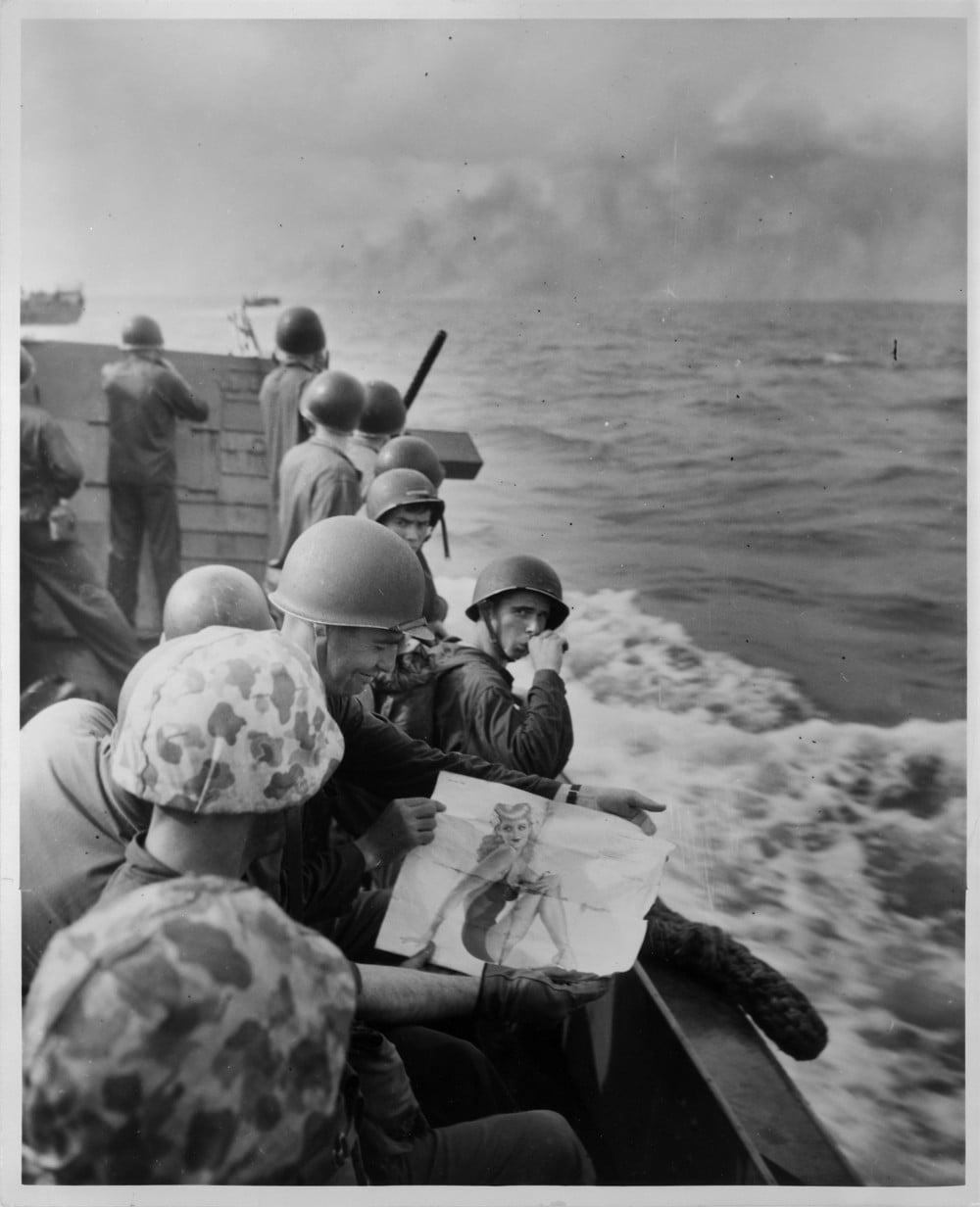
Somewhere off the coast of Tarawa, in November 1943, a group of American Marines crowded together aboard a landing craft. One of them held up a picture of a beautiful woman. She was blonde, dressed in black lingerie, and smiling. The men gathered around to look. Behind them, smoke rose from the island they were about to invade. It was an ordinary enough moment, the sort of thing young men had been doing for generations, except that these particular young men were on their way to a place where a great many of them would die.
The island was Betio, a narrow strip of coral barely two miles long, defended by some 4,500 Japanese troops and fortified with bunkers, machine-gun nests, and artillery positions. The American commanders expected a difficult fight, but few anticipated the slaughter that followed. The tides proved too shallow for many of the landing craft to cross the surrounding reef, forcing Marines to climb over the sides and wade hundreds of yards through chest-deep water while Japanese guns fired from the shore. Men fell into the water and did not get up. Others reached the beach only to discover that there was almost nowhere to hide. By the time the island was secured, roughly seventy-six hours later, more than a thousand Americans had been killed and over two thousand wounded.
It is tempting to look at the photograph and see only the irony: men admiring a pretty girl while death waits a short distance away. But the picture suggests something more ordinary and more human. Most of these Marines were young men who had left behind girlfriends, wives, families, and lives that had scarcely begun. They carried photographs, wrote letters, told dirty jokes, complained about the food, and dreamed of going home. The pin-up was not simply a decoration or a joke. It was a small reminder of a world in which the most pressing concerns were girls, Saturday nights, and what one might do with the rest of one’s life. For a few seconds, the men in that landing craft could occupy that world again.
We do not know what became of the Marines in the photograph. Some may have survived the battle and gone on to fight elsewhere in the Pacific. Others may have died before the day was over. The photograph offers no answers. It preserves only a brief moment before the landing, when the men were still together, still smiling at a picture, still capable of forgetting, however briefly, what lay ahead. Behind them, the island burned. In front of them was a war that would make no distinction between the brave and the frightened, the experienced and the young, or those who had someone waiting for them at home and those who did not.
“We Won’t Fight Another Rich Man’s War!!!” – Vietnam Veterans Against the War, circa 1970
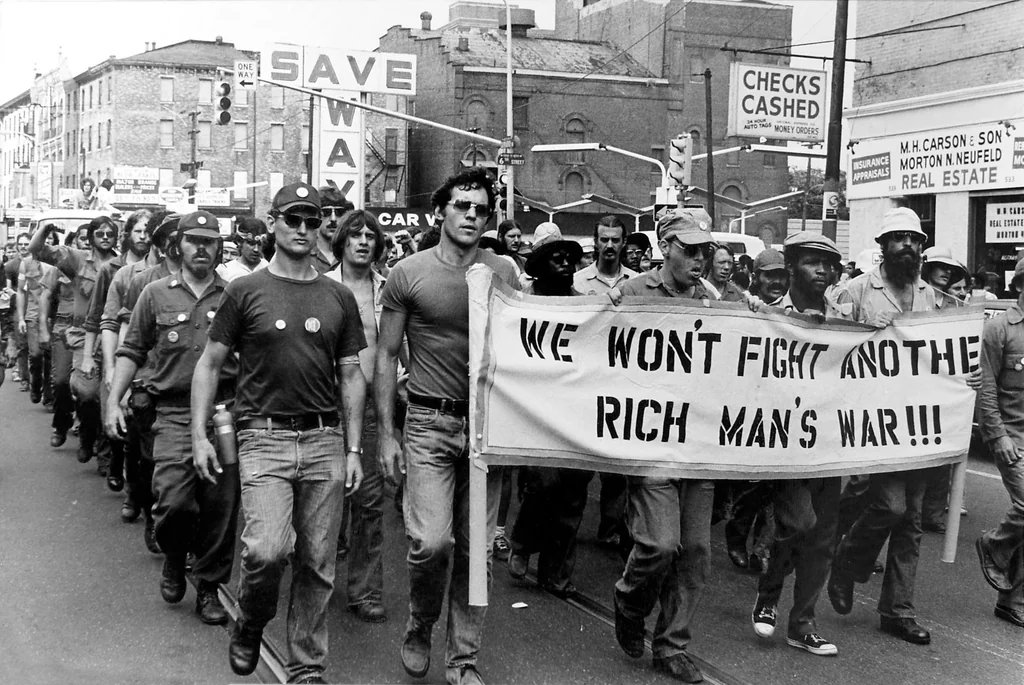
The men marching beneath the banner had already done what their country had asked of them. They had worn the uniform, served in Vietnam, and returned to an America increasingly divided over the war. Now they were carrying a message that would have been unthinkable to many Americans a decade earlier: “We Won’t Fight Another Rich Man’s War.” These were not young men trying to avoid military service. They were veterans who had experienced the war firsthand, and some had come to believe that the greatest betrayal was not their opposition to the war, but the decision to send them there in the first place.
The Vietnam War had exposed a profound inequality in American society. The men who planned and directed the war were largely drawn from the country’s political and intellectual elite, educated at prestigious universities and accustomed to positions of authority. The men who fought it were disproportionately drawn from families with fewer resources and fewer ways to escape the draft. College deferments allowed many young Americans to postpone military service, while others lacked the money or educational opportunities to qualify. The system was not quite as simple as the slogan suggested—men from every social class served and died in Vietnam—but the underlying resentment was real. For many working-class Americans, the war had become another example of a society in which the powerful made decisions and the less powerful paid the price.
What made Vietnam Veterans Against the War so unsettling to the political establishment was that its members could not easily be dismissed as naive students or unpatriotic outsiders. They had been there. They had seen the villages destroyed, the civilians caught between armies, the young American soldiers killed in battles whose strategic importance was often difficult to explain. They had heard the official assurances that progress was being made, that victory was approaching, that another deployment or another offensive would finally turn the tide. And they had watched those assurances collapse against the reality of what they experienced. Their opposition carried a particular moral force because it came from men who had once accepted the very obligations they were now questioning.
The banner was more than an antiwar slogan. It was an accusation directed at the people who had governed the country, and at the system that had allowed them to wage a costly war for years without fully confronting its consequences. By the time the United States withdrew its combat forces, more than 58,000 Americans would be dead, along with vastly greater numbers of Vietnamese. The men in this photograph were asking a question that would outlast the war itself: Who decides when a nation goes to war, and who is expected to die when those decisions prove wrong? It was a question made all the more difficult to ignore because it was being asked by the very men who had been sent to fight.