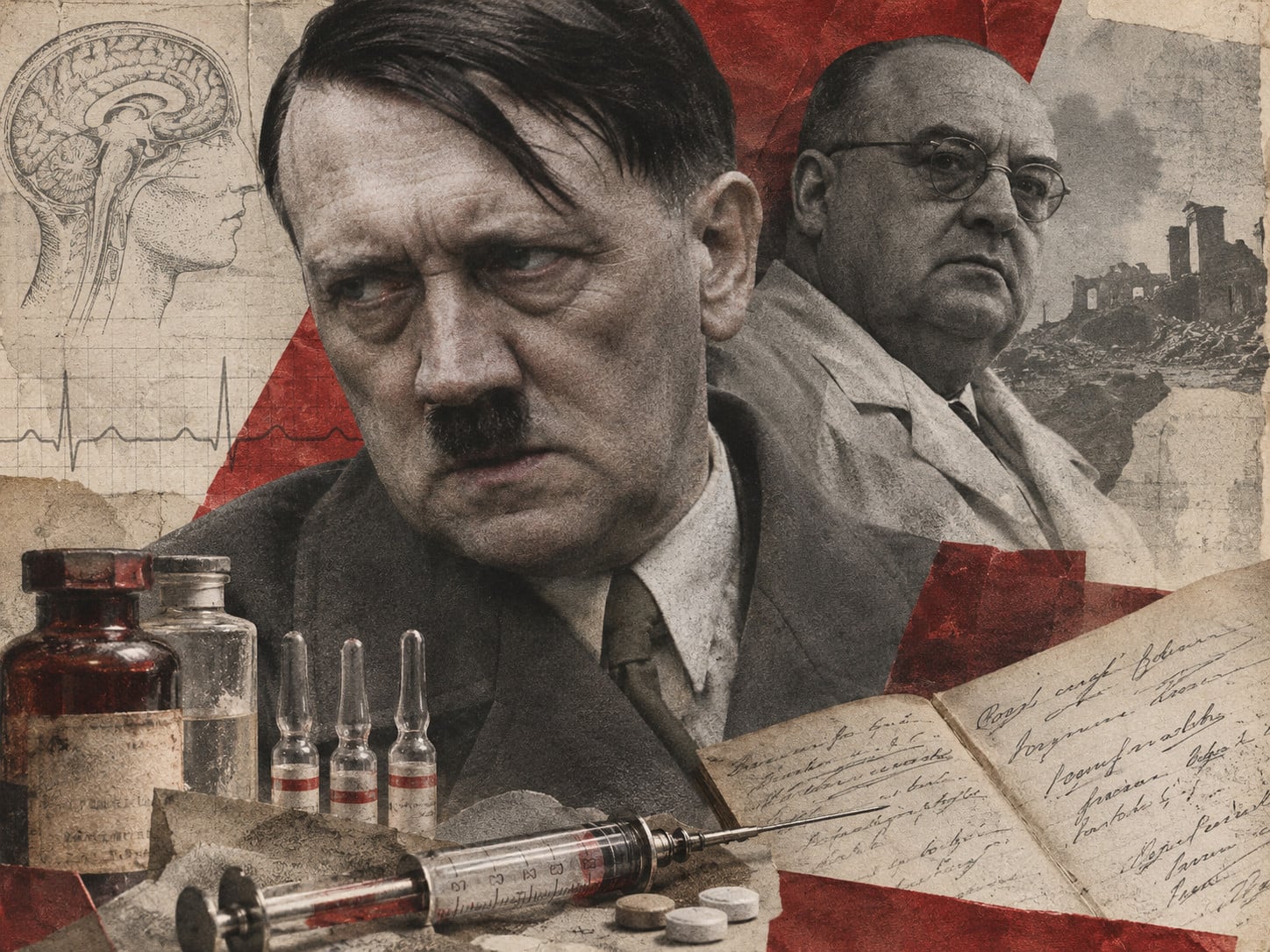
Adolf Hitler didn’t drink alcohol. He didn’t smoke. He was largely vegetarian and cultivated an image of extraordinary personal discipline. Nazi propaganda presented him as a model of physical purity, a man supposedly free from the weaknesses and vices of ordinary people.
By the final years of World War II, however, Hitler was receiving injections of powerful opioids from a doctor who had become one of the most important people in his life.
His name was Theodor Morell, and he kept detailed medical notes documenting what he gave Hitler, when he gave it, and how his patient responded.
Morell became Hitler’s personal physician in 1936, initially treating him for chronic digestive problems. Hitler was impressed with the results, and Morell soon became a permanent fixture in his inner circle.
At first, the treatments consisted largely of vitamins, glucose injections, and digestive remedies. But as the war progressed, the medications became considerably stronger.
On July 18, 1943, Hitler was suffering from severe stomach pains and exhaustion before an important meeting with Italian dictator Benito Mussolini. Morell recorded administering “an ampoule of Eukodal” before Hitler’s departure.
Eukodal was a pharmaceutical form of oxycodone, a powerful opioid capable of producing euphoria, pain relief, and dependence.
By the fall of 1944, Morell’s notes described an increasingly troubling situation.
On October 30, Hitler summoned his physician at six in the morning after working through the night. Complaining of painful stomach cramps, he received an intravenous injection combining Eukodal and another medication, Eupaverin.
Morell noted that administering the injection was difficult because of “many recent needle scars.” He advised that Hitler’s veins needed a rest.
Just four days later, on November 3, Hitler complained about the persistent trembling in his hands and left leg. Morell suggested rest, relaxation, and avoiding arguments.
Hitler wanted something else.
“Isn’t there some kind of drug or shot you can give me against it?” he asked.
The records provide an extraordinary glimpse into the relationship between the dictator and his doctor. Morell wasn’t merely treating occasional illnesses. He was administering a growing collection of medications to a man who increasingly turned to injections for relief.
The situation became even stranger in 1944, when Hitler also received cocaine-based nasal treatments following injuries sustained during an assassination attempt.
According to Norman Ohler, author of Blitzed: Drugs in the Third Reich, Hitler developed a dependence on Morell’s powerful opioid treatments.
And then the supply began to disappear.
As Allied bombing devastated Germany’s pharmaceutical industry, Eukodal became increasingly difficult to obtain. Ohler argues that Hitler experienced opioid withdrawal in early 1945, contributing to his physical deterioration.
That interpretation remains disputed. Historians disagree over the extent of Hitler’s addiction, and his shaking and declining health may also have resulted from neurological illness.
What the medical records do establish is that Hitler received powerful drugs, sometimes repeatedly, from a physician he trusted almost completely.
None of this excuses Hitler’s ideology, the Holocaust, or his responsibility for the war. His crimes and political convictions existed long before the strongest drugs entered his treatment.
But it exposes one of the strangest contradictions of Nazi Germany: the dictator who preached purity and self-control spent his final years repeatedly turning to a doctor armed with a syringe.

Was this worth your time?
What missed? (optional)