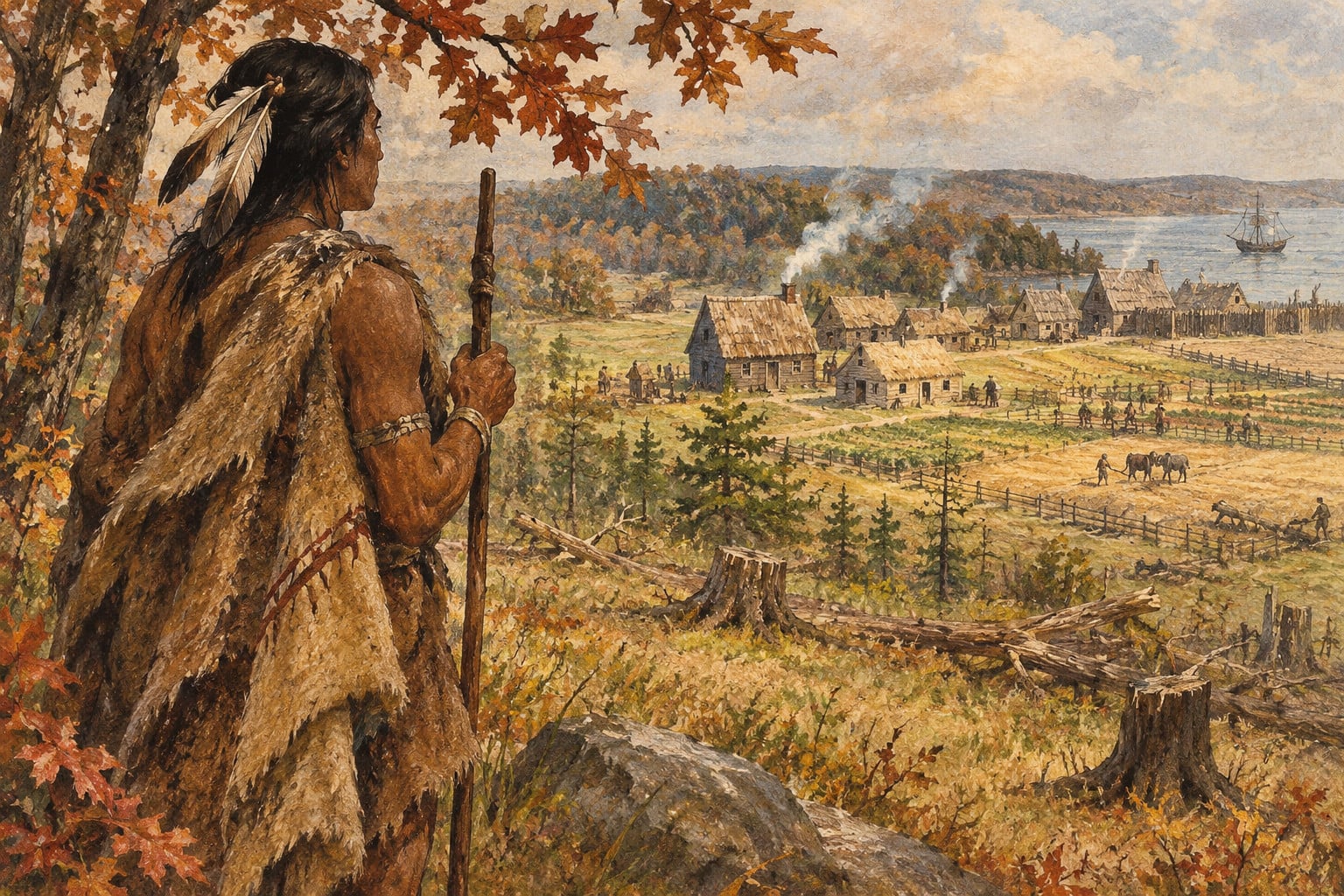
If your knowledge of the Pilgrims comes primarily from elementary school, you could be forgiven for thinking that the story ends in the autumn of 1621, with English settlers and Native Americans sitting down to share a meal.
But what happened over the next fifty years is arguably a far more compelling story.
At the time of that famous harvest celebration, the English settlers were in an extraordinarily vulnerable position. Nearly half of the Mayflower’s passengers had died during their first winter. They were strangers in an unfamiliar environment, dependent in part on the knowledge and cooperation of the Wampanoag people.
For the Wampanoag leader Ousamequin, however, helping the English was also a calculated political decision. Epidemics had devastated his people, leaving them vulnerable to rival Indigenous nations. An alliance with the newcomers offered a potential military advantage.
For a time, the arrangement worked. The two communities traded, maintained diplomatic relations and largely avoided war.
But something was happening that would fundamentally alter the relationship.
More Europeans were coming.
Beginning in 1630, thousands of English settlers arrived in New England. They established towns, cleared forests, built farms and acquired increasingly large amounts of Indigenous land. What had begun as a small, struggling settlement was becoming an expanding colonial society.
Imagine how different this must have looked from the Wampanoag perspective. The handful of vulnerable foreigners who had once depended on your assistance were becoming a population large enough to threaten your people’s independence.
The balance of power was shifting dramatically.
After Ousamequin died in the early 1660s, leadership eventually passed to his son Metacom, whom the English called King Philip. Unlike his father, Metacom faced a colonial population that was increasingly capable of imposing its laws, religious expectations and territorial demands on Indigenous communities.
In 1675, following years of deteriorating relations, war broke out.
What followed was one of the most devastating conflicts in American history relative to the population of the region. Entire settlements were destroyed, thousands of people died, and Indigenous survivors faced displacement, enslavement and the loss of their ancestral lands.
Metacom was killed in 1676. His head was displayed on a pole in Plymouth for roughly two decades. His wife and son were taken captive.
Consider the historical distance between those two scenes: a harvest celebration attended by Ousamequin in 1621, and the public display of his son’s severed head in the very same community fifty-five years later.
Plymouth Colony continued to grow before eventually being incorporated into the larger Province of Massachusetts Bay in 1691. The Wampanoag, despite catastrophic losses, survived and continue to exist as distinct Indigenous communities today.
The cooperation of 1621 was real. So was the destruction that followed it. Understanding one without the other gives us a profoundly incomplete picture of American history.
The first Thanksgiving was not the conclusion of a story about two peoples learning to live together. It was the opening chapter of a much longer and more consequential story about what happens when two societies with vastly different ambitions find themselves occupying the same land.
Was this worth your time?
What missed? (optional)