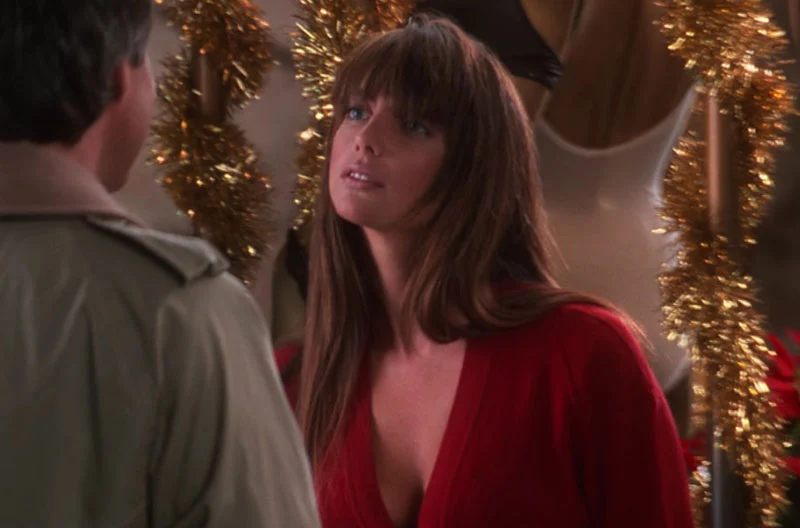
Every December, without fail, she returns. Not in the way Mariah Carey does, blasting from retail speakers, but in a quieter, more visual way—appearing in that scene, from that movie, that half the country treats like sacred text. You might not know her name, but you remember the moment: the red swimsuit, the imaginary pool, Clark at the window. Nicolette Scorsese didn’t need a blockbuster career—she had a single fantasy sequence that somehow became immortal.
The Pool Scene That Launched a Thousand Crushes
If you’ve ever watched National Lampoon’s Christmas Vacation (and let’s be honest, you have—probably on a couch surrounded by half-eaten cookies and passive-aggressive family dynamics), you remember her. Not just the lingerie store scene—that was the setup. The punchline, the legacy, the moment, came later.
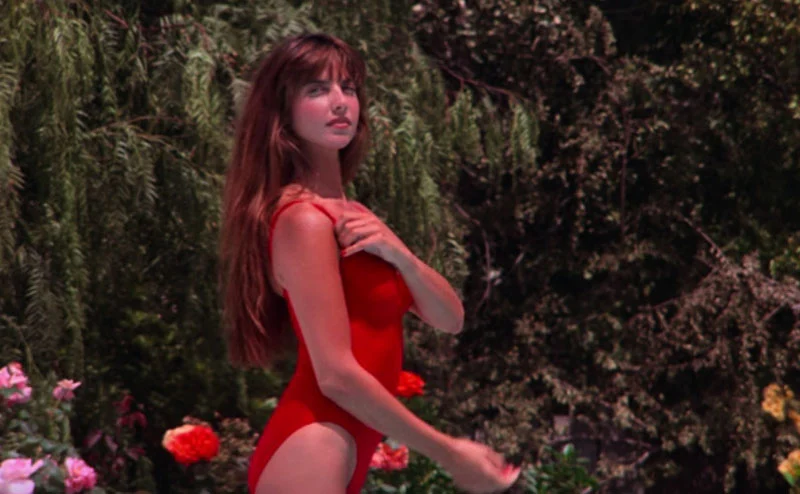
Clark Griswold stands at the window, staring out at the snowy backyard. The pool isn’t even built yet. But in his mind, it’s finished. The snow melts into fantasy. A single red swimsuit is peeled off—slowly, flirtatiously—by Nicolette Scorsese’s character, Mary. And then it smash-cuts to her climbing out of the imaginary pool, glistening, graceful, and entirely unforgettable.
It was ridiculous. It was dreamlike. It was edited with the same hormonal rhythm as a teenage daydream. And in its own absurd, suburban-satirical way, it was iconic. Every person watching Christmas Vacation for the first time in adolescence immediately understood that this was their generation’s version of Fast Times at Ridgemont High. Phoebe Cates had the diving board. Nicolette Scorsese had the backyard fantasy sequence. Both were flashbulb moments in the teenage brain. Both would outlive the films they appeared in.
This was the scene that crystallized Nicolette Scorsese in American pop culture—not as a character, but as a memory.
Not That Scorsese
Let’s get this out of the way: she’s not related to Martin Scorsese. There’s no deleted scene in The Irishman with Nicolette playing a mob wife. She didn’t get the role through family connections. She just happened to share a very famous last name while starring in a very famous Christmas movie.
Her career followed a pattern that was both predictable and unfortunate. Early modeling, then commercials, then bit roles in shows like The A-Team and Charles in Charge. After Christmas Vacation, Hollywood noticed—but for the wrong reasons. She was given roles with titles like “Fantasy Lover,” “Busty Barmaid,” and “Hostess,” in projects like Aspen Extreme, Boxing Helena, and Girls in Prison. The scripts didn’t offer nuance. They offered one thing. And she had it.
And Then She Disappeared
By the early 2000s, the credits stopped. Her final known appearance was—fittingly—as a “Busty Barmaid” on NYPD Blue. And then, silence. No fanfare. No comeback tour. No awkward red carpet interviews years later trying to reclaim the narrative. Nicolette Scorsese did something almost no one in the industry manages: she vanished on purpose.
No memoir. No personal website. No Instagram feed of wellness quotes and dogs in sweaters. Just a long pause that turned into a full stop.
You can still find her name on fan pages. You can still read about how she once dated Sean Penn and Antonio Sabato Jr. But there’s no post-Hollywood chapter written in public. She exited stage left—and stayed gone.
The Occasional Glimpse

Every now and then, though, a photo surfaces—grainy, unverified, usually from a fan encounter or a long-lost candid. And while the year of these pictures is often unclear, one thing is obvious: Nicolette Scorsese has aged gracefully. Still beautiful, still composed, still somehow radiating the same quietly magnetic energy she had in that pool scene decades ago. The glamour has softened, but the glow is still there. If anything, her mystique has only deepened.
Cultural Ghosts and Freeze-Frame Fame
Some actors have careers. Others have moments. Nicolette Scorsese had a scene. One. But it was so perfectly calibrated—so locked into the hormonal geometry of adolescence and holiday nostalgia—that it became eternal.
She became a kind of cultural ghost, replaying eternally in the background of living rooms every December. She never aged. She never changed. She’s frozen in fantasy, climbing out of that imaginary pool in slow motion, while Clark Griswold stares slack-jawed through the frosted window.
And maybe that’s the strangest kind of immortality there is.