
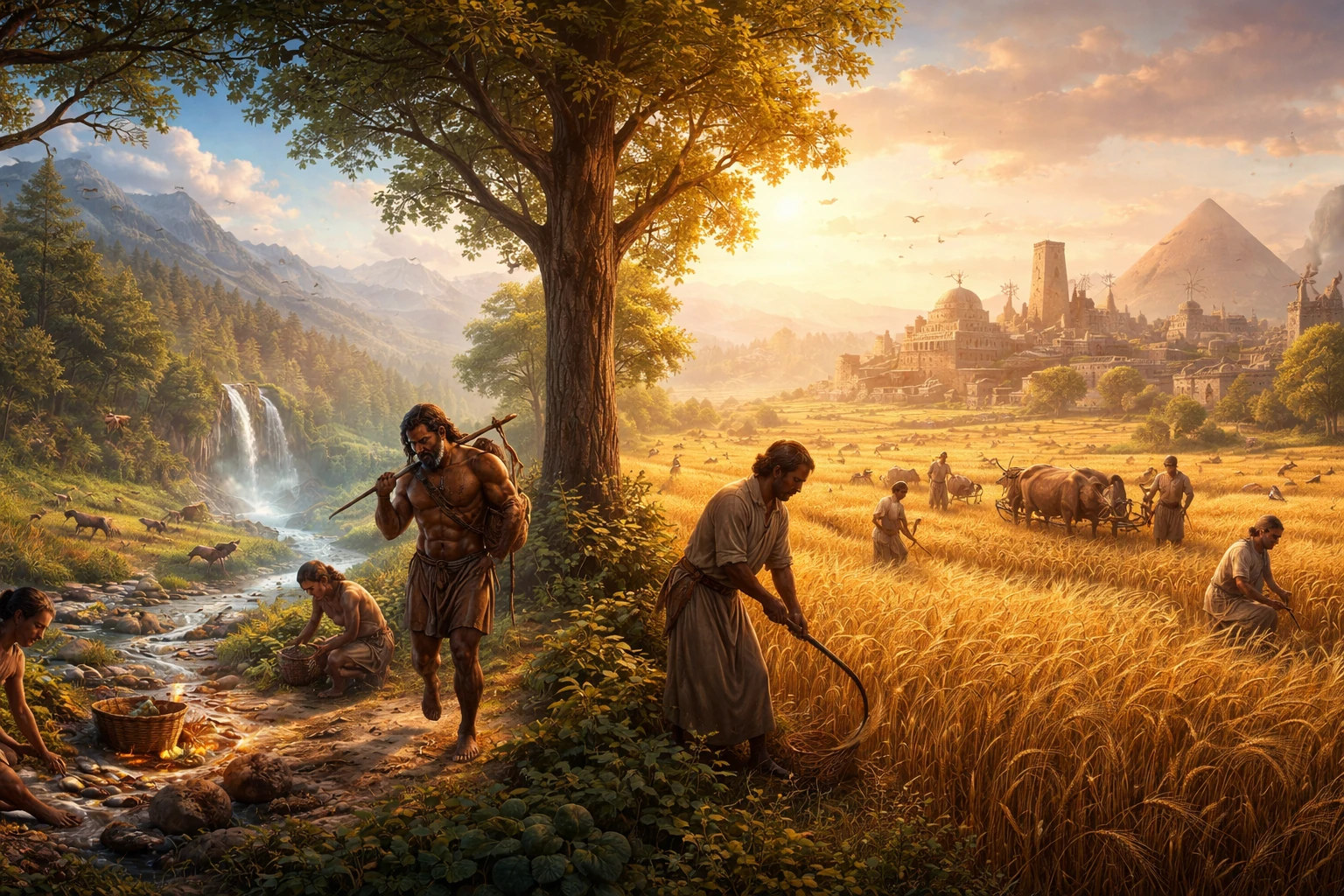
For most of human history, agriculture did not exist.
For tens of thousands of years, Homo sapiens lived as hunter-gatherers—small, mobile bands embedded deeply in their ecosystems. They followed seasonal rhythms, knew hundreds of plant species, and relied on social bonds rather than stored surplus. Then, roughly 12,000 years ago, something curious happened. Humans began domesticating wheat, rice, maize, and animals. Villages grew. Fields spread. Granaries filled. Hierarchies hardened.
We call this moment the Agricultural Revolution, and we usually describe it as progress.
But what if it wasn’t?
What if agriculture never took off the way it did—not as a marginal experiment, but as the organizing principle of civilization?
The World Before Fields
Archaeological evidence paints an uncomfortable picture for our modern assumptions. Early farmers often worked longer hours than hunter-gatherers. Their diets were narrower. Their skeletons show more signs of malnutrition and disease. Close living quarters and domesticated animals created ideal breeding grounds for epidemics. Inequality, rare in foraging societies, became structural.
Hunter-gatherers, by contrast, enjoyed varied diets, strong social cohesion, and—perhaps most strikingly—time. Time to talk, to rest, to tell stories, to observe.
In many ways, agriculture did not liberate humans. It domesticated them.
Wheat did not bend to human will; humans bent their spines to wheat.
If agriculture had remained a niche strategy rather than a planetary takeover, humanity might have continued living in smaller, more flexible groups—less productive, yes, but also less fragile.
No Surplus, No Kings
Agriculture created surplus. Surplus created storage. Storage required protection. Protection required authority.
Without large-scale farming, there are no granaries worth taxing, no fields worth conquering, no populations dense enough to rule from palaces. Power remains personal, negotiated, and temporary. Leaders persuade more than they command.
In such a world, the idea of a permanent ruling class makes little sense.
There are no divine kings because there is no agricultural base large enough to support people who do nothing but rule. There are no professional armies because there is nothing stable enough to defend or steal at scale.
History, as we know it—full of empires rising and falling—simply does not happen.
The Absence of “Progress”
Without agriculture, there are no cities. Without cities, there are no bureaucracies. Without bureaucracies, there are no writing systems, no tax codes, no standing religions with rigid doctrines.
This also means no monumental architecture, no industrial revolution, no modern science.
But it also means no mass famines triggered by crop failure. No caste systems justified by land ownership. No peasants bound to soil they do not own.
Human societies might still innovate—tools, language, art—but innovation would be horizontal, not exponential. Knowledge spreads through stories and imitation rather than institutions. Cultures evolve slowly, but collapse rarely.
Progress becomes cyclical instead of linear.
A Planet That Breathes
Agriculture reshaped Earth more radically than any volcano or asteroid since the dinosaurs. Forests cleared. Rivers redirected. Ecosystems simplified. A handful of crops replaced thousands of species.
If farming had remained limited, the planet would look profoundly different.
Large mammals would still roam many regions now covered in fields. Biodiversity would be higher. Carbon cycles would be more stable. Climate change, as we experience it, would be unlikely—there would be no fossil-fuel civilization to trigger it.
Humans would still alter their environment, but not at planetary scale. The Anthropocene might never arrive.
The Myth of Inevitable Civilization
We often assume that once agriculture appeared, everything else followed naturally. Cities, states, technology, modernity—it all seems inevitable in hindsight.
But inevitability is a story told by the winners.
Agriculture succeeded not because it made individual humans happier, healthier, or freer—but because it allowed populations to grow. Groups that farmed produced more children, even if those children lived harder lives. Over generations, farming societies simply outnumbered foragers.
In other words, agriculture won by arithmetic, not wisdom.
If ecological constraints, climate conditions, or cultural choices had limited its spread, human history could have taken a radically different path—one that valued balance over growth.
Happiness Without History
Would humans in a mostly hunter-gatherer world be happier?
There is no simple answer. Happiness is shaped by expectations, and expectations are shaped by culture. A person who has never imagined a skyscraper does not miss it. A society without private property does not envy billionaires.
What is clear is this: modern humans possess unprecedented power, but not unprecedented satisfaction.
We control the planet, yet struggle to control our minds. We live longer than ever, yet are haunted by anxiety and alienation. We produce abundance, yet constantly fear scarcity.
Agriculture made us masters of nature—and servants of systems we barely understand.
The Unasked Question
The true provocation is not whether agriculture was good or bad.
It is this: Was there another way to be human that we abandoned too quickly?
A way that traded domination for intimacy, expansion for resilience, history for presence.
We cannot return to that world. The fields are planted. The cities stand. The wheat has won.
But understanding that our path was not inevitable—and not obviously optimal—forces a humbling realization:
What we call “civilization” is not destiny.
It is a choice made long ago, whose consequences we are still living with.
And the next choice may be even more consequential.