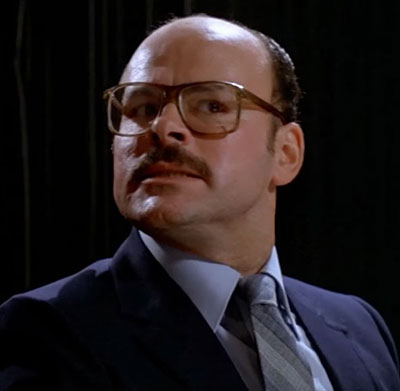
Japanese Samurai, 1866. Photograph by Felice Beato
By the time this photograph was taken, the samurai were already living on borrowed time.
This is Japan in 1866, a country balanced on the edge of a transformation so total that it would erase a social class that had dominated its history for nearly seven centuries. The man in the image still carries the outward symbols of authority: the swords, the posture, the clothing that marks him as a warrior of rank. But the world that gave those symbols meaning is collapsing quietly beneath his feet.
For most of Japanese history, the samurai were not just fighters. They were administrators, tax collectors, local enforcers of order, and living embodiments of loyalty to a lord. Their power rested on a rigid social hierarchy enforced by violence when necessary and tradition always. The sword was not decoration—it was a legal instrument. Only samurai could carry it. Only samurai had the sanctioned right to kill in the name of order.
But by the mid-19th century, that order was rotting from the inside.
Japan had been officially isolated from the outside world for over two hundred years, ruled by the Tokugawa shogunate, a military government that valued stability above all else. Peace had lasted so long that many samurai no longer fought wars; they managed rice stipends, settled disputes, and studied philosophy. The warrior class became bureaucratic, while still clinging to the mythology of martial honor.
Then the outside world arrived—suddenly and violently.
In 1853, American warships forced Japan to open its ports. The shock was existential. Western powers had steamships, modern artillery, industrial economies, and global empires. Japan’s feudal system, frozen in time, was no match. The shogunate’s authority cracked as domains argued over how to respond: resist and risk annihilation, or modernize and abandon centuries of tradition.
By 1866, Japan was in a state of near civil war.
This samurai stands in that moment of uncertainty. He still carries two swords—the daishō—the visible proof of his caste. But firearms are already reshaping warfare. Armies trained and equipped along Western lines are forming. Loyalty is shifting away from feudal lords toward the emperor, a figure who had been politically sidelined for generations but was about to be restored as the center of power.
What makes the image haunting is not the weaponry, but the expression.
This is not a triumphant warrior. It is a man aware that the ground beneath him is moving. The sword at his side represents a way of life that is becoming impractical, even dangerous to cling to. Within a few years, the samurai class would be legally abolished. Stipends would be ended. The right to carry swords in public would be revoked. Some samurai would adapt—becoming officers, civil servants, or industrialists. Others would rebel, fighting doomed uprisings against the modern state they helped create.
The photograph itself is part of the transformation.
Felice Beato, the photographer, was a foreign observer documenting a Japan that was rapidly disappearing. Photography was new, imported, and symbolic of the modern world pressing in. This image freezes the samurai not as myth or legend, but as a human being caught at the end of an era. Not a battlefield death. Not a dramatic last stand. Just a quiet moment before history moves on without asking permission.
Within two years, the Meiji Restoration would begin in earnest. Japan would industrialize at a pace that stunned the world. The samurai would become an idea rather than a class—romanticized, memorialized, and selectively remembered.
This photograph is not about glory. It’s about transition. It captures the final years of a warrior elite whose power was built for a world that no longer existed, standing calmly, sword in hand, as history prepares to render him obsolete.
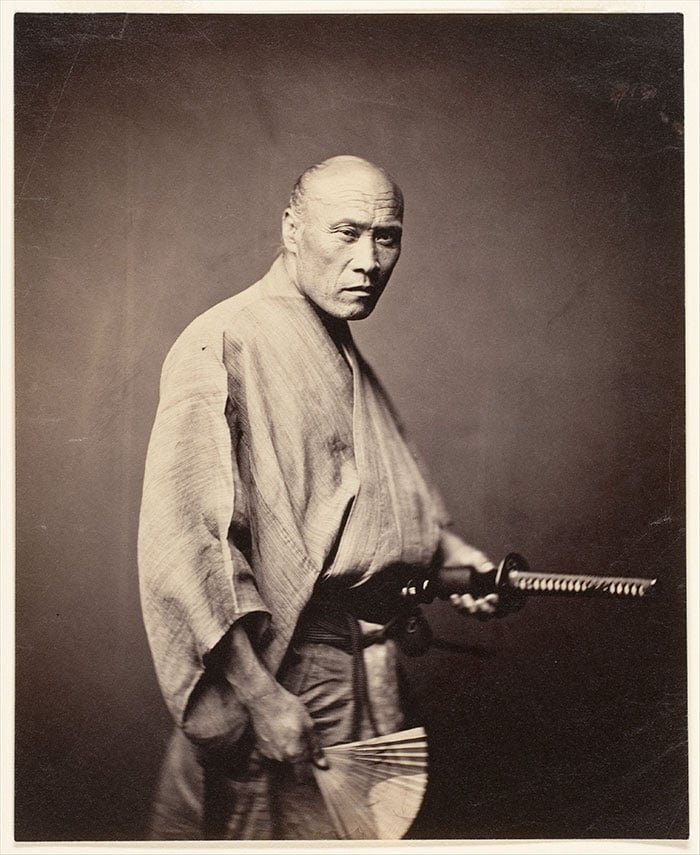
Jewish prisoners after being liberated from a death train, 1945
The train did not arrive anywhere it was supposed to.
It sat half-embedded in the countryside, cars streaked with soot and rust, doors yawning open like broken teeth. What remained inside was not cargo in any normal sense—no inventory, no manifest that could explain the human arithmetic that had taken place here. This was a death train that had outlived its purpose. The system that launched it had collapsed faster than it could finish the job.
The people spilling out of the cars looked less like survivors than evidence.
They moved with the urgency of prey that hasn’t yet learned the hunter is gone. Some ran. Some stumbled. Some clutched children who were too light for their age, whose weight had been negotiated away day by day, calorie by calorie. Clothing hung loosely, not because it was oversized, but because the bodies inside had been reduced to what could still move. Faces carried the same expression you see on soldiers just after an artillery barrage—shock mixed with disbelief, as if the world had malfunctioned.
The woman in front is not celebrating. She is fleeing. Her grip on the child’s hand is tight in the way people hold onto reality when they’re not convinced it’s real. Behind her, others fan out across the embankment, spreading instinctively, like people escaping a burning building even though the flames have already gone out. The train still looms behind them, metal and immobile, but its power hasn’t expired yet—not in their minds.
That’s the thing about systems like this: they don’t end cleanly.
The death train was part of an industrial process. Not chaos. Not rage. Process. Timetables. Rail lines. Paperwork. Decisions made far away by men who would never see this hillside or these faces. When the war began to collapse inward on itself, the machinery didn’t stop—it just broke down in pieces. Guards fled. Orders went unanswered. Trains stalled. And in those gaps, people like this emerged, not freed so much as abandoned by the mechanism designed to erase them.
Liberation is too neat a word.
These people were not stepping into safety. They were stepping into uncertainty without a map. Many had no homes to return to, no families to look for, no language for what had been done to them. Some had been in motion for weeks, shuttled from camp to camp as front lines shifted, fed just enough to stay alive and just little enough to weaken resistance. Survival here was not a triumph—it was a statistical anomaly.
Look closely and you’ll notice something unsettling: no one is looking back at the train.
That’s not because it doesn’t matter anymore. It’s because they already know exactly what it represents. You don’t stare at the mouth of something that nearly consumed you. You get distance. You put space between yourself and the thing that almost worked.
By 1945, the world was littered with moments like this—places where the machinery of mass death failed not because it was challenged morally, but because it ran out of time. The people who stepped out of those failures carried with them the physical proof of what the system had been capable of when it functioned properly.
This photograph captures the awkward pause between catastrophe and comprehension. The war is ending. The killing apparatus is breaking apart. But the human cost is already sunk. No announcement, no ceremony, no flag can reverse the math that led to this hillside and this moment of frantic motion away from a train that was never meant to stop.
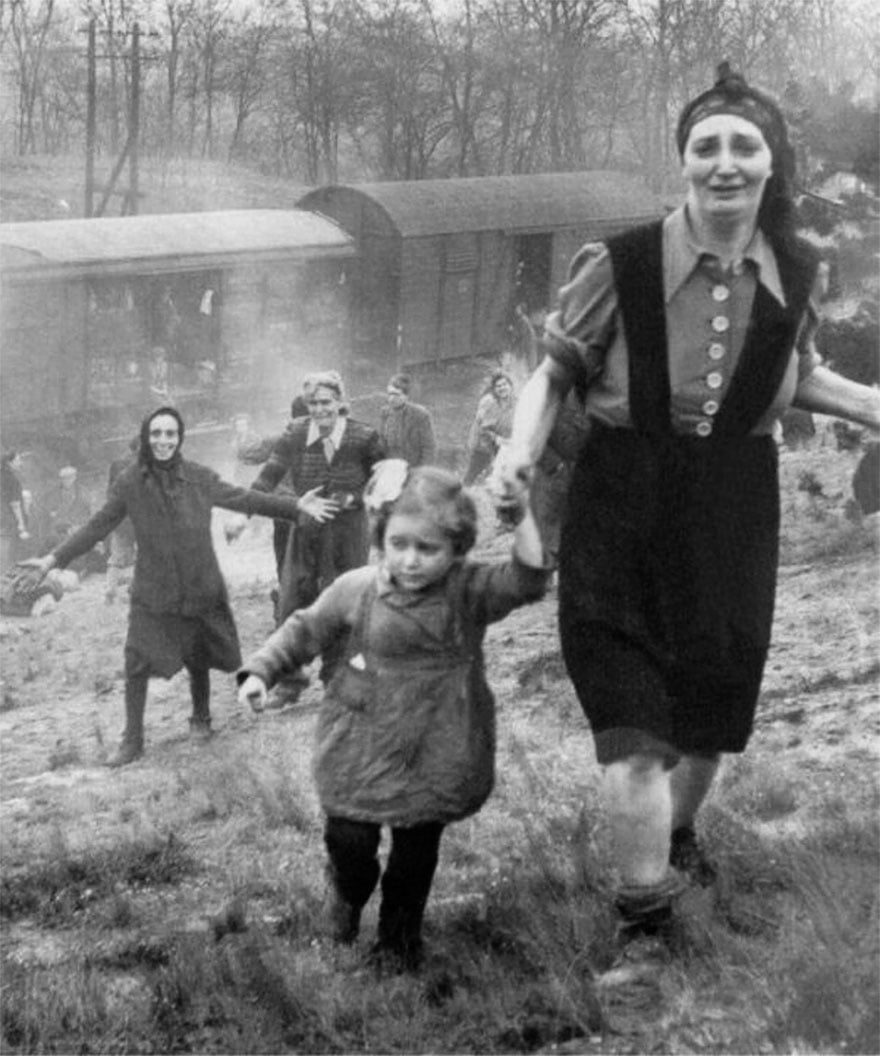
Soviet Soldier in a parade in Moscow, 1940
The uniform is immaculate. The formation is perfect. The message of the parade is confidence.
The face says something else.
This is Moscow, 1940—months before the world the Soviet Union thinks it understands is about to shatter. The soldier stands at attention, rifle vertical, bayonet fixed, part of a machine designed to project certainty. The state is strong. The army is disciplined. History is under control.
And yet the expression betrays the script.
He looks worried. Not panicked. Not afraid in the obvious sense. But tight. Alert. Like someone who knows more is coming and suspects it won’t be clean or glorious. His eyes don’t have the glazed enthusiasm of propaganda posters. They’re focused, inward, almost calculating. This isn’t a man swept up in spectacle. This is someone doing exactly what he’s told while quietly measuring the cost.
That tension matters.
Because by 1940, the Soviet Union had every reason to be uneasy. The purges were still fresh—officers disappeared overnight, commands rewritten after the fact, loyalty constantly tested. Everyone marching in this parade knew that survival depended not just on bravery, but on staying aligned with shifting political gravity. You could do everything right and still vanish.
Now add what was happening beyond Red Square.
Germany had already demonstrated what modern war looked like—speed, coordination, annihilation. Poland was gone. France was wobbling. Officially, the Soviet Union had bought itself time. Unofficially, everyone knew time was the only thing separating them from catastrophe.
So this soldier stands there, rifle polished, boots aligned, representing a system that values appearance and mass above individual insight. But his face suggests awareness. Maybe he’s thinking about where this parade leads. Maybe he’s thinking about how many of the men beside him won’t be standing a year from now. Maybe he understands—without being able to articulate it—that no amount of symmetry can prevent what’s coming.
That’s what makes the image unsettling.
This is not the face of ideological fervor. It’s the face of someone trapped between obedience and intuition. He knows the role he’s playing. He also knows that roles don’t stop bullets, hunger, or winter.
In hindsight, that worried look feels almost prophetic. Within months, the Soviet Army would absorb losses on a scale that defies comprehension. Entire formations erased. Cities encircled. Soldiers like this one forced to learn war not as a parade, but as survival stripped to its rawest form.
The photograph freezes a moment when the state is still pretending everything is under control—and one soldier seems unconvinced.
Couples rush to secure a marriage license and get married in Las Vegas, ahead of Executive Order 11241 taking effect, which eliminated the draft exception for married men. August 26, 1965.
On August 26, 1965, President Lyndon B. Johnson signed Executive Order 11241, which terminated the marriage deferment. President Johnson’s executive order made it so that childless men who were married after August 26, 1965 would be considered the same as single men when selecting and ordering registrants to report for induction. A new group (Group 4) consisted of childless men who were married on or before August 26, 1965; these men would be selected next, after the supply of delinquents, volunteers, and single nonvolunteers and nonvolunteers who married after August 26, 1965 had been exhausted.
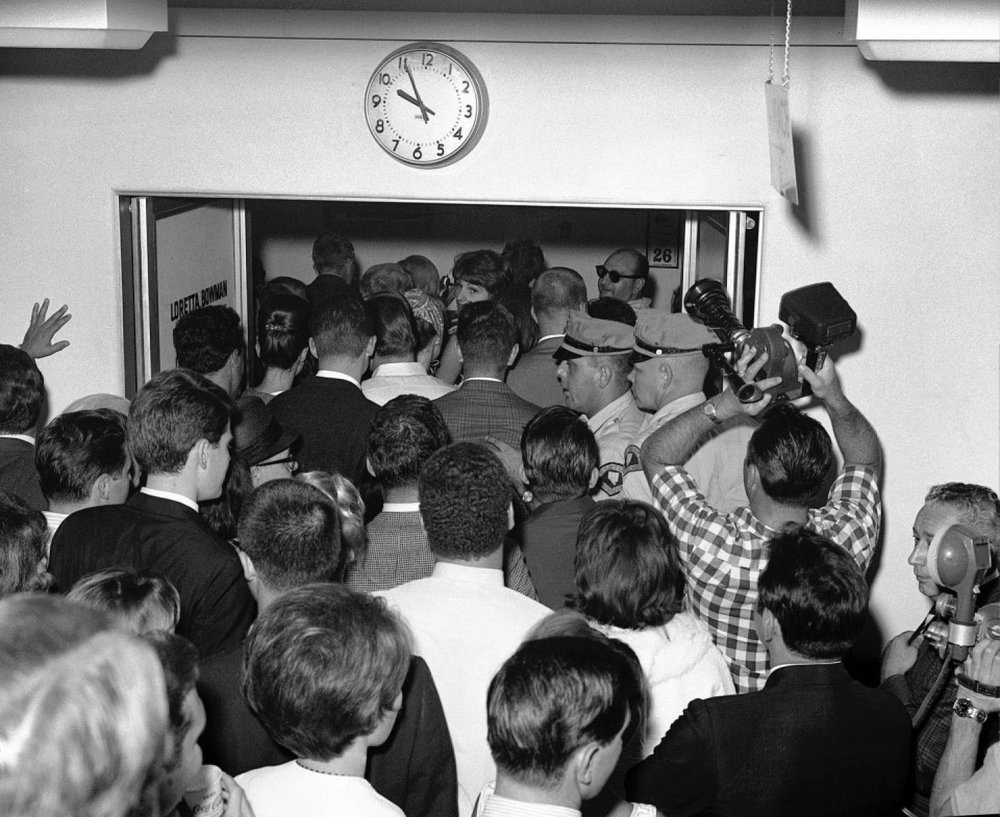
History sometimes turns on paperwork.
Not speeches. Not battles. Not sweeping moral reckonings. Paperwork. A signature. A line of text that quietly rewrites the rules of who is safe and who is not.
In late August of 1965, that line was about to be crossed.
For years, marriage had functioned as a kind of legal shield in the American draft system. If you were married, especially with children, the chances of being sent to Vietnam dropped dramatically. It wasn’t advertised as mercy, but that’s how it worked in practice. The war was expanding. Casualties were rising. And the Selective Service system needed bodies. Marriage had become, unintentionally, a loophole.
Then came Executive Order 11241.
Signed by President Lyndon Johnson, it eliminated the automatic draft deferment for married men. The message was blunt, even if the language was bureaucratic: marriage would no longer save you. The war required everyone. Love was no longer a defense.
Word spread fast.
In Las Vegas—already America’s capital of speed and convenience—couples rushed the system. Courthouses filled. Chapels ran late. People who had been “planning to get married someday” suddenly needed it to happen now. Not because of romance, not because of vows, but because the clock was running out. Midnight was coming, and with it, eligibility for a jungle half a world away.
The atmosphere wasn’t celebratory. It was transactional.
These weren’t honeymoons; they were calculations. If we do this today, maybe I don’t go. If we wait, maybe I do. The wedding photos from this period don’t look like joy—they look like urgency. Young men in pressed shirts. Women holding purses instead of bouquets. Clerks stamping forms while the radio carried news from Southeast Asia.
This is how mass mobilization really works.
Not with flags waving, but with ordinary people reacting to rule changes they didn’t vote on and can’t stop. The draft wasn’t an abstraction. It was a letter in the mailbox. A number pulled from a bowl. A future narrowed down to a single question: Will this decision keep me alive?
And here’s the cruel irony—many of these marriages didn’t even work as intended.
Executive Order 11241 didn’t stop the draft. It just closed one door. Married men were still called. Some went anyway. Some delayed the inevitable by months. Some married people they barely knew, under pressure that had nothing to do with compatibility and everything to do with survival.
The war didn’t care.
This moment captures the collision between private life and state power. Love, commitment, tradition—all of it suddenly subordinated to manpower requirements. The government wasn’t telling people not to marry. It was telling them that marriage no longer mattered in the one way they needed it to.
By the end of 1965, hundreds of thousands of American troops were in Vietnam. The system had been “corrected.” The loophole closed. And the couples who rushed through Las Vegas chapels became a footnote in the logistics of war—evidence that even in a modern democracy, large conflicts don’t just reshape borders. They reach into relationships, timing, and the most personal decisions people make.
This wasn’t about romance.
It was about trying to outrun a war with a marriage license—and discovering that history usually moves faster.
Bagpipers were usually the first ones out of the trenches when it was time to fight; playing as they lead the soldiers into each battle 1910s
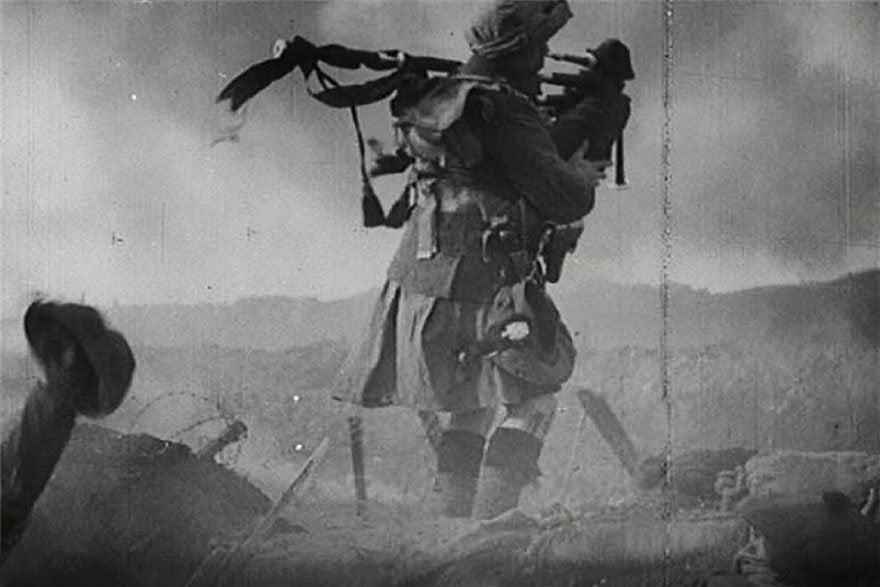
When the order came to go over the top, the first sound was not gunfire.
It was music.
In the trench warfare of the 1910s—particularly among Scottish regiments—the bagpiper often climbed out first. Not with a rifle. Not with grenades. But with an instrument slung over his shoulder, pipes already screaming into the smoke. As whistles blew and ladders went up, the piper stepped into open ground and began to play.
From a modern perspective, this borders on the absurd. Machine guns were cutting men down by the thousands. Artillery had turned battlefields into lunar landscapes. Survival depended on keeping your head low, minimizing movement, avoiding attention.
And yet the piper did the opposite.
The role was not symbolic in some vague, romantic sense. It was deliberate. The pipes were meant to be heard over chaos—to cut through explosions, screams, and confusion. They provided rhythm and direction when officers were killed and formations disintegrated. In a world where visual signals were useless and shouted commands vanished into noise, music became a tool of command.
More than that, it was psychological warfare—aimed at both sides.
For the soldiers advancing behind the piper, the sound anchored them. It connected the present moment to tradition, identity, home. These were not anonymous conscripts rushing into slaughter; they were members of a regiment with history, songs, and shared memory. The pipes reminded them who they were supposed to be while doing something almost no one could psychologically endure.
For the enemy, it was unsettling.
Imagine being in a trench, exhausted, terrified, and hearing bagpipes rise out of the fog. Not shouts. Not bugles. Music. It signaled that an attack was coming—and that the men advancing were willing to announce themselves as they did it. It suggested a kind of defiance that felt irrational, even in a war already stripped of reason.
Pipers were obvious targets.
They were unarmed. Highly visible. Loud. Many were killed within seconds. Casualty rates among regimental pipers were brutal, and everyone involved understood that volunteering for the role was, statistically speaking, a bad idea. But the position persisted. Commanders requested pipers. Units demanded them. Men stepped forward anyway.
That tells you something important about how humans fight wars.
World War I was an industrial catastrophe—impersonal, mechanical, optimized for mass death. And yet, inside that system, armies still relied on ancient ideas about courage, ritual, and morale. The bagpiper was a relic of earlier warfare, dropped into a conflict defined by machines. He didn’t make tactical sense. He made human sense.
Even as the war dragged on and tactics evolved, the image endured: a lone figure standing upright in no-man’s-land, music spilling out as bullets snapped past. Not because it improved the odds—but because it gave meaning to something otherwise unbearable.
Later wars would erase roles like this. Radios replaced music. Firepower replaced spectacle. Command and control became quieter, more efficient, more lethal.
But for a time, in the mud and wire of the 1910s, armies sent musicians into hell first—not to fight, but to remind the men following them that they were still human while history tried very hard to prove otherwise.