Handling serpents at the Pentecostal Church of God. Kentucky. Photo by Russell Lee. 1946
-by-Russell-Lee-NARA-541335.webp)
This remarkable photograph by Russell Lee shows worshippers handling snakes during a service at the Pentecostal Church of God in Lejunior, a coal-mining community in Harlan County, Kentucky. Lee encountered the church while documenting American coal communities, preserving a rare view of a religious tradition that had taken root in parts of Appalachia.
Serpent handling emerged among a small number of Holiness and Pentecostal churches in the Appalachian South during the early twentieth century. Practitioners based the ritual primarily on a passage in the Gospel of Mark describing believers taking up serpents without harm. For these congregations, handling a venomous snake was not entertainment or a test of bravery. It was understood as an act of faith performed when worshippers believed they were moved by the Holy Spirit.
The practice became particularly associated with isolated communities in Kentucky, Tennessee, West Virginia, Virginia, and neighboring states. These were places where Pentecostal worship could be intensely physical and emotional, incorporating spontaneous preaching, healing, speaking in tongues, music, shouting, and other expressions of religious experience.
The setting of Lee’s photograph is important. Harlan County was coal country, and life there could be brutally dangerous. Miners descended underground knowing that explosions, collapsing roofs, machinery, and disease could kill or disable them. The region had also endured bitter labor conflicts and severe poverty. Most members of this congregation were miners and their families, making the church an important center of community life.
Lee photographed the scene as part of a much larger effort to document American mining communities. Rather than focusing only on the unusual ritual, he also photographed company towns, miners’ homes, workplaces, and families. His work placed serpent handling within the broader story of Appalachian life instead of treating it as a curiosity.
Residents of Japanese ancestry registering for evacuation and housing, later, in War Relocation Authority centers for duration of the war, 1942
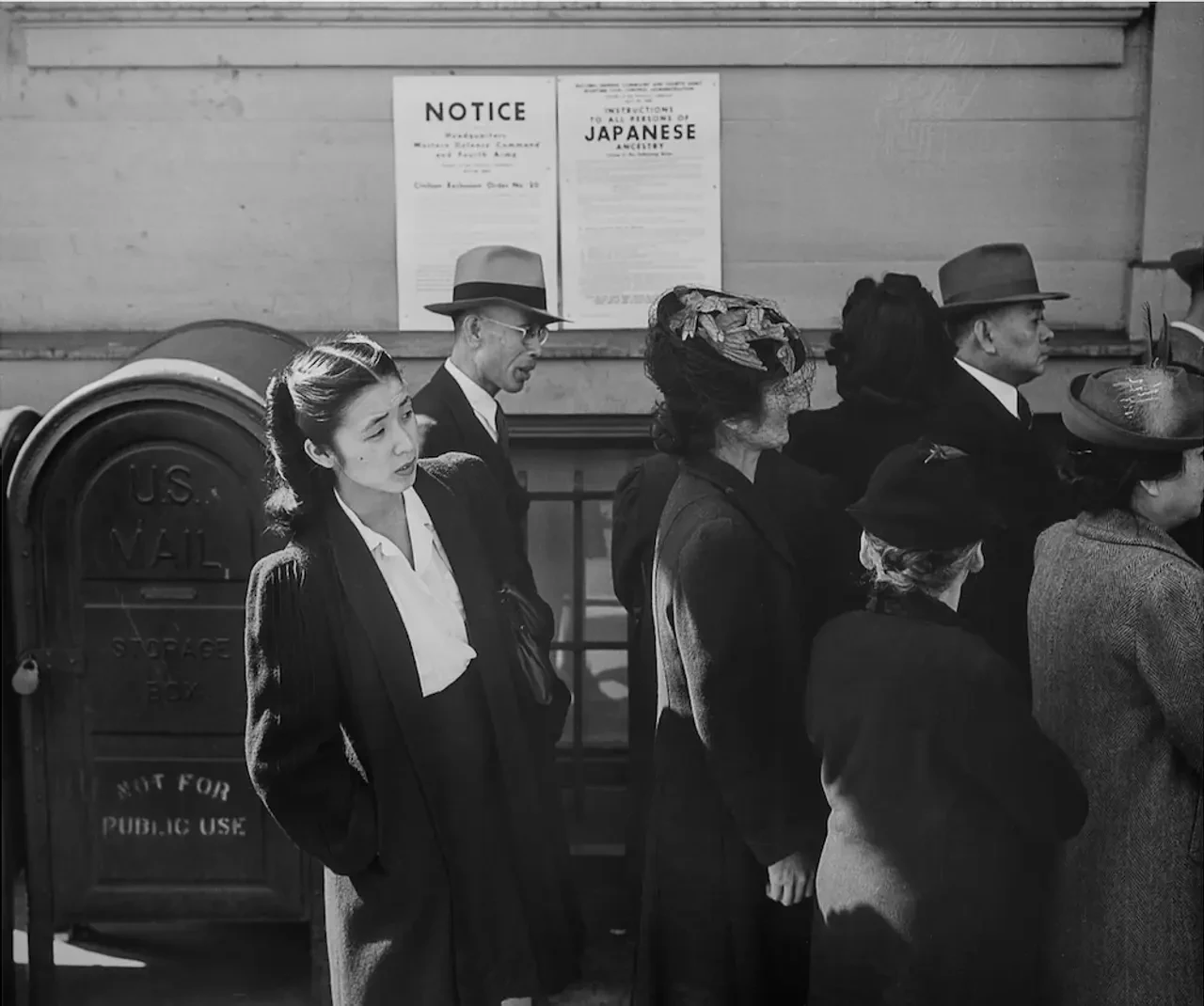
In the spring of 1942, thousands of Americans of Japanese ancestry found themselves standing in lines unlike any they had ever imagined. They weren’t registering to vote or applying for work. They were reporting to authorities so the government could decide where they would spend the rest of the war. Families arrived carrying identification papers and whatever belongings they could manage while officials recorded names, ages, and occupations. The paperwork looked orderly, but beneath every form was the same reality: citizens and legal residents were preparing to surrender their freedom.
The attack on Pearl Harbor had shattered America’s sense of security only months earlier. Fear spread rapidly along the West Coast, fueled by rumors of espionage and invasion. Military leaders argued that removing everyone of Japanese ancestry from key coastal areas was necessary for national defense. It made little difference whether someone had immigrated from Japan decades earlier or had been born in California. Ancestry alone became grounds for suspicion.
The registration process was methodical. Government workers assigned family numbers and organized transportation. Families were told what they could bring and what had to be left behind. Businesses built over decades were sold for a fraction of their value, farms were abandoned, and homes were locked with no guarantee they would still be there after the war. The forms reduced entire lives into administrative records while ignoring everything being lost.
Entire communities disappeared almost overnight. Neighbors watched familiar families board buses carrying numbered luggage instead of suitcases. Schoolchildren left classrooms without knowing if they would ever return. Churches and local organizations tried to safeguard belongings, but there was only so much they could do. Ordinary American neighborhoods were suddenly marked by absence.
The first destinations were temporary assembly centers at racetracks, fairgrounds, and livestock facilities. Families often lived in converted horse stalls or crude barracks with little privacy. Dust, overcrowding, and long lines became part of everyday life while larger camps were built farther inland.
Eventually, most evacuees were sent to ten War Relocation Authority camps scattered across remote deserts and plains. Rows of identical barracks, barbed wire fences, and armed guard towers surrounded communities whose residents had never been convicted of a crime. The camps were designed for efficiency, not comfort.
Despite the circumstances, life continued. Schools reopened, newspapers were printed, gardens were planted, and sports leagues formed. Parents worked to create a sense of normalcy for their children even though fences and guard towers were constant reminders that they were not free.
The government’s justification rested on military necessity, yet later research found no evidence of widespread espionage by Japanese Americans on the West Coast. German Americans and Italian Americans faced wartime restrictions, but neither group experienced mass incarceration on the same scale. The policy demonstrated how fear can reshape constitutional rights during a national crisis.
While many families remained behind barbed wire, thousands of young Japanese American men volunteered or were drafted into the U.S. military. Units like the 442nd Regimental Combat Team became among the most decorated in American history, creating the remarkable contradiction of soldiers fighting for a nation that continued to imprison their families.
When the camps closed after the war, freedom could not restore what had been lost. Many families returned to find homes, businesses, and livelihoods gone. Decades later, the United States formally apologized through the Civil Liberties Act of 1988 and provided compensation to surviving internees. The registration photographs from 1942 endure because they capture ordinary Americans complying with extraordinary orders they had little power to refuse.
“Five Cent a Spot” Unauthorized Lodgings in a Bayard Street Tenement, New York City 1889.
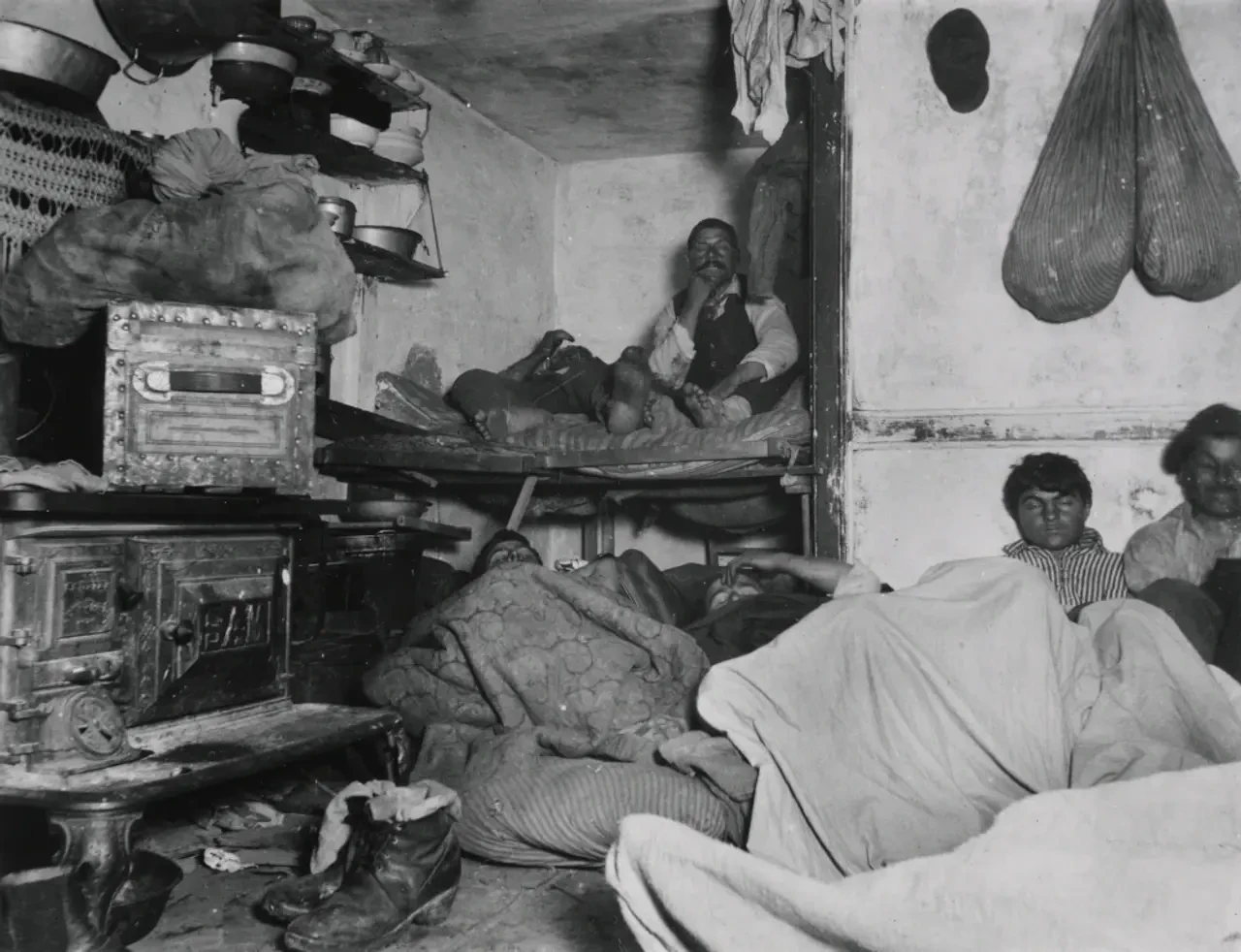
Taken by journalist and photographer Jacob Riis around 1889, “Five Cent a Spot” captures one of the harshest realities of life in New York City’s Lower East Side during the Gilded Age. The room wasn’t a legal boarding house or apartment. It was an unauthorized lodging where people paid just five cents a night for a place to sleep on the floor or crude wooden platforms. Riis later included the photograph in his groundbreaking 1890 book How the Other Half Lives, which exposed the conditions endured by the city’s working poor.
By the late 1800s, New York was absorbing millions of immigrants from Europe. Most settled in neighborhoods like the Lower East Side, where housing was scarce and wages were low. Tenement owners often squeezed every possible dollar from their buildings by illegally renting out overcrowded rooms, hallways, and storage spaces as sleeping quarters.
The phrase “five cents a spot” referred to renting nothing more than a place to lie down for the night. There were no private rooms, proper beds, or ventilation. Riis reported that this particular lodging house violated city regulations by packing far too many people into a single room. Authorities occasionally raided these places, but many reopened because demand was so high.
The photograph shows how every inch of space was used. Mattresses cover rough wooden platforms, people sleep on the floor, shelves are crammed with cookware, and a small stove provides heat for everyone. It wasn’t just a bedroom—it was a kitchen, storage room, and living space for multiple people at once.
Riis was able to capture scenes like this using the new technology of magnesium flash powder. Most tenement rooms were nearly dark, making photography impossible without artificial light. His photographs revealed living conditions that many middle- and upper-class New Yorkers had never seen.
When How the Other Half Lives was published in 1890, it shocked readers and became a catalyst for reform. The images helped convince the public that overcrowded tenements were not simply the result of poverty, but also of weak housing laws and exploitative landlords.
Public pressure eventually led to stricter housing regulations requiring better ventilation, fire safety, sanitation, and access to light. While the reforms did not eliminate poverty, they dramatically improved living conditions and changed how cities approached public health and housing.
A family on their porch during the Great Depression in the United States. Alabama. 1936
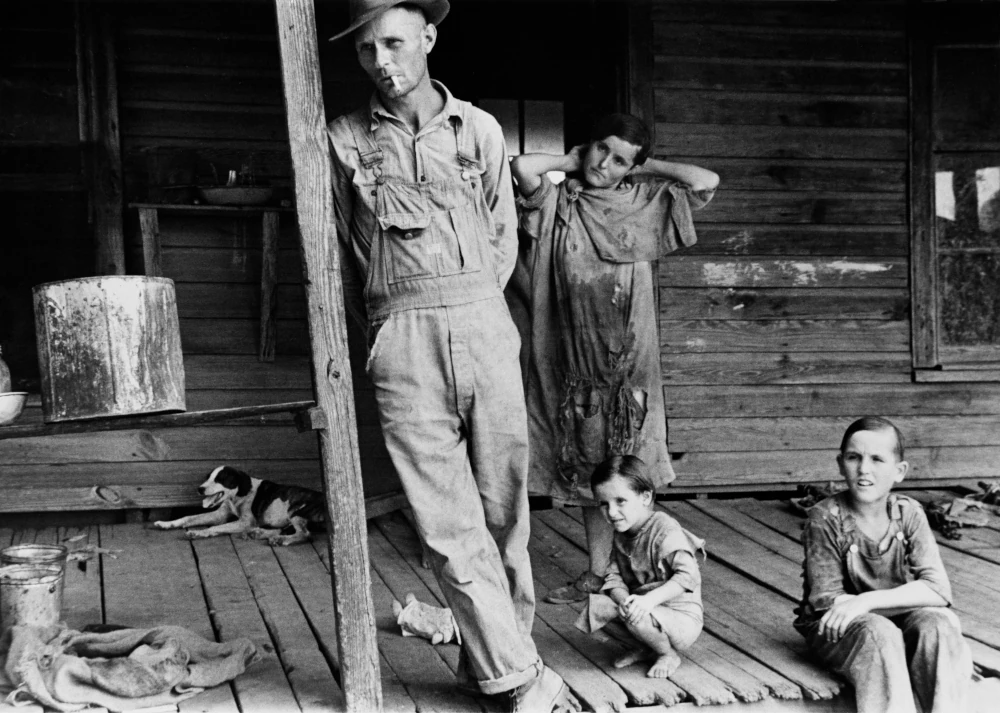
This photograph, taken by Walker Evans during the Great Depression, captures an ordinary American family standing on the porch of their home in the rural South. Created for the Farm Security Administration (FSA) in the mid-1930s, images like this were intended to document the devastating economic hardship affecting millions of Americans. Rather than stage dramatic scenes, Evans focused on quiet, everyday moments that revealed the resilience and dignity of people struggling through one of the nation’s darkest periods.
The Great Depression began with the stock market crash of 1929, but for many rural families, hardship had already been a way of life. Falling crop prices, mounting debt, and years of poor harvests pushed countless farmers into poverty. By the mid-1930s, unemployment nationwide had reached nearly 25 percent, and many families survived only through subsistence farming, odd jobs, or government relief programs.
Walker Evans was hired by the Farm Security Administration, a New Deal agency created to combat rural poverty. The FSA sent photographers across the country to document conditions in farming communities, believing that powerful photographs could help Americans understand the scale of the crisis and build support for relief efforts. Evans became one of the program’s most influential photographers, alongside Dorothea Lange, Arthur Rothstein, and Russell Lee.
Unlike many documentary photographers, Evans rarely asked his subjects to smile or pose dramatically. His style was straightforward and unsentimental. In this image, the family’s worn clothing, bare feet, weathered porch, and simple wooden home tell the story without exaggeration. The father’s tired expression and the children’s quiet curiosity speak to lives shaped by constant uncertainty.
Although the photograph reflects poverty, it also captures endurance. Families like this often stayed together despite enormous financial pressure, growing their own food, repairing what they owned, and relying on neighbors and extended family to survive. They had few possessions, but they continued raising children and maintaining their homes as best they could.
Photographs like this became some of the defining images of the Great Depression. They helped transform statistics about unemployment and poverty into human stories that Americans could see and understand. Today, Walker Evans’ work remains one of the most important visual records of the era, preserving the faces of ordinary people whose quiet perseverance carried them through extraordinary hardship.
The Journey to America, Ellis Island, 1905
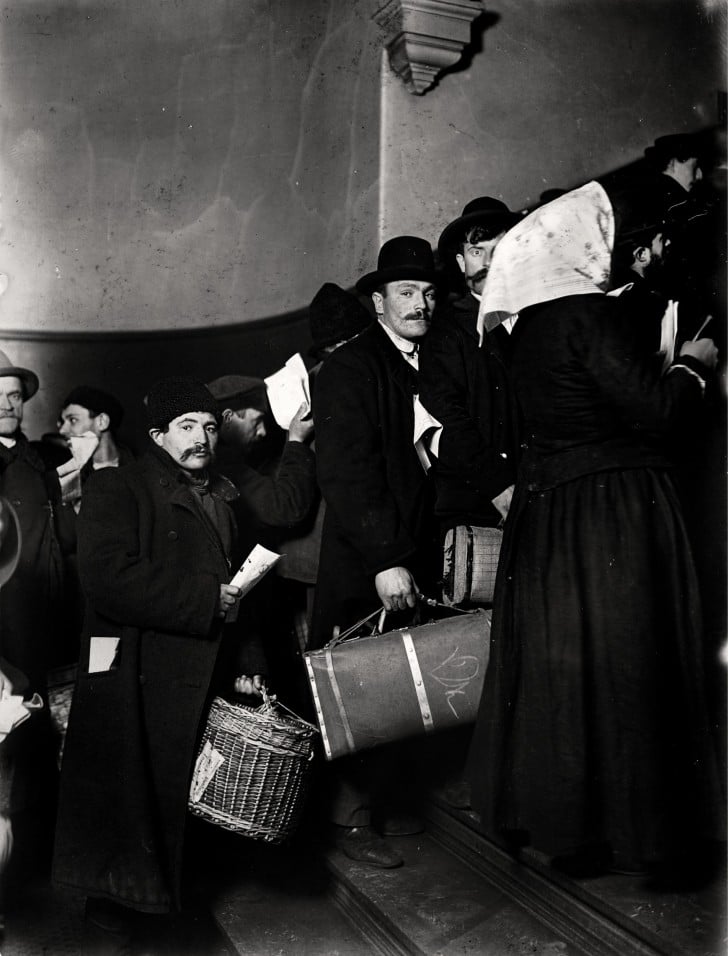
Taken in 1905 by photographer Lewis Hine, this photograph captures a moment experienced by millions of immigrants arriving in the United States through Ellis Island. Suitcases, baskets, and bundles fill the frame, carrying nearly everything these travelers owned. Their faces reveal a mixture of exhaustion, uncertainty, and hope as they wait to complete the final steps before entering a country they believed could offer a better life.
Between 1892 and 1954, more than 12 million immigrants passed through Ellis Island, making it the busiest immigration station in American history. Most came from Southern and Eastern Europe, fleeing poverty, political unrest, religious persecution, or a lack of economic opportunity. For many, the voyage across the Atlantic lasted weeks in crowded steerage compartments, where conditions were often cramped and unsanitary.
Arrival at Ellis Island marked the end of one journey but the beginning of another. Immigrants underwent medical inspections and legal interviews to determine whether they could enter the country. Doctors watched for signs of contagious diseases, while inspectors questioned newcomers about their health, occupations, finances, and whether they had family waiting in America. Most completed the process in just a few hours, though some faced additional examinations or deportation.
Lewis Hine understood that immigration was more than a political issue—it was a human story. Rather than photographing anonymous crowds, he focused on individuals and families, allowing viewers to see the people behind the statistics. His images emphasized dignity and resilience, documenting immigrants not as strangers, but as future Americans beginning new lives.
Many who passed through Ellis Island settled in cities like New York, Chicago, Boston, and Philadelphia, where they found work in factories, construction, garment shops, and small businesses. Their labor helped fuel America’s rapid industrial growth during the early twentieth century, while their cultures, languages, and traditions permanently reshaped the nation’s identity.