
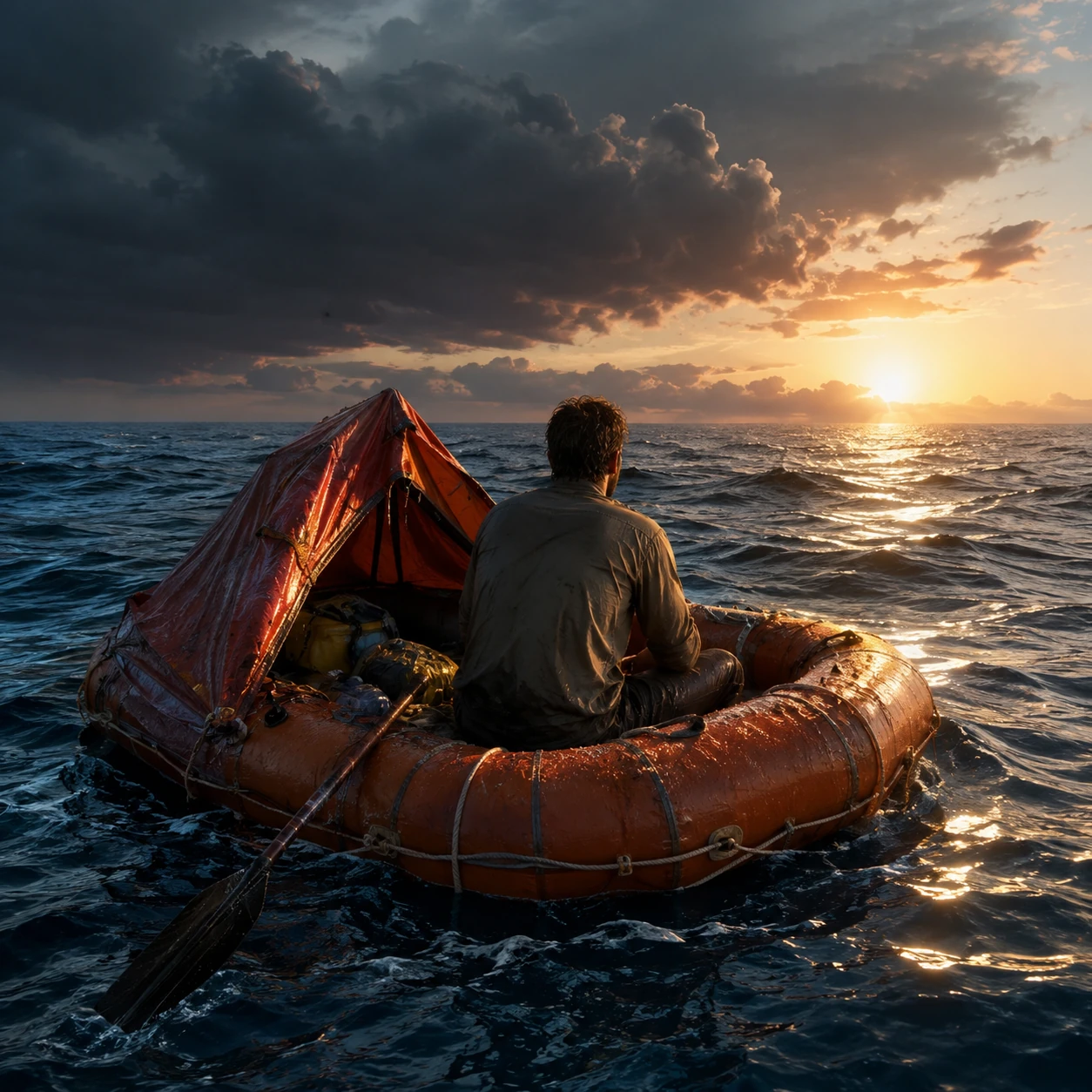
Your boat goes down about forty miles offshore, and you make it into a six-person life raft, alone. Search and rescue knows the boat is missing, but not where you are.
You have a little water, some basic equipment, and roughly three days before the weather turns. Every hour brings a new decision, and the ocean is unforgiving of the wrong ones.
Each scenario is a real choice, in the order you’d face it. Pick what you think keeps you alive until rescue comes—and find out whether you’d have lasted the seventy-two hours.
Lost at Sea
Hour 1. You have six 500 mL bottles of water. It's 88°F, sunny, and you're already thirsty. What's your water strategy?
Hour 3. There's almost no wind. Your GPS is gone, but you think land is about 40 miles west. Your raft has paddles. What do you do?
Hour 8. You notice a slow leak in one section of the inflatable raft. It's still holding air but gradually getting softer over time. What's the right first response?
Hour 14. Clouds gather and rain looks possible. You have about 2 liters of fresh water left. What's your move?
Hour 20. You spot what looks like a ship near the horizon. You have three handheld flares and a signaling mirror. Visibility is good. What do you use first?
Hour 27. You're wet and shivering slightly. The air has dropped to 65°F. The seawater is 70°F. What's the best strategy?
Hour 35. You haven't eaten since the accident. Your kit has 2,000 calories of food. You're hungry but functioning fine. What do you do?
Hour 44. A large wave flips the raft. You're in your life jacket and surface beside the overturned raft, exhausted. What do you prioritize?
Hour 55. You spot an aircraft in the distance. You can't tell if it's part of the search. You have one flare, a mirror, and a whistle. What do you do?
Hour 68. You see land, maybe 5 to 8 miles off. You're exhausted and mildly dehydrated. The raft is drifting roughly parallel to shore. You have one paddle, about 500 mL of water, and no idea when rescue will come. What do you do?