There was a time, not terribly long ago, when you could leave your house and nobody knew where you were.
Think about that.
You could walk out the front door at nine in the morning, disappear for six hours, and return at three carrying a bag of Doritos and absolutely no explanation of your movements. Your mother might ask where you’d been, but this was more conversational than forensic. There was no little blue dot traveling suspiciously across a map.
You had simply been out.
This was one of the defining characteristics of life before the internet: enormous portions of the day were conducted on faith.
Suppose you arranged to meet a friend outside a movie theater at 7:00.
You arrived at 7:00.
Your friend did not.
And that was it. You had now entered one of the great informational voids of the twentieth century.
Was he coming? Had he forgotten? Was he standing outside a different theater? Had his car broken down? Had he been abducted by circus performers?
There was no way to know.
You stood there.
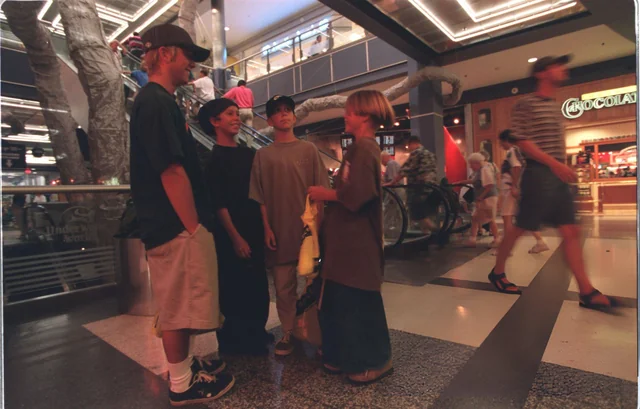
People were exceptionally good at standing around in those days.
Eventually, at perhaps 7:17, your friend would come jogging around the corner shouting something about his mother needing the car, and instead of demanding documentary evidence, you accepted this and went inside.
Getting somewhere unfamiliar required another vanished skill: following directions given by another human being.
These directions were almost always terrible.
“Go about three miles until you see a gas station that used to be a Texaco. Turn left where the old Kmart was.”
The fact that neither the Texaco nor the Kmart existed anymore apparently did not diminish their usefulness as landmarks.
If you missed a turn, there was no calm electronic woman saying, “Recalculating.”
You were simply lost.
You might remain lost for quite some time.
Eventually you pulled into a gas station, where a man named Earl would emerge from beneath a Buick and give you an entirely new set of directions involving a water tower, two stop signs, and “the Henderson place.”
Remarkably, civilization functioned this way.
Finding information was equally adventurous.
Today, if you suddenly wonder who played the father on ALF, you can know within seconds. Before the internet, this was not considered information you had a constitutional right to possess immediately.
You wondered.
Sometimes for years.
Arguments could therefore last indefinitely.
One person would say, “I’m telling you, Casablanca came out in 1943.”
Another would say, “No, it was 1942.”
And unless someone happened to own an encyclopedia containing an unusually detailed entry on Humphrey Bogart, that was where things remained.
There was no reaching into your pocket and ending the argument in twelve seconds.
You simply developed enemies.
The telephone was attached to your house, which seems almost comical now.
When you called somebody, you weren’t calling them. You were calling a building and hoping they happened to be inside it.
Worse, somebody else might answer.
If you were a thirteen year old boy calling a thirteen year old girl, this person would inevitably be her father.
“Hello?”
“Uh…is Jennifer there?”
“Who’s calling?”
This was the twentieth century equivalent of a border interrogation.
There was also usually only one telephone line for the entire family. If your sister was talking to her boyfriend, nobody else could communicate with the outside world.
Parents eventually developed a sophisticated network management protocol known as yelling:
“GET OFF THE PHONE!”
Entertainment required commitment.
Television programs appeared at a specific time, and if you wanted to watch one, you arranged your life accordingly.
If your favorite show came on Thursday at eight, Thursday at eight was when you watched it.
If you missed it, the television networks did not express concern.
There was no streaming service politely asking if you’d like to resume from 23:14.
You had missed it.
Perhaps you would see it again in July.
Movies required leaving the house. Music required owning physical objects. Photographs had to be taken to a store, where strangers developed them and returned them several days later in a paper envelope.
Only then did you discover that half your vacation pictures contained your father’s thumb.
Shopping was another activity involving a surprising amount of physical movement.
If you needed shoes, you went to a shoe store.
If the shoe store didn’t have your size, you went to another shoe store.
At no point did a pair of shoes materialize on your porch the following afternoon because you pressed a button while sitting on the toilet.
And yet there were advantages to all this inconvenience.
Waiting was built into life.
So was boredom.
You stood in lines without looking at anything. You sat in waiting rooms and stared at walls. You rode in cars and watched telephone poles go by. Children spent entire afternoons doing things that had no measurable purpose whatsoever.
Most importantly, when you left somewhere, you actually left it.
Work couldn’t follow you home in your pocket.
The news couldn’t refresh itself every thirty seconds.
Nobody you went to high school with could suddenly appear at breakfast to show you photographs of their vacation.
If someone said something stupid at a party, perhaps twelve people heard it.
By Monday, six had forgotten.
There was something wonderfully merciful about that.
None of this means life before the internet was better. In countless ways it wasn’t. Being lost is considerably less charming when you’re actually lost. Encyclopedias were expensive. Long distance telephone calls cost money. Finding an obscure book could require weeks. Keeping in touch with distant friends took genuine effort.
The internet solved thousands of problems so efficiently that we’ve forgotten they were ever problems.
But it also erased a peculiar kind of existence, one filled with unanswered questions, missed connections, uncertain directions, unavailable people, and long stretches in which absolutely nothing happened.
We were frequently inconvenienced.
We were occasionally bored out of our minds.
And somehow, without knowing anyone’s location, having access to all recorded human knowledge, or being able to order socks at 2:00 in the morning, we managed to get through the day.
Mostly by standing around and waiting for Kevin.