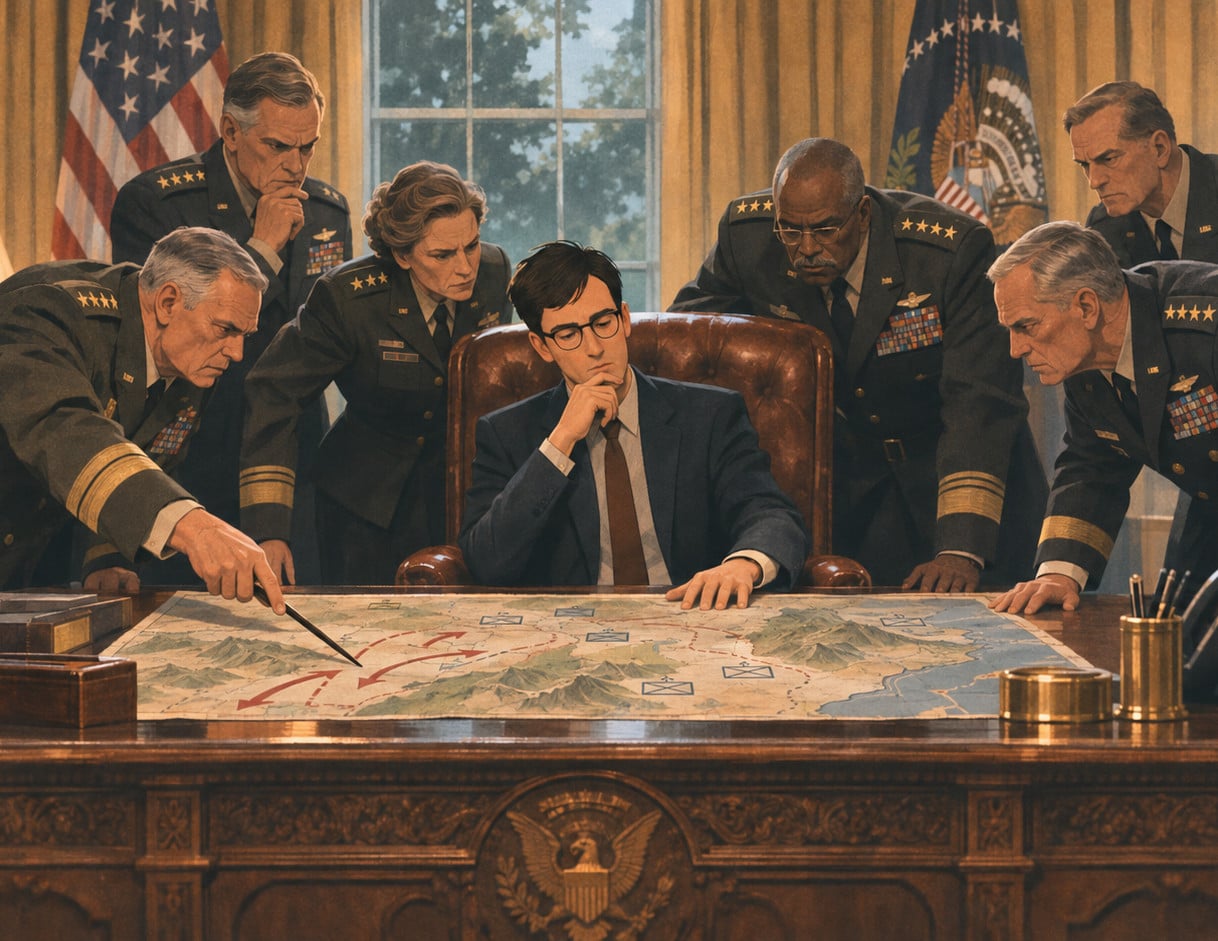
Imagine applying for a job in which you would oversee millions of military personnel, help decide whether your country goes to war, and have ultimate command over the most powerful armed forces on Earth.
Now imagine that the job requires absolutely no military experience whatsoever.
You don’t need to have commanded a battalion, studied military strategy, or even spent a single afternoon in boot camp. You could have spent your entire adult life selling real estate or practicing law, and you’d still be perfectly qualified, at least according to the United States Constitution.
This is, of course, the job of president.
Under Article II of the Constitution, the president is designated commander in chief of the armed forces. That means a civilian with no military background can give orders to four-star generals who have spent 40 years studying the business of warfare.
It seems a rather curious arrangement. But as it turns out, the people who designed the American government had a very good reason for it.
And that reason was fear.
The Founding Fathers Were Terrified of Armies
When the Constitution was written in 1787, the men gathered in Philadelphia had recently fought a revolution against a king whose military power they deeply resented.
They were particularly suspicious of standing armies, which are armies maintained even during peacetime. Throughout history, such forces had occasionally developed the unfortunate habit of turning their weapons on the very people they were supposed to protect.
The Founders understood that an army was necessary for defending a country. They also understood that giving professional soldiers too much political power was a splendid way to end up living under a dictatorship.
The solution was to make sure the military answered to civilian leadership.
And so they placed the armed forces under the command of the president, an elected official who was ultimately accountable to the public.
The important qualification wasn’t that the president knew how to fight a war. It was that the president derived political authority from the constitutional system rather than from control of an army.
But What If the President Knows Absolutely Nothing About Warfare?
This is where the arrangement gets interesting.
Suppose a president has never served in the military and couldn’t tell a destroyer from an aircraft carrier. Does that person really get to tell experienced generals what to do?
Yes.
But commanding the military doesn’t mean personally planning every battle.
A president doesn’t ordinarily decide where to position machine guns or which hill a platoon should occupy. Those decisions belong to military professionals who have spent their careers learning such things.
Instead, the president makes the larger decisions. What is the military trying to accomplish? Should American forces be deployed? What risks are acceptable? When should an operation end?
The generals then advise the president on how those objectives might be achieved, what resources would be required, and what could go wrong.
It’s rather like being the owner of an airline without knowing how to fly a Boeing 747. You may decide where the company operates and how much it spends, but you would be wise to leave the actual flying to someone who knows what all those little switches do.
Of course, the analogy has its limits. Airline executives don’t ordinarily have nuclear weapons at their disposal.
Even George Washington Didn’t Do Everything Himself
Interestingly, the first president had more military experience than most of his successors.
George Washington had commanded the Continental Army during the Revolutionary War and was familiar with the difficulties of keeping soldiers fed, equipped, and reasonably enthusiastic about being shot at.
Yet even Washington helped establish the tradition of civilian control.
During the Whiskey Rebellion of 1794, he personally accompanied militia forces responding to unrest in western Pennsylvania. It was an unusual display of presidential military leadership, and subsequent presidents generally left battlefield command to professional officers.
Over time, the distinction became clearer: the president would set the direction, while military leaders would manage the operations.
So Can the President Just Start Any War?
Not exactly.
The Founders were sufficiently suspicious of concentrated power that they divided military authority between the president and Congress.
The president commands the armed forces, but Congress has the constitutional power to declare war, raise and support armies, establish military rules, and control government spending.
In theory, this arrangement prevents any one person from having complete authority over war.
In practice, things have become considerably messier.
Presidents have repeatedly ordered military operations without formal declarations of war. Congress has sometimes authorized these actions, sometimes challenged them, and sometimes found itself arguing about the whole business after the fighting had already begun.
The precise boundaries of presidential war powers remain a subject of considerable constitutional debate.
But the underlying idea is still there: military authority is supposed to be constrained by laws and institutions, not simply by the wishes of whoever happens to occupy the White House.
Wouldn’t a Former General Make a Better President?
Possibly. But military experience doesn’t automatically translate into sound political judgment.
A brilliant battlefield commander might know exactly how to defeat an enemy army while having very little understanding of whether fighting that enemy serves the nation’s interests in the first place.
And those are two quite different questions.
Military leaders are trained to accomplish objectives. Presidents must decide which objectives are worth pursuing, weighing military advice against diplomacy, economics, public opinion, and the consequences of war.
There is also a danger in assuming that someone who is exceptionally good at commanding soldiers will necessarily be exceptionally good at governing civilians.
History provides plenty of examples of military leaders who proved much less talented at the second occupation.
The Whole Point Is That the Military Doesn’t Choose Its Boss
Ultimately, the American system rests on a deceptively simple principle.
The armed forces belong to the country, not to the generals who command them or the president who directs them.
A president can be inexperienced, poorly informed, or spectacularly mistaken. Civilian control doesn’t guarantee good decisions, and the Founders certainly didn’t invent a system that makes incompetence impossible.
What they tried to establish was something more fundamental: the people who possess military power should not be the ones who determine who governs.
That is why a president with no military experience can outrank a general with 40 years of service.
It may not always produce the best military decisions. But the alternative—allowing the military to decide who deserves to command it—carries risks that the Founders understood all too well.
The peculiar genius of the arrangement is that the most powerful soldier in America must ultimately answer to someone who doesn’t have to be a soldier at all.
Was this worth your time?
What missed? (optional)