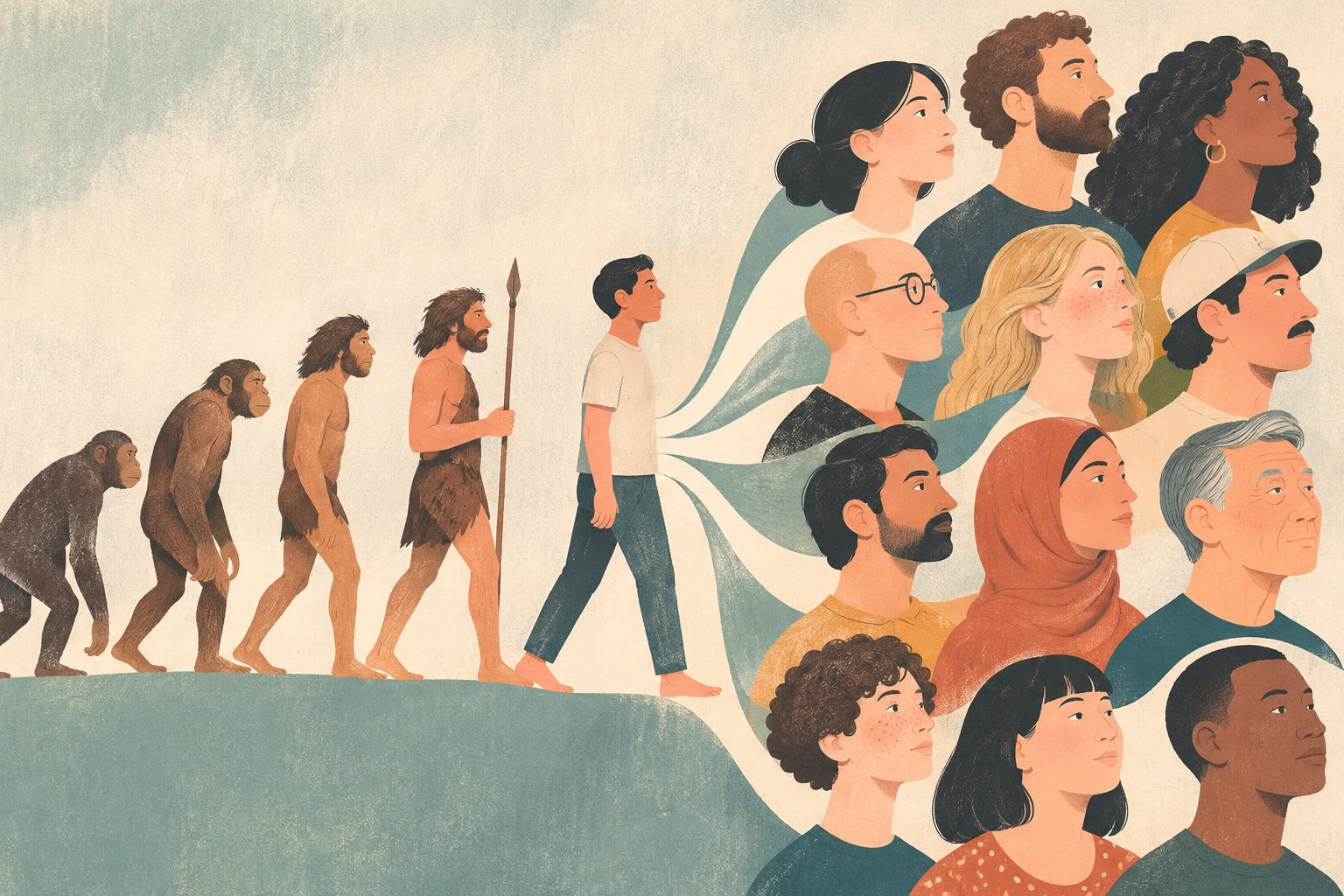
If physical attractiveness helps people find romantic partners and reproduce, shouldn’t millions of years of evolution have eventually made everyone attractive?
It sounds logical, but it rests on a misunderstanding of how evolution works.
Evolution doesn’t work toward perfection. Natural selection favors inherited characteristics that help organisms survive and reproduce in a particular environment. You don’t need to be exceptionally attractive to pass on your genes. You just need to reproduce.
And humans choose partners for a surprisingly complicated set of reasons. Physical appearance certainly plays a role, but so do personality, kindness, humor, intelligence, emotional connection, stability and shared values. Someone who isn’t considered conventionally attractive may have just as much reproductive success as someone who is.
There’s also no universal blueprint for beauty.
Researchers have identified some characteristics, such as facial symmetry, that tend to be considered attractive across cultures. But preferences also vary considerably between individuals, societies and historical periods. What’s desirable in one environment or generation isn’t necessarily desirable in another.
Then there’s the complicated nature of genetics. Attractiveness isn’t determined by a single gene. Our facial features are influenced by numerous genes interacting with one another, as well as environmental and developmental factors.
Two exceptionally attractive parents aren’t guaranteed to produce an exceptionally attractive child. A combination of individually attractive features doesn’t necessarily translate into an attractive face.
Evolution also involves trade-offs. Imagine a genetic variant that contributes to a particular physical feature but also provides some unrelated survival or reproductive advantage. Natural selection doesn’t evaluate that feature in isolation. What matters is its overall effect on reproductive success.
And genetic variation is continually being introduced and reshuffled through mutation and reproduction. Even strong evolutionary pressures don’t necessarily eliminate differences between individuals.
It’s also worth addressing the idea that other animals all look alike. To humans, two penguins might look practically identical. But penguins can recognize individual members of their own species through signals that we barely notice. We’re particularly good at detecting subtle differences in human faces because distinguishing other humans is important to our social lives.
Perhaps the biggest misconception is that evolution is supposed to produce some ideal version of a species.
There is no finish line. There is no perfect human being that natural selection is gradually working toward. Evolution has no concept of beauty, fairness or desirability.
The fact that humans continue to look remarkably different from one another isn’t evidence that evolution has failed.
It’s entirely consistent with how evolution works.
Was this worth your time?
What missed? (optional)