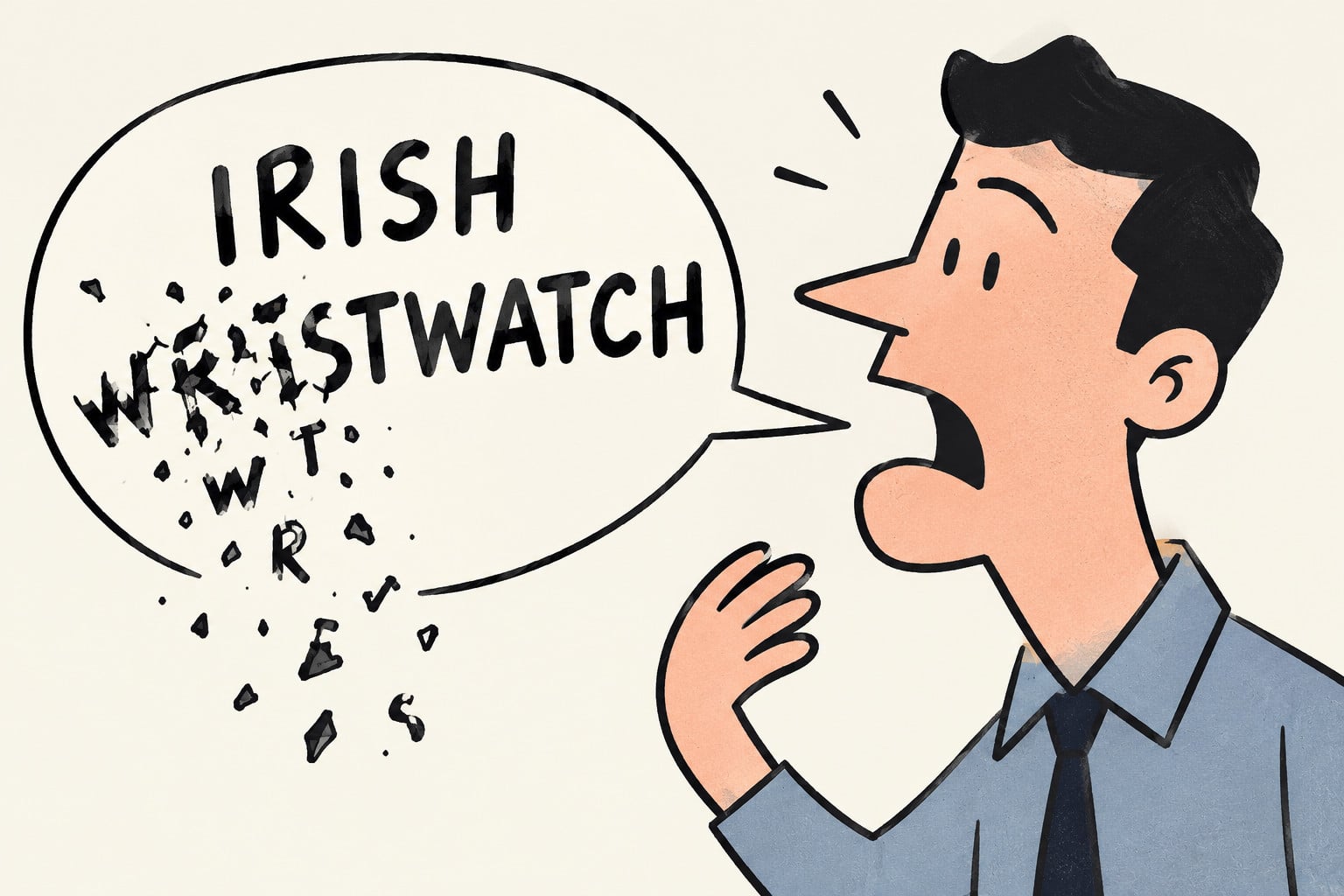
Try saying “Irish wristwatch” five times in a row. Go ahead. I’ll wait.
Chances are, somewhere around the third attempt, your tongue stopped cooperating. What started as two perfectly ordinary English words turned into something that sounded like you were trying to speak with a mouthful of peanut butter.
But why?
You can say “Irish” perfectly fine. You can say “wristwatch” without any trouble. So why does putting them together suddenly make you sound like you’ve forgotten how to speak English?
It turns out there’s a surprisingly interesting explanation.
Your Tongue Can’t Keep Up
Speaking is actually one of the most complicated physical things we do.
Every time you say a word, your brain sends instructions to your tongue, lips, and jaw, telling them exactly where to move and when. These movements happen so quickly that you don’t even notice them.
But some combinations of sounds are much harder to produce than others.
Take “Irish wristwatch.”
Your tongue has to move rapidly between the R and SH sounds, while your lips round for the W sounds. The movements are individually easy, but putting them together quickly is another story.
It’s like trying to pat your head and rub your stomach at the same time. You can do both separately, but combining them takes coordination.
And “Irish wristwatch” isn’t the only phrase that causes problems.
Try these:
- Rural juror — Two ordinary words that somehow sound impossible together.
- Sixth sick sheik’s sixth sheep — A nightmare of S, SH, and TH sounds.
- Toy boat — Surprisingly difficult when repeated quickly.
- Red leather, yellow leather — Your tongue keeps wanting to mix up the sounds.
- Unique New York — Easy once. Much harder five times in a row.
- Specific Pacific — Your mouth has to navigate a series of similar sounds without mixing them up.
Your Brain Is Getting Ahead of Your Mouth
Here’s where things get interesting.
When you speak, your brain isn’t just thinking about the sound you’re making right now. It’s already preparing the sounds that come next.
Normally, that’s what makes speech feel effortless.
But when several similar sounds are packed closely together, your brain can get its instructions mixed up.
This is a form of speech interference. You might accidentally swap two sounds, repeat part of a word, or combine sounds that were supposed to stay separate.
That’s why “red leather, yellow leather” sometimes comes out as “red lellow, yellow reather.”
Your brain knows exactly what you want to say. Your mouth just isn’t following the instructions in the right order.
Why Can You Say It Slowly but Not Quickly?
Try saying “Irish wristwatch” again, but this time, say it very slowly.
Easy, right?
Now gradually speed up.
Eventually, you’ll probably stumble.
That’s because speaking quickly requires your mouth to begin preparing for the next sound before it has completely finished the previous one.
Most of the time, this overlapping process makes speech smoother. But with tongue twisters, those movements can get in each other’s way.
The faster you go, the less time your brain and mouth have to sort everything out.
The good news is that practice helps. Repeating a difficult phrase slowly and gradually increasing your speed allows your brain to become more familiar with the sequence of movements.
The Funny Thing About Speaking
What’s remarkable is that we do this all day without thinking about it.
You can have an hour-long conversation, tell a story, or argue with someone without consciously thinking about where your tongue needs to go.
Your brain coordinates thousands of tiny movements almost perfectly.
And then two innocent words come along and expose how complicated the whole operation really is.
“Irish wristwatch.”
Now try “rural juror.”
And if you’re feeling particularly confident, try saying “Irish wristwatch, rural juror, unique New York” five times as fast as you can.
Good luck.
Was this worth your time?
What missed? (optional)