
Queen Victoria photobombing her son’s wedding photo by sitting between them wearing full mourning dress and staring at a bust of her dead husband, she blamed her son for Albert’s death.
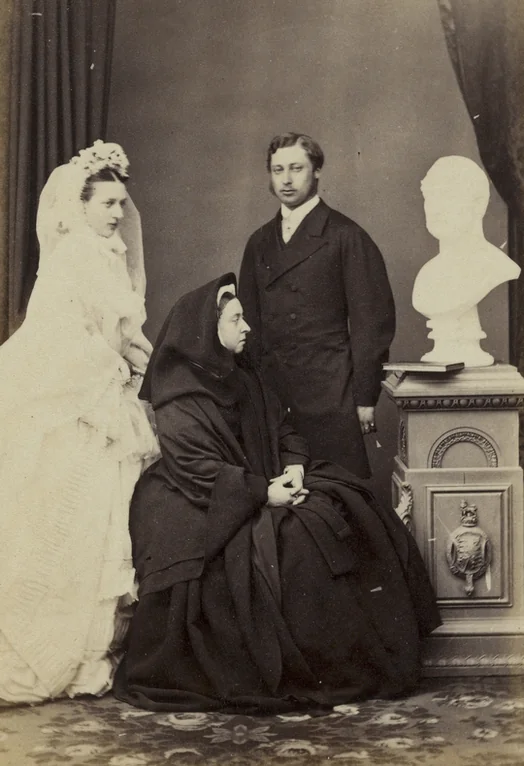
The wedding of the Prince of Wales should have been a triumph—a symbol of renewal for the British monarchy, a coming together of royal houses, a moment to look forward. Instead, the centerpiece of the official wedding photograph is not the happy couple, but their mother, Queen Victoria, clad head-to-toe in black. She sits between her son and his new wife, her entire presence wrapped in grief, her eyes fixed not on the future of her family, but on a marble bust of her late husband, Prince Albert, which she had placed prominently in the shot. The effect is eerie, almost theatrical—a collision of public ritual and private agony. This wasn’t just a photobomb. This was a message, delivered in velvet and shadow, to the world and to her son: The Queen was not moving on.
Victoria and her eldest son, Albert Edward—known to the family as Bertie—had a relationship defined as much by disappointment as by blood. Bertie had been born into expectation: Albert’s vision for a better, more moral monarchy, Victoria’s hope for a worthy heir. But Bertie never quite fit the mold. Where his father was scholarly and serious, Bertie was sociable and restless, more drawn to pleasure than principle. To the rigid, almost joyless world of his parents’ court, Bertie’s appetites were not youthful mischief but threats to the very project they’d dedicated their lives to.
Then came tragedy. When Prince Albert died suddenly, Victoria’s grief quickly congealed into blame. She believed her son’s indiscretions, particularly a notorious affair at Cambridge, had contributed to Albert’s death by breaking his spirit. From that point on, Bertie became something less than a son in her eyes—he was a living reminder of loss, and a scapegoat for it. She kept him at a distance, denying him real responsibility, letting him know at every turn that he could never replace, or even live up to, his father.
So when Victoria inserted herself—literally—into her son’s wedding photograph, flanked by newlyweds and staring at her dead husband’s likeness, it was about more than just grief. It was about control, about memory, about never letting Bertie—or anyone else—forget the standard he had failed to meet. Even on a day meant to mark new beginnings, Victoria cast a long shadow, ensuring that the past would remain at the center of her family’s future. The photograph doesn’t just capture a moment; it crystallizes decades of resentment, mourning, and the impossible expectations of a mother who could never let go.
In 19th century England, innkeepers supplied patrons with a “penny hang,”. For a penny, innkeepers provided ropes for seamen to sleep on.

Picture 19th-century England, the damp fog curling through alleyways, the relentless drizzle seeping into every bone. For the working poor—especially dockworkers and itinerant laborers—just getting out of the weather was a kind of luxury. Most nights, even a proper bed was out of reach. Enter the “penny hang.” For a single penny, innkeepers and publicans offered not a bed, not even a mat on the floor, but a heavy rope strung from wall to wall. Patrons would shuffle in, hand over their coin, and drape themselves over the rope—arms hanging, knees buckling, their bodies collapsing forward in a sort of communal exhaustion. It wasn’t sleep in any real sense; no one could stretch out, no one could dream. It was more like a temporary suspension from misery, a pause button on the fatigue of the streets.
The “penny hang” was less about rest and more about survival. Imagine seamen, soaked through after days on the docks, too broke for a proper room but desperate for a place to escape the cold. These drying-out rooms became makeshift shelters, part hostel, part holding pen for the city’s surplus labor. The ropes kept people upright enough not to asphyxiate but offered no comfort, no privacy, and certainly no dignity. And yet, they were in demand. The fact that so many people paid for this minimal mercy says everything about what life at the margins of Victorian England could be—gritty, desperate, and always one penny away from a night in the open air.
Shoichi Yokoi, the Japanese soldier who hid in the jungle in Guam for 27 years to avoid capture, weeps upon his return to Japan in February 1972

Shoichi Yokoi’s odyssey is one of those stories that strains the limits of belief, a testament to the extremes of human endurance, isolation, and the iron grip of ideology. When the guns finally fell silent in 1945, most Japanese soldiers surrendered, were captured, or died. But on the tiny island of Guam, deep beneath the towering tangles of vines and roots, Yokoi refused to yield. Like so many of his generation, he’d been drilled with the conviction that surrender was worse than death—that returning alive from the battlefield, unless victorious, was a permanent stain on one’s honor, not just for himself, but for his entire family.
For 27 years, Yokoi transformed the jungle into a kind of living prison. He dug an underground shelter with bamboo tools and his bare hands, lining the walls with woven reeds. He fashioned clothes from the fibers of wild hibiscus and survived on a diet of frogs, rats, river shrimp, and wild breadfruit. At night, he listened to the jungle’s symphony of insects and rain, haunted by the fear that the enemy might still be out there, just beyond the reach of the bamboo and darkness. Now and then, he glimpsed leaflets or heard distant voices, but he never fully trusted the messages that the war had ended; propaganda, he thought, or a trick. Even when his two fellow holdouts died, he chose solitude over surrender.
It wasn’t until January 1972 that two local hunters stumbled upon him near a riverbank. Yokoi was gaunt, bearded, and nearly feral, blinking at the sunlight of a world that had moved on without him. When they finally convinced him that Japan had lost and peace had reigned for decades, the full weight of those lost years crashed down. He was returned to Japan a week later, stepping out onto the tarmac in Tokyo with trembling hands.
The homecoming was both triumphant and deeply tragic. Crowds gathered to see the “last samurai,” a living time capsule of imperial discipline and suffering. But as the cameras flashed, Yokoi wept uncontrollably, his shoulders shaking with shame and grief. “It is with much embarrassment that I return,” he told the crowd, bowing deeply. He had survived the unimaginable, but he saw himself not as a hero, but as a remnant of a vanished world—one who had clung to the old code so tightly that it nearly erased him from history itself. For Yokoi, Japan’s postwar transformation—from devastation to neon-lit prosperity—was almost incomprehensible. He returned to a nation that celebrated him, but in his own heart, he carried the sorrow and loneliness of those twenty-seven lost years.
In 1989, Russian President Boris Yeltsin visited a Houston grocery store and was astonished by the abundance, later describing it as a moment of despair for the Soviet people.

Boris Yeltsin’s 1989 visit to a Houston grocery store reads almost like a parable for the end of the Soviet era. Here was a high-ranking member of the Soviet political elite—a man accustomed to the closed, shadowy corridors of Kremlin power—walking the fluorescent-lit aisles of Randall’s supermarket in suburban Texas. What he found there hit him harder than any diplomatic summit or ideological debate ever could: clean, orderly rows of fresh produce, meats, snacks, and household goods, all available to ordinary Americans at prices they could afford. Bananas, grapes, ice cream, multiple kinds of bread, and more brands of beer than anyone in Moscow could even imagine.
Yeltsin wandered the store in a daze, picking up boxes, poking at fruit, talking to store workers and fellow shoppers. He saw families choosing what they wanted, no ration cards, no surly clerks, no empty shelves. “Even the Politburo doesn’t have this choice. Not even Mr. Gorbachev,” he reportedly muttered, almost to himself. It was, he later recalled, a moment of despair—a kind of existential shock. If average Americans enjoyed this kind of abundance as a matter of routine, what had the decades of Soviet sacrifice, secrecy, and shortages really accomplished?
On the flight home, Yeltsin couldn’t stop talking about it. He scribbled notes in his diary and confided to aides that if people in the Soviet Union could see what he had seen, the entire system would collapse overnight. For him, that supermarket—mundane, almost invisible to locals—was nothing less than a revelation, and a turning point. It laid bare the yawning gap between the promises of communism and the everyday reality of life in the West. In that fluorescent-lit moment, Yeltsin saw not just the abundance of the shelves, but the poverty of an entire ideology.
How Nazi Germany Pushed Meth to Soldiers and Civilians Alike

In the 1930s and 1940s, Germany was swept up in a pharmaceutical craze that would later be recognized as both extraordinary and deeply destructive: the widespread use of methamphetamine, branded as Pervitin. If you look at the advertisement you just shared, you see it presented with the cheerful normalcy of any over-the-counter remedy—a “stimulant for the psyche and circulation,” promising relief from depression, fatigue, low blood pressure, and even post-operative recovery. To modern eyes, it’s chilling. But in pre-war and wartime Germany, Pervitin was promoted as a wonder drug, embraced by doctors, civilians, and eventually—most infamously—the Nazi military.
The science was simple, if dangerously shortsighted. Methamphetamine makes you feel alert, powerful, and tireless. German civilians snapped up Pervitin tablets to get through long work days and household chores; it was so common that you could buy it at the pharmacy without a prescription. Students used it to cram for exams, and homemakers popped it to push through daily fatigue. Even chocolate laced with meth was marketed to busy housewives under the name “Hildebrand Schokolade.” In a society obsessed with productivity, efficiency, and strength, a pill that erased exhaustion felt like a miracle.
But it was the German military that took pharmaceutical ambition to a new level. As the Wehrmacht launched its lightning-fast invasions across Europe—what the world came to know as Blitzkrieg—commanders distributed millions of Pervitin tablets to soldiers. The goal was to create an army that never slept, never tired, never hesitated. Soldiers could march for days without rest, drive tanks through the night, and stay locked in battle well past the limits of human endurance. Reports from the front described troops who seemed superhuman—until the inevitable crash came, bringing hallucinations, psychosis, and utter physical collapse.
The dark genius of Nazi Germany’s methamphetamine experiment was its fusion of modern science with the regime’s most dangerous fantasies. The same society that trumpeted “purity” and “strength” was quietly addicted to a chemical shortcut. Pervitin was everywhere: in the rations of stormtroopers, in the medicine cabinets of housewives, and on the desks of overworked bureaucrats. The costs, both personal and societal, were ignored or hidden—at least for a while. By the end of the war, addiction, breakdown, and despair followed in the wake of the initial “miracle.” Nazi Germany’s bet on meth turned out to be a toxic promise—one that left scars on a generation long after the pills ran out.
Photo of Private Albert Cashier of the 95th Illinois Infantry, 1864. Though born Jennie Hodgers, Albert adopted the identity of a man shortly before enlisting, and continued his life as a man for 53 years until his death in 1915

After three years marching and fighting in the blue uniform of the Union Army—crossing the battered South, enduring siege and battle—Albert Cashier returned to civilian life not as the Irish girl born Jennie Hodgers, but as the same man who had fought in over forty engagements from Vicksburg to Brice’s Crossroads. For Albert, the war was not a passing episode of borrowed identity. It was the crucible in which he claimed a life of his own making, and he held to that life for over half a century in small-town Illinois.
Settling in Saunemin, Cashier took on the steady, humble jobs that knit together the fabric of a rural community: cemetery worker, janitor, lamplighter, handyman. He lived frugally, eating many meals with neighbors and sleeping wherever work could be found—sometimes in a hardware store, sometimes in the home of a local family, and eventually in a small house built for him by the Chesbro family, who treated him as a loyal friend. Town payroll records and church attendance lists quietly marked his presence year after year. As a man, Cashier could do what most women in that era could not: vote, open a bank account, receive a soldier’s pension, and move through the world on his own terms.
The truth about Albert’s identity was known to a select few over the decades—neighbors and friends who discovered it by accident, or doctors who tended to his injuries—but they kept his secret. Loyalty and respect, earned on the battlefield and in honest labor, outweighed the shock of any revelation. Even after an accident in 1911 left him unable to work, and a hospital stay revealed more than a broken leg, Cashier’s community closed ranks to protect him.
But the system was less kind. With age came frailty, and with frailty came the need for institutional care. At the Soldiers and Sailors Home, then later at the Watertown State Hospital, staff discovered his assigned sex at birth and forced him, for the first time in over fifty years, to wear women’s clothes. Yet when Cashier’s military pension was threatened by a fraud investigation, surviving veterans of the 95th Illinois stepped forward to vouch for him—insisting that Albert Cashier was indeed their comrade, the same man they’d marched and fought alongside in the worst of the war.
Albert Cashier died in 1915, buried in his uniform and with full military honors. For decades, his grave bore only his chosen name, rank, and regiment. It took years to trace his origins back to Jennie Hodgers, and by then, the meaning of that life had changed. Today, Cashier is remembered not just as one of the hundreds of assigned-female-at-birth Civil War soldiers, but as someone who lived authentically—on the battlefield, in the voting booth, and in the quiet corners of rural Illinois—for more than half a century. His story endures as a rare testament to the possibility of living one’s truth, even in a world that rarely had words for it.
An East German soldier ignores orders to let no one pass and helps a boy, who was found on the opposite side from his family, cross the newly formed ‘Berlin Wall’- 1961

In August 1961, as the Berlin Wall’s first coils of barbed wire and concrete snaked through the heart of the city, confusion and heartbreak gripped Berliners on both sides. Families who’d only the day before shared breakfast together found themselves abruptly divided by a border that went up overnight. East German soldiers, young and tense, stood guard under strict orders: let no one cross.
Amid this chaos, a moment of quiet rebellion broke through the machinery of the state. A small boy, separated from his family in the frantic rush and shifting boundaries, found himself trapped on the eastern side of the Wall. His family waited just yards away in the West, calling for him, desperate and helpless. The soldiers—mostly teenagers themselves—were told to hold the line, to follow orders, to be the living barrier between worlds.
But one soldier, rifle slung across his shoulder, chose conscience over command. Ignoring the shouts and the threats of his superiors, he bent down, scooped up the frightened boy, and carried him across the divide—passing him safely into his family’s arms. In that brief, astonishing act, the soldier risked not just his career, but his freedom. To defy the orders of the East German regime, even for a moment of mercy, was a profound act of courage.
The photograph of that day became a symbol: proof that even at the very birth of the Wall, humanity could not be entirely contained. For a fleeting second, compassion trumped ideology, and the iron curtain parted just enough to let a child go home.