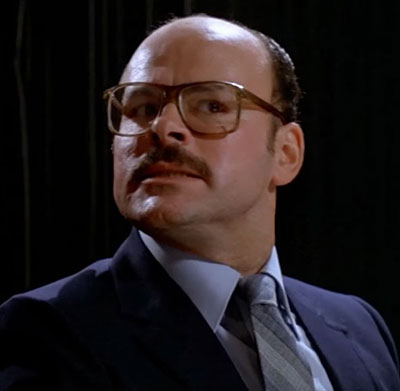
Outside of the Headquarters of National Association Opposed to Woman Suffrage, 1914
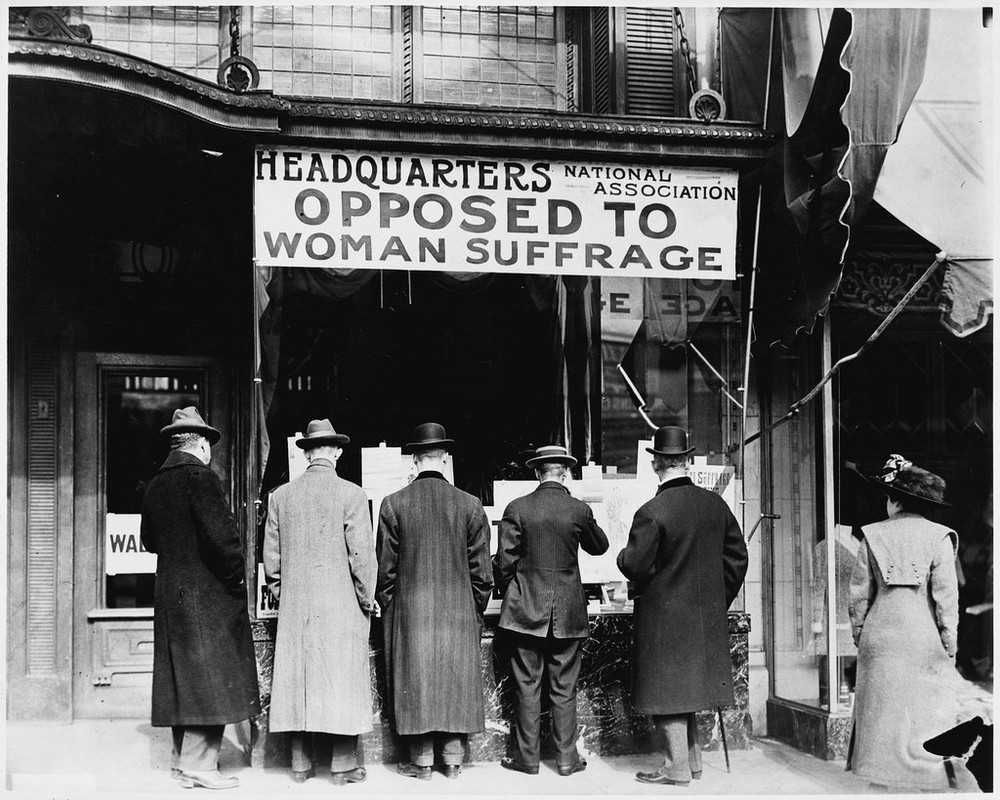
In an era when women were rallying, marching, and risking arrest to win the right to vote, here was a group—led and largely staffed by women—fighting fiercely to preserve the status quo. The building itself was unassuming, yet from its doors poured pamphlets, petitions, and editorials warning of the dangers women’s suffrage would supposedly bring: a disruption of social order, the decline of the family, and chaos in politics. Signs and banners would have declared the group’s purpose in bold letters, standing as both a literal and symbolic barrier to progress.
The women and men inside believed, or at least claimed, that enfranchising women would weaken society rather than strengthen it. Their arguments drew on tradition, religion, and the idea that a woman’s place was in the home, not at the ballot box. Yet in a twist of history, the very act of organizing—setting up offices, planning campaigns, speaking publicly—forced these anti-suffrage women to step into roles of activism and leadership that mirrored those of their suffragist opponents. In fighting so strenuously to keep the vote out of women’s hands, the National Association inadvertently proved just how capable women were of engaging in political life.
Oskar Schindler being greeted by 300 holocaust survivors in Jerusalem, on May 1, 1962

It’s May 1, 1962. Oskar Schindler steps off a plane in Jerusalem, and the reception is unlike anything you’d expect for a bankrupt, chain-smoking, complicated man whose greatest achievement was a list. Three hundred Holocaust survivors—living, breathing proof that his defiance mattered—are there to meet him. These are people who, by every calculation of the Nazi machine, shouldn’t exist. They shake his hand, they embrace him, some weep openly. You can almost hear the collision of worlds: the bureaucratic, industrialized cruelty of the camps, and the stubborn, miraculous persistence of life.
Schindler, who once played the part of war profiteer, stands in the middle of it all, stripped of his former bravado. The moment is strange and raw. He’s a rescuer who never called himself a hero, haunted by those he couldn’t save, suddenly confronted by the magnitude of those he did. Jerusalem in 1962 is a world away from Kraków in 1944, but the gratitude—the almost electric intensity of survival—transcends geography and time. In that gathering, the numbers that defined the Holocaust—six million, a list of names, a tally of loss—give way to faces, stories, and a kind of redemption that history rarely delivers.
Mussolini giving the ‘Roman Salute’ infront of a statue of Augustus Caesar, 1935

The year is 1935. Mussolini, in all his theatrical bravado, plants himself before a colossal statue of Augustus Caesar. He raises his arm in the “Roman Salute”—a gesture deliberately borrowed, not invented, meant to send a message as clear as a thunderclap. For the cameras, for the crowds, for history, Il Duce attempts to graft his own reign onto the sinew and bone of the Roman Empire. Augustus, the man who ended a century of civil war and hammered a republic into an empire, stands frozen in marble behind him—a silent witness, or maybe a silent judge.
It’s a moment heavy with symbolism, but also with a kind of anxious overcompensation. Mussolini’s Italy is nothing like the Rome of Augustus, not in reach, not in power, not in destiny. And yet here’s Mussolini, cloaking himself in the mythology of Rome, using ancient glory as a shield and a mask. It’s almost desperate—this urge to make the world, and maybe himself, believe that Fascist Italy is heir to an eternal legacy, rather than a regime scrambling for legitimacy on the ruins of the past.
A German WWII prisoner is reunited with his 12-year-old daughter.The child had not seen her father since she was one year old, 1956. Photograph by Helmuth Pirath

An executioner from India in 1903.

Saddam Hussein and his half-brother at their trial, 2004-2005

Inside the heavily fortified courtroom in Baghdad, 2004, Saddam Hussein sits in the defendant’s dock—a former absolute ruler now reduced to a man on trial for his life. His half-brother, Barzan Ibrahim al-Tikriti, is by his side, both men flanked by guards, both defiant. It’s a surreal scene: the men who once wielded total power in Iraq now forced to answer for their roles in torture, executions, and decades of brutality. The spectacle is thick with tension, as if the air itself is charged by the memory of what these men once meant to an entire nation.
Saddam, ever theatrical, uses the proceedings as a stage, refusing to recognize the court’s legitimacy, railing against his captors, oscillating between rage and arrogance. Barzan, no less stubborn, launches into angry tirades and bitter denunciations. The trial is not just a reckoning for their crimes, but for the ghosts of an era—dictatorship on trial in the heart of a fractured, violent Iraq. Cameras capture every gesture and glance, every flash of bravado, every flicker of fear. It’s history in the making: the fall of a regime, stripped of its myth and exposed to the pitiless light of justice, if only for a moment.
A mother in Chicago offers her children for sale during extreme post-war poverty. USA, 1948

Marilyn Monroe at a dinner for Nikita khrushchev, Los Angeles California, September 21, 1959

On September 21, 1959, Los Angeles found itself in the strange, surreal embrace of Cold War diplomacy when Soviet Premier Nikita Khrushchev visited the city on his American tour. The Beverly Hills set, still flushed with the glamour of Hollywood’s golden age, hosted a dinner for him at Twentieth Century-Fox Studios. Among the crowd was Marilyn Monroe—America’s most dazzling star, the walking embodiment of postwar optimism and sexual revolution. She was invited, not just for her fame, but as a living, breathing symbol of American allure, the kind of soft power Khrushchev couldn’t fail to notice. Monroe, in a shimmering dress and perfect waves, greeted the Soviet leader with the kind of smile that launched ships and sold movies, representing everything the USSR both envied and mistrusted about the West.
For Monroe, the evening was less about politics and more about performance—she was, by all accounts, nervous and somewhat mystified by the attention. Yet her presence did what Hollywood always intended: it created a spectacle, a collision of worlds where glamour and geopolitics uneasily mingled. Khrushchev, blunt and blustery, seemed simultaneously delighted and bewildered by Monroe’s effortless charisma, later recounting the dinner with bemusement.
Nazi defendants in the first of the 13 Nuremberg war crimes trials on Nov. 11, 1945.

Only known photo ever taken of Edo period Samurai Saito Hajime, 1897. Saito was one of the only members of the Shinsengumi, an elite secret police force formed to protect the Shogun, to survive the fall of the Shogunate. He later worked as an undercover policeman for the Meiji government

Ernst Röhm: The Openly Gay Power Broker of Nazi Germany, 1933

Ernst Röhm was one of the most controversial and consequential figures of the early Nazi movement—a man whose life and death would help shape the fate of Hitler’s Germany. As the co-founder and commander of the Sturmabteilung (SA), or Brownshirts, Röhm was instrumental in transforming the ragtag paramilitary group into a force of hundreds of thousands, capable of intimidating political opponents and destabilizing the Weimar Republic.
Unusually for his time, Röhm was open about his homosexuality within Nazi circles, a fact known to Hitler and other top leaders. His presence at the core of the Nazi movement was both a sign of his immense value to Hitler and a simmering source of tension, as rivals within the party seized on his sexuality and the SA’s reputation for street violence to undermine him.
Röhm’s story is also a cautionary tale about power and loyalty under dictatorship. As the SA grew in size and boldness, Röhm became both indispensable and dangerous to Hitler, who feared the paramilitary’s independence and Röhm’s personal ambitions. In June 1934, during the “Night of the Long Knives,” Hitler moved decisively against Röhm and the SA leadership. Röhm was arrested and given the chance to take his own life; when he refused, he was executed by SS men.
A British soldier scolding a German civilian for laughing at a screening of concentration camp conditions. She was ordered to rewatch the film. May 1945

One of the only photographed meetings between Yugoslavian communist leader Josip Broz Tito & Joseph Stalin, reviewing the 1945 May Day parade. Within a few years the two men had a severe falling-out, with Tito defying Soviet hegemony & Stalin repeatedly attempting to assassinate him

Vladimir Lenin’s last photo. He had had three strokes at this point and was completely mute, 1923

In the last known photograph of Vladimir Lenin, taken in 1923, the once-fiery revolutionary is nearly unrecognizable—a stark symbol of how quickly power and vitality can slip away. Lenin, who had orchestrated the October Revolution and shaped the Soviet state with unrelenting force, sits in a chair in the garden at Gorki, his gaze unfocused and body visibly frail. By then, he had suffered three debilitating strokes, leaving him completely mute and partially paralyzed. The leader who once electrified crowds with speeches and dominated the inner workings of the Bolshevik party could no longer communicate except through gestures or brief, scrawled notes.
This final image is heavy with historical irony. Just a few years earlier, Lenin was the central engine driving world-shaking events, feared and revered across continents. Now, surrounded by caregivers and the silence of his own mind, he was a bystander to the political machinations of his would-be successors. The photograph captures not just the physical decline of one man, but the uncertainty that settled over the Soviet Union—a regime whose founding architect was present in body, but absent in voice and will.
Lizzie Magie, Showing a prototype of Monopoly, Which She Invented to Warn the Dangers of Land Speculation (1936)

A display at the Nazi’s anti-Soviet propaganda exhibition “The Soviet Paradise” which depicts the interior of a Soviet workers’ home to highlight the poverty and depravity of the USSR for the purpose of justifying the war against the Soviet Union. Brussels, Belgium, March 1943