Orson Welles speaking to the press after the nationwide panic caused by his “War of the Worlds” radio broadcast (New York City, October 31, 1938)
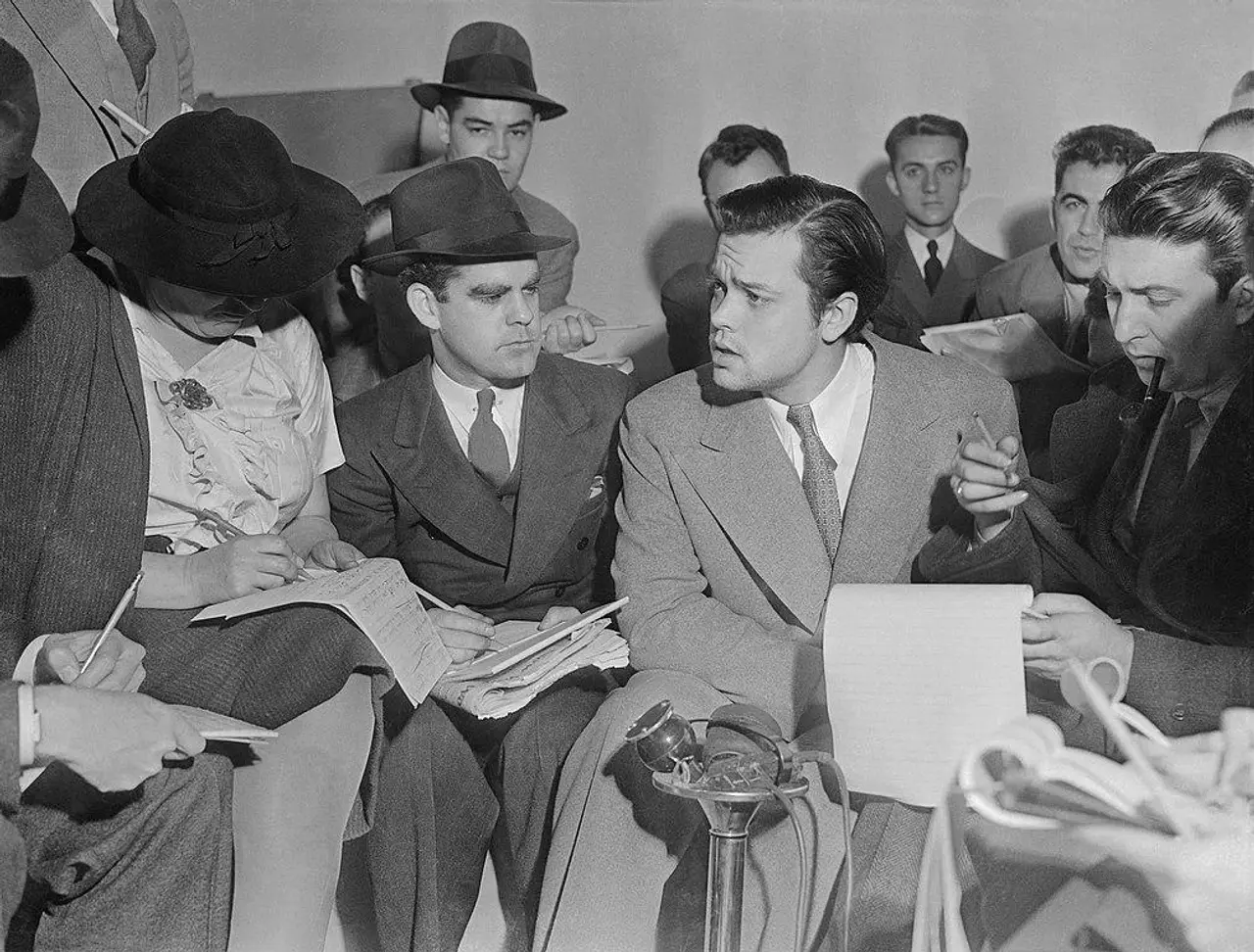
The broadcast, presented as a series of news bulletins, led some listeners to believe an alien invasion was underway, prompting public panic and later sparking debates about media responsibility.
The Pulitzer Prize–winning photo of Tony Kiritsis holding a shotgun to the head of his mortgage broker, Richard Hall (Indiana, 1977)

Kiritsis engineered a crude but effective homemade shotgun rigged with a trigger mechanism attached to his neck, ensuring that if he were shot or incapacitated, the weapon would fire into Hall’s head. The 63-hour standoff ended without fatalities after Kiritsis surrendered. He was later convicted of kidnapping and sentenced to life in prison.
The Immortal Ten, a group of militant abolitionists in Kansas, 1859

The Immortal Ten were part of the violent anti-slavery movement in “Bleeding Kansas,” a series of armed conflicts between pro-slavery and anti-slavery settlers that foreshadowed the American Civil War.
Suspected Viet Cong officer Nguyen Van Lem being escorted by South Vietnamese soldiers moments before his execution (Saigon, Tet Offensive, February 1968)

The photograph was taken by Eddie Adams and became one of the most influential images of the Vietnam War. The execution was carried out by South Vietnamese General Nguyen Ngoc Loan and helped shift public opinion in the United States against the war.
The first Coca-Cola bottle sold to the public (Vicksburg, Mississippi, March 12, 1894)

Early Coca-Cola formulations contained small amounts of cocaine derived from coca leaves. The drug was gradually reduced and fully removed by the early 1900s as public attitudes and regulations changed.
Communist Party leader Xi Jinping participating in farm labor during a rural inspection, 1988

At the time, Xi was serving as party secretary of Ningde Prefecture. Such staged labor activities were commonly used to project ideological alignment with rural workers and socialist values.
Mandarin official in Tonkin, French Indochina, September 1915

Franklin D. Roosevelt delivering his “Day of Infamy” speech to Congress, 1941

The speech formally requested a declaration of war against Japan following the attack on Pearl Harbor and marked the United States’ entry into World War II.
A 4th Infantry Division GI trudges through mud during the Battle of the Hürtgen Forest, December 1944

The Hürtgen Forest campaign became one of the longest and costliest battles fought by the U.S. Army in World War II, marked by brutal terrain, freezing weather, and heavy casualties.
The coronation procession of Thai King Bhumibol Adulyadej (Rama IX), 1950

Rama IX reigned for 70 years, making him one of the longest-serving monarchs in recorded history. His estimated personal fortune placed him among the wealthiest royals in the world.
Young Pony Express mail rider Frank Webner/Wegner, Missouri, 1861

The Pony Express operated for only 18 months before being rendered obsolete by the transcontinental telegraph, but it became a lasting symbol of frontier endurance.
Italian medium Eusapia Palladino performing table levitation, 1895

Palladino was investigated by prominent scientists of the era. While some initially endorsed her abilities, many later concluded her séances relied on sleight of hand and illusion.
Interior of Crapper Jack’s Saloon, Cripple Creek, Colorado, 1890s

Cripple Creek was a booming gold-mining town, and saloons like this often doubled as gambling halls and brothels during the height of the Colorado Gold Rush.
M4 Sherman tank crew and equipment, 1943

The M4 Sherman was the most widely used Allied tank of World War II, valued for reliability and ease of production despite being outgunned by later German armor.
Sketch of the Maginot Line, circa 1940

The French defensive fortification failed strategically when German forces bypassed it by invading through Belgium, rendering much of it ineffective.
North Vietnamese woman guiding American POW Gerald Santo Venanzi

Hitler smiling after learning of France’s surrender, June 17, 1940

U.S. Marines using a flamethrower to clear Japanese tunnels on Iwo Jima, 1945

Japanese forces constructed extensive underground tunnel networks, forcing U.S. troops to use flamethrowers and explosives in close-quarters combat.
President William McKinley walking toward his assassination at the Temple of Music (Buffalo, NY, September 6, 1901)

McKinley was shot at point-blank range by anarchist Leon Czolgosz and died eight days later, elevating Theodore Roosevelt to the presidency.