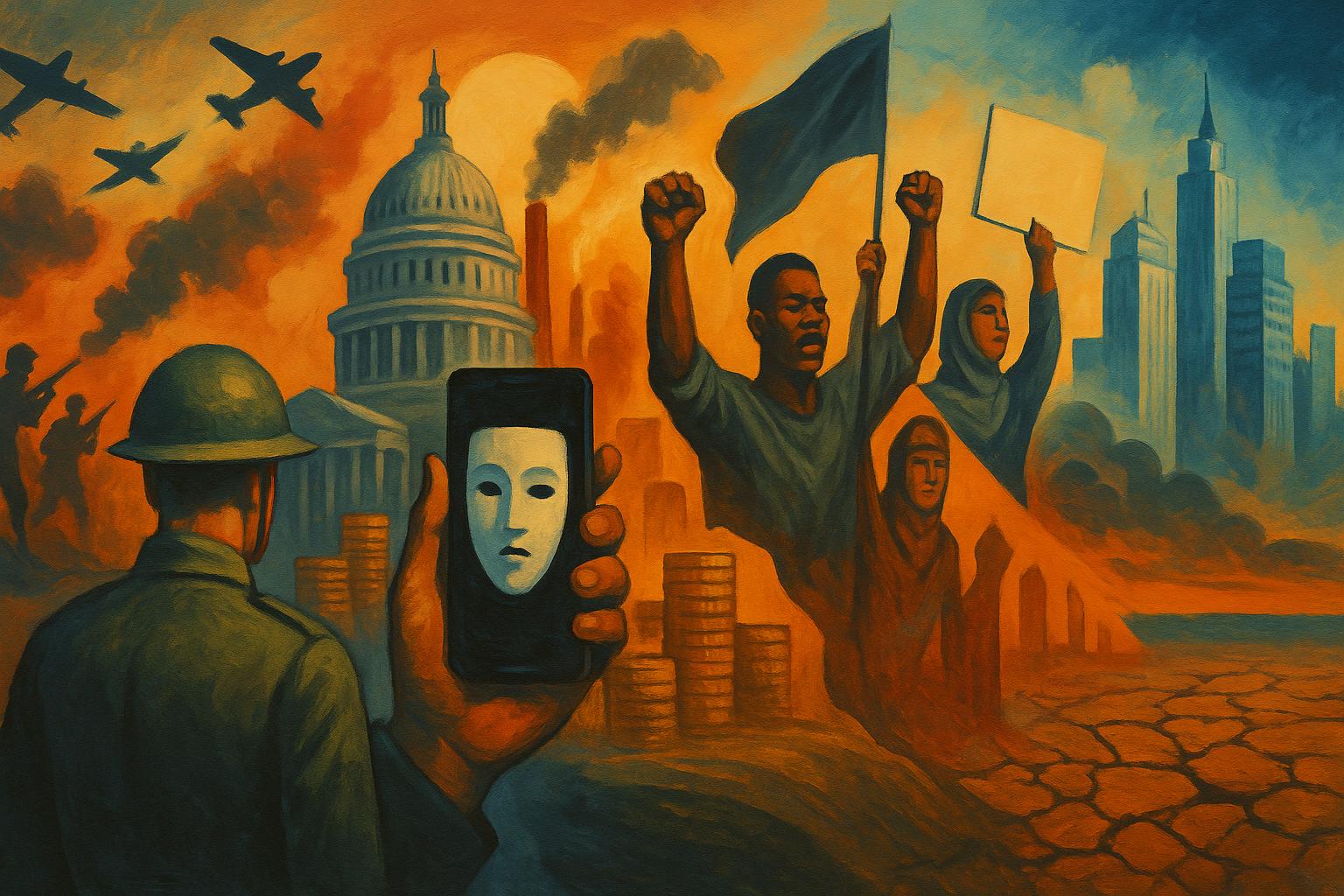
They say history repeats itself, how is history repeating itself today?
History doesn’t repeat like a bad TV rerun. It mutates. It takes on new costumes, new sets, new actors — but when you listen closely, the rhythm underneath is the same.
Take geopolitics. In 1914, Europe’s great powers were locked into alliances, rattling sabers, convinced their enemies would back down. They didn’t. Today, NATO stares across the line at Russia as the war in Ukraine drags on, while the Taiwan Strait simmers with the potential to draw in the U.S. and China. Everyone swears they don’t want another world war. That’s exactly what they said before the last two.
Or look at economics. The tulip bubble, the South Sea bubble, the crash of ’29, the dot-com implosion, the subprime meltdown. Different assets, same cycle: speculation, mania, collapse. Today it’s meme stocks and crypto coins skyrocketing overnight before crashing back to earth. People in the 17th century were ruined by a flower bulb. People in the 21st century are ruined by digital tokens with dog faces. The names change, but greed is timeless.
Politics doesn’t escape the loop either. In the 1930s, charismatic populists rose from chaos, promising to restore national pride, blaming “enemies within” for decline. You can hear that same soundtrack now in speeches from leaders in Eastern Europe, Latin America, even the United States. Social media is their modern-day stadium rally — a tool for mobilization, outrage, and scapegoating that makes Joseph Goebbels look like an amateur.
Pandemics? In 1918, newspapers downplayed influenza, people refused to mask, conspiracy theories spread faster than the virus. A century later, during COVID-19, the same arguments exploded again — masks or no masks, shutdowns or freedom, medicine or snake oil. Science leapt forward, but human nature stayed put.
And the streets keep replaying their old stories. Women chained themselves to fences for suffrage in the early 1900s. Black Americans marched for civil rights in the 1960s. Today, movements for racial justice after George Floyd, protests in Iran for women’s freedom, and demonstrations in Hong Kong for democracy all carry the same heartbeat: ordinary people standing against entrenched power while authorities warn that too much change, too fast, will tear society apart.
Authoritarianism doesn’t die, it hibernates. Fragile democracies collapsed in the 1930s, citizens willingly trading liberty for order. You see shades of that bargain now in Hungary, Turkey, and in the rhetoric of politicians worldwide who chip away at institutions, redefine “truth,” and promise protection in exchange for submission.
Technology rewrites the world in ways that are shockingly familiar. The printing press shattered medieval authority structures. The Industrial Revolution uprooted centuries of work and living patterns. Today, artificial intelligence and automation are doing the same — destabilizing entire industries, reshaping economies, leaving millions asking what role humans will have in the future.
Even climate repeats its warnings. Civilizations like the Mayans and Mesopotamians collapsed under drought and resource exhaustion. Now it’s global — wildfires in Greece, floods in Pakistan, droughts in the American West. History has already written the script about what happens when societies ignore the limits of their environment.
And hovering over it all is inequality. In the late 1800s, the Gilded Age produced robber barons in mansions and laborers in slums. Today, billionaires launch themselves into space while workers strike for living wages and gig workers fight for healthcare. The wealth gap is back to Gilded Age levels, and with it, the same resentments that fuel upheaval.
The technologies are different. The borders are different. The names and faces are different. But the patterns? The patterns are old. They keep replaying, no matter how many times we swear we’ve learned.

How did Pol Pot rationalized 3 million deaths?
Imagine you’re Pol Pot. You’ve overseen a regime that leaves one out of every four Cambodians dead. Starved. Beaten. Executed. And yet, when asked about it years later, you don’t hang your head in shame. You don’t mutter apologies. You don’t even flinch. Instead, you calmly explain that you were saving your country. That all that blood, all those mass graves, were the unfortunate but necessary cost of survival.
That’s the chilling part. Pol Pot didn’t see himself as a monster. He saw himself as a patriot. To him, the real danger wasn’t the starvation, the purges, the torture chambers—it was the Vietnamese. He framed it like this: if the Khmer Rouge hadn’t acted, if the cities weren’t emptied, if the “enemies of the revolution” weren’t eliminated, then Cambodia itself would have been swallowed whole by a foreign power. And so the “killing fields” weren’t atrocities—they were a defensive measure. That’s how he rationalized it.
And notice the language he used: “mistakes.” Not crimes. Not atrocities. Mistakes. As though millions of deaths were just clerical errors in a larger, righteous struggle. In his mind, yes, things went wrong, yes, excesses happened—but the goal was pure. He turned the deaths into collateral damage. Collateral damage in a war that existed as much in his own head as it did on the battlefield.
When confronted with places like Tuol Sleng prison—literal torture factories—he simply denied it. Claimed it was Vietnamese propaganda. That the photos, the confessions, the evidence were all manufactured. And right there you see the true terror: not just the brutality of the regime, but the rewriting of history as it’s happening. Pol Pot could look at the rivers of blood and convince himself—and try to convince others—that it wasn’t what it seemed. That it was a story spun by enemies.
This is where you realize how slippery morality becomes in the hands of ideologues. Pol Pot didn’t grapple with guilt. He reframed it. He told himself, and anyone who would listen, that he was on the right side. That history had misunderstood him. That he’d been forced into the nightmare by circumstance, by enemies, by the imperatives of revolution.
And so he went to his grave unrepentant. Not haunted, not tortured by conscience, but convinced. Convinced he had been the hero of his own story. That’s what makes men like him so terrifying. Because once you accept that millions of deaths are simply “the price you pay,” then there is no atrocity too large, no crime too great, no line too far. Everything—everything—can be rationalized away.
What Does It Take to Be a Dictator in the 21st Century?

In the 20th century, dictatorship was a blunt weapon. If you wanted power, you rolled tanks through the capital, declared martial law, and made sure the generals were on your side. Think of the images: soldiers in the streets, posters of the leader plastered across every wall, opposition figures dragged off in the middle of the night. Brutality and intimidation were the tools of the trade. But the 21st century has changed the landscape. Modern dictatorship is subtler, quieter, and in many ways more effective. It doesn’t always look like a man in a uniform pounding a podium. Sometimes, it looks like a polished politician in a suit, holding elections, giving speeches, and smiling for the cameras. The methods have evolved, but the objectives—absolute control, survival, and longevity—remain the same.
Today’s autocrats don’t just censor newspapers or burn books. They control the narrative by flooding the zone. Social media is their printing press, their radio, their propaganda ministry all rolled into one. Instead of silencing dissent, they overwhelm it with so much noise that truth itself becomes impossible to pin down. Facts blur into fiction, and people are left too exhausted to fight over what’s real. Confusion becomes a weapon more powerful than fear.
These leaders also understand the importance of appearances. Unlike their 20th-century predecessors, they don’t always scrap elections—they stage them. They hold votes, craft constitutions, and talk the language of democracy while quietly gutting the institutions that could restrain them. Courts are filled with loyalists, parliaments reduced to rubber stamps, opposition parties neutered by harassment and intimidation. To the outside world it all looks, at least on paper, like democracy. To those living inside it, it feels like a theater where the ending has already been written.
Surveillance, too, has entered a new age. Where the secret police once had to intercept your mail or tap your phone, now the citizens willingly carry the tools of surveillance in their pockets. Smartphones, cameras, data trails—all feeding into systems powered by artificial intelligence. A modern dictator doesn’t need to guess who opposes him. He can see it in real time. And because people know this, the threat of resistance is often crushed before it even begins.
The dictator’s pitch is also different now. He doesn’t always promise glory. He promises stability. In a world battered by terrorism, pandemics, economic chaos, and foreign meddling, the strongman offers certainty. “You may not like me,” he implies, “but you’ll hate what happens without me.” It’s a cruel bargain, but for many living in fragile states, it’s one they are willing to accept. Fear of collapse outweighs hunger for freedom.
And then there’s the global game. In the Cold War, superpowers picked their proxies and toppled the ones they didn’t like. Now, the playing field is more complicated. Dictators must balance between rivals—cutting deals with China, buying weapons from Russia, courting investments from the West. They survive not by aligning with one side but by exploiting all sides, staying just valuable enough to each that no one wants to topple them outright.
So what does it take to be a dictator in the 21st century? Brutality still plays a role, but it’s no longer enough. The modern strongman must be adaptable. He must weaponize democracy instead of abolishing it, exploit technology instead of fearing it, and present oppression not as tyranny but as governance. And that’s perhaps the most unsettling part. The dictators of today don’t feel like relics of the past. They feel like products of our own present—the systems we’ve built, the technologies we use, the fears we live with. They don’t look like monsters from history books. They look like reflections staring back at us in real time.
Is history really just the story of human psychology — ambition, fear, greed, and hope — written at scale?

If you strip away the banners, the speeches, the marble monuments — what’s left? Human beings. And if you zoom in close enough, the story of history starts to look less like the rise and fall of nations and more like the magnification of the same forces that drive one person’s life.
Ambition. You can see it in Alexander the Great, a young man with a chip on his shoulder and a desire to prove he wasn’t just his father’s son. That’s psychology. But zoom out and it becomes an empire stretching from Greece to India, millions of lives reshaped because one man’s drive knew no limits.
Fear. Fear is why Stalin built gulags and purges. It wasn’t just ideology — it was the paranoia of a man convinced that shadows were enemies. Fear is why nations rush into arms races, why the U.S. and Soviet Union stockpiled tens of thousands of nuclear weapons — not out of rational need, but because of the gnawing dread of falling behind.
Greed. Look at the conquistadors in the New World. These weren’t carefully crafted policy decisions from the Spanish Crown. These were men who wanted gold, who wanted status, who wanted to go back to Spain richer than anyone in their village. Their greed toppled empires, enslaved nations, and set off centuries of colonialism.
And hope. Hope is why revolutions happen. Hope is why abolitionists fought a system that looked unbreakable, why civil rights marchers faced down dogs and fire hoses, why people in Tiananmen Square or Kyiv’s Maidan raised their hands and said: “Things can be different.” Hope doesn’t always win, but it always ignites the fire.
So yes, you could argue history is the story of psychology writ large. What we call “World War II” might just be millions of human fears and ambitions colliding at once. What we call “the Enlightenment” might be generations of hope overpowering fear. It’s the same emotions that govern a family argument, only stretched across continents and centuries, with armies and economies as the playing pieces.
The uncomfortable part is this: if history really is human psychology at scale, then progress isn’t guaranteed. Because psychology doesn’t change as fast as technology does. We may have AI, nuclear weapons, global trade, and space stations — but we still have the same brains that panicked, hungered, and schemed in caves 50,000 years ago.