
When she used her compact camera to capture the view from her window in the German city of Kiel one December afternoon in 1931, Rosi Posner was doing more than just taking a snapshot.
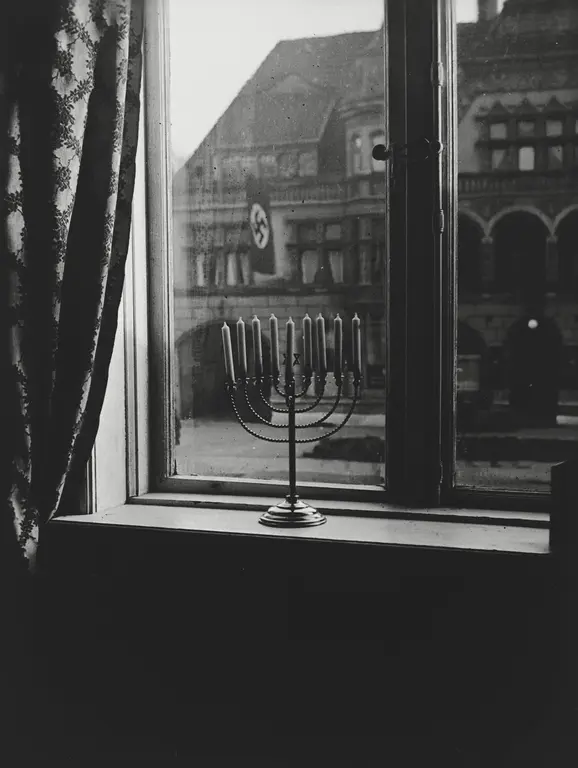
When Rosi Posner raised her compact camera to the window in Kiel that cold December afternoon of 1931, she wasn’t recording a dramatic event. There were no banners, no parades, no ruins—just a quiet German port city going about its business. But history was coiled tightly beneath that still surface. The Weimar Republic was unraveling. Industrial output had collapsed by almost half since 1929. Unemployment gripped six million Germans. Street battles between the brown-shirted SA and the communist Red Front had become routine. To look out that window was to see a nation in economic free fall and political delirium, but not yet aware of just how far it could still fall.
Kiel itself carried ghosts of earlier chaos. In 1918, it had been the spark of revolution: sailors in mutiny against the Kaiser’s hopeless war had refused to sail and lit the fire that toppled the German Empire. By 1931, those revolutionary embers had cooled into despair. The navy was rebuilding under the strict limits of Versailles; resentment festered in the docks and shipyards. Ordinary Germans like Posner lived between two worlds—one defined by democratic experiment, another by the lingering myth of imperial pride and revenge.
Only a year later, Hitler would be chancellor. By 1935, Kiel’s harbor would again bristle with U-boats and destroyers. By 1938, the Jewish families who once walked its streets freely would face boycotts, smashed windows, and deportation. The photograph Rosi took would soon become a relic of a Germany that no longer existed—an image from the fragile hinge between freedom and fanaticism.
And that’s what gives her snapshot its gravity. It isn’t about what she saw, but about what was about to happen just outside the frame: the transformation of a modern, educated society into a totalitarian war machine. Her picture is a still point in a storm not yet visible—a reminder that history doesn’t always announce itself with trumpets. Sometimes, it waits quietly behind a window, in the calm before the catastrophe.
The last sighting of a wild Barbary lion in the Atlas Mountains taken by Marcelin Flandrin in 1925.

When Marcelin Flandrin lifted his camera in the Atlas Mountains in 1925, he was unknowingly capturing the end of a species that had once ruled the empires of North Africa. His photograph—grainy, sun-bleached, and unassuming—shows the last confirmed sighting of a wild Barbary lion. This was no ordinary big cat. For centuries, it had been a living emblem of power, adorning Roman mosaics, paraded through Moroccan courts, and hunted by kings. Its dark mane and massive frame made it the stuff of myth—the lion of gladiatorial arenas, the beast that stalked Hannibal’s homeland. And yet, by the time Flandrin clicked his shutter, the Barbary lion’s dominion had been reduced to a rumor among shepherds and an entry in a hunter’s logbook.
The fall of the Barbary lion mirrored the story of the land it once roamed. Colonial expansion under the French had transformed Morocco’s forests and highlands into farmland, railways, and military outposts. The lions, already driven from the lowlands by rifles and deforestation, retreated deeper into the Atlas until there was nowhere left to go. The last of them weren’t slain in grand hunts or epic duels, but in quiet, bureaucratic extermination—shot as pests, their bones sent to museums in Paris and London. The empire that once used lions to symbolize conquest had finally conquered the lions themselves.
Flandrin’s photograph endures as something more than a zoological record—it’s a death certificate for a lineage that had survived since the Ice Age. The Barbary lion had seen Roman legions march, Moorish dynasties rise, and French colonial banners unfurl. And then, with a single image, it was gone. What lingers in that frame is not just an animal on the brink, but the uneasy realization that civilization’s progress has always been written in the disappearance of its wildest symbols.
Polish Jews captured by Germans during the suppression of the Warsaw Ghetto Uprising, 1943

In the spring of 1943, as smoke coiled above the ruins of the Warsaw Ghetto, German soldiers marched lines of exhausted men, women, and children through streets that were no longer streets—just corridors of ash and brick. The photo, taken during the suppression of the Warsaw Ghetto Uprising, shows Polish Jews being captured: hands raised, faces hollow, defiance finally crushed beneath the weight of a mechanized empire. It is one of those rare images where history doesn’t just record tragedy—it stares back at you with eyes that still seem alive, aware of what’s coming.
The uprising had begun weeks earlier, in mid-April. Armed with smuggled pistols, makeshift explosives, and a desperation that bordered on sacred, the Jews of Warsaw—trapped in a ghetto of nearly half a million souls—rose up against the German forces sent to deport them to Treblinka. They knew the odds. They knew there was no victory waiting for them, no rescue coming from outside. But they fought anyway. For nearly a month, they held off one of the most powerful armies in Europe with little more than courage and conviction. Every window became a firing point, every burned-out apartment a final stand.
When the Germans finally crushed the revolt, they did so with a precision that bordered on ritual. Street by street, bunker by bunker, they set the ghetto ablaze. By May, what had once been one of Europe’s most vibrant Jewish communities was a charred wasteland. General Jürgen Stroop, who led the operation, filed a report titled The Jewish Quarter of Warsaw Is No More. Inside it, the infamous photograph of captured civilians appeared—a document meant to signify order restored, rebellion extinguished.
But time has inverted the meaning of that image. The soldiers in the frame have faded into anonymity. The child with his hands raised, the women looking past the camera—those faces endure. They represent something the Nazis could never extinguish: the moment when ordinary people, stripped of everything, still chose resistance over surrender. The ruins of the Warsaw Ghetto became their monument, and that photograph their eternal witness.
Johnny Clem, the “Drummer Boy of Chickamauga” who shot and killed a Confederate officer and rose through the ranks to Major General at the time of his retirement in 1916.

Johnny Clem was ten years old when he ran away from home to join the Union Army. Too small to shoulder a rifle, too young to enlist, he found his place behind a drum in the 22nd Michigan Infantry. He became the regiment’s mascot, its adopted child, and eventually its legend. By the time most boys his age were memorizing their catechisms, Johnny Clem was marching through the smoke of the American Civil War. History remembers him as the “Drummer Boy of Chickamauga,” but that title barely hints at the impossible story that followed.
At Chickamauga in 1863, the line collapsed around him. Confederate troops poured through the trees. A mounted officer, sword drawn, demanded the boy’s surrender. Clem, barely twelve, raised a sawed-down musket instead. He fired once, hitting the officer squarely. When the smoke cleared, the child soldier stood alone among the fallen. The newspapers got hold of the story almost immediately—“The Drummer Boy of Chickamauga,” they called him—a living symbol of Union grit and youthful courage. In an age hungry for heroes, America found one in a child.
After the war, Clem didn’t fade into obscurity as many of his comrades did. He stayed in uniform, rising through the ranks over the decades that followed. By the time he retired in 1916, he was a Major General—the last Civil War veteran still on active duty. His career spanned the transformation of the United States from a fractured republic to an industrial power standing on the brink of global war. In Clem, you can trace the arc of a nation that survived its own destruction and grew up alongside the boy who refused to surrender.
There’s something mythic about his life—a child of war who lived long enough to watch the modern age unfold. The “Drummer Boy of Chickamauga” became more than a name in a history book. He was a reminder that America’s most enduring legends often begin not with great men, but with frightened children who did not know they were making history.
Shell-shocked US marine, Hue, Vietnam (1968)

His face is caked in grime, his hands locked around the barrel of his rifle like a lifeline. This is a U.S. Marine in Hue, Vietnam, 1968—photographed during one of the most brutal urban battles of the war. His eyes are vacant, not from fear, but from something beyond it: exhaustion so deep it erases the boundary between body and mind. In that thousand-yard stare lives the essence of modern war—disbelief that the world could ever be put back together again.
The Battle of Hue was supposed to be a limited engagement. Instead, it became one of the bloodiest fights of the entire Vietnam War. For nearly a month, American and South Vietnamese troops fought house-to-house through the ancient imperial city, a place once known for temples and poetry, now reduced to rubble. The North Vietnamese had occupied it during the Tet Offensive, turning monasteries into machine-gun nests and courtyards into killing fields. The Marines had trained for jungle warfare, not medieval street combat. Every doorway was a potential ambush. Every shadow, a grave.
By the end of February, Hue was a shattered monument to human endurance. Civilians lay buried in the ruins, and the perfume of incense was replaced by the stench of death. Reporters described Marines who could no longer speak, who flinched at the sound of their own breathing. Psychologists called it “combat fatigue.” Soldiers called it “the thousand-yard stare.” The man in this photo is that stare incarnate—his expression caught somewhere between survival and surrender.
He isn’t posing. He isn’t performing. He’s waiting—between orders, between worlds. You can almost hear the silence pressing against him, the awful pause before another explosion tears through the street. And in that silence, you glimpse what wars truly leave behind—not just the ruins of cities, but the fragments of the men who fought through them.