The Last Known Tasmanian Tiger (1933)
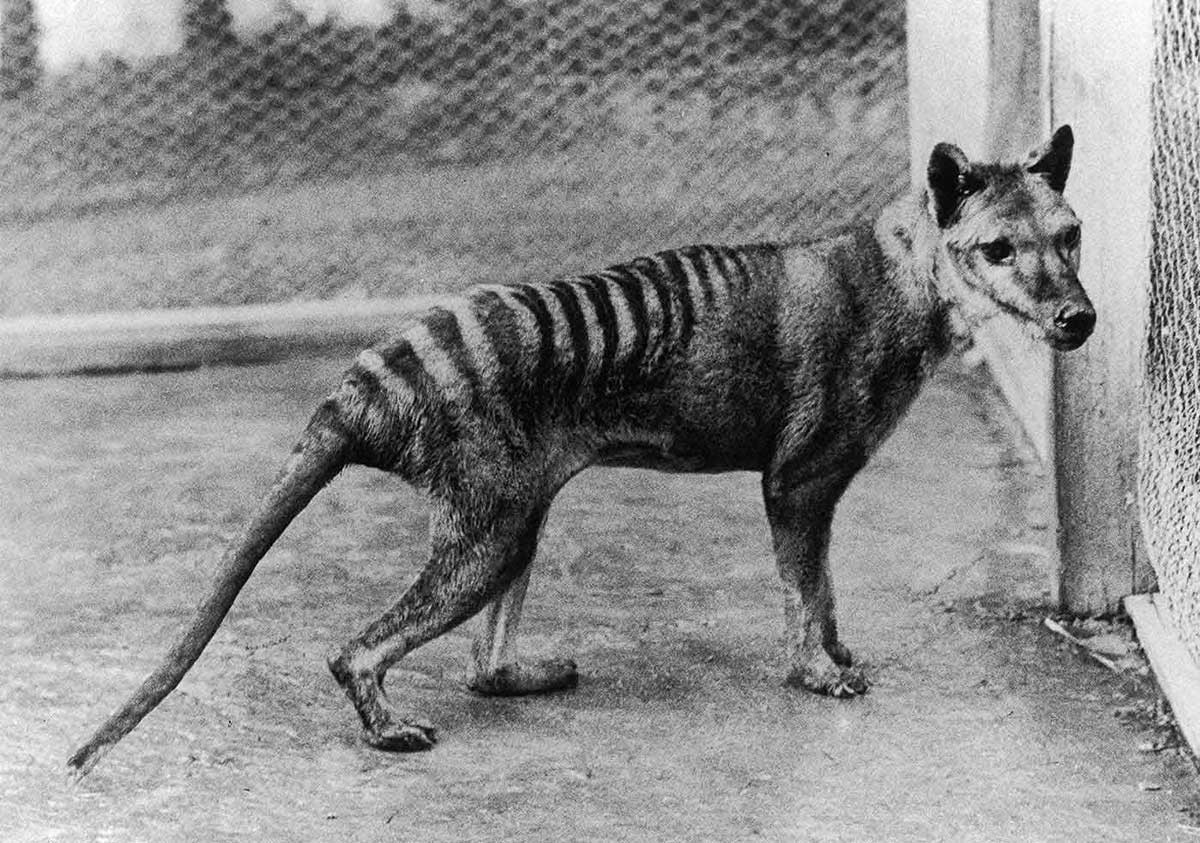
In 1933, a quiet moment was captured inside the Hobart Zoo in Tasmania — a striped, dog-like animal pacing behind wire fencing. The creature was a thylacine, commonly known as the Tasmanian tiger. Within just a few years, the species would be gone forever.
The photograph doesn’t show drama or violence. There is no hunter, no visible threat, no obvious catastrophe unfolding. Instead, it shows extinction happening slowly, in full view of modern civilization.
The thylacine had once roamed across Australia and Tasmania for thousands of years. It was a top predator, a marsupial hunter shaped by an ancient ecosystem. But by the late 19th and early 20th centuries, European settlement had transformed the landscape. Farmers blamed the animals for killing livestock, and the Tasmanian government placed bounties on them. Hunting campaigns, habitat loss, and introduced species pushed the population toward collapse.
By the early 1900s, the species existed mostly in scattered sightings and a handful of animals held in captivity.
The animal seen in the famous images and film footage is believed to be the last known individual, often referred to as “Benjamin,” though even that name is uncertain. It lived alone in the Hobart Zoo, displayed to visitors as a curiosity — the final representative of a species that had survived for millions of years.
In 1936, after being accidentally locked out of its shelter during cold weather, the animal died.
Only two months later, the Tasmanian government officially granted the species protected status.
The timing reveals the broader historical context. It captures a period when modern society still believed nature was endless, and when extinction was not yet widely understood as a permanent human consequence. The thylacine disappeared not because of a single event, but through policy decisions, economic pressure, and ordinary human activity carried out over decades.
The photograph marks a turning point in humanity’s relationship with the natural world — a moment when industrial expansion, settlement, and environmental loss became visibly connected.
Maria Callas and Marylin Monroe at the 1962 celebration of JFK’s birthday in NYC

That photograph was taken on May 19, 1962, at Madison Square Garden during the elaborate celebration for John F. Kennedy’s 45th birthday — an event that functioned less as a party and more as a display of American cultural power at the height of the Cold War. The room was filled with politicians, financiers, entertainers, and global cultural figures. The United States was projecting not just military strength, but prestige, influence, and sophistication.
Standing side by side are Maria Callas and Marilyn Monroe — two women who represented entirely different forms of global power.
Callas embodied the authority of European high culture. By 1962 she was the most famous opera singer in the world, representing centuries of artistic tradition built on discipline, training, and elite cultural legitimacy. Opera had long been tied to aristocratic taste and cultural hierarchy, and Callas brought intense drama and psychological realism to it, reshaping how audiences experienced the art form. At the same time, her dramatic personal transformation and her highly publicized relationship with shipping magnate Aristotle Onassis had made her a modern media figure — a bridge between old-world cultural authority and the emerging machinery of celebrity.
Monroe represented something different: the new American system of mass fame. She was the creation of Hollywood and modern media, a figure whose influence came from image, charisma, and enormous popular appeal rather than elite tradition. Her presence at the event signaled how entertainment and politics were beginning to merge into a single spectacle. Later that night she would deliver her famous “Happy Birthday, Mr. President,” a performance that blurred the line between political ceremony and celebrity theater in a way that felt unusually intimate for a presidential setting.
The Kennedy presidency actively cultivated this fusion of power and culture. The administration sought to present the United States as refined and culturally sophisticated while embracing Hollywood’s influence and visibility. The birthday celebration itself symbolized that shift — a moment when political authority, cultural prestige, and media spectacle occupied the same stage.
The image carries additional historical weight because of what followed. Within three months Monroe would be dead. Within eighteen months Kennedy would be assassinated. The photograph captures a brief moment of early-1960s confidence and glamour before a decade defined by upheaval.
Callas appears formal and composed, representing inherited tradition and cultural discipline. Monroe appears radiant and modern, representing a new kind of influence built on mass attention. The photograph captures a moment when older definitions of prestige and newer forms of celebrity power stood side by side, revealing a world in the process of redefining what influence actually meant.
Survivors of the first atomic bomb ever used in warfare are seen as they await emergency medical treatment in Hiroshima, Japan, in 1945.

On August 6, 1945, at 8:15 in the morning, a single bomb detonated over the city of Hiroshima, Japan. It was the first atomic weapon ever used in warfare. In an instant, the center of the city was consumed by heat, pressure, and radiation on a scale the world had never seen.
This photograph shows survivors in the immediate aftermath. They sit, collapse, or move slowly through streets that had only moments earlier been part of a functioning city. Many are burned, injured, or disoriented as they wait for emergency treatment. Hospitals had been destroyed or overwhelmed, medical staff killed or injured, and infrastructure wiped out. Aid, where it existed, was improvised.
The bomb, nicknamed Little Boy, was dropped by a U.S. B-29 bomber and exploded roughly 600 meters above the city. The blast produced temperatures hotter than the surface of the sun at ground level and a shockwave that flattened buildings across miles of urban space. Tens of thousands died instantly. By the end of 1945, an estimated 140,000 people in Hiroshima had died from blast injuries, burns, or radiation exposure.
Many survivors suffered severe burns from the intense thermal radiation. Others experienced radiation sickness in the days and weeks that followed — symptoms included hair loss, internal bleeding, fever, and organ failure. At the time, radiation exposure was poorly understood, and medical workers struggled to treat conditions they had never encountered before.
The atomic bombing of Hiroshima came near the end of World War II as Japan’s military position had already deteriorated. The United States argued the use of atomic weapons would force a rapid surrender and avoid a prolonged invasion of the Japanese mainland. Three days later, a second atomic bomb was dropped on Nagasaki. On August 15, 1945, Japan announced its surrender, bringing the war to an end.
The people in this image became known as hibakusha — survivors of the atomic bombings. Many lived with lifelong health complications, social stigma, and the lasting effects of radiation exposure. Their experiences shaped global awareness of nuclear warfare and contributed to international debates about nuclear weapons, deterrence, and the ethics of their use.
The photograph records one of the first moments in the nuclear age, when a new form of warfare revealed its human consequences not in theory, but in the lives of those who survived it.
Boris Yeltsin visits a grocery store in Houston, Texas with an official Soviet delegation

In 1990, Boris Yeltsin — then a rising political figure in the Soviet Union — walked through the aisles of a grocery store in Houston, Texas as part of an official Soviet delegation visiting the United States. The visit was intended to showcase everyday American life. What he encountered instead was a quiet confrontation with the economic realities separating the two superpowers.
Yeltsin was not visiting a government facility or a carefully staged exhibit. He was taken to a standard suburban supermarket — the kind of place ordinary Americans used every day. The shelves were full. Produce was abundant. Meat counters were stocked. Refrigerated aisles offered dozens of varieties of foods, drinks, and packaged goods. Consumers moved freely, selecting what they wanted without restriction.
For someone raised inside the Soviet economic system, this was not normal.
The Soviet Union operated under a centrally planned economy where production targets were determined by the state. Chronic shortages of basic goods were common. Long lines for food were routine. Consumer choice was limited, and distribution failures frequently left stores empty regardless of official production claims. The system prioritized heavy industry, military strength, and state control over consumer supply.
Yeltsin reportedly reacted with visible disbelief. Members of the delegation questioned whether the store had been staged specifically for their visit. They examined prices, packaging, and supply levels, trying to understand whether such abundance could exist on a national scale. The idea that an ordinary store, in an ordinary neighborhood, could maintain such consistent inventory challenged core assumptions about how economies functioned.
The visit occurred during a moment of deep instability inside the Soviet Union. By 1990, the state was already struggling with economic stagnation, declining productivity, and growing public dissatisfaction. Reform efforts under Mikhail Gorbachev — including perestroika and glasnost — had exposed structural weaknesses without fully repairing them. Shortages were worsening, and public faith in the system was eroding.
The Houston supermarket became a kind of informal demonstration of consumer capitalism. It showed not military power or ideological messaging, but logistical capacity — the ability to produce, transport, distribute, and sell goods efficiently across a vast market economy. It revealed a system built around supply chains, competition, and consumer demand rather than centralized allocation.
The encounter reportedly had a lasting effect on Yeltsin. Accounts from participants suggest he left the store shaken, openly acknowledging that the Soviet system could not compete with what he had seen. The experience reinforced his growing belief that fundamental economic and political transformation was necessary.
Within two years, the Soviet Union would collapse. Yeltsin would emerge as the first president of the Russian Federation, presiding over the turbulent transition from a planned economy to a market-based system.
The grocery store visit stands as a small but revealing episode in the final chapter of the Cold War — a moment when geopolitical rivalry was experienced not through weapons or speeches, but through the contents of supermarket shelves.
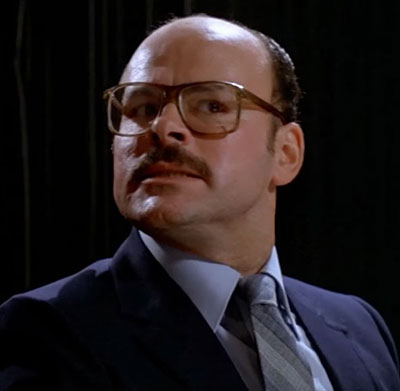
Orson Welles During the War of the Worlds Broadcast (1938)

In October 1938, Orson Welles stood inside a CBS radio studio in New York and helped trigger one of the strangest episodes in American media history. The broadcast was part of Mercury Theatre on the Air, a weekly radio drama. That night’s performance adapted H.G. Wells’ novel The War of the Worlds — but not as a traditional story. It was delivered as a series of simulated news bulletins describing a Martian invasion of the United States.
To understand what happened, you have to understand radio in 1938.
Radio wasn’t background noise. It was authority. It was how Americans learned about wars, disasters, elections, and crises. When programming was interrupted by a news bulletin, it meant something serious had happened. The voice coming through the speaker carried institutional trust.
Welles and his team built the broadcast around that trust. The program began like a normal music performance before suddenly shifting into urgent reports. A strange object had fallen in New Jersey. Scientists were on the scene. Military units were mobilizing. The situation was escalating. Reporters described crowds fleeing, weapons failing, entire cities under attack.
The actors delivered the lines in restrained, professional tones — the language and cadence of real emergency coverage. The structure mirrored how Americans were used to hearing breaking news.
Some listeners tuned in late and missed the opening disclaimer identifying the show as fiction. What they heard instead sounded like catastrophe unfolding in real time. Phone lines at police stations and newspapers lit up. People sought confirmation from neighbors and authorities. Some prepared to evacuate. Though later reports exaggerated the scale of the panic, the reaction was real enough to expose something new about modern society.
The timing mattered. The world in 1938 was tense. Europe stood on the edge of war. Americans had grown used to hearing sudden international developments over the radio. The idea that normal life could be interrupted by shocking news did not seem far-fetched.
The broadcast revealed something larger than a successful radio drama. It demonstrated the power of mass communication to shape perception instantly. A small group of performers in a studio created a national reaction by speaking with the voice of authority. The boundary between fiction and reality proved thinner than many assumed.
What this photograph captures is more than a moment in broadcasting history. It shows the early architecture of the modern information age — a system where trust in media can mobilize emotion, shape belief, and influence behavior at scale. The technology was radio, the medium was drama, but the mechanism is familiar: information delivered with authority can become reality in the minds of millions.