
A young Joseph Stalin (right) stands over the body of his 22yr old wife, Kato Svanidze. They had only just welcomed their first son.”This creature softened my heart of stone. She died and with her died my last warm feelings for humanity.” 1907
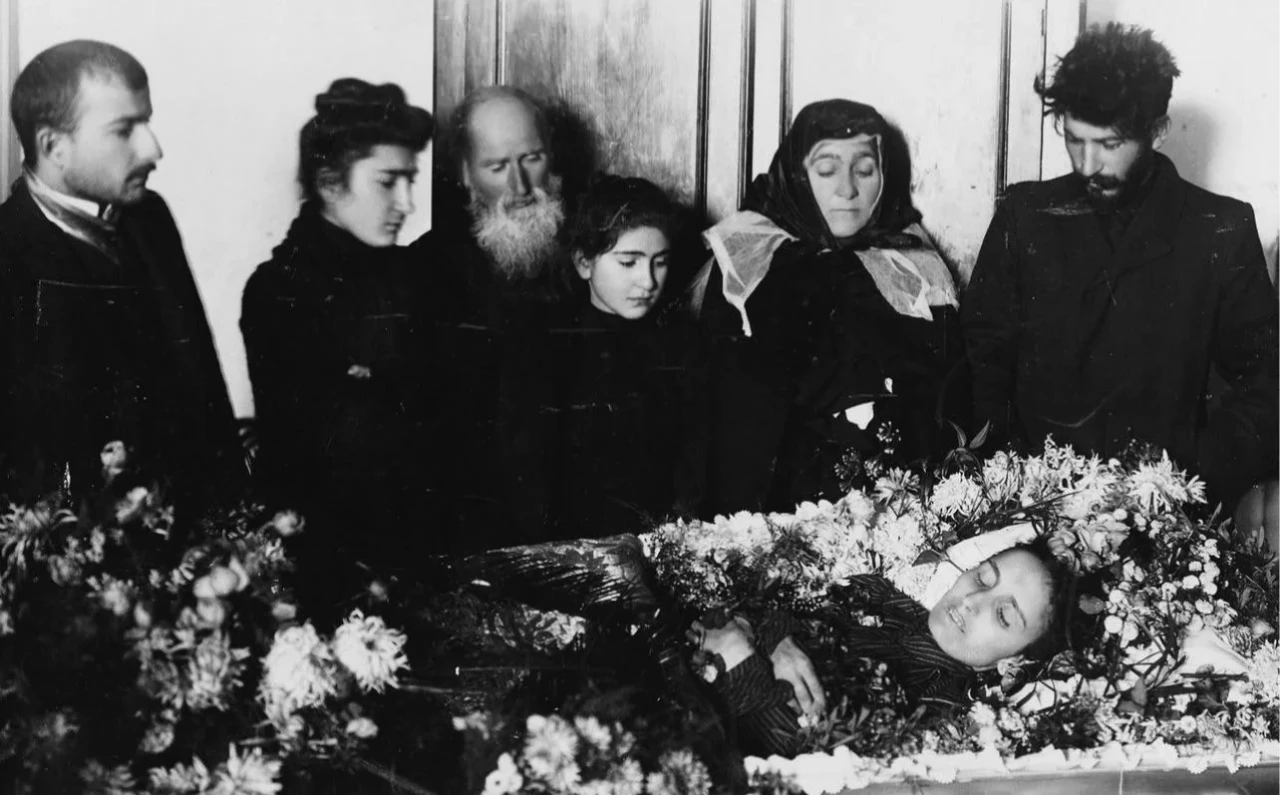
The photograph captures something unsettling. Stalin still known more as Ioseb Jughashvili than as the iron figure history would later remember stands rigid. The future dictator, architect of purges and famine, is here simply a widower.
Georgia in the early 20th century was restless and brittle. The Russian Empire strained under revolution. Stalin had already tasted prison, exile, underground politics. His life was conspiracies, pamphlets, coded letters. Kato was something else. Warm, devout, from a respectable Georgian family. Against the chaos of revolution, she represented something almost domestic. Human.
When she fell ill typhus likely, or tuberculosis there was little to be done. Medicine in the Caucasus at the time could not compete with infection. Within months of giving birth to their son, Yakov, she was dead.
At her funeral, Stalin reportedly threw himself against the coffin. Witnesses later recalled him distraught, inconsolable. And then came the line attributed to him. “This creature softened my heart of stone. She died and with her died my last warm feelings for humanity.”
Whether polished by memory or sharpened by later myth, the sentiment fits the trajectory. After 1907, the young revolutionary hardened. The underground work deepened. Arrests followed. Siberian exile. Escape. Return. Each step pulling him further from the intimate sphere of husband and father and closer to something colder. Ideological. Relentless.
His son Yakov would grow up distant from him. Their relationship would fracture under the weight of revolution and expectation.
Historians debate how much personal grief shapes political cruelty. Was this the moment something closed. Or was the stone already there, merely waiting for history to carve it into something monumental.
In 1907, though, before the Five Year Plans, before the purges, before the machinery of the state turned lethal on millions, there is this still image. A young man in mourning clothes, staring down at a coffin. The revolution had not yet remade him into steel.
But whatever warmth existed in him, if we take his words seriously, he believed it was buried there in Tiflis alongside a 22 year old woman who never saw what her husband would become.
Mohammad Shah Pahlavi with his wife and child the day of his coronation, October 26, 1967

On October 26, 1967, Mohammad Shah Pahlavi stood at the center of a ceremony built to project permanence. The setting was Tehran. The stage was imperial. The message was unmistakable. After more than two decades on the throne, the Shah was finally crowning himself.
Beside him stood his wife, Farah, and their young child. The image was deliberate. Not just a ruler, but a dynasty. Not just power, but continuity.
The coronation came late. Mohammad Reza Shah had technically ruled Iran since 1941, placed on the Peacock Throne after Allied forces forced his father, Reza Shah, to abdicate during the Second World War. But for years his position had been fragile. Political crises, foreign influence, and internal opposition meant that authority had to be built carefully, sometimes ruthlessly.
By 1967, he believed that moment had arrived.
The ceremony itself was controlled spectacle. Crowns heavy with jewels. Military uniforms pressed to perfection. Ancient Persian symbolism woven into modern state power. The Shah placed the crown on his own head, a gesture loaded with meaning. Authority granted not by clergy, not by parliament, but by destiny and history.
Then came something unprecedented in Iranian monarchy. He crowned Farah as Empress. For the first time in modern Iranian history, a woman was given a formal constitutional role as regent, empowered to rule if the Shah died before their son came of age. It was presented as modernization, a vision of Iran stepping into the future.
The family standing together that day embodied the promise he wanted the world to see. A young heir. A modern royal couple. A nation rising through rapid industrialization, education reforms, and sweeping social change often grouped under the banner of the White Revolution.
But beneath the pageantry, tension lived quietly.
Iran was transforming at a speed that left many behind. Rural traditions collided with urban modernization. Religious authorities watched with suspicion as Western influence spread through culture and politics. Wealth from oil fueled development, but also deepened inequality. The same state that celebrated progress also expanded its security apparatus, silencing dissent through surveillance and force.
The coronation, in this sense, was more than ceremony. It was a declaration that history had chosen its direction.
For a brief moment, captured in photographs, everything appeared settled. The Shah, the Empress, the child. Order, continuity, and imperial confidence.
Twelve years later, the monarchy would collapse in revolution. The dynasty presented as eternal would be swept away by forces already stirring beneath the surface on that October day in 1967.
But in that moment, under the weight of crowns and the gaze of a nation, the future still seemed secure. A family stood together, believing they were not witnessing history’s turning point, but its confirmation.
The mother offered her children for sale in Chicago in 1948 due to extreme poverty hiding her face in shame

In 1948, in Chicago, a photograph captured a moment that cut straight through the idea of postwar American prosperity. A mother stood beside her children and offered them for sale. She turned her face away from the camera, hiding it in shame.
The United States had just emerged from the Second World War as the world’s dominant economic power. Factories were booming. Suburbs were expanding. The American middle class was being built in real time. But beneath that growth lived another reality. Entire families, especially in crowded urban neighborhoods, existed on the edge of survival.
For many working class Americans, the transition from wartime production to peacetime stability was uneven. Jobs disappeared. Housing shortages were severe. Inflation strained families already living paycheck to paycheck. Public assistance programs were limited and often carried deep social stigma. Poverty was not simply economic hardship. It was isolation.
The woman in the photograph, later identified as Lucille Chalifoux, lived in a small Chicago apartment with her husband and four children. Her husband was reportedly unemployed and abusive. Their rent was overdue. Food was scarce. According to later accounts, she had reached a point where selling her children seemed like the only way to keep them alive.
The sign placed near the children read simply: “4 children for sale.”
The image spread quickly through newspapers. It shocked the public, not only because of the act itself, but because it exposed a contradiction. This was not a distant famine or a war zone. This was America in 1948, a nation celebrating victory and prosperity while some of its citizens faced desperate choices.
What followed made the story even darker.
The children were eventually sold. Two were taken by one family, two by another. Reports from decades later described harsh conditions and abuse in their adoptive homes. The act meant to save them instead scattered the family permanently.
Wyoming Internment camps for the forcibly relocated Japanese Americans during World War II

The policy began in 1942, after Japan’s attack on Pearl Harbor. Fear spread quickly across the American West Coast. Military leaders and political officials argued that Japanese Americans, even those born in the United States, might act as spies or saboteurs. Evidence was thin, but the atmosphere of wartime panic made restraint difficult.
President Franklin D. Roosevelt signed Executive Order 9066 on February 19, 1942. The order authorized the military to designate exclusion zones and remove anyone considered a threat. In practice, it targeted Japanese Americans almost exclusively. Families were given days or weeks to sell businesses, leave homes, and carry only what they could hold.
They were first sent to temporary assembly centers, often converted racetracks or fairgrounds. From there they were transported inland to permanent camps run by the War Relocation Authority. Ten major camps were built across remote regions of the United States. Wyoming’s Heart Mountain Relocation Center was one of the largest.
The choice of location was deliberate. Harsh climates, geographic isolation, and wide open terrain made surveillance easier. At Heart Mountain, more than 14,000 people lived behind barbed wire and under armed guard at its peak. The barracks were hastily constructed from wood and tar paper, offering little insulation against Wyoming’s brutal winters or scorching summers.
Life inside the camps developed its own structure. Schools were organized. Newspapers were printed. People formed baseball leagues, churches, and community groups. Yet this appearance of normalcy existed within confinement. Residents could not leave freely. Guards watched from towers. Their imprisonment was based not on proven actions but on ancestry.
The policy also revealed a profound contradiction. Nearly two thirds of those interned were American citizens by birth. While their families were confined, thousands of young Japanese American men volunteered or were drafted into the U.S. military. The 442nd Regimental Combat Team, composed largely of Japanese Americans, became one of the most decorated units in American military history.
Resistance existed as well. Some refused military service while their rights were suspended. At Heart Mountain, a group of draft resisters challenged the government, arguing that loyalty could not be demanded while constitutional protections were denied. They were prosecuted and imprisoned.
By 1944, the Supreme Court upheld the government’s actions in Korematsu v. United States, ruling that wartime necessity justified the exclusion. The camps began closing in 1945 as the war ended. Families returned to communities where homes, businesses, and property were often gone.
Decades later, the United States government formally acknowledged the injustice. In 1988, the Civil Liberties Act issued an apology and provided financial reparations to surviving internees, recognizing that the policy had been driven by race prejudice, war hysteria, and a failure of political leadership.
The rows of barracks in Wyoming represent more than a wartime measure. They mark a moment when fear overrode constitutional principles, when citizenship proved fragile, and when a democratic nation chose confinement as a solution to uncertainty.
Adolf Eichmann Walks Around the Yard of his Cell, 1961

In 1961, Adolf Eichmann walked slowly around the yard of his prison cell in Israel. The image shows an ordinary man in plain clothes, pacing under guard. By then, he had become one of the most recognizable defendants of the postwar era.
During the Third Reich, Eichmann was not a battlefield commander or a public figure. He was a bureaucrat. As head of Section IV B4 of the Reich Main Security Office, he oversaw the logistics of deporting millions of Jews to ghettos and extermination camps. His work was paperwork, train schedules, quotas, and coordination between ministries. The machinery of genocide depended on that kind of administrative precision.
After Germany’s defeat in 1945, Eichmann was captured briefly by American forces but escaped. Using false papers, he moved through networks that helped former Nazis flee Europe. By 1950, he had settled in Argentina under the alias Ricardo Klement. For more than a decade, he lived quietly, working in factories and raising his family.
In 1960, Israeli intelligence agents located and abducted him in Buenos Aires. The operation, carried out by the Mossad, transported Eichmann to Israel to stand trial. The capture was controversial internationally, but it ensured that one of the central organizers of the Holocaust would face public justice.
The trial began in Jerusalem in April 1961. It was among the first major proceedings to be widely televised. Survivors testified in detail about deportations, ghettos, forced labor, and extermination. The proceedings shifted global awareness of the Holocaust. For many viewers, this was the first time survivor testimony was broadcast into living rooms around the world.
Eichmann’s defense rested on a claim that would become infamous. He argued that he was merely following orders, a functionary carrying out state policy without personal malice. Observers were struck by his demeanor. He did not appear monstrous. He appeared bureaucratic. Controlled. Detached.
The photograph of him walking in the prison yard captures that unsettling contrast. The organizer of mass deportations reduced to a solitary figure under guard, pacing within the confines of a modern state that had been born from the catastrophe he helped engineer.
In December 1961, he was found guilty on multiple counts, including crimes against humanity and war crimes. He was sentenced to death and executed in 1962. His body was cremated, and his ashes were scattered at sea beyond Israel’s territorial waters.
The trial marked a turning point. It reinforced the principle that individuals, not just states, could be held accountable for crimes against humanity. It also forced the world to confront the administrative structure of genocide, the reality that mass murder had depended not only on ideology and hatred, but on officials who insisted they were simply doing their jobs.