
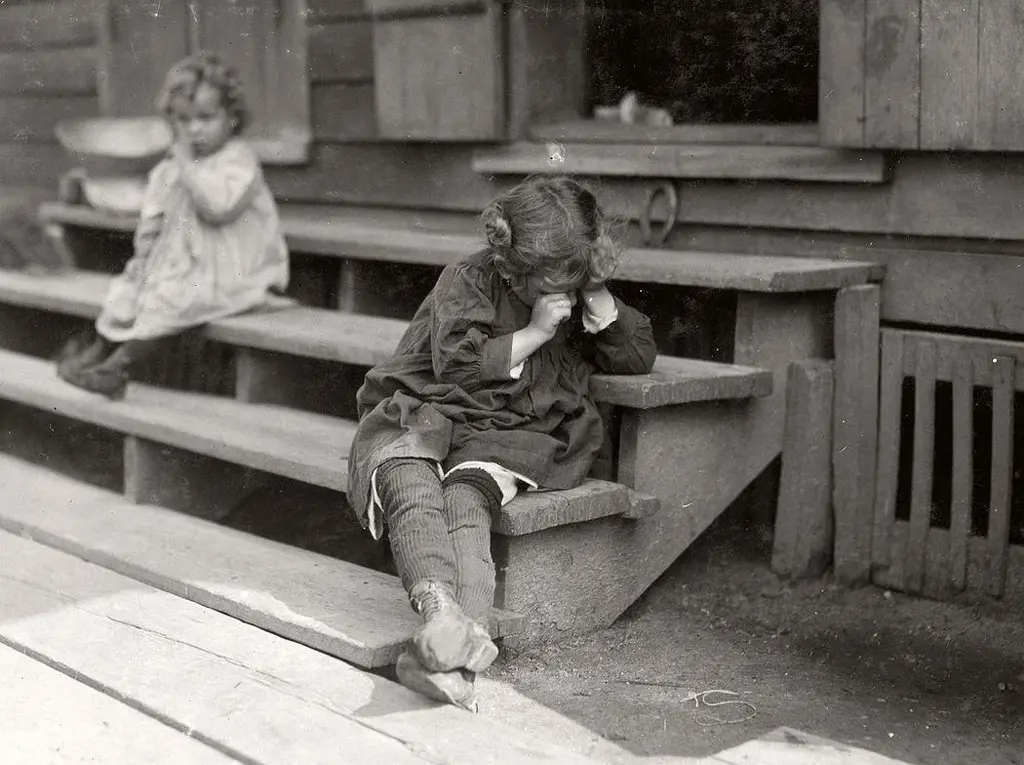
5-year-old after day’s work, was tired and refused to be photographed, Biloxi, Mississippi, 1911. Photo by Lewis Hine for National Child Labor Committee.
There’s a moment here—small, almost forgettable if you’re not paying attention—where history stops pretending to be abstract.
A five-year-old. Not a symbol. Not a statistic. A kid. And already, the day has taken something out of her.
Look at the posture. Not dramatic. Just… spent. The kind of exhaustion that doesn’t belong to children. Her body has learned something too early—that effort is constant, that rest is conditional.
And then the camera arrives.
Not as a neutral observer, but as part of a campaign. By 1911, the United States is deep into its industrial adolescence. Along the Gulf Coast—places like Biloxi—canneries and seafood operations relied on cheap labor. And “cheap” often meant children.
The logic was simple. Small hands for delicate work. Lower wages. Fewer complaints. Kids peeled shrimp, shucked oysters, sorted seafood for hours that blurred together—sometimes before sunrise, sometimes long after dark. Laws were weak or ignored. Families needed money. Employers needed labor. The system fed itself.
Enter Lewis Hine.
Not just a photographer, but an investigator for the National Child Labor Committee. He traveled factory to factory, sometimes lying to get inside. He carried a camera and a notebook—recording names, ages, hours, wages—turning lives into evidence.
But nothing was simple.
These weren’t staged portraits. They were negotiations. Children who didn’t trust him. Foremen who didn’t want him there. And moments like this—where the subject refuses.
“Just one picture.”
But she refuses. And that refusal matters.
Because it’s one of the few things she can control.
She can’t control the work, the hours, or the expectations. But she can turn away. She can deny the world one more thing it wants from her.
And maybe that resistance becomes part of the record too.
Because the photograph still gets taken.
And when people far from Biloxi see images like this, it begins to chip away at what had been accepted. Over time, pressure builds. Laws tighten. The idea that childhood should be protected—slowly, unevenly—takes hold.
This image sits in the middle of that shift.
Not as a turning point. Just a fragment. A child on wooden steps, refusing a photograph after a day’s work.
And in that refusal, you can see both the world as it was—and the first cracks in it.
Japanese army entering Nanjing, December 13, 1937

December 13, 1937. The gates of Nanjing give way.
What had been the capital of China—political center, cultural anchor, a city with centuries behind it—becomes something else almost immediately. The Imperial Japanese Army enters, and whatever structure or restraint might have existed begins to dissolve.
To understand what follows, you have to rewind just slightly.
Shanghai has fallen after months of brutal fighting. Japanese forces, hardened and frustrated by the resistance they faced, move inland toward Nanjing. The Chinese government retreats. Soldiers are left behind—some still armed, many discarding uniforms and trying to blend into the civilian population. The city fills with fear before the first troops even arrive.
And then they do.
At first, it looks like occupation. Troops marching in. Positions taken. Order imposed.
But that order doesn’t hold.
What follows is not controlled violence. It is violence that spreads.
Captured soldiers—many of them disarmed, bound, no longer capable of resistance—are taken in groups to the outskirts of the city. Along the Yangtze River. Into open fields. There, they are executed in waves. Machine guns. Bayonets. Bodies falling into ditches, into water, into piles that grow faster than they can be buried.
Civilians are not spared. Men are pulled from their homes under suspicion of being former soldiers and killed on the spot. Others are lined up and shot without explanation. Entire sections of the city become places where people simply disappear.
And then there are the assaults.
Women and girls—young, old, it makes no difference—are dragged from homes, from streets, from places they believed were safe. The violence is not isolated. It is repeated, widespread, carried out openly. In many cases, victims are killed afterward. In others, left alive in a city where there is no protection left to find.
Looting follows. Houses are emptied. Shops stripped. Fires break out and are left to burn. What begins as entry turns into something closer to collapse—of law, of restraint, of the idea that there are limits.
And this continues. Not for a day. Not for a single outburst.
For weeks.
The numbers are argued over, as they often are. But even the lowest estimates point to tens of thousands killed. Many historians place it far higher—into the hundreds of thousands. It becomes known as the Nanjing Massacre, though that word—massacre—feels almost insufficient for something this prolonged.
What’s striking is how much of it is recorded as it happens.
Foreigners who remain in the city—missionaries, doctors, businessmen—establish what becomes the Nanjing Safety Zone, an attempt to protect civilians in a small section of the city. They write diaries. They send letters. They document what they see: executions, assaults, bodies in the streets. Day after day, trying to capture something that resists being fully captured.
There are photographs too. Not distant, not abstract—immediate. Evidence created in the middle of the event itself.
The entry into Nanjing is not just a military moment. It is a threshold.
A point where whatever limits existed collapse, and violence becomes self-sustaining. Each act making the next easier. Each day lowering the boundary further.
By the time the world begins to understand what has happened, the city has already been transformed.
December 13 is only the beginning.
What follows is what defines it.
Operation Babylift brought more than 3000 Vietnamese babies to the USA after their parents died during the Vietnam War-

April 1975. South Vietnam is collapsing.
The war that had stretched across decades is reaching its final days. North Vietnamese forces are closing in on Saigon. The government is unraveling. Evacuations begin—not in an orderly way, but in fragments. Helicopters, cargo planes, last-minute decisions made under pressure.
And in the middle of that, there’s a different kind of movement.
Not soldiers. Not diplomats.
Children.
Operation Babylift is announced as a humanitarian effort—an attempt to evacuate thousands of Vietnamese orphans before the fall of Saigon. The idea is simple on the surface: remove them from a war zone, place them with families in the United States and other countries, give them a life that the war might otherwise take away.
But the reality on the ground is far less clean.
These aren’t just “orphans” in the way the word suggests. Some are. Many have lost parents to the war—bombings, displacement, disease, the slow grinding collapse of daily life in a country at war with itself and others. But others are children whose families are still alive, separated in the chaos. Paperwork is rushed. Records are incomplete. Decisions are made quickly because time is running out.
The first flight leaves on April 4, 1975.
A U.S. Air Force C-5A Galaxy, one of the largest aircraft in the world, loaded with hundreds of children—infants strapped into makeshift carriers, older children seated where space allows. It’s a picture of urgency more than planning. A massive machine built for war, now carrying its smallest passengers.
And then, shortly after takeoff, something goes wrong.
A mechanical failure. Loss of control. The plane crashes.
More than a hundred children die, along with crew members and volunteers. The mission that was meant to save lives begins with catastrophe.
But the operation doesn’t stop.
Flights continue. Planes leave Saigon carrying children out of a country that is, in real time, ceasing to be what it was. By the end, more than 3,000 children are evacuated to the United States and other countries.
And here’s where the story becomes harder to pin down.
Because for some, this is rescue. Children placed into families, given stability, safety, opportunity—lives that unfold far from the war that defined their beginnings.
For others, it’s something closer to dislocation. Identities erased or rewritten. Families lost—not always to death, but to separation that can’t be undone. Questions that don’t have answers: Who were my parents? Was I meant to leave? Was I taken from something, or saved from it?
What you see in the photographs—the rows of babies, the crowded aircraft, the sense of urgency—is only the surface.
Underneath it is a collision of intentions.
Humanitarian impulse. Political urgency. Chaos. Fear. Hope.
All compressed into a narrow window of time, just days before Saigon falls.
Operation Babylift doesn’t fit neatly into a single category. It isn’t purely rescue. It isn’t purely loss.
It’s both, happening at the same time.
And for the thousands of children carried out of Vietnam in those final days, it becomes the dividing line of their lives—before and after—whether they chose it or not.
German women clearing rubble in Berlin. 1945.

Berlin, 1945. The war is over, but the city hasn’t caught up to that idea yet.
What remains is not a capital. Not really even a city in the way people understand it. It’s a landscape of broken walls, collapsed roofs, streets that don’t lead anywhere anymore. Entire neighborhoods reduced to piles of brick and dust. The infrastructure of a country that had tried to dominate a continent now lying in pieces at its own center.
And in the middle of it, there are women.
Not gathered for a moment, not posing for the camera—working.
They are called Trümmerfrauen—“rubble women.”
The men, for the most part, are gone. Dead, missing, or sitting in prisoner-of-war camps scattered across Europe and beyond. What’s left behind are the people who have to deal with what the war actually did to the ground itself. And so the work falls to them.
Brick by brick.
There’s a rhythm to it. Clear, stack, salvage. Anything that can be reused is set aside. Anything that can’t is moved out of the way. Not because there’s a grand plan in place, but because there has to be some way forward, and this is the only one available.
It’s physical work. Repetitive. Relentless. The kind of labor that doesn’t announce progress in big moments, only in small changes—a cleared street, a partially standing wall, a space where something might eventually be rebuilt.
And there’s something else happening here too, just under the surface.
Because this isn’t just reconstruction. It’s confrontation.
Every brick was part of something. A home. A government building. A piece of a system that, not long ago, felt permanent. Now it’s in their hands, reduced to fragments. The same society that had marched in lockstep is now reduced to individuals carrying debris, one load at a time.
No speeches. No banners. Just the aftermath.
The photographs don’t show dramatic emotion. No grand expressions of grief or anger. Just faces focused on the task. Because whatever comes next—politically, socially, morally—can’t even begin until the physical reality is addressed.
You can’t rebuild a country while it’s still buried.
And so they clear it.
Day after day. Street after street. Not as a symbolic act, but as a necessary one.
By the time Berlin starts to resemble a city again, much of that work will already have been done quietly, without recognition, without ceremony.
What you’re looking at isn’t the end of the war.
It’s what comes after the ending—when there’s nothing left to do but pick up what remains and decide, piece by piece, what gets built in its place.
West Virginia coal mine, circa 1940.

West Virginia, around 1940. Before the sun comes up, the day has already started.
The mines don’t wait for daylight. They don’t care about seasons, or weather, or how a man feels when he wakes up. The work is the same—down into the earth, into spaces carved out just enough to stand, sometimes not even that.
There’s a shift change, a brief moment where one group surfaces and another goes down. Faces coming up are hard to read under the coal dust. Eyes stand out first. Everything else is blackened, blurred into something almost uniform.
Underground, time works differently.
No sky. No horizon. Just the narrow beam of a lamp and the sound of tools hitting rock. The air is thick—coal dust suspended, invisible but constant. It settles into lungs over years, slowly turning breath into something heavier, shorter. Not all at once. Just enough, over time, that a man notices it when he climbs a hill, or tries to sleep.
The work itself is repetitive. Cut, load, haul. Machines help, but they don’t remove the danger. Roof collapses happen without warning. Gas pockets ignite. A single mistake—or sometimes no mistake at all—can turn a shift into something else entirely.
And yet, this is steady work.
In a place where options are limited, the mine offers something close to certainty. A paycheck. Not a large one, not always a fair one, but enough to keep things moving above ground—families, homes, entire towns built around the rhythm of extraction.
Because that’s what this is, at its core.
Taking something out of the earth and turning it into power somewhere else. Electricity in distant cities. Heat in homes that will never see the men who made it possible. The connection exists, but it’s invisible.
What you see in the photograph—men covered in coal, standing at the edge of a shift—is only the surface of that system.
There’s no spectacle here. No single dramatic moment. Just accumulation. Days turning into years. Dust turning into something permanent inside the body.
By 1940, people already know some of the cost. Black lung disease isn’t a mystery, even if it’s not fully understood. Accidents aren’t rare, even if they’re treated as part of the job. The risk is built in, accepted not because it’s reasonable, but because the alternative is unclear.
And so the work continues.
The men go down. The coal comes up. The world above keeps moving.
And in between those two things—deep underground and far away—there’s a space where the cost exists, mostly unseen.