British Prime Minister Arthur Neville Chamberlain and Reich Chancellor Adolf Hitler in Munich before signing the agreement on the transfer of the Sudetenland region of Czechoslovakia to the Third Reich, September 29, 1938.
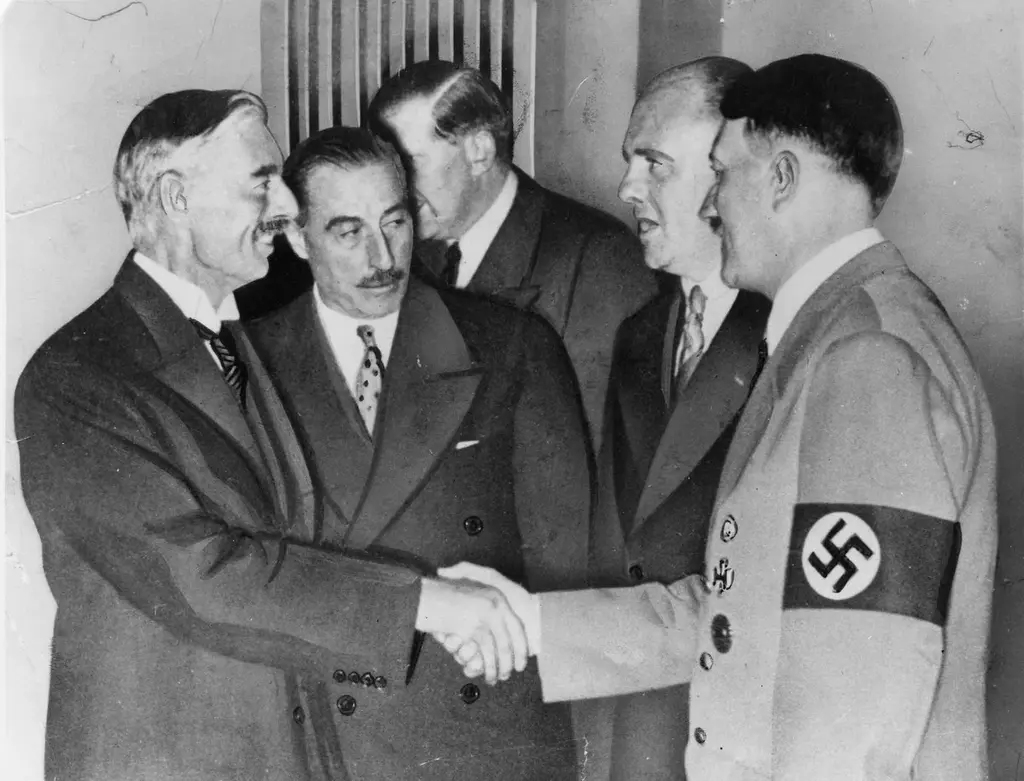
September 29, 1938. Munich.
The room is controlled, almost polite. A handshake between British Prime Minister Neville Chamberlain and Adolf Hitler, two men representing states moving toward very different futures, but for a moment standing as if an agreement might hold things together.
They are not alone. Around them are the other architects of the deal, including French Prime Minister Édouard Daladier and Italian dictator Benito Mussolini. Notably absent is Czechoslovakia itself, the country whose fate is being decided in the room without its participation.
The issue is the Sudetenland, a border region of Czechoslovakia with a large ethnic German population. Hitler had demanded its annexation, framing it as self determination. But the demand was backed by the threat of war. German forces were already mobilized. Europe had seen this pattern before, in the remilitarization of the Rhineland and the annexation of Austria earlier that same year.
For Britain and France, the memory of the First World War was still close enough to shape every decision. The loss, the scale, the sense that Europe nearly destroyed itself. Chamberlain arrived in Munich carrying that weight, convinced that another war had to be avoided if at all possible.
The agreement they reached allowed Germany to occupy the Sudetenland.
In return, Hitler assured them that he had no further territorial demands in Europe.
On paper, it looked like a compromise. A concession made to preserve peace. Chamberlain would return to Britain and speak of securing peace for our time, believing that he had stepped back from the brink.
But even in this moment, there were signs of what this really was.
Czechoslovakia was a functioning democracy with defensive alliances, a modern army, and fortified borders in the Sudetenland. By forcing it to cede that territory, the agreement stripped away its natural defenses and left it exposed. Within months, in March 1939, Germany would occupy the rest of the country outright, proving that the promise made in Munich was never meant to last.
The photograph captures something quieter than what we now know it represents.
There is no visible tension in the handshake. No sense of urgency. Just the formality of diplomacy, the ritual of leaders behaving as though they are managing events rather than being carried by them.
But the imbalance is already there.
One side is making concessions to avoid conflict.
The other is learning that those concessions can be extracted without consequence.
Less than a year later, in September 1939, Germany would invade Poland. Britain and France would declare war. The attempt to contain the crisis through agreement would give way to a conflict far larger than the one it was meant to prevent.
The last Romanov costume ball held at Winter Palace in 1903. It was held in the in two stages, on February 11 and 13
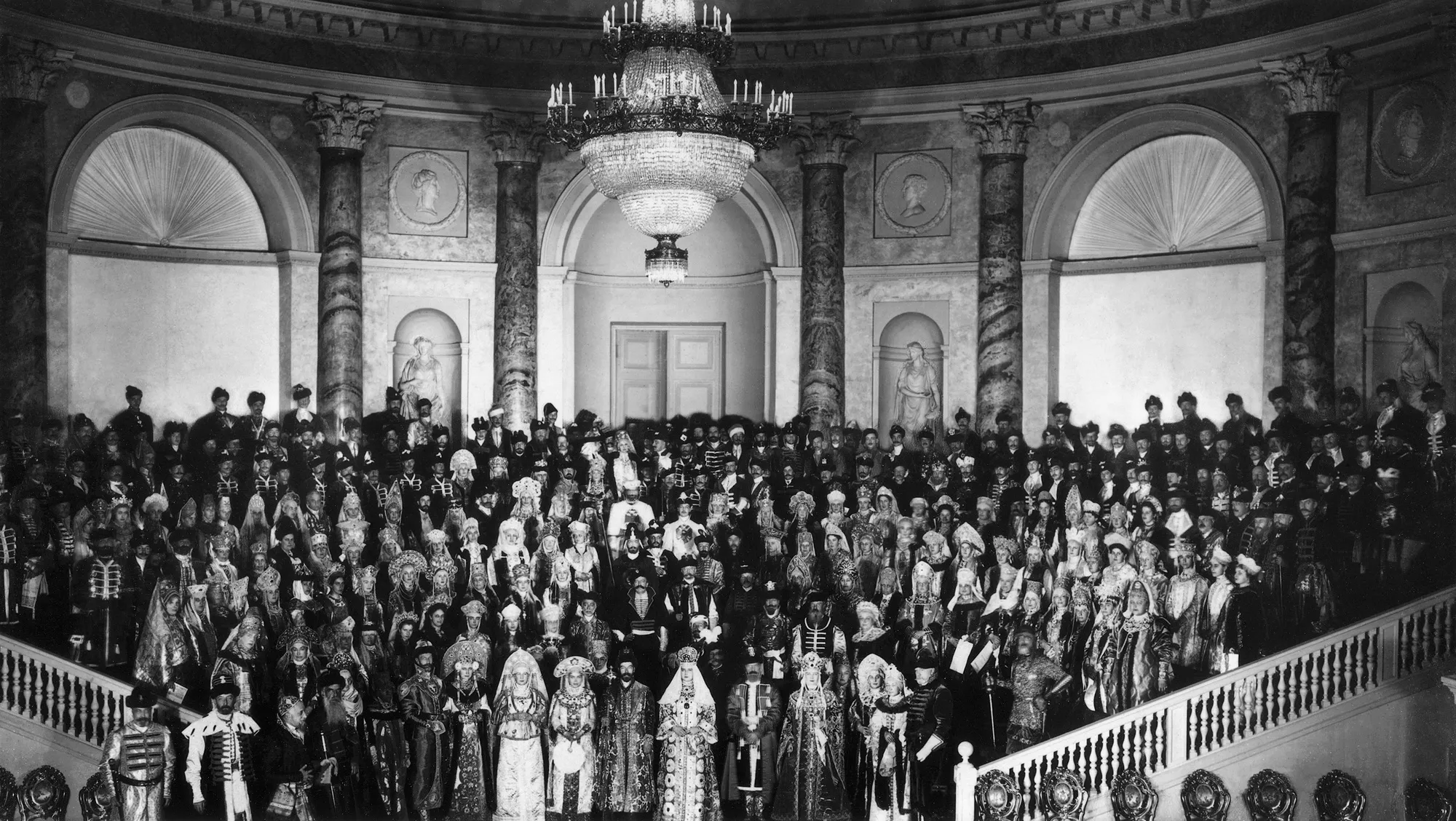
February 1903. The Winter Palace is lit like it still belongs to a world that cannot end.
They came dressed as ghosts of a Russia that never quite existed, boyars and tsarinas from the 17th century, before Peter the Great forced the empire to look west. The costumes were not improvised. They were painstakingly researched from old court records and paintings, designed to recreate the court of Tsar Alexei Mikhailovich down to the embroidery and headdresses. Silk, brocade, sable fur. Jewels layered so heavily they blurred the line between ornament and burden.
Nearly four hundred members of the imperial court filled the halls of the Winter Palace in Saint Petersburg, grand dukes, duchesses, generals, ladies in waiting, and officers of the guard. The Romanov elite, gathered at the height of their power. Photographers were brought in to document it all, producing images that would later feel less like portraits and more like evidence.
At the center stood Tsar Nicholas II and Empress Alexandra, dressed as 17th century rulers, he as Tsar Alexei, she as Maria Miloslavskaya. It was more than pageantry. The Romanovs were consciously reaching backward, invoking a pre modern, almost mythic Russia, before reforms, before industrialization, before the state had to answer to anything beyond itself. A visual argument that their rule was ancient, sacred, and unbroken.
The event unfolded over two nights. The first was a formal reception and concert. The second was a grand ball where traditional Russian dances replaced the more modern European styles that had dominated court life for centuries. Even the menu leaned into historical nostalgia. It was, in every sense, a curated retreat into an earlier version of Russia.
But outside the palace, the real Russia was already pulling in the opposite direction.
Industrialization had accelerated through the late 19th century, especially in cities like Saint Petersburg and Moscow. Workers were living in crowded, unstable conditions. Political movements, socialists, anarchists, and reformists, were gaining traction. Just two years later, in 1905, the empire would be rocked by revolution, sparked in part by the massacre known as Bloody Sunday. Strikes, mutinies, and uprisings would force Nicholas II to concede a constitution and create the Duma, Russia’s first parliament, something unthinkable in the world being celebrated at this ball.
Even within the aristocracy, there were fractures. Some saw the need for reform. Others clung tightly to the idea of absolute autocracy. But here, in this room, those tensions were dressed over, literally, by layers of history and ceremony.
Looking back, the ball feels less like a celebration and more like a statement of denial. A ruling class deliberately choosing to embody a past where their authority was unquestioned, at the exact moment when that authority was beginning to erode.
Fourteen years later, after the strain of World War I and the collapse of the state during the Russian Revolution of 1917, Nicholas II would abdicate. The Romanov family would be executed in 1918. Many of the people in that photograph would share similar fates, killed, exiled, or scattered across Europe.
A crowd arrives at Auschwitz-Birkenau death camp. 1944.
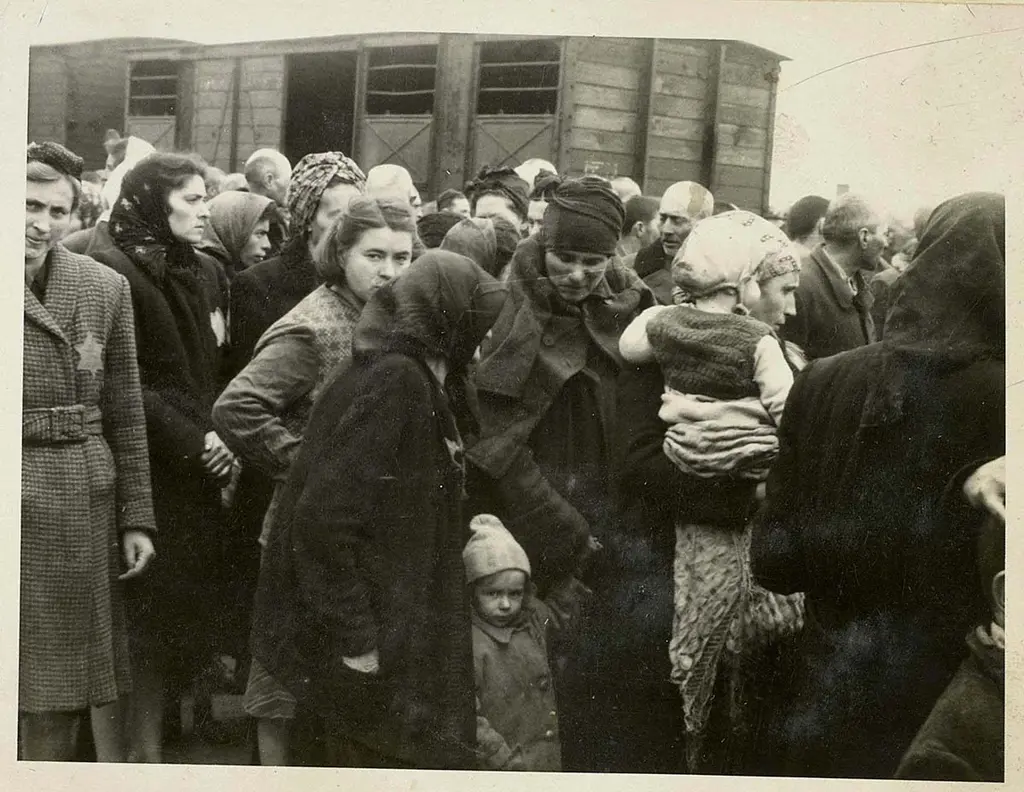
They are coming from Hungary, in one of the fastest and most concentrated deportation operations of the Holocaust. In a matter of weeks, more than 400,000 Hungarian Jews were transported there. By this point, the system was no longer experimental. It was industrial, practiced, and efficient.
The doors open.
People step down onto the ramp carrying what they were told to bring, luggage, documents, sometimes even keys to homes they believed they might return to. Families cluster together, trying to make sense of where they are. Some had traveled for days in sealed cattle cars. The air is thick with confusion, exhaustion, and the faint, growing awareness that something is wrong.
The process begins immediately.
SS officers stand along the platform, directing the flow with small gestures. A nod to the left. A motion to the right. Decisions made in seconds. Those judged capable of labor, mostly young men and some women, are separated out. The rest, the elderly, the sick, mothers with children, are sent in another direction.
There is no explanation.
The separation is presented as routine. Necessary. Temporary.
But it is not temporary.
For most arriving during this period, especially from Hungary, the majority are sent directly to the gas chambers within hours. The scale is staggering. At its peak, Auschwitz Birkenau is killing thousands of people per day. The machinery of death, gas chambers, crematoria, and forced labor units, operates with a rhythm that depends on speed and obedience.
And yet, in these images, there is still a pause.
You can see people standing together. Talking. Holding onto bags. Trying to stay close to one another. There is still a sense, however fragile, that this is a process they might survive if they follow instructions.
That illusion is part of the system.
Because what is happening here is not chaos. It is control.
Everything is designed to move quickly, quietly, and without resistance. The appearance of order is essential. Panic would slow things down. Questions would disrupt the flow. So the process is kept deceptively calm, even as it funnels thousands toward a predetermined end.
Within a few hours, the crowd on that ramp will be gone.
Some will be inside the camp, beginning a different kind of ordeal, forced labor, starvation, survival measured day by day. Most will not be inside the camp at all. They will have been processed through a system designed to leave almost nothing behind.
But in that moment, stepping off the train, they are still together.
Still carrying what they thought they needed.
Still trying to understand where they are.
The Khmer Rouge assume control of Phnom Penh and begin forcing its residents into the countryside.
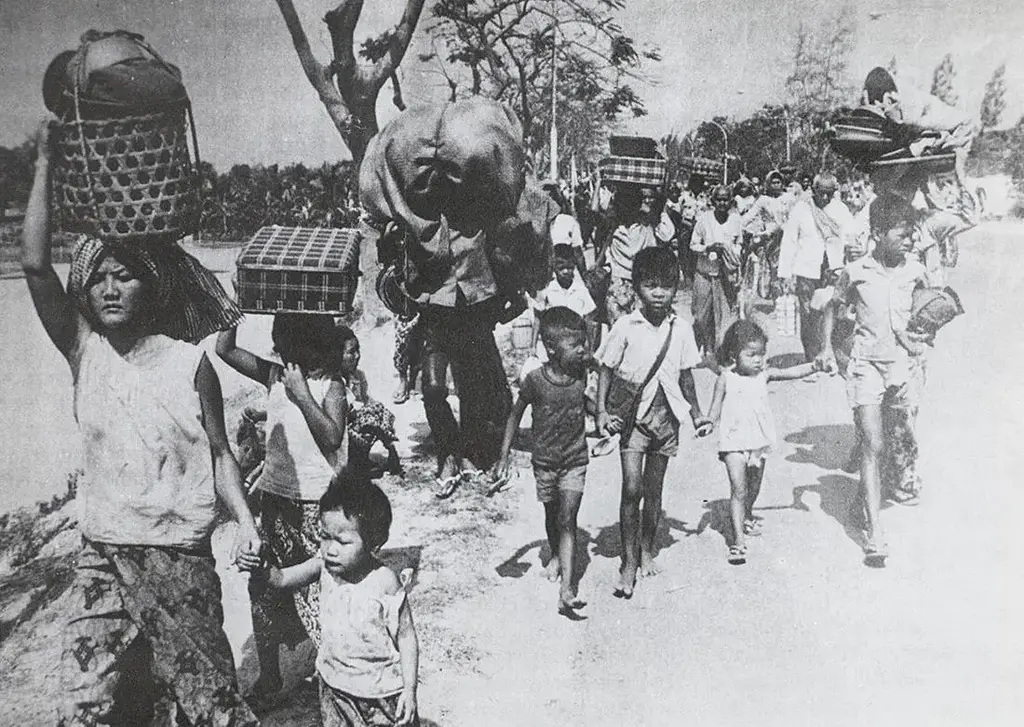
April 1975. Phnom Penh falls silent in a way that does not feel like peace.
The war is over. Or at least that is how it appears at first.
After years of civil conflict and American bombing campaigns across Cambodia, the Khmer Rouge entered the capital. For many civilians, there was a brief moment of relief. The fighting had stopped. The uncertainty, they hoped, was ending.
Then the orders began.
The city had to be emptied.
Not gradually. Not over weeks or months. Immediately.
Hospitals were cleared. Patients were forced out, some still connected to IVs. Families were told to take only what they could carry. They were told this was temporary. That they would return in a few days. That American planes were coming to bomb the city. That it was for their safety.
So they left.
You can see it in the photograph. People moving in one direction, carrying everything they believed they needed to survive the next few days. Bags, baskets, children. The elderly being helped along. No one really understanding that this was not an evacuation.
It was a removal.
The ideology driving this was radical even by revolutionary standards. Under Pol Pot, the regime was attempting to reset Cambodia to what they called Year Zero. Cities were seen as corrupt. Intellectual life was suspect. Modern society itself was treated as something to be erased.
So the population was pushed into the countryside.
Millions of people, many with no farming experience, were forced into labor camps. Families were separated. Food was scarce. Suspicion was constant. Even small things, education, speaking a foreign language, wearing glasses, could mark someone as an enemy of the new state.
What began on roads like this turned into one of the deadliest social experiments in modern history.
Between 1975 and 1979, an estimated 1.5 to 2 million people would die through execution, starvation, disease, and overwork. The killing fields were not a single place, but a network of sites spread across the country. The system did not need to be hidden. It only needed to function.
But in this moment, captured in the image, none of that is fully visible yet.
There is movement, but not panic.
People are still together. Parents holding children. Neighbors walking side by side. There is still a sense, however fragile, that this is temporary. That there is a plan. That someone is in control of what is happening.
And in a way, someone is.
Just not in the way they think.
Because what is unfolding here is not an evacuation.
It is the beginning of a complete dismantling of a society, one road, one family, one step at a time.
Churchill, Stalin and Roosevelt at the Yalta Conference, 1945
-(B-W).jpg)
February 1945. Yalta.
Three men sit together at the edge of a war that is already decided, but not yet finished.
Winston Churchill, Joseph Stalin, and Franklin D. Roosevelt, the leaders of the Allied powers that had broken Nazi Germany, met to decide what came next. The fighting in Europe was nearing its end. Berlin would fall within months. But victory created its own problem.
Who would control what remained?
The photograph shows them seated, composed, almost relaxed. But the reality behind it was negotiation under pressure. Each man arrived with different priorities, shaped by geography, ideology, and the cost their countries had paid.
Stalin’s position was the most direct. The Soviet Union had absorbed unimaginable losses, with tens of millions dead, and its armies now occupied much of Eastern Europe. Control, for him, was not theoretical. It was already on the ground. His goal was to secure a buffer zone of friendly, or at least compliant, states between the Soviet Union and the West.
Roosevelt was trying to hold something together that may already have been coming apart. His focus was on creating a postwar system that could avoid another global conflict. The United Nations was central to that vision. He also needed Soviet cooperation in the war against Japan, which was still ongoing.
Churchill saw the danger more clearly than most in the room, but had the least leverage to shape it. The British Empire was strained. Its resources were limited. He was trying to preserve some balance of power in Europe, particularly the independence of countries like Poland, whose fate was being discussed in terms that felt increasingly abstract.
Because Poland was at the center of this.
It was the reason Britain entered the war in 1939. Now, in 1945, its future was being negotiated without its direct control. Borders were redrawn. Governments were discussed. The language was diplomatic, but the underlying reality was that influence followed armies.
And the Soviet Army was already there.
The agreements that came out of Yalta spoke in terms of self determination, free elections, and cooperation. On paper, they suggested a shared vision for postwar Europe. In practice, they left enough ambiguity for each side to interpret them differently.
That ambiguity became the space where the next conflict grew.
Within a few years, Europe would be divided into spheres of influence. Eastern Europe would fall under Soviet control. The West would organize itself in response. The wartime alliance would fracture into what became the Cold War.
But in this moment, that future was not fully visible yet.
The war was still the dominant reality. The alliance still existed. The language was still one of cooperation, not confrontation.
The photograph captures that narrow window.
Three men, representing systems that would soon define opposing worlds, sitting close enough to suggest unity, even as the lines between them were already being drawn.