
Future US President Theodore Roosevelt as a North Dakota deputy sheriff, holding 3 boat thieves he captured at gunpoint, 1886. Roosevelt was only 28 years old at the time.
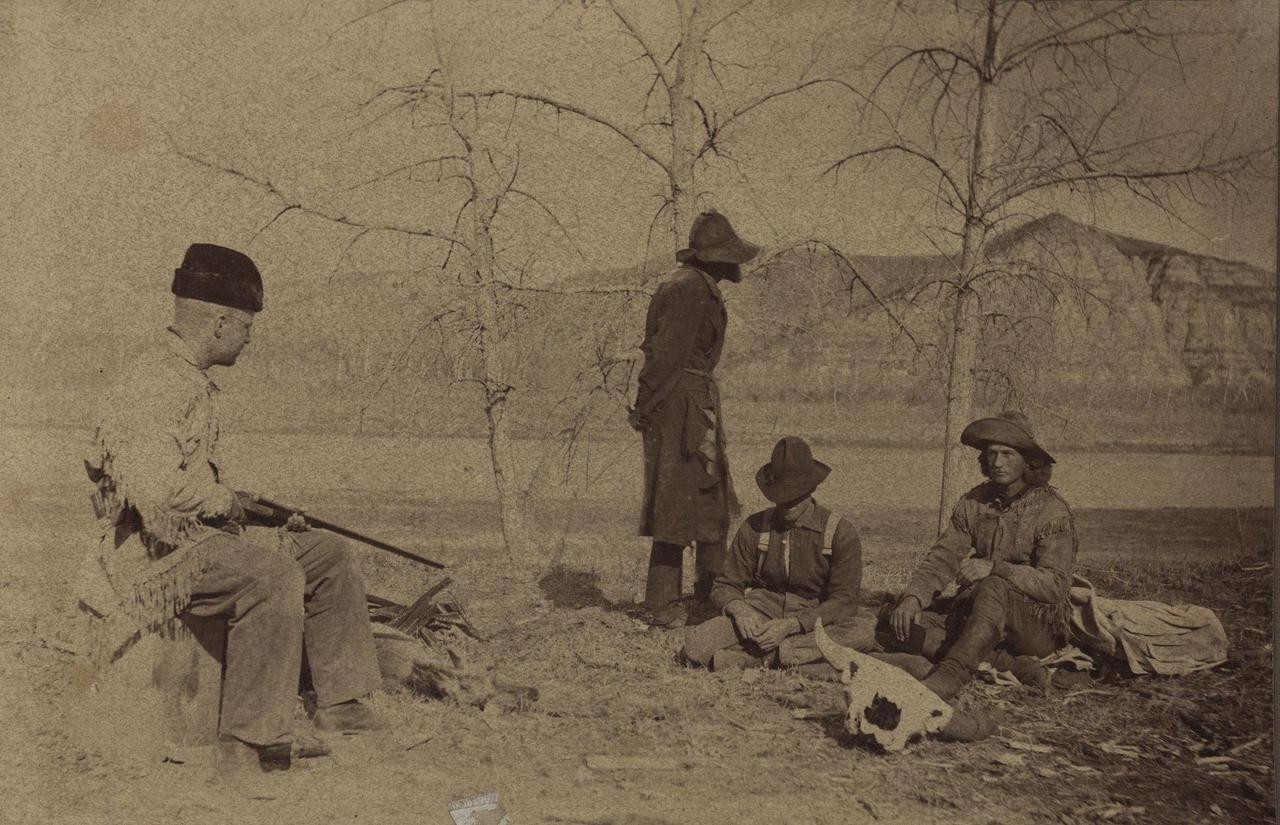
In 1886, a 28-year-old Theodore Roosevelt found himself far from the polished rooms of New York politics, standing instead on the frozen edge of the American frontier.
This wasn’t theater. It was the Dakota Territory, still rough, still unsettled, where law existed more as an idea than a guarantee. Roosevelt had gone west after personal tragedy—the deaths of his wife and mother on the same day in 1884—and what he found there wasn’t escape so much as a different kind of proving ground.
The story behind the photograph is almost too on-the-nose to be real. Three men stole Roosevelt’s boat on the Little Missouri River. Not a minor inconvenience out there. A boat was transport, survival, leverage. Roosevelt didn’t report it and move on. He tracked them.
Alone at first. Then with a couple of hired hands.
He followed them through the Badlands in winter, navigating snow, isolation, and the kind of terrain that didn’t forgive mistakes. When he caught up to them, he didn’t negotiate. He took them at gunpoint.
And then came the part that separates this from a simple frontier anecdote.
He didn’t just retrieve the boat. He arrested them.
Roosevelt marched the three thieves overland for days—through freezing conditions—toward Dickinson, North Dakota, so they could be processed through the legal system. He read constantly along the way, carrying a book with him, as if this were just another task layered into his day.
That detail matters. It tells you what kind of frontier figure he was. Not a drifter. Not a vigilante. He was trying to impose order. To take a place defined by improvisation and bend it toward structure, toward law.
The American West in the 1880s wasn’t the clean myth later generations would build. It was cattle booms and busts, harsh winters, failed ranches, and men testing themselves against an environment that didn’t care if they succeeded. Roosevelt’s own ranching ventures would eventually collapse after the brutal winter of 1886–87.
But moments like this—capturing thieves, enforcing rules where rules were thin—fed directly into the persona he would carry into national life.
Not just a politician.
A man who had gone out into the chaos and tried to shape it.
The Clark Doll Experiment, 1939 – Conducted by psychologists Kenneth and Mamie Clark, revealed the damaging effects of racial segregation on Black children’s self-esteem by showing their preference for white dolls over Black dolls, highlighting internalized racism and societal bias.
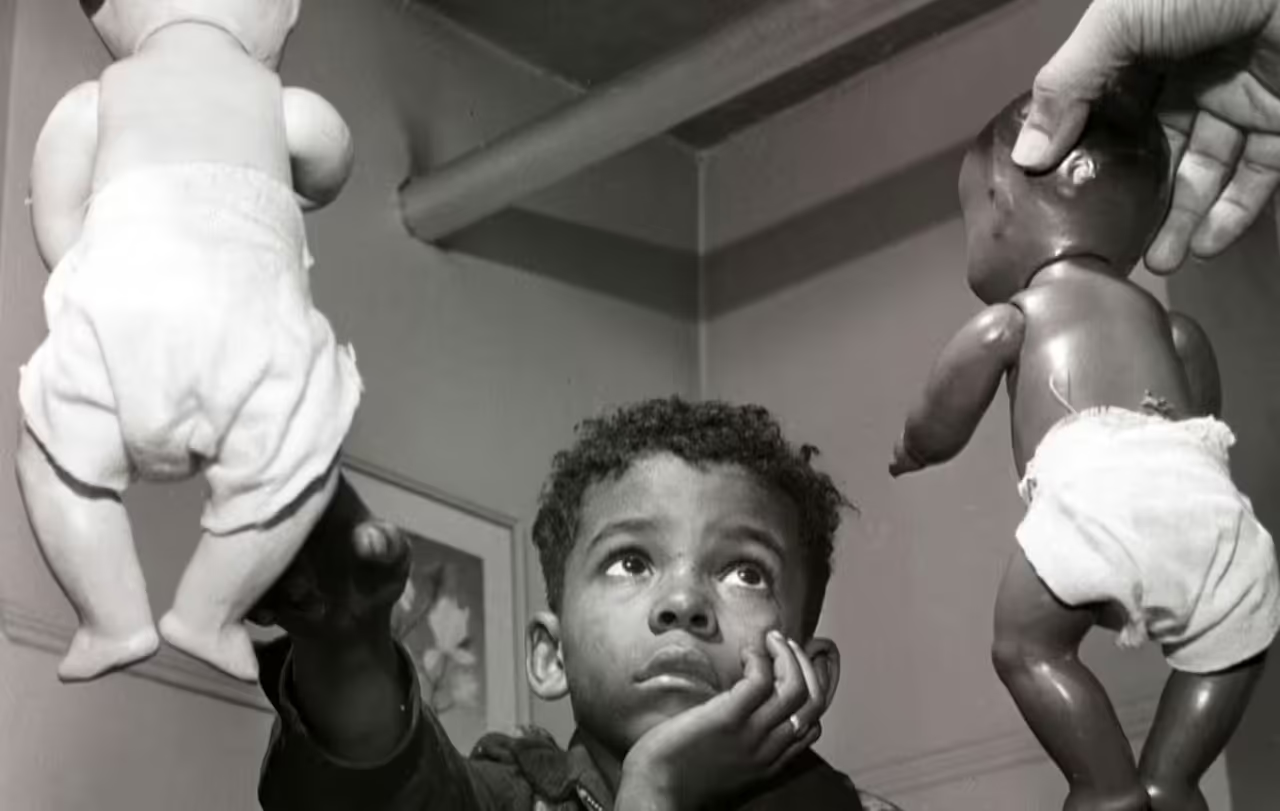
In 1939, psychologists Kenneth and Mamie Clark set up a deceptively simple test. Two dolls. Same size. Same shape. One with white skin and yellow hair. The other with brown skin and black hair. Children were asked a series of questions.
Which doll is nice?
Which doll is bad?
Which doll looks like you?
The answers came back with a pattern that was hard to ignore and harder to explain away. Many Black children—some as young as three—assigned positive traits to the white doll. They called it “nice.” “Pretty.” The good one. The Black doll, more often than not, was labeled “bad.” “Ugly.” When asked to choose the doll that looked like them, some hesitated. Some pointed incorrectly. Some refused to answer at all.
This wasn’t preference in the casual sense. It wasn’t about toys. It was about hierarchy, absorbed early and reinforced constantly. These children were navigating a world structured by segregation, where laws, schools, media, and daily interactions all carried the same underlying message: whiteness was valued; Blackness was not.
The Clarks weren’t uncovering something hidden so much as measuring something already in motion. Segregation didn’t just separate bodies. It shaped identity. It reached into the minds of children before they had the language to question it, before they had the defenses to resist it. The damage wasn’t abstract. It showed up in self-perception—in how a child understood their own worth.
Their findings would later be cited in the landmark Brown v. Board of Education decision in 1954, when the U.S. Supreme Court ruled that racial segregation in public schools was unconstitutional. The Court acknowledged what the Clarks had demonstrated: separation enforced by law carried psychological consequences. It stamped one group as inferior, and children understood that message clearly.
Two dolls on a table. A controlled environment. But the results pointed far beyond the room.
Portrait of Vance a Trapper Boy (15 years old), 1908. He has trapped for several years. $.75 a day for 10 hours work. All he does is to open and shut this door: most of the time he sits here idle, waiting for the cars to come. Photo by Lewis Hine
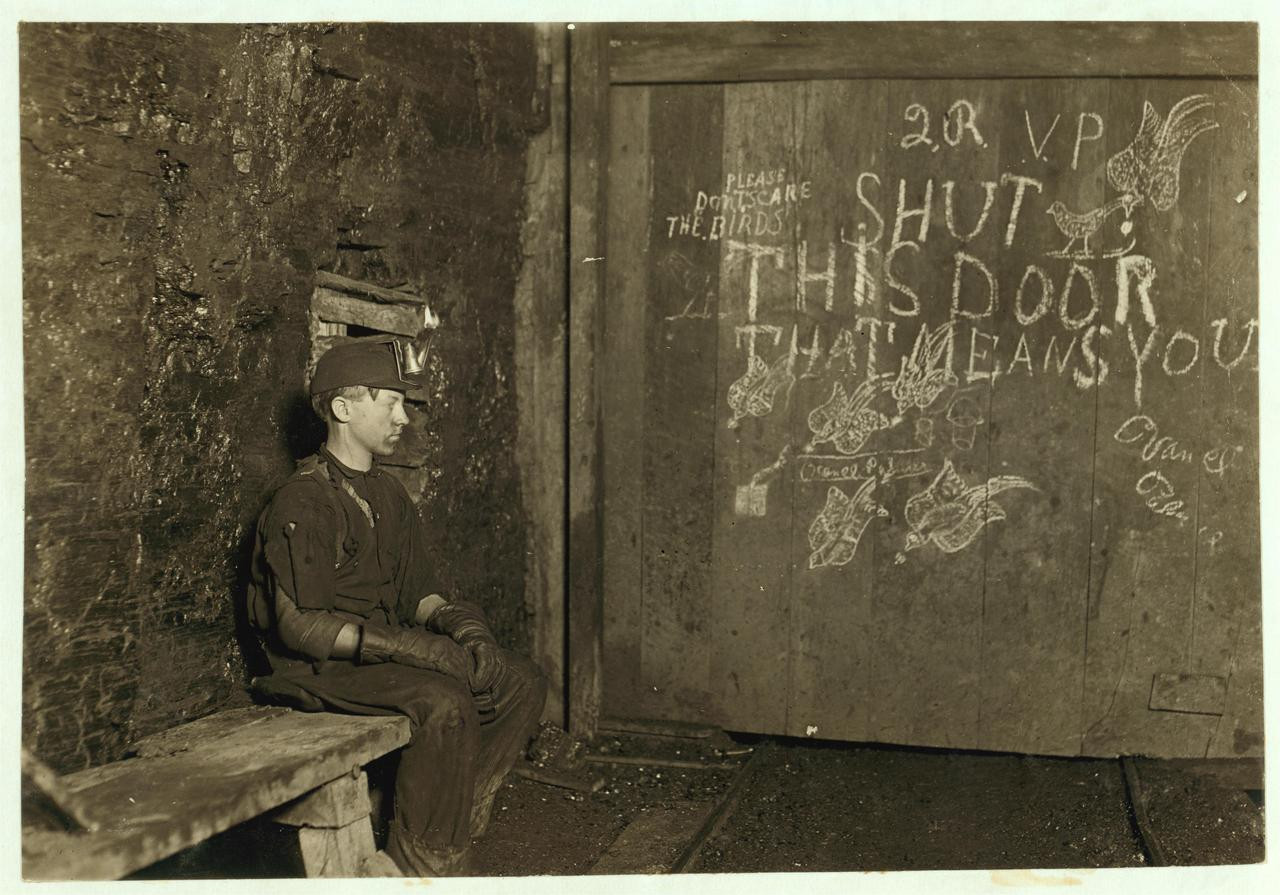
In 1908, Lewis Hine documented a fifteen-year-old boy named Vance working as a trapper in an industrial facility—likely a coal breaker or mill, part of the vast machinery of early 20th-century American industry.
The job of a “trapper boy” was specific to this era. In coal breakers and mines, boys were stationed at ventilation doors deep inside the structure. Their task was simple: open the door when a cart approached, then close it immediately to maintain airflow through the mine or facility. The entire system depended on those doors staying shut except for brief moments. If they failed, the air currents collapsed, and the mine could fill with dangerous gases.
It was repetitive, solitary work. And it was almost always given to children.
By the early 1900s, child labor was not an exception in the United States—it was foundational to many industries. Coal, textiles, glassmaking, agriculture. Children were cheaper, easier to control, and small enough to fit into spaces adults couldn’t. In places like Pennsylvania’s coal regions, boys as young as eight or nine worked long hours in breakers, sorting coal or operating machinery. Vance, at fifteen, was already considered experienced. Hine notes he had been doing this work for several years.
Seventy-five cents for a ten-hour day.
That number matters because it places him directly inside the economics of the time. Industrialization was accelerating, cities were growing, and demand for cheap labor was constant. Families often depended on their children’s wages to survive. There wasn’t much room for alternatives. Schooling was inconsistent. Enforcement of labor laws—where they existed—was weak.
Hine wasn’t just taking photographs. He was working for the National Child Labor Committee, which aimed to expose these conditions to the public. His images were evidence—visual arguments used to push for reform.
And reform did come, slowly. Over the next few decades, state laws tightened, compulsory education expanded, and federal legislation like the Fair Labor Standards Act of 1938 set minimum working ages and standards. But in 1908, those protections were still forming, uneven, and often ignored.
So Vance sits at the door. Not as an outlier, but as part of a system that depended on him being there. A system where childhood and labor weren’t separate categories, but overlapping ones—where a boy could spend his formative years opening and closing a door in the dark, because the industrial world had decided that was where he fit.
Photo of a Rubber plantation worker of the Belgian Congo by Anti-Slavery english missionary Alice Seeley Harris, 1898.

In 1898, Alice Seeley Harris raised her camera in the Congo Free State and captured an image that would travel far beyond the moment it froze.
The man in the photograph is a rubber worker. His labor wasn’t voluntary. It was part of a system built on quotas—impossible quotas—enforced through violence. Under the rule of King Leopold II, the Congo Free State was not a colony in the traditional sense. It was a private enterprise, run for profit, where rubber had become one of the most valuable commodities in the world.
Bicycles. Telegraph wires. Industrial belts. The global demand for rubber surged in the late 19th century, and the Congo became one of its primary sources.
But extraction required labor, and labor was taken.
Villages were given quotas to meet. If they failed, punishment followed. Hostages were taken. Whippings were routine. In some cases, soldiers were required to account for every bullet fired by presenting the severed hands of those they killed—or claimed to have killed. The system incentivized brutality, and it spread through the territory with bureaucratic efficiency.
Harris and her husband were missionaries, but the camera changed the scale of what they could do. These photographs became evidence. Not rumors. Not secondhand reports. Images that could be shown in Europe, where Leopold’s enterprise had been marketed as a civilizing mission.
The photograph of the rubber worker fits into that broader record. It doesn’t need spectacle to communicate what’s happening. The setting, the posture, the context—it all points back to a system that reduced human lives to output.
By the early 1900s, these images began circulating through reform movements like the Congo Reform Association. Public pressure built. Investigations followed. Eventually, in 1908, the Belgian government took control of the territory from Leopold, ending his personal rule.
The photograph remains as part of that turning point.
Not just documentation.
Evidence of how a global demand—something distant and abstract—translated into something immediate and human, carried out in places far from where the demand began.
German soldiers in a dug out waiting for an enemy artillery barrage to lift, 1917.
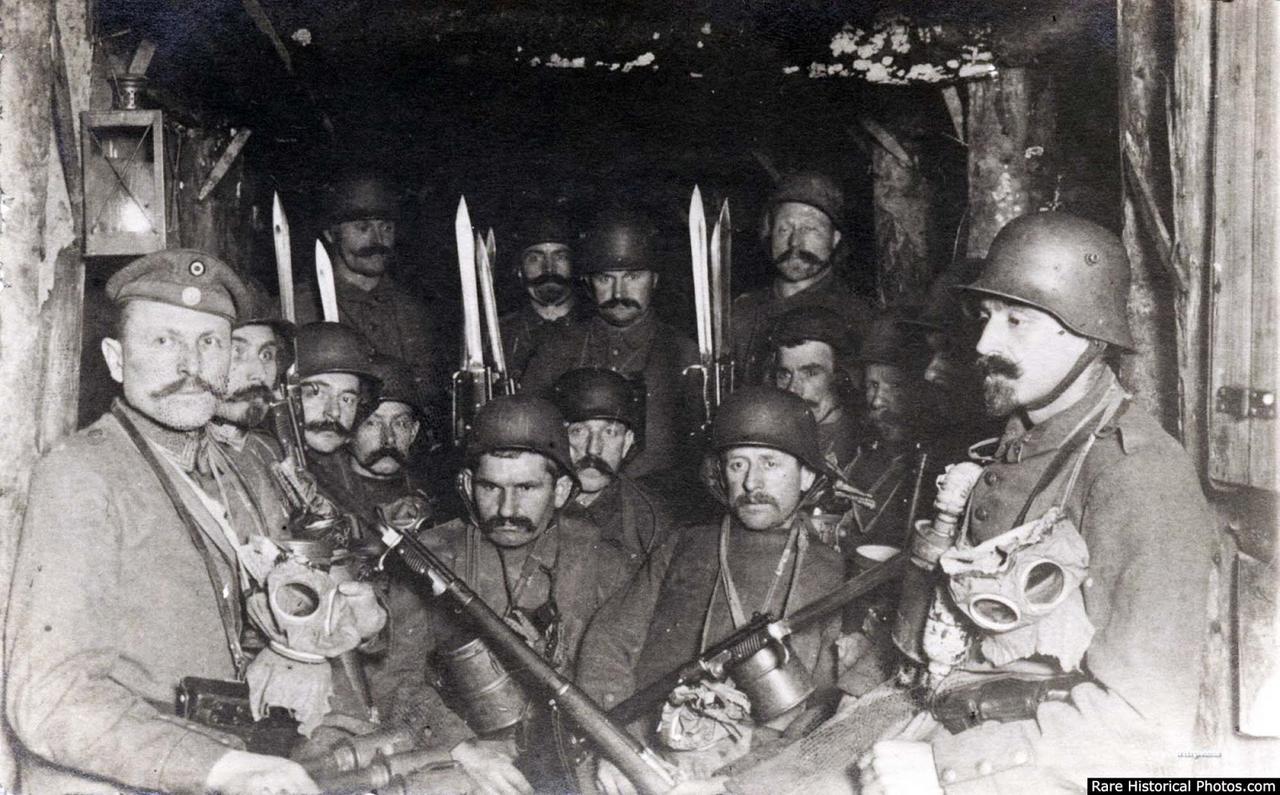
In 1917, somewhere along the trench lines of World War I, a group of German soldiers sat inside a dugout, waiting.
Not advancing. Not firing. Just waiting for the artillery to stop.
By 1917, the war had settled into a kind of brutal equilibrium. The Western Front stretched from the North Sea to Switzerland, a continuous system of trenches, barbed wire, and mud. Movement above ground was costly. Visibility meant exposure. And exposure meant artillery.
Shelling defined the rhythm of the war.
Before an attack, artillery would hammer enemy positions for hours, sometimes days. The goal was simple: destroy defenses, cut wire, break morale. In practice, it churned the landscape into something unrecognizable—craters overlapping craters, trees reduced to splinters, entire sections of ground erased and remade into mud.
For the men on the receiving end, survival meant going underground.
Dugouts were carved into trench walls, reinforced with timber when possible, sometimes just packed earth. They offered limited protection—enough to survive near misses, not enough to guarantee anything against a direct hit. Inside, soldiers waited out the barrage, counting the seconds between impacts, listening for changes in rhythm.
Because the moment the shelling stopped, something else usually began.
An attack.
That pause—the sudden silence after sustained bombardment—was its own kind of signal. It meant the enemy might be coming over the top. Rifles had to be ready. Positions manned. Whatever safety the dugout offered was temporary, conditional.
So they waited in a space that was both shelter and trap.