
Children pledging allegiance to the American flag at San Francisco’s Raphael Weill Elementary School in 1942. Those whose families were of Japanese ancestry were sent to internment camps.
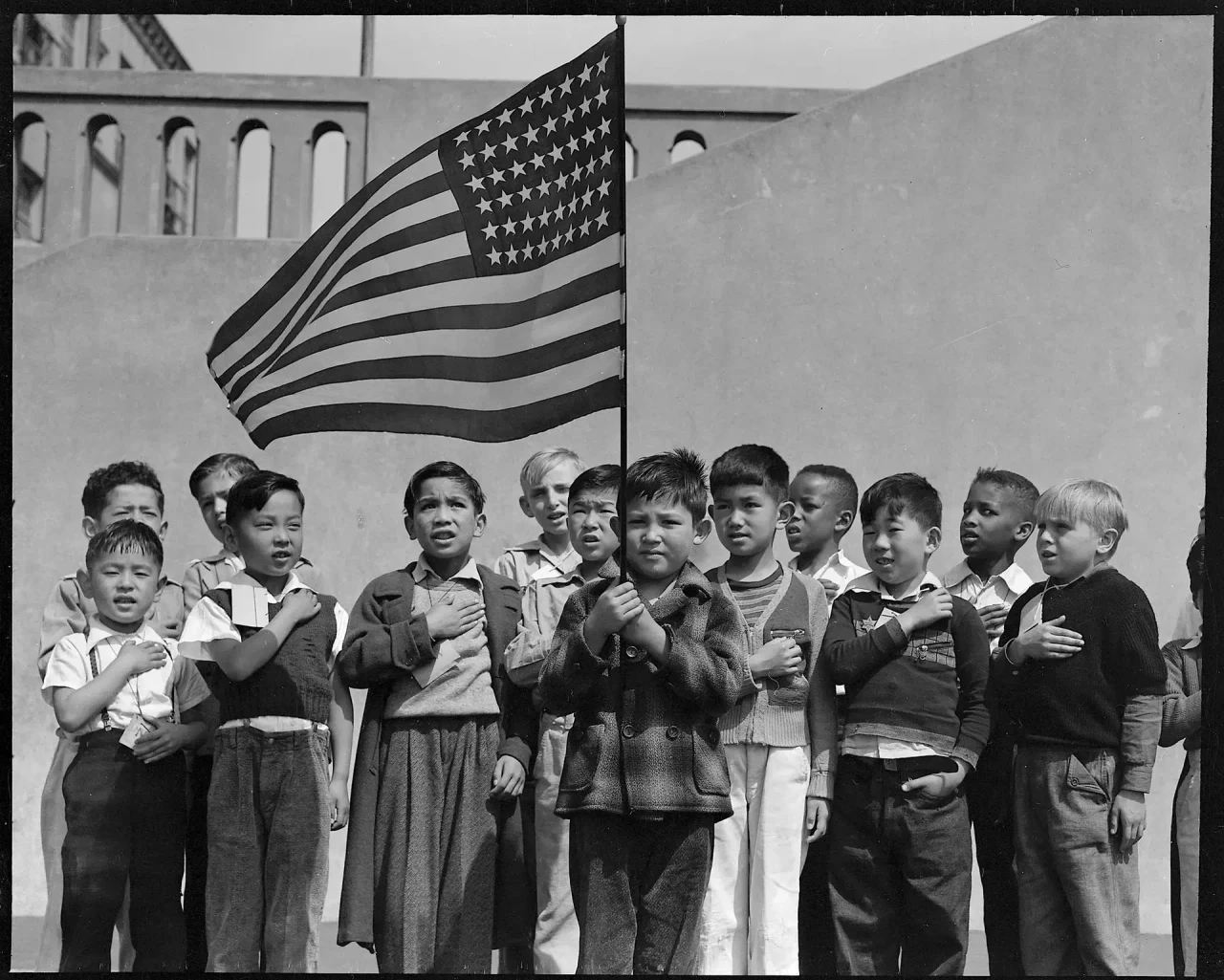
These kids, hand over heart, mouths open mid verse, earnest as only children can be, are performing one of the most American rituals imaginable. The Pledge of Allegiance. A declaration of loyalty and belonging. And for some of them, this moment sits just days, maybe weeks, before the United States government would decide that their loyalty was irrelevant. That their Americanness was conditional. That the blood running through their veins disqualified them from the very flag they are saluting.
Pearl Harbor is roughly 60 to 90 days in the past. The shock of it, the humiliation, the fear, is still raw and electric in the American psyche. The West Coast feels exposed. Vulnerable in a way it had never felt before. Newspapers are screaming. Generals are nervous. Politicians are looking for something to do.
On February 19th, 1942, Franklin D. Roosevelt, the same man who would later be canonized as one of America’s greatest presidents, signed Executive Order 9066. With a stroke of a pen, he authorized the forced removal of anyone deemed a military threat from designated “exclusion zones.” The language was deliberately vague. It did not say Japanese. It did not have to.
It meant Japanese.
About 120,000 people were ultimately removed from their homes on the West Coast. Roughly two thirds of them were Nisei, American citizens. Born here. Some of them had never even been to Japan. Many did not speak Japanese. They paid American taxes, attended American schools, rooted for American baseball teams. They had done everything right by every measure of assimilation the country had ever asked of them.
None of it mattered.
San Francisco’s Japantown, known as Nihonmachi, was one of the most established Japanese American communities in the country. Families had been there for generations. They had built grocery stores, flower shops, newspapers, churches. They were woven into the fabric of the city.
Within weeks of this photo being taken, families received notices. You have days to report. You may bring only what you can carry. Businesses were liquidated at catastrophic losses, buyers knew the sellers had no leverage. Homes were abandoned or handed over. Pets were given away or, in heartbreaking cases, simply left behind.
They were sent first to temporary “assembly centers,” racetracks and fairgrounds, many of them, where families lived in horse stalls. Then to more permanent camps in the inland deserts and mountains. Manzanar. Tule Lake. Heart Mountain. Places deliberately chosen for their remoteness and their harshness.
It is worth noting what did not happen. The feared wave of Japanese American sabotage and espionage, the entire stated justification for the internment, never materialized. Not one documented case of Japanese American espionage was ever proven. Meanwhile, the 442nd Regimental Combat Team, composed almost entirely of Japanese Americans, many of whose families were in the camps while they served, became one of the most decorated units in American military history. They fought, and bled, for the country that had imprisoned their parents.
The government eventually acknowledged the wrong. In 1988, Ronald Reagan signed the Civil Liberties Act of 1988, issuing a formal apology and providing 20,000 dollars in reparations to surviving internees. It was, as these things always are, too late and too little, but it was something. An admission that the country had looked at these children, children pledging allegiance in good faith, and flinched into its worst instincts.
Liberated women inmates at the Bergen-Belsen Concentration Camp get loaves of bread from one of the five camp cookhouses – 24 April 1945.

April 24, 1945. The war in Europe has nine days left.
Bergen-Belsen had been liberated by British forces on April 15th, just nine days before this photograph was taken. What the soldiers found when they entered the camp was beyond anything most of them had language for. Thousands of unburied bodies. Tens of thousands of survivors in catastrophic condition. The camp had no functioning water supply, almost no food, and was overtaken by typhus, dysentery, and tuberculosis. Soldiers who had fought across North Africa and through the hedgerows of Normandy later said Bergen-Belsen was the worst thing they ever saw.
Bergen-Belsen had not been an extermination camp in the way Auschwitz-Birkenau was. There were no gas chambers. Instead it killed through deliberate neglect — starvation, disease, and overcrowding so severe that the camp’s population had more than doubled in the final months of the war as prisoners were force-marched in from camps further east, ahead of the advancing Soviet army. By the time the British arrived, people were dying at a rate of hundreds per day.
Among the dead were Anne Frank and her sister Margot, who had arrived from Auschwitz in late October 1944. Anne is believed to have died in late February or early March 1945, just weeks before liberation. She was 15.
The five cookhouses referenced in the caption were part of the British military’s immediate relief effort. Feeding 60,000 surviving prisoners was not straightforward. Many were so starved that eating too much too quickly could — and did — kill them. Army doctors worked to calibrate intake carefully, a heartbreaking medical reality that meant people who had just been freed from starvation still had to be given food slowly and in small amounts. Some survivors did not survive liberation itself.
In the weeks that followed, British forces compelled local German civilians to tour the camp and help bury the dead. They wanted it documented. They wanted it witnessed. Military cameramen and journalists were brought in. The BBC’s Richard Dimbleby broadcast a report from inside the camp that was so harrowing that the BBC initially refused to air it, believing it must be exaggerated. He threatened to resign if they didn’t. They aired it.
By the end of May 1945, the remaining survivors had been moved to a proper hospital facility and the camp itself was burned to the ground to prevent further spread of disease. A sign was erected where the main gate had stood. This is the site of the infamous Belsen Concentration Camp liberated by the British on 15 April 1945. 10,000 unburied dead were found here. Another 13,000 have since died. All of them victims of the German New Order in Europe and an example of Nazi kultur.
More than 50,000 people died at Bergen-Belsen in total. The women in this photograph are among those who did not. They are standing in a line, holding bread, nine days after the gates opened. That they are upright. That they are here. That someone thought to photograph this ordinary, extraordinary moment — people receiving food like people — is its own kind of testimony.
A British officer reading a newspaper while being fanned with a palm frond & getting a pedicure from one of his servants in India, late 1800’s
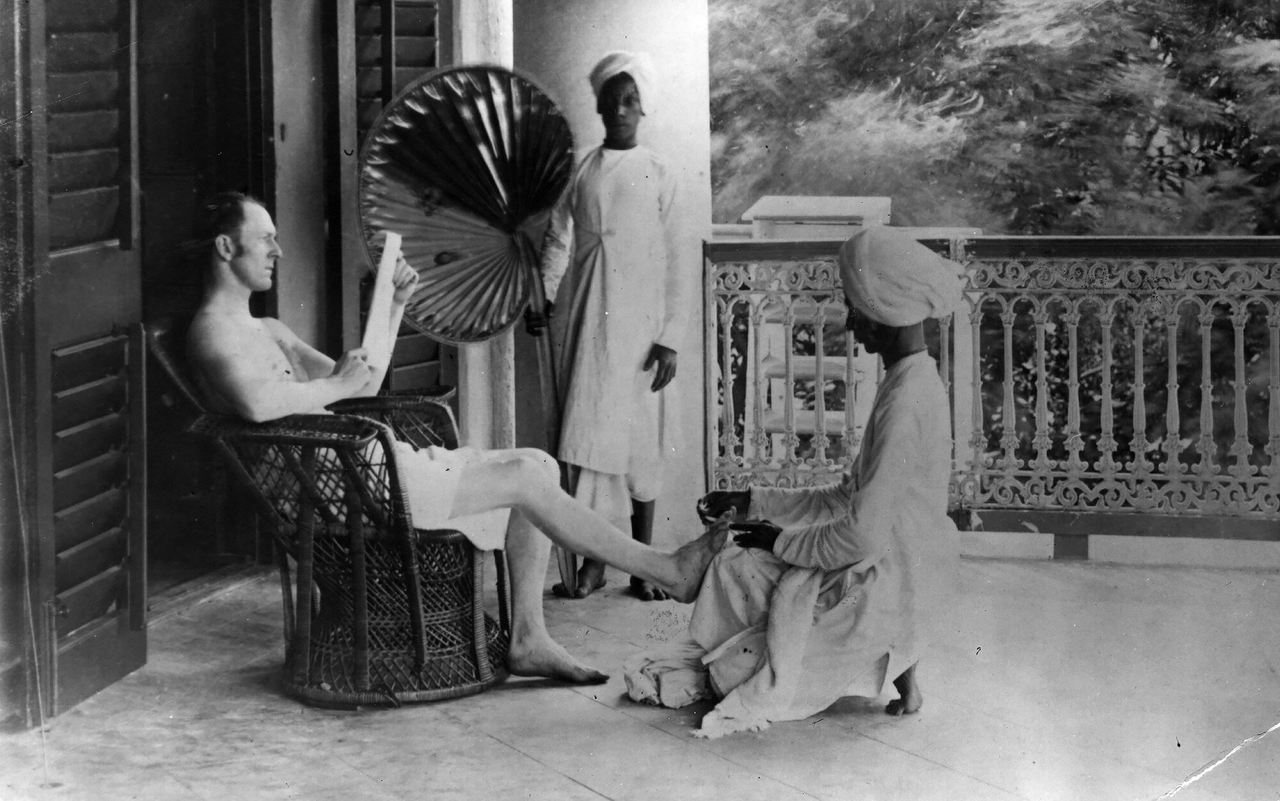
Nothing about this scene is accidental. It’s the visible surface of an entire imperial system, one that took more than a century to build and reshape the Indian subcontinent.
By the late 1800s, what we call the British Raj had fully replaced the earlier rule of the British East India Company. That transition did not happen gently. It came in the aftermath of the great uprising of 1857, what the British called the “Sepoy Mutiny,” and what many Indians remember as the First War of Independence. The rebellion shook British confidence to its core. When it was finally crushed, the British Crown stepped in directly, reorganizing governance, tightening control, and reinforcing the social hierarchy that scenes like this quietly display.
Because this officer is not just a man reading a paper.
He represents a ruling class that numbered only in the tens of thousands, governing a population of hundreds of millions. The British presence in India was always thin, always dependent, not on overwhelming numbers, but on structure, discipline, and a rigidly maintained sense of superiority.
And that superiority had to be performed. Daily. Visibly.
The servants in the image, often referred to as “bearers,” “khidmatgars,” or “punkah wallahs,” were part of an elaborate system of domestic service that underpinned colonial life. A British officer or civil servant might employ multiple attendants, each assigned a narrow role. One to manage clothing. One to handle food. One to fan away the heat. Another, as we see here, to tend to personal grooming.
This was not just about comfort. It was about reinforcing distance.
In the oppressive climate of India, especially in the northern plains or the coastal humidity, British officers clung to routines that mimicked home while insulating themselves from the environment and from the people they ruled. Verandas, ceiling fans worked by hand pulled ropes, iced drinks shipped or manufactured at great expense, all of it formed a kind of barrier between ruler and ruled.
By the late 19th century, this world was at its height. Railways stretched across the subcontinent. Telegraph lines connected distant cities. The machinery of empire hummed along with an air of permanence.
But if you step back and really look at the image, there’s a tension beneath the stillness.
Because the same system that allowed for this quiet moment of leisure also planted the seeds of its own undoing. Indian elites were being educated in British schools. Ideas about nationalism, self rule, and political identity were beginning to circulate. The Indian National Congress had already been founded in 1885, just a few years before scenes like this were commonplace.
So while the officer reads, perhaps about politics back home, or imperial affairs, the world around him is already shifting in ways he may not fully grasp.
That’s the strange thing about empires at their peak.
They often look the most stable right before the ground begins to move beneath them.
Workers on Top of the Empire State Building (1930s)
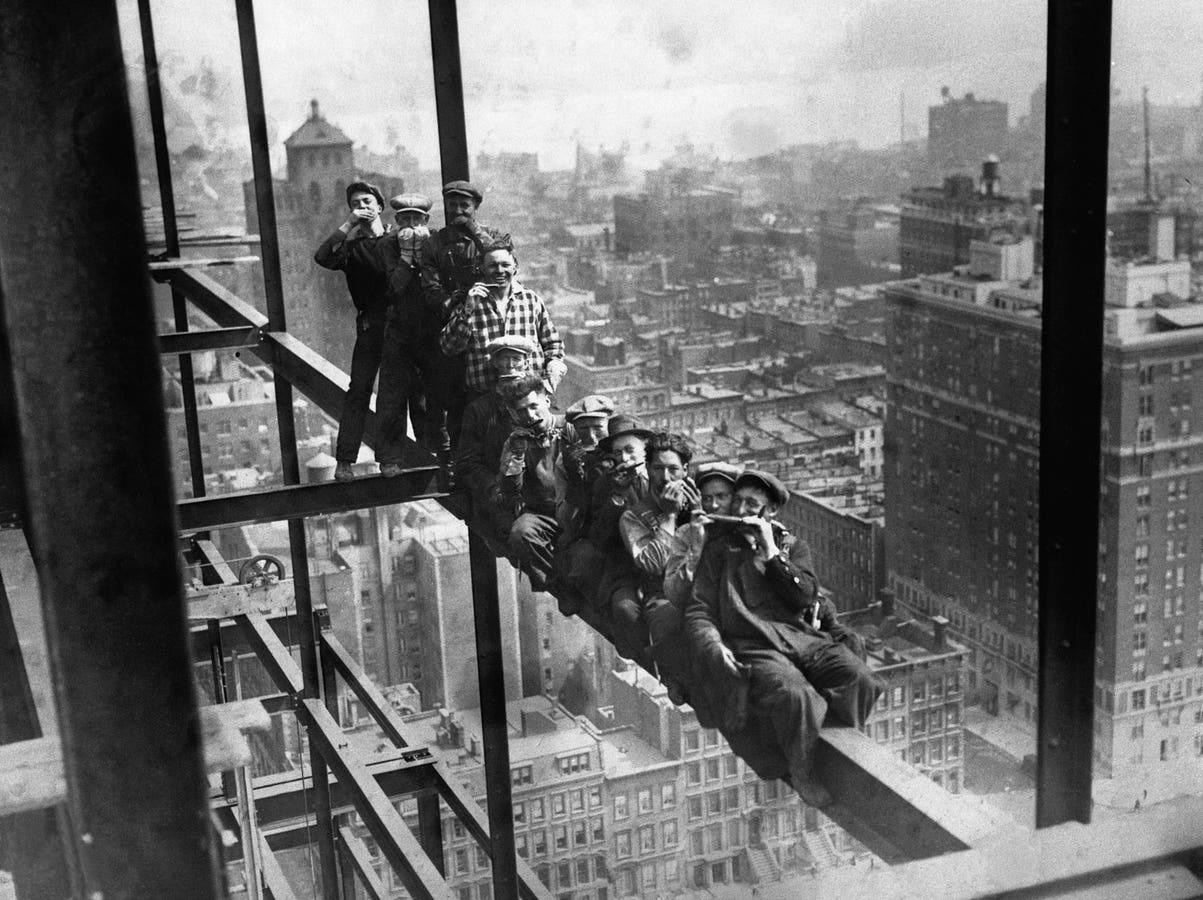
A line of men, perched on a steel beam, hundreds of feet above the streets of New York. No harnesses. No guardrails. Just gravity beneath them and lunch in their hands. One leans back slightly, another grins, a few look directly at the camera as if to say: What’s the big deal?
But the real story here is not the height. It’s the moment in history that put them there.
This photo was taken during the construction of the Empire State Building, completed in 1931. And that date matters. Because outside the frame, the world was unraveling.
The Great Depression had taken hold. Banks were collapsing. Unemployment in the United States had surged to levels the country had never seen before. Entire families were losing homes, livelihoods, and any sense of stability. For many men, work like this was not a choice between danger and safety. It was a choice between danger and nothing.
So when you look at these workers sitting on that beam, what you are really seeing is not fearlessness. You are seeing necessity.
The men themselves were often immigrants or the sons of immigrants. Irish, Italian, Eastern European. Many were also Mohawk ironworkers, part of a long tradition of Indigenous workers who became renowned for their ability to work at extreme heights. They brought skill, yes, but also a cultural familiarity with risk that made them invaluable in an industry where one mistake could mean a fall into open air.
And the pace of the work was staggering.
The Empire State Building rose at a speed that still feels almost impossible today. Construction moved at about four and a half stories per week. Steel was hoisted, riveted, locked into place in a kind of organized chaos. The skyline itself was being rewritten in real time, and these men were the ones physically carrying that transformation on their backs.
Look again at how they sit.
There is no hesitation in their posture. No visible tension in their grip. That’s not because the danger isn’t there. It’s because, by this point, the danger has become routine. Familiar. Almost invisible to them.
And that’s what makes the image unsettling.
Because it reveals something about human beings that shows up again and again across history. We adapt to extreme conditions faster than we probably should. Whether it’s war, economic collapse, or working on a narrow steel beam hundreds of feet in the air, the extraordinary becomes ordinary when survival depends on it.
But there’s another layer here too.
This image has often been remembered as a symbol of American grit. And in many ways, it is. It captures a kind of rugged determination, a willingness to build something massive in the face of uncertainty.
At the same time, it quietly exposes the cost of that ambition.
The skyline of New York, those towering symbols of progress and modernity, did not rise on abstract ideas. They were built by men like these, balancing between sky and street, trading safety for a paycheck, participating in a system that demanded both courage and sacrifice.
So what you’re looking at is not just a lunch break.
It’s a snapshot of a country in crisis, still building anyway.
A liquidator prepares to descend onto the roof of reactor No. 3 at the Chernobyl Nuclear Power Plant to clear radioactive debris released by the explosion of reactor No. 4, April 1986.
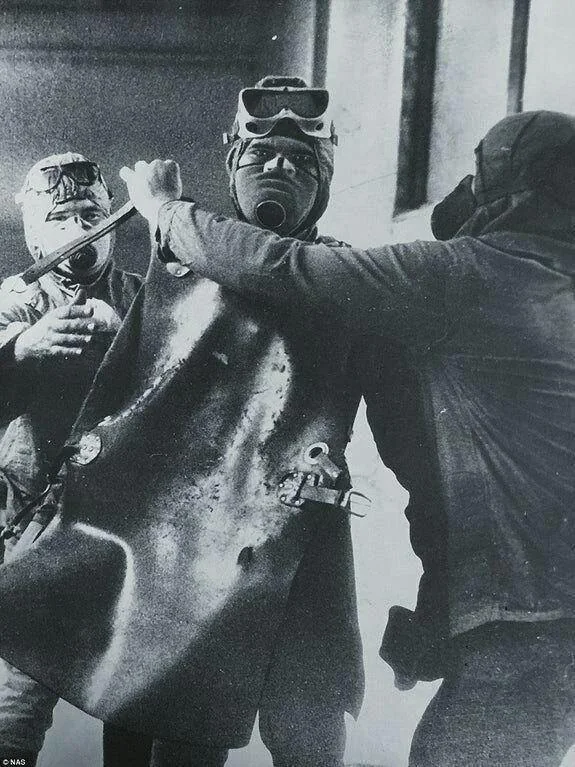
April 1986. The Chernobyl disaster has already torn open Reactor No. 4, blasting radioactive graphite and fuel into the air and scattering it across the surrounding buildings like some invisible, lethal snowfall. Reactor No. 3, right next door, is now part of the problem. Its roof is littered with fragments so radioactive that they can fry electronics, scramble machinery, and deliver a fatal dose to a human being in minutes.
So the Soviets do something that feels almost medieval in its simplicity.
They send men.
They call them liquidators, a clinical word for a very human task: climb up there, shovel the radioactive debris back into the abyss, and get out before it kills you.
This man, standing at the edge of that roof, is about to enter what was effectively one of the most dangerous workspaces on Earth. Not for hours. Not even for long minutes. His mission is measured in seconds, often 60 to 90 at most. Any longer, and the radiation dose starts stacking into something irreversible.
Think about that.
An entire operation built around the idea that a human body can absorb just enough damage if it moves fast enough.
Machines had already tried and failed. Remote controlled robots, including ones borrowed from Western Europe, were sent up first. But the radiation was so intense it crippled them, fried their circuits, and rendered them useless. So the fallback plan wasn’t more advanced technology.
It was flesh and bone.
The men were given crude protective gear, lead lined aprons, helmets, sometimes little more than that, and tools as basic as shovels. They would sprint out, grab or push chunks of graphite, pieces that were once inside a nuclear core, and hurl them over the edge back toward Reactor No. 4.
Then they would run back.
Some of them later described it not as work, but as a kind of sprint through an invisible fire. You could not see it. You could not feel it immediately. But it was there, saturating everything.
And hovering over all of this is a bigger, almost unsettling realization.
This wasn’t just about cleaning a roof.
This was about preventing something worse, keeping Reactor No. 3 from becoming compromised, limiting the spread, containing a disaster that already felt barely containable. The Soviet Union threw hundreds of thousands of people into the broader cleanup effort, but on that roof, it came down to individuals. Moments. Decisions measured in seconds.
And that’s the image that sticks.
Not the explosion. Not the plume.
But a single man, stepping forward with a shovel, knowing on some level that he is trading a piece of his future to stabilize the present.