Winston Churchill delivering his “Blood, toil, tears and sweat” speech shortly after becoming British Prime Minister, London, 1940
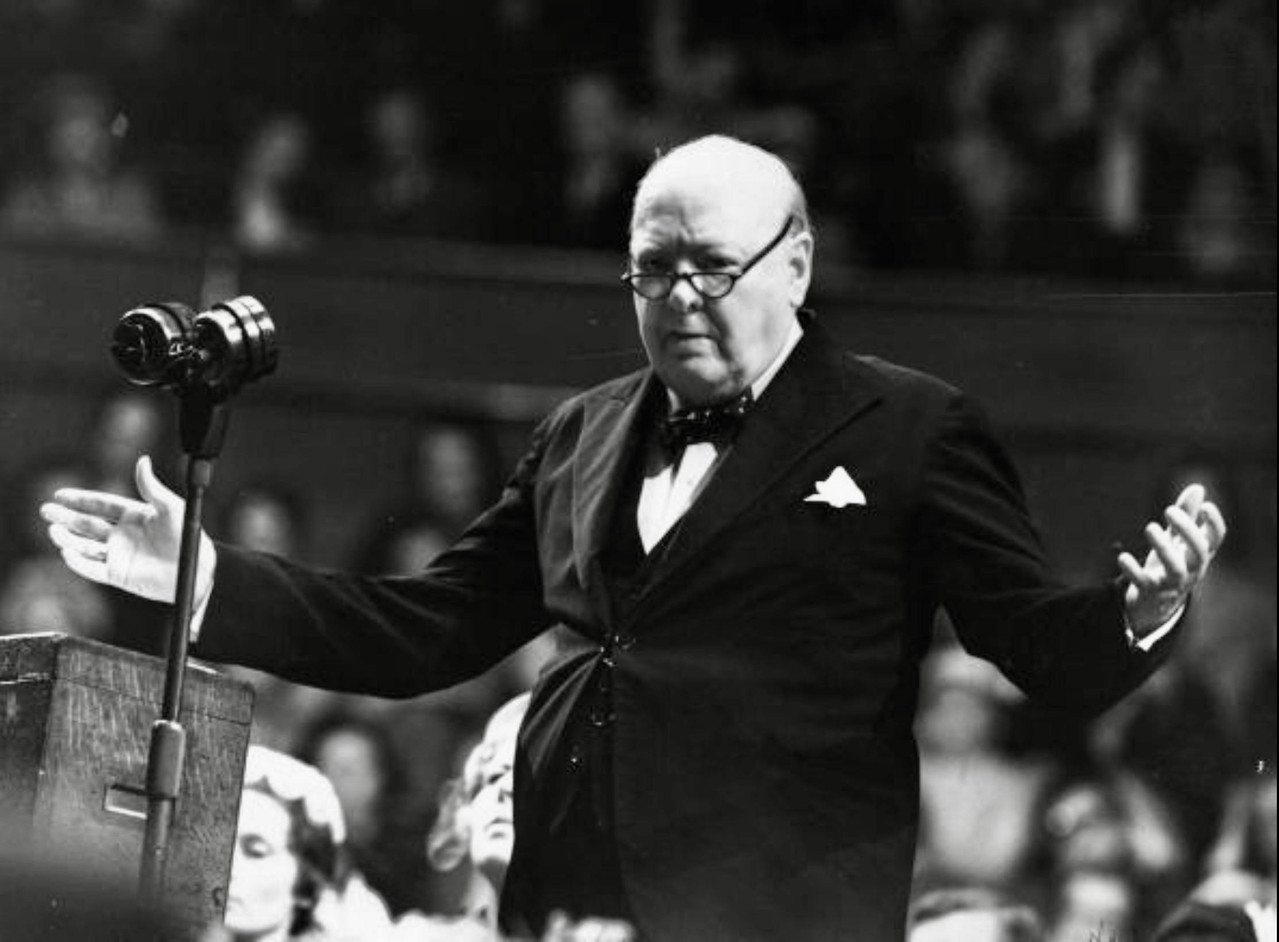
In May 1940, when Winston Churchill rose to deliver his “Blood, toil, tears and sweat” speech, Britain was standing at the edge of catastrophe. Nazi Germany had already swallowed much of Europe with shocking speed. Poland had fallen. Denmark and Norway had been overrun. Within days, German forces would crash through France and the Low Countries with a violence that stunned the world. Many believed Britain might be next.
Churchill had only just become Prime Minister, replacing Neville Chamberlain at one of the darkest moments in British history. And Churchill himself was hardly the universally trusted wartime icon he would later become. To many in Parliament, he was controversial, reckless, even politically damaged from earlier failures like Gallipoli during the First World War. But in that moment, Britain needed someone willing to say out loud what others were still trying to soften.
The speech was remarkably blunt.
“I have nothing to offer but blood, toil, tears and sweat.”
No promises of quick victory. No comforting illusions. Churchill understood something important about leadership during existential crises: people can endure extraordinary hardship if they believe they are being told the truth.
And the truth in 1940 was terrifying.
The British Expeditionary Force was about to become trapped at Dunkirk. France, Britain’s major ally on the continent, was collapsing far faster than expected. Across Europe, the image of German invincibility was growing by the week. There were members of the British establishment who quietly wondered whether some kind of negotiated settlement with Hitler might eventually become necessary.
Churchill rejected that entirely.
What makes the photograph and the speech so historically powerful is that they capture the moment Britain psychologically shifted from hoping to avoid disaster to preparing to survive it. Churchill wasn’t offering optimism in the modern sense. He was offering endurance. Resistance. The idea that survival itself was now the mission.
And for all Churchill’s flaws — and there were many — he possessed an extraordinary ability to weaponize language during moments of national fear. His speeches did not merely describe events. They framed reality itself. Britain was no longer simply fighting a war over territory or politics. In Churchill’s telling, it was defending civilization against something barbaric and consuming.
Looking back now, it’s easy to hear those speeches through the filter of history, knowing Britain survived, knowing the Allies eventually won. But in May 1940, none of that was guaranteed. The men listening in Parliament that day were staring into a future that looked genuinely uncertain. The map of Europe was collapsing in real time. And Churchill was essentially telling the country: this will be brutal beyond anything you want to imagine, and we are going to endure it anyway.
One of the last known photos of Vladimir Lenin, taken in the summer of 1923 after his third stroke. The USSR banned this photo for years to hide his deteriorating health.

By the summer of 1923, Vladimir Lenin was only 53 years old, but he looked decades older. Three strokes had ravaged his body in rapid succession. The once relentless revolutionary who had spent years writing manifestos in exile, orchestrating insurrection, and driving the Bolsheviks through civil war now struggled to move and speak.
In one of the last known photographs of him, Lenin sits outdoors in a wicker chair, wrapped in blankets, his expression distant and exhausted. There is no triumphant architect of world revolution left in the frame. What remains is a visibly broken man trying to hold himself together while history moves around him.
The Soviet Union buried the image for years.
To understand why, you have to understand what Lenin represented in 1923. The Soviet state itself was still fragile, barely six years removed from revolution and only recently victorious in a catastrophic civil war that had killed millions. Entire regions of the former Russian Empire were devastated by famine, violence, and economic collapse.
The Bolsheviks had survived not because they were universally loved, but because they proved more disciplined, ruthless, and organized than their enemies. Lenin stood at the center of all of it. He wasn’t just the leader of the revolution. He was the revolution.
And revolutions are dangerous things to attach to a single human being, because human beings decay.
The Bolsheviks understood the power of imagery better than many governments before them. They knew photographs could become political weapons. A healthy Lenin symbolized inevitability. A frail Lenin suggested uncertainty. If the man who embodied the future looked weak, what did that say about the future itself?
So the state carefully controlled what the public saw.
Official portraits showed Lenin energetic and commanding: standing before crowds, speaking passionately, writing at his desk. The Soviet machine was already constructing the myth of Lenin before he was even dead. This was the birth of something that would define much of the twentieth century: the modern political cult of image management.
Not merely censorship in the traditional sense, but the deliberate engineering of reality itself.
The irony is brutal. Lenin had helped create a system that depended on projecting strength at all times, and by 1923 he could no longer physically embody the image the system required.
Behind the scenes, the atmosphere inside the Soviet leadership was becoming poisonous. Lenin’s health crisis created a silent countdown clock over the entire government. Everyone understood that the succession struggle had already begun, even if nobody said it openly.
Leon Trotsky, brilliant and charismatic, seemed like the natural heir to many observers. But Joseph Stalin, quieter and more methodical, was steadily building power through bureaucracy and party appointments. Lenin himself had reportedly grown wary of Stalin near the end, criticizing his growing authority and harshness in private writings that Soviet officials would later suppress or downplay.
While the public saw carefully managed images of stability, the men around Lenin were maneuvering like courtiers around a dying emperor.
That hidden photograph captures more than physical decline. It captures the moment when the revolutionary era was ending and something colder was beginning to emerge. The idealistic fury of 1917 was giving way to institutional power, surveillance, propaganda, and internal fear.
Lenin may have founded the Soviet Union, but the machinery that would define its darkest decades was already taking shape while he sat weakened and half-silent after his strokes.
The Soviet state could suppress the photograph, but it couldn’t suppress the reality behind it. Lenin was dying. And once he was gone, the battle over what the Soviet Union would become moved fully into the hands of men far more ruthless than the exhausted figure sitting in that chair during the summer of 1923.
Incendiary bombs are dropped from USAAF Boeing B-29 Superfortress heavy bombers – over the port city of Kobe, Japan, c. June 4th, 1945.
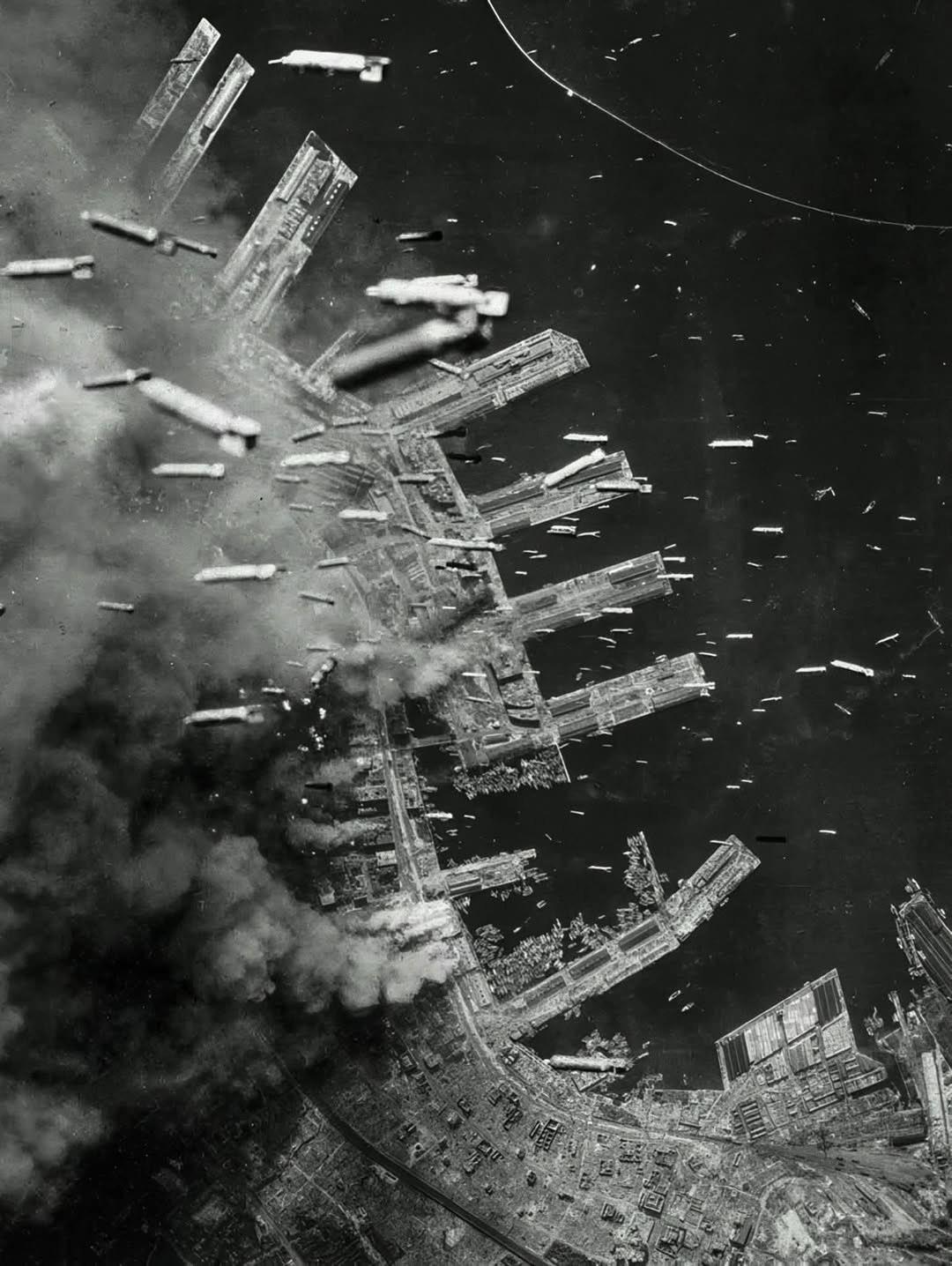
By June 1945, the war against Japan had become something grimly industrial. The United States was no longer fighting merely to defeat the Japanese military in the field. It was systematically dismantling the country’s ability — and perhaps willingness — to continue the war at all.
The photograph of incendiary bombs falling over Kobe captures that terrifying shift in modern warfare. Seen from high above, the bombs almost look orderly, suspended in neat lines beneath the bellies of Boeing B-29 Superfortresses. But what they carried down into the city was chaos on a scale difficult to comprehend.
These were not precision strikes aimed at a single factory or military headquarters. The B-29 campaign in 1945 increasingly targeted entire urban areas, especially cities built densely with wood and paper structures. Incendiary bombs turned those cities into furnaces. Kobe, one of Japan’s major ports and industrial centers, was especially vulnerable.
When the bombs hit, fires spread with horrifying speed. Individual blazes merged into firestorms powerful enough to create their own winds, pulling oxygen through streets like giant bellows. Temperatures became so extreme that people suffocated in shelters or were consumed where they stood. Entire neighborhoods vanished overnight.
The attack on Kobe in June 1945 was only one piece of a much larger strategy. Earlier that year, the firebombing of Tokyo had already killed an estimated 80,000 to 100,000 people in a single night — a death toll comparable to some of the atomic bombings that would follow months later. By the summer of 1945, much of urban Japan was being systematically burned apart from the air.
And the crews inside those B-29s often witnessed it from thousands of feet above. They could see entire sections of cities glowing red beneath clouds of smoke, the fires so large they altered the landscape itself. For many airmen, it produced a strange emotional distance. At 30,000 feet, destruction can look abstract. Patterns of light. Columns of smoke. Tiny flashes below.
But down there were civilians, families, workers, children, all trapped inside a kind of mechanized apocalypse created by modern industry and modern war.
That’s part of what makes the image so unsettling. It shows how warfare had evolved into something almost assembly-line in nature. Massive bombers. Standardized payloads. Entire cities reduced to targets on operational maps. The technology of the 20th century had made it possible not simply to fight armies, but to erase urban civilization block by block from the sky.
Mob shakes and screams at African american family pasing by in their car, Clinton, Tennessee, 1956.
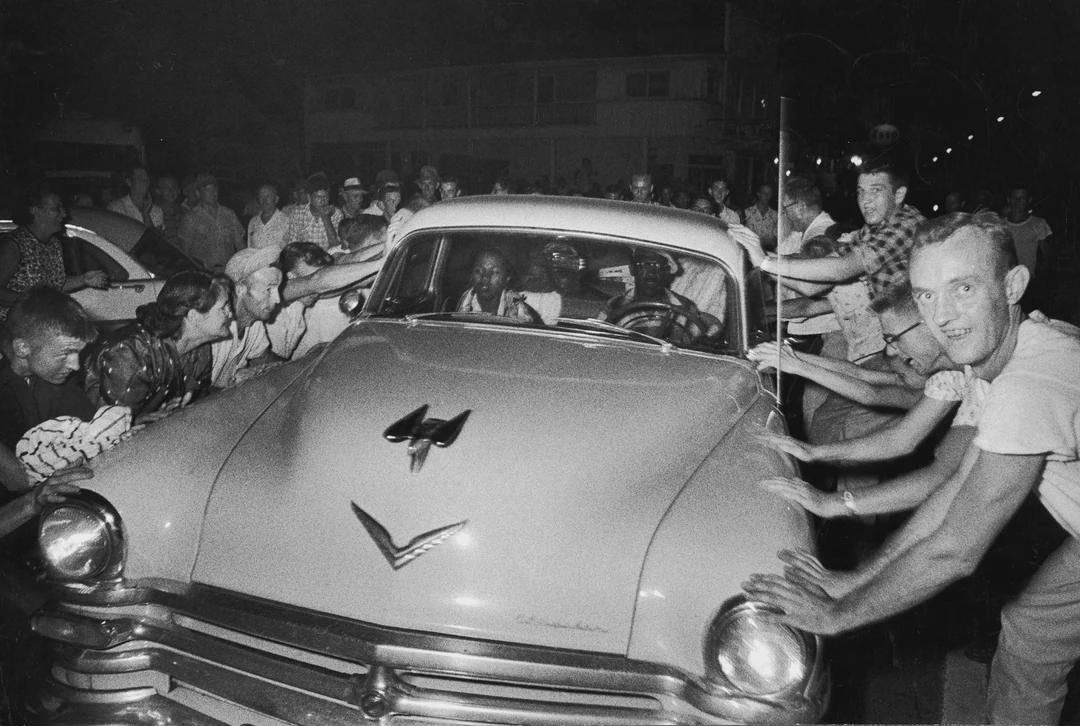
The photograph from Clinton, Tennessee in 1956 captures one of the ugliest realities of the Civil Rights era: ordinary people transforming into a mob simply because a Black family dared to exist publicly in a space white Americans believed belonged only to them.
The image is chaotic and deeply unsettling. White men crowd around the family’s car, screaming, shaking the vehicle, faces twisted with rage. Inside the car sits an African American family forced to endure the terror of being trapped in a metal box surrounded by people who hated them on sight.
It’s one thing to read abstractly about segregation and racial violence. It’s another to look at a photograph like this and realize how personal it was. This wasn’t happening on some distant battlefield. It was happening on an American street in broad daylight.
Clinton had become a flashpoint after the desegregation of Clinton High School following the Supreme Court’s Brown v. Board of Education ruling. Twelve Black students known as the “Clinton 12” had enrolled at the previously all-white school in 1956, making it one of the first schools in the South to integrate.
For many white segregationists, this felt like an attack on the social order they had built their entire lives around.
And that’s what makes photographs like this historically important. They destroy the comforting myth that resistance to civil rights was confined to a handful of extremists. The mob in Clinton wasn’t composed of faceless monsters from another species. Many were local residents, workers, fathers, churchgoers, neighbors.
People who likely saw themselves as decent citizens while participating in public intimidation against a family driving down the street.
That contradiction sits at the center of much of American history.
By the 1950s, the United States liked to present itself internationally as the leader of the “free world,” especially during the Cold War against the Soviet Union. But scenes like this exposed the enormous gap between America’s ideals and its reality.
The same nation speaking about liberty and democracy abroad still had citizens who believed Black children attending school with white children justified mass outrage and violence.
The family inside that car almost certainly understood the danger surrounding them. In the South of the 1950s, mobs could escalate quickly. Insults could become beatings. Beatings could become lynchings.
Fear was part of daily life for many African Americans navigating segregated America because they knew how fragile the line was between public hostility and outright violence.
What lingers about the photograph is not just the hatred on display, but the courage required simply to endure it. The Black families integrating schools, walking through hostile crowds, or driving through angry streets were often doing something extraordinarily dangerous while trying to live ordinary lives.
Taking children to school. Driving through town. Existing publicly in a society that had spent generations telling them they had no right to equal citizenship.