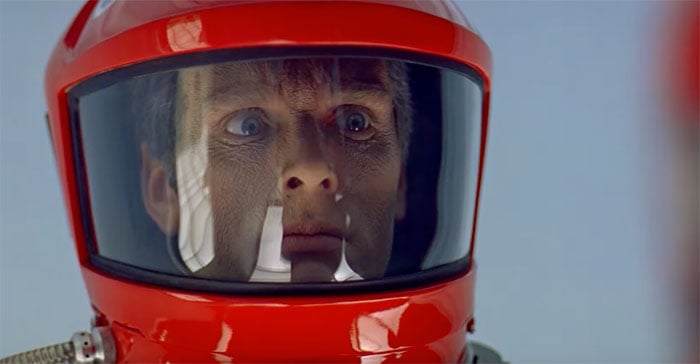
Stanley Kubrick Had All the Props from 2001: A Space Odyssey Destroyed So They Couldn’t Be Reused in Bad Sci-Fi Movies
After 2001: A Space Odyssey wrapped, Stanley Kubrick did something that feels less like a post-production decision and more like the final act of a Bond villain: he had all the sets and props destroyed. The glowing monolith? Gone. The EVA pods? Scrapped. The sleek interior of the Discovery One, with its antiseptic beauty and unsettling symmetry? Bulldozed into oblivion.
When Stalin was dying, his doctor was unavailable because he was being tortured by the secret police. Paralyzed and unable to speak, Stalin lay untreated for 12h while his terrified subordinates debated calling a doctor, fearing he might recover and punish them for acting without orders.
On the night of March 1, 1953, Joseph Stalin—the man who had ruled the Soviet Union through terror, purges, and absolute authority—lay helpless on the floor of his Kuntsevo dacha, his body betraying him at last. He had suffered a massive stroke, leaving him paralyzed and unable to speak. But the true tragedy, the dark poetry of the moment, was not just his failing body—it was that no one dared to help him.
In 1985 Michael Jackson bought the Lennon–McCartney song catalog for $47.5m then used it in many commercials which saddened McCartney. Jackson reportedly expressed exasperation at his attitude, stating “If he didn’t want to invest $47.5m in his own songs, then he shouldn’t come crying to me now”
It started as one of the great music friendships—two icons, two geniuses, two men who had both reshaped the industry in their own ways. Michael Jackson and Paul McCartney, together, had created some of the catchiest collaborations of the 1980s: Say Say Say, The Girl Is Mine. They admired each other, respected each other.
And then, Michael Jackson bought the Lennon-McCartney song catalog.
Schopenhauer called the post-orgasm moment of clarity as “devil’s laughter” because it’s when we realize we’re slaves to a biological imperative uncaring of our happiness
Arthur Schopenhauer, the 19th-century philosopher best known for making even Nietzsche seem like an optimist, had a particularly bleak take on human existence. Life, he argued, was little more than a cruel joke played by an indifferent universe, and nowhere was this more apparent than in the moments immediately following orgasm. He called it the devil’s laughter—that sudden, crushing moment of clarity when you realize that, just seconds ago, you were a marionette dancing on the strings of biology, wholly possessed by forces that care nothing for your long-term happiness.
Today’s daters are increasingly turning to online platforms to find partners
If you’re dating in 2025, chances are you’re swiping, scrolling, or matching your way through an algorithmically curated feed of potential partners. Gone are the days of organically meeting someone at a coffee shop or through a friend—today’s singles are turning to platforms like Hinge, Bumble, and even niche apps catering to hyper-specific interests (think: farmers, dog lovers, or NFT collectors). The shift isn’t just about convenience; it’s about efficiency. Why waste time navigating vague vibes IRL when you can pre-screen for political alignment, music taste, and love languages before even exchanging a message?
But as dating goes digital, the rules of attraction are evolving. The rise of video-first features and AI-generated profile prompts means that personality—or at least the illusion of it—is more important than ever. And with social media lurking in the background, every interaction comes with a layer of public scrutiny: your matches can Google you, stalk your LinkedIn, or find your TikTok before you’ve even set up a date. While some hail the hyper-connectivity of modern romance as a game-changer, others are left feeling burned out, stuck in an endless cycle of ghosting, breadcrumbing, and chasing the ever-elusive “spark” in a sea of curated personas.
Ever stumble across something so cleverly designed that you wonder, “Why didn’t anyone think of this sooner?” This post is packed with exactly that kind of brilliance. From mind-blowing innovations to everyday items reimagined in the coolest ways possible, these 25 genius designs prove that creativity has no limits.
If you want to understand memecoins, you have to start by accepting that they exist for the same reason conspiracy theories exist: people like feeling smarter than the system, even when they’re the ones getting played.
The USPS has unveiled a new fleet of Next Generation Delivery Vehicles designed by Oshkosh Defense
The Oshkosh Next Generation Delivery Vehicle (NGDV) is bringing a major overhaul to the USPS fleet with a host of new features designed for efficiency, safety, and future adaptability. Unlike the aging Grumman LLVs, the NGDV offers both gasoline-powered and battery-electric variants, with options for front-wheel drive or all-wheel drive, allowing for more versatility across different delivery routes.
The new truck is significantly larger, providing up to 155 cubic feet of cargo space, making it easier for carriers to handle high mail volumes. Visibility and safety have been vastly improved with a 360-degree camera system, automatic emergency braking, and collision avoidance technology—a huge leap forward from the nearly 40-year-old fleet still in use.
Another game-changer is air conditioning, something mail carriers have never had before in their trucks. The vehicle’s right-hand drive layout remains, but with a higher ceiling, allowing carriers to stand while sorting mail inside.
So there you are, minding your own business, when some friend, coworker, old classmate, distant cousin, or guy from the gym who definitely uses too much cologne slides into your messages with an exciting business opportunity. It’s exclusive, it’s time-sensitive, and, for reasons that will never be fully explained, it absolutely has to be discussed over coffee. At this point, you have two options: decline immediately or lean into the spectacle, fully aware that you are about to witness capitalism at its most evangelical.