
Crows hold “funerals” for their dead — gathering silently around a deceased crow not out of grief, but to collectively learn what killed it, essentially running a danger debrief
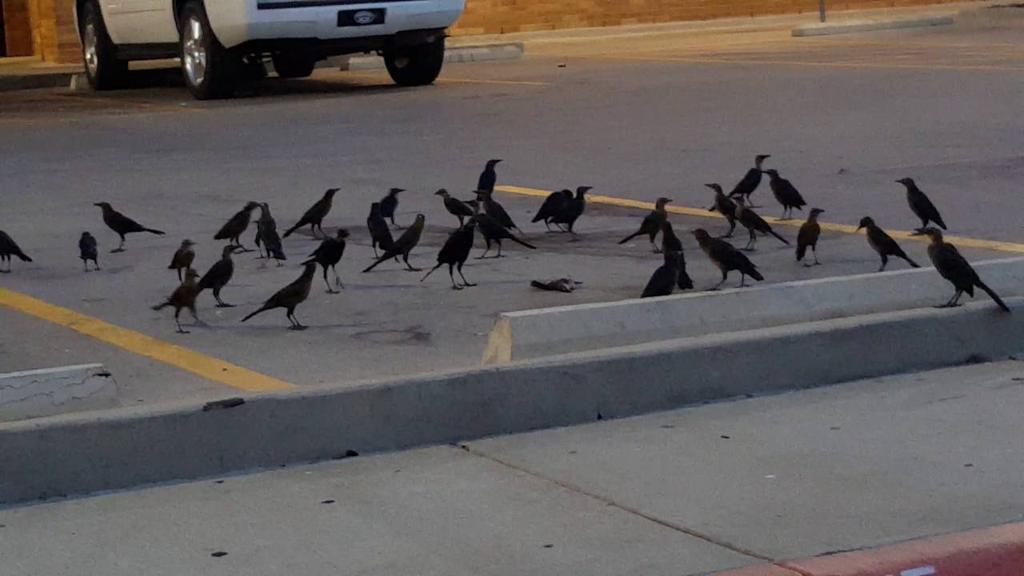
Crows do something that looks eerily human. When one of them dies, other crows will often gather nearby, go quiet, and focus intently on the body and the surrounding area. To us, it can look like a funeral. But what makes it fascinating is that it probably is not mourning in the way humans mourn. It appears to be something much more practical.
Crows are highly intelligent animals, and that intelligence shows up in ways that feel almost unsettling. They can recognize individual human faces and remember them for years, even warning other crows about specific people they perceive as threats. They use tools, bending sticks or shaping objects to get food out of hard-to-reach places. They can solve multi-step problems, understand cause and effect, and even appear to plan ahead. In some experiments, crows have demonstrated the ability to drop nuts into traffic so cars will crack them open, then wait for the light to change before safely retrieving the food. This is not just instinct. It is flexible, adaptive thinking.
That same intelligence is on display when they gather around a dead crow. They are not just reacting emotionally; they are processing information. When they encounter a body, they seem to treat it as a data point. What predator was here? Was a human involved? Is this a place to avoid? The group dynamic amplifies this. Multiple crows observing the same event can spread that knowledge quickly through their social network.
Researchers have found that crows will scold and mob individuals they associate with danger, sometimes long after the initial threat has passed. That suggests memory, communication, and a kind of shared awareness within the group. So when they cluster around a dead crow, it is likely part of that same system—a collective effort to understand and respond to risk.
A Dutch sailor shipwrecked in Japan in 1600 became one of the only Western samurai in history, eventually commanding his own fleet and influencing Japanese foreign policy for decades
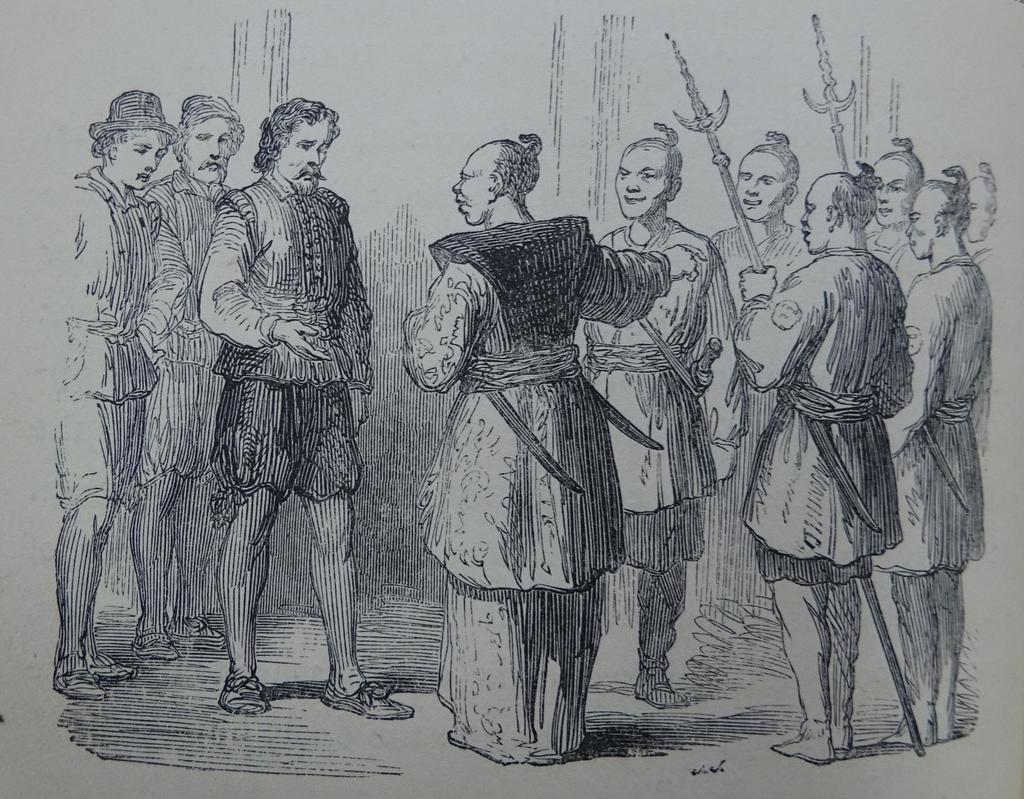
In 1600, a battered Dutch ship drifted into the waters off Japan, its crew decimated by disease, starvation, and months of brutal sailing. Among the survivors was an English pilot named William Adams. He had set out as part of a Dutch expedition seeking trade routes in Asia, but what he found instead was a country on the brink of transformation—and a role in it that no Westerner had ever held before.
Japan at the time was fractured, ruled by competing warlords. One of the most powerful among them was Tokugawa Ieyasu, a man consolidating power in a way that would soon reshape the entire nation. When Adams was brought before him, he wasn’t treated as just another foreign castaway. Ieyasu saw something useful: a man who understood ships, navigation, mathematics, and the wider world beyond Japan’s shores. Adams explained European trade, warfare, and religion in ways that stood apart from the Portuguese missionaries already operating in Japan, whose influence Ieyasu had begun to distrust.
Instead of executing or expelling him, Ieyasu kept Adams close. Over time, Adams became an advisor, a translator of Western knowledge, and eventually something far more unusual—he was granted the status of a samurai. This wasn’t symbolic. He received a Japanese name, Miura Anjin, a residence, a stipend, and the right to carry swords. In a rigid, hierarchical society where status was tightly controlled, this was almost unthinkable.
Adams didn’t just exist at the fringes of power. He helped build Western-style ships for Japan, advised on trade relationships, and played a role in shaping how the country interacted with foreign powers. As Ieyasu moved toward establishing what would become the Tokugawa shogunate, Adams’ insights helped inform a cautious approach to European influence—welcoming trade, but limiting the spread of Christianity and foreign political entanglements.
Despite opportunities to leave, Adams remained in Japan for the rest of his life. He married, had children, and became woven into the fabric of the country he had once stumbled into by accident. His story sits in a strange, almost myth-like space: a foreigner who didn’t just visit feudal Japan, but was absorbed into it at the highest levels.
In the end, William Adams wasn’t just a survivor of a shipwreck. He became a bridge between worlds at a moment when Japan was deciding how much of the outside world it would allow in—and how much it would keep out.
A 12-year-old Canadian girl named Shania Twain was secretly performing in bars until 2am in the 1970s because her family was so poor her parents felt they had no choice — the bars would look the other way because she was that good

Long before the world knew her as Shania Twain, she was a 12-year-old girl singing in bars late into the night, long after most kids her age were asleep. In the 1970s, growing up in rural Canada, her family struggled deeply with poverty. Money was tight to the point where survival—not comfort—was the priority, and her parents leaned on the one thing that seemed to offer a way through: her voice.
Night after night, she would perform in local bars, sometimes staying out until 2 a.m., surrounded by adults, cigarette smoke, and the low hum of conversations that had nothing to do with childhood. Legally, she shouldn’t have been there. But the bar owners looked the other way. She was that good. Good enough that people were willing to ignore the rules, good enough that a kid could hold a room full of adults and keep them listening.
It wasn’t a glamorous beginning. There was no stage lighting, no cheering arenas, no illusion of overnight success. It was long hours, exhaustion, and the kind of pressure most children never have to carry. While other kids were worrying about school and friends, she was helping keep her family afloat, one song at a time.
But those nights did something to her. They hardened her. They sharpened her instincts as a performer. Singing for a bar crowd that didn’t care unless you gave them a reason to is a brutal kind of training. You either learn how to command attention, or you get ignored. She learned.
By the time the world eventually discovered her, she wasn’t just talented—she was seasoned. The confidence, the control, the ability to connect with an audience—it had all been built in those late nights when she was just a kid trying to help her family survive.
A species of jellyfish (Turritopsis dohrnii) can revert back to its juvenile polyp state after reaching sexual maturity — essentially resetting its biological clock — making it the only known animal capable of theoretically infinite life

There is a species of jellyfish, Turritopsis dohrnii, that does something no other known animal can do. After reaching full maturity, instead of following the usual path toward death, it can reverse its own life cycle.
Most organisms move in one direction: birth, growth, reproduction, and eventually death. This jellyfish breaks that pattern. When faced with stress, injury, or even the natural end of its life stage, it can transform its cells and revert back into an earlier form of itself known as a polyp—the juvenile stage from which it originally developed.
This process, called transdifferentiation, allows the jellyfish to effectively reset its biological clock. Its adult body collapses, reorganizes, and begins again as if starting life over. From that polyp stage, it can grow back into a mature jellyfish once more, repeating the cycle.
Because of this ability, Turritopsis dohrnii is often referred to as “biologically immortal.” In theory, it can avoid death indefinitely by continuously returning to its juvenile state. While it can still be killed by predators, disease, or environmental changes, it does not appear to die of old age in the traditional sense.
This small, nearly transparent creature, drifting in the ocean, quietly defies one of the most universal rules of life: that time only moves forward.
Three separate Soviet submarines came within a single officer’s veto of launching nuclear torpedoes during the Cuban Missile Crisis — and in each case, one man’s refusal is the reason a nuclear exchange did not begin underwater in 1962

In October 1962, at the height of the Cuban Missile Crisis, the world hovered closer to nuclear war than most people realized. Beneath the surface of the Atlantic, far from public view, Soviet submarines carrying nuclear torpedoes were already in position, cut off from communication and under intense pressure.
These submarines were being hunted by U.S. naval forces, who had begun dropping practice depth charges—small, non-lethal explosives meant to signal the submarines to surface. But the crews below had no way of knowing that. To them, it felt like the opening moves of an attack.
Inside those submarines, the conditions were brutal. Temperatures climbed, air grew thin, and tension built with every passing hour. The officers on board were operating in near isolation, with no clear sense of whether war had already begun above them. And they carried weapons that could ensure it had.
Each of these submarines was armed with a nuclear-tipped torpedo, powerful enough to devastate an entire fleet. But launching one was not a simple decision. It required the agreement of multiple senior officers. In those moments of confusion and fear, the decision came down to individuals—men forced to interpret the situation without guidance, knowing the consequences could be irreversible.
On more than one of these submarines, the pressure to fire was real. Some officers believed they were already under attack and argued that launching the nuclear torpedo was justified. But in each case, at least one officer refused to give consent. That refusal stopped the launch.
These were not grand, visible acts. There were no speeches, no witnesses, no immediate recognition. Just tense, claustrophobic rooms deep underwater, where a single dissenting voice held the line. In those confined spaces, with incomplete information and the weight of the world unknowingly resting on them, restraint won out over escalation.
The crisis would eventually pass, remembered for the standoff between superpowers and the negotiations that followed. But beneath the surface, in those silent moments where decisions could have triggered a nuclear exchange, history hinged on something far more fragile: one person choosing not to turn a key.