
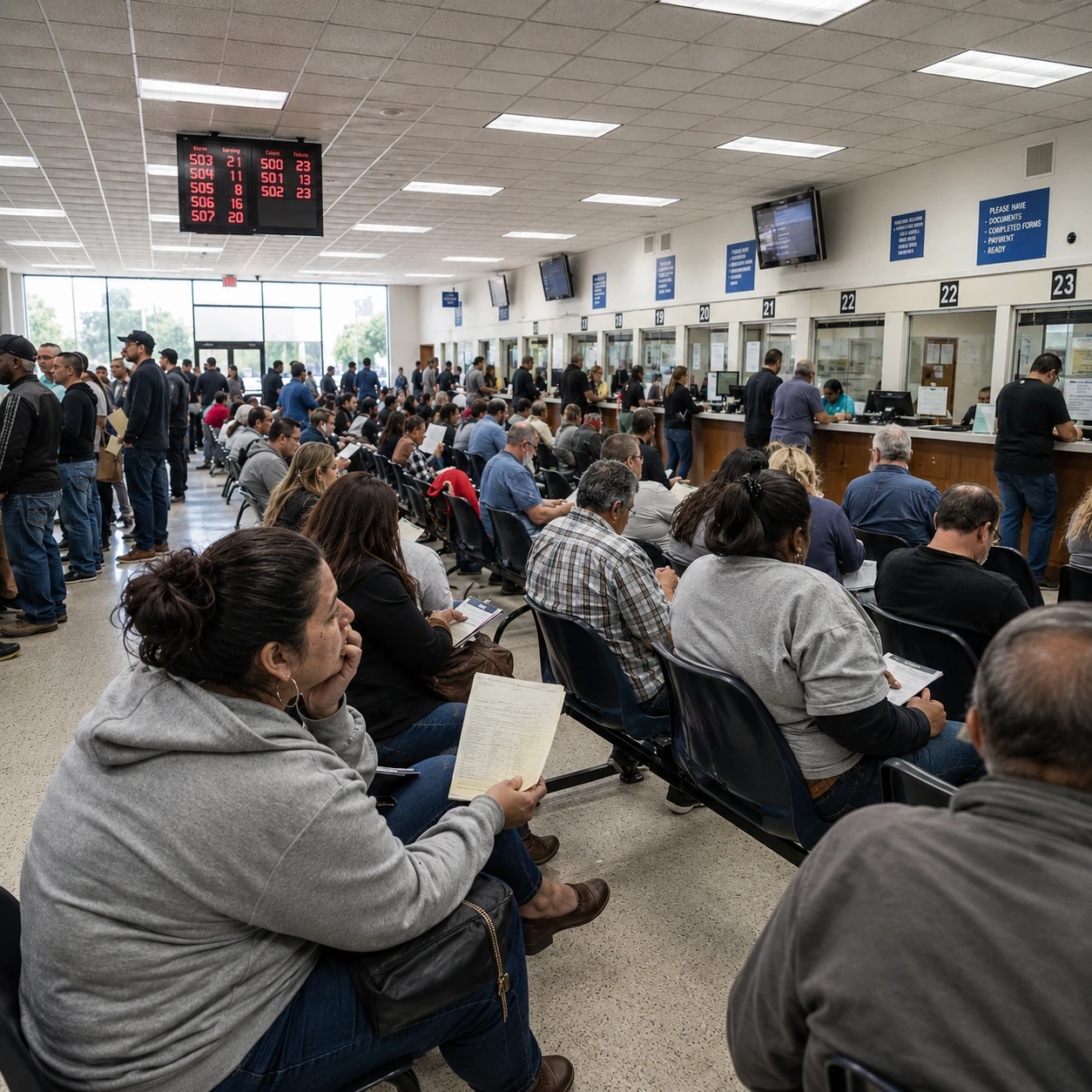
Few places inspire dread quite like the DMV. You can arrive before lunch with one simple task and emerge hours later feeling as though you have survived a minor natural disaster. The chairs are uncomfortable, the lighting is unforgiving, and the person ahead of you always seems to be attempting a type of vehicle transaction never before encountered by human civilization.
So why is the DMV still this bad?
The short answer is that it has been given an almost impossible job. The DMV must serve nearly every adult in the state while verifying identities, administering tests, collecting fees, maintaining enormous databases, enforcing complicated laws, and preventing fraud. At the same time, it is expected to be fast, inexpensive, accurate, secure, and accessible to everyone.
Those goals do not always play nicely together.
Everyone Has to Use It
Most businesses can control how many customers they serve. A restaurant can stop taking reservations. A doctor can limit the number of appointments available. A private company can raise its prices or simply decide that certain customers are not worth the trouble.
The DMV cannot do that.
It must serve teenagers getting their first licenses, elderly drivers taking new tests, immigrants presenting unfamiliar documents, people replacing stolen IDs, commercial truck drivers, car dealerships, accident victims, people transferring vehicles after a death, and millions of ordinary drivers renewing registrations.
Many of these people arrive at the same time: before work, during lunch, on Saturdays, near the end of the month, or shortly before a deadline.
The DMV is not dealing with a steady stream of identical transactions. It is dealing with unpredictable waves of people carrying problems of wildly different complexity.
One Complicated Case Can Stop Everything
A fast-food restaurant can keep its line moving because most orders follow the same basic process. DMV transactions are different.
One person may need only a simple license renewal. The next person may have an out-of-state title, a missing signature, an insurance problem, a name change, an unpaid fee, and a vehicle inherited from a relative who died ten years ago.
That case may require an employee to inspect several documents, search multiple databases, consult a supervisor, and explain why another form is necessary. The customer may then argue, call a family member, search through an email account, or insist that the rules were different the last time they visited.
Meanwhile, everyone behind them wonders why the line has not moved.
A DMV line is therefore not really one line. It is dozens of different government processes forced through the same set of counters.
The DMV Has to Assume People Might Be Lying
If the DMV merely took people at their word, it could move much faster. Unfortunately, driver’s licenses and vehicle titles are valuable legal documents.
A license can be used to board an airplane, open a bank account, apply for credit, obtain government benefits, or prove someone’s identity. A vehicle title establishes ownership of an asset that may be worth tens of thousands of dollars.
That means the DMV must guard against identity theft, forged documents, stolen vehicles, fraudulent disability placards, fake addresses, altered odometers, and people attempting to obtain multiple identities.
Every security measure adds friction. Employees must compare records, examine paperwork, verify information, take photographs, collect fingerprints in some cases, and follow strict rules about what they can accept.
To the honest customer, these steps can feel like pointless bureaucracy. But the system is slow partly because the consequences of getting it wrong are serious.
The Rules Are Complicated and Constantly Changing
The DMV does not invent every requirement it enforces. Legislatures pass laws. Courts issue rulings. Federal agencies establish identification standards. Insurance requirements change. New privacy and emissions rules appear. Each change must somehow be translated into forms, computer systems, employee instructions, and procedures at thousands of service windows.
The result is a mountain of rules filled with exceptions.
A document that works for one transaction may not work for another. A renewal that can normally be completed online may require an office visit because of someone’s age, driving record, immigration status, address change, or the timing of the previous renewal.
Employees must interpret all of this while facing a frustrated customer who may have waited two hours and taken time off work.
Even a well-trained employee can struggle in a system where the answer is frequently, “It depends.”
Government Agencies Cannot Adjust Quickly
When a private business becomes overwhelmed, it can hire temporary workers, extend its hours, simplify its product line, or spend more money to increase capacity.
A government agency usually cannot react that quickly.
Hiring may require budget approval, background checks, civil-service procedures, training, and negotiations over staffing. Funding is often determined months or years in advance. Adding a new office can involve leases, construction, security requirements, and political approval.
By the time additional employees arrive, the original surge may have changed or another problem may have appeared.
The DMV is often criticized for having too few workers, but taxpayers and elected officials also pressure it to keep costs low. People want shorter lines, more offices, better technology, and longer hours. They are less enthusiastic about paying for them.
Old Technology Makes Everything Worse
Many motor-vehicle agencies rely on a mixture of modern websites and older computer systems built over decades. New services are often placed on top of databases that were never designed for online appointments, digital documents, or instant communication with other agencies.
Replacing those systems is difficult and risky. A DMV database contains millions of driving records, vehicle titles, addresses, fees, restrictions, and legal actions. A failed upgrade could prevent people from registering cars, obtaining licenses, or proving ownership.
So agencies often modernize one piece at a time. This produces the familiar government experience in which a website looks reasonably modern until something goes wrong, at which point the customer is told to print a form and visit an office.
Technology has eliminated many routine visits, but it has also changed who remains in the waiting room. The easiest transactions now happen online. The people who still show up in person are more likely to have complicated cases that take longer to resolve.
Customers Are Part of the Problem
It is satisfying to blame the DMV, but some delays begin on the other side of the counter.
People arrive without appointments. They bring expired documents, incomplete forms, unacceptable payment methods, or no proof of insurance. They wait until the final day before a deadline. Some have not checked what documents they need because they assume the employee will “look it up.”
A missing signature can turn a five-minute transaction into a twenty-minute argument. Multiply that by hundreds of visitors, and the entire office falls behind.
Confusing instructions deserve some of the blame. Government websites are not always written in language ordinary people understand. But a public office serving thousands of unprepared customers will inevitably become slower for everyone.
There Is Little Competitive Pressure
If a restaurant consistently makes customers wait three hours, people will stop going. The DMV does not face that threat. You cannot take your business to a stylish new licensing agency across the street.
That does not mean DMV employees do not care. Many are trying to do difficult work while absorbing frustration from the public all day. But the institution itself does not experience competition in the way a private company does.
Its customers are required to return.
Without competition, improvement depends on political pressure, competent management, adequate funding, and public officials being willing to invest in changes that may not produce visible results until years later. That is a much weaker incentive than the possibility of going out of business.
Why It Feels Even Worse Than It Is
The psychological experience of visiting the DMV magnifies every delay.
You are usually there because the government requires you to be. The task is rarely enjoyable. You may be missing work, managing a child, worrying about a deadline, or carrying documents that took days to gather. You have little control over the process and often receive no clear explanation of how long it will take.
An unexplained wait feels longer than an explained one. An involuntary wait feels longer than a voluntary one. A wait in an uncomfortable room feels longer than the same wait at home.
The DMV combines all three.
Watching ticket numbers advance without understanding the system makes the process feel arbitrary. Someone who arrived after you may be called first because they need a different service, but from your chair it looks as though the government has simply forgotten you exist.
Can It Be Fixed?
It can certainly be improved. More transactions can be moved online. Forms can be simplified. Appointment systems can give realistic wait estimates. Customers can upload documents in advance and learn whether something is missing before leaving home. Offices can separate quick transactions from complicated cases.
Some services can also be handled by approved private businesses, automobile clubs, dealerships, or kiosks. Better staffing forecasts could place more employees in offices during predictable rushes.
But there is no single technological fix. If the DMV makes identity verification faster, it may create new opportunities for fraud. If it eliminates documentation requirements, it may issue titles or licenses incorrectly. If it hires more employees, the public must pay for them.
The real challenge is finding the least painful balance between convenience, cost, security, accuracy, and fairness.
The DMV is crappy partly because it is bureaucratic, sometimes poorly managed, and often stuck with outdated systems. But it is also crappy because we have assigned it a huge collection of complicated, high-stakes responsibilities and demanded that it perform them cheaply for almost everyone.
That does not make a three-hour wait any less miserable. It does, however, explain why the solution is more complicated than opening another service window.