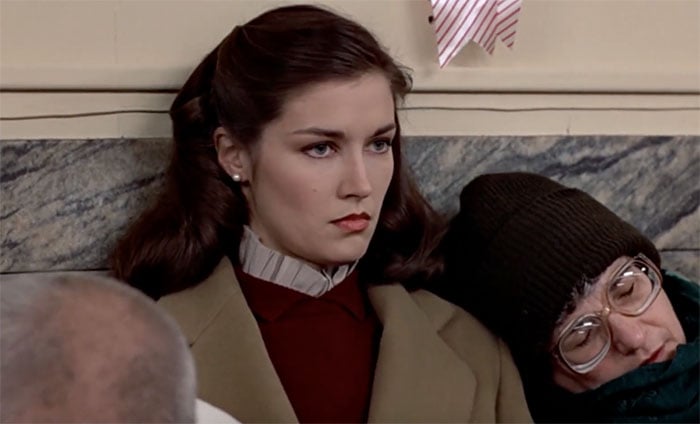
Let’s be honest: you probably don’t remember Kristin Holby’s name. But you remember the face—cool, elegant, framed by that impossibly perfect 1980s hair, moving through Trading Places with the detached ease of someone who never expected life to be anything but smooth. She was Penelope Witherspoon: the fiancée, the status symbol, the kind of person you only ever see at fundraisers and on the cover of old Town & Country magazines your parents left in the attic.
And then, almost as quickly as she appeared, she vanished—not with a scandal or a flourish, but with the gentle fade-out reserved for characters (and actors) who were always meant to be a little bit out of reach. What happened to Kristin Holby? Why did she disappear? And why, decades later, does her absence feel oddly significant? Let’s try to trace the outline of a person Hollywood seemed to misplace.
Background Info
Born in Oslo, Norway, in 1951, she was the kind of kid who didn’t stay in one place for long—her family moved to New York before she was old enough to have an accent, landing her in the orbit of suburban schools like Murray Avenue and Mamaroneck High, places where “show business” meant drama club and the annual musical.
After high school, Holby did what a lot of creative kids from the suburbs dream of doing—she enrolled at the Rhode Island School of Design, chasing something that felt both artistic and pragmatic: apparel design. It was in the classrooms and fabric labs at RISD that she fell for fashion—not as a fleeting interest, but as a way of seeing the world. She started out behind the scenes, working as a fabric designer at a local textile company. But this wasn’t a story destined to end quietly behind a desk.
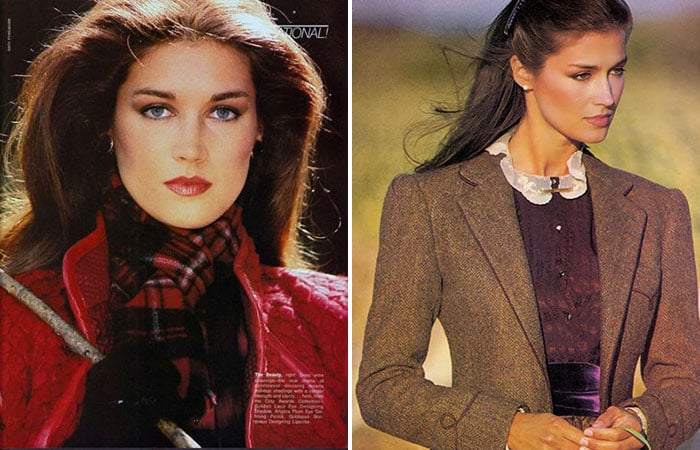
By the late seventies, Kristin stepped into the actual spotlight, swapping fabric swatches for runways. She became a familiar face in the rarefied world of high fashion, modeling for the kind of names that require no first names: Givenchy, Ralph Lauren, Chanel, Yves Saint Laurent. If you flipped through a Vogue in that era, odds are you saw her—sometimes only realizing it decades later, when you wondered why her face seemed lodged in some elegant, sepia-toned corner of your memory.
Trading Places
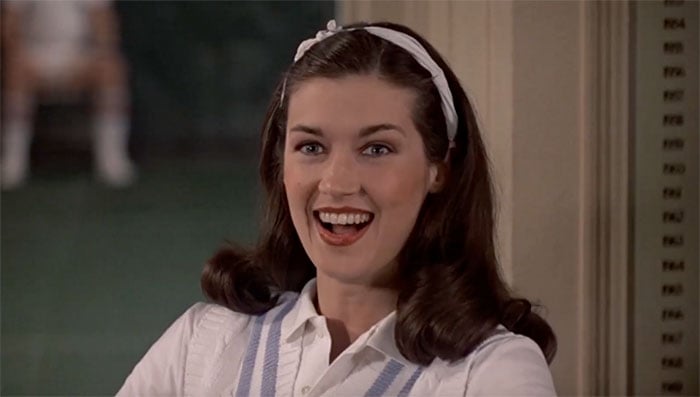
After the catwalks and magazine covers faded, Kristin Holby pivoted—like so many before and after her—from modeling to acting. Her defining moment arrived in 1983, when she landed the role of Penelope Witherspoon in Trading Places. You know the movie: Dan Aykroyd, Eddie Murphy, social satire with a Philadelphia address and a John Landis zip code, everyone swapping lives (and coats and fortunes) to test a theory about nature versus nurture. It’s the kind of film that feels both perfectly of its time and strangely evergreen, full of acerbic wit and eighties sheen.
Penelope, Holby’s character, isn’t in on the experiment. She’s the fiancée—glacial, proper, and perfectly coiffed—who quickly abandons Aykroyd’s Louis Winthorpe III as soon as his life detours from “old money” to “tabloid cautionary tale.” It’s a role that requires a very specific kind of presence: someone who seems like she’s always existed on the upper floors of a building you’ll never be invited into.
After Trading Places, Holby’s career slowed to a near standstill—one of those mysterious industry pauses that feels, in retrospect, more like an ellipsis than a period. But she did resurface, briefly but memorably, as Mrs. Jacobi in Michael Mann’s Manhunter (1986). This time, she was on the periphery of a new kind of nightmare: a sleek, neon-lit thriller about an ex-FBI profiler stalking the “Tooth Fairy,” a serial killer as mythic as his nickname. Holby’s role was small, but her presence—like always—lingered in the background, a reminder of the strange, unpredictable paths Hollywood carves for its supporting players.
What is Kristin Holby Doing Now?
Kristin Holby’s story as a public figure pretty much ends in 1986, with a fleeting but memorable appearance in Manhunter—a closing credit, not a curtain call. After that, she seemed to vanish, not with fanfare but with the kind of elegant decisiveness that matches her on-screen vibe. Somewhere in the gap between Trading Places and Manhunter, she married Sebastian White—a physicist, which, if you’re keeping track, means that Holby has a knack for real-life pairings even more eclectic than her film roles. Together they had three children: a son and twin daughters, Camilla and Phoebe. But the marriage itself was short-lived.
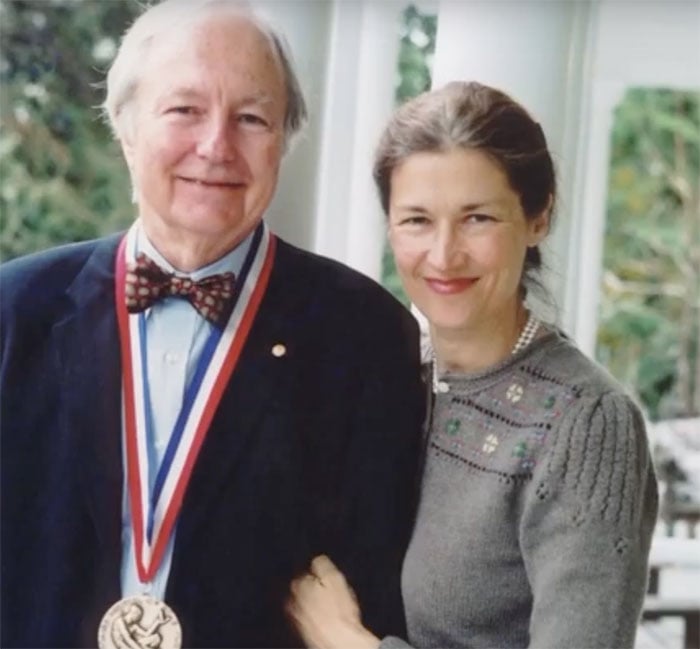
In the early ’90s, Kristin found a new chapter with James Edwin Darnell, Jr.—not a household name in the tabloid sense, but a rock star in the world of molecular biology. Darnell, now in his nineties, is the kind of scientist whose résumé is too dense for a Wikipedia summary: Astor Professor Emeritus at Rockefeller, major player in RNA research, textbook author, and recipient of awards so prestigious they involve actual presidents handing them out. The specifics of their wedding are MIA—lost to the pre-internet ether, or maybe just to Holby’s preference for privacy.
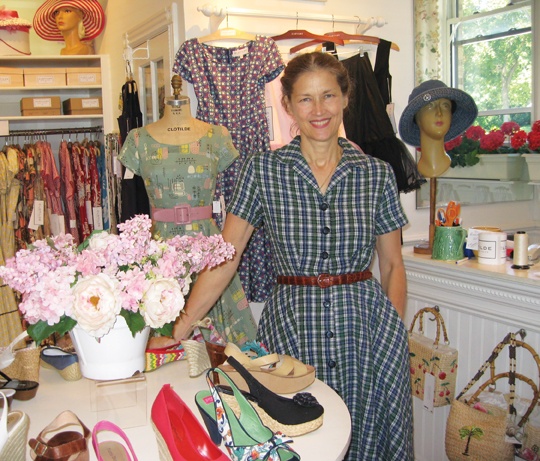
And privacy really is the headline here. Kristin Holby, now well into her seventies, is almost entirely off the grid. No Instagram, no Facebook, no late-career reinvention tour—just a handful of fake accounts and an authentic, analog life. The closest thing to a public project? Clotilde: The Dress Shop, her quietly stylish boutique in Larchmont, New York. Holby’s not giving interviews or reliving her film moments for streaming retrospectives. She’s simply living—offstage, offscreen, and maybe, finally, exactly where she wants to be.