Lenin and Stalin at Gorki, just outside of Moscow, September 1922
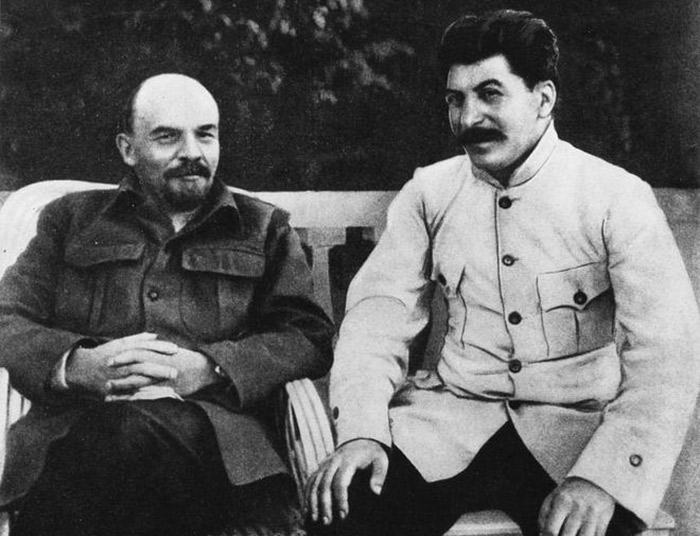
There’s a strange, almost theatrical quality to the moment when two of the 20th century’s most consequential figures sat together at Gorki in 1922. By then, the Russian Revolution’s victorious whirlwind was slowing, but beneath the surface, new storms were brewing. Lenin, the ideological engine of the Bolsheviks, was well aware that the revolution he’d birthed was at a crossroads—and that the men surrounding him were already thinking about what came next.
Stalin was among them, but his ambitions were less visible, more subterranean. He wasn’t the thunderous orator or the theorist that others in the Bolshevik circle were; he was a master of the slow game, of bureaucracy, of quietly placing allies in key positions. At Gorki, Stalin spent long stretches at Lenin’s side. He listened. He offered support. But he also maneuvered, sometimes out of Lenin’s view, sometimes right in front of him, consolidating his grip on the party’s apparatus.
Lenin, even in declining health, was sharp enough to see what was happening. He wrote memos—some addressed to the party congress—warning about Stalin’s growing power and his temperament. Yet, it’s one of history’s dark ironies that the machinery Lenin had helped build, the very centralization and control that made revolution possible, also created the perfect stage for an operator like Stalin to step in.
In the months that followed, the power struggle in Moscow intensified. Trotsky, Bukharin, Zinoviev—all had visions for the revolution’s future, but none were as methodical or as ruthless as Stalin. The time at Gorki becomes a kind of silent transfer, with Lenin—intentionally or not—handing off the revolution to a man who would transform it into something else entirely. The consequences would echo for generations, reshaping the fate of nations and millions of lives. History’s pivot points aren’t always loud; sometimes they happen in quiet gardens, in private conversations, while the world outside has no idea what’s coming next.
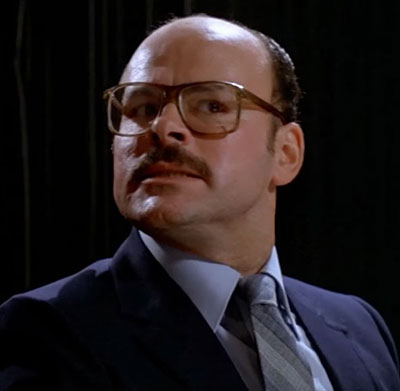
Philippe Pétain, head of the collaborationist regime of Vichy France from 1940 to 1944, on trial for treason at the Palais de Justice, Paris. Pétain was previously considered a war hero after leading the French Army in WWI. July 30, 1945

In a Paris courtroom in the summer of 1945, France put one of its most decorated soldiers on trial for treason. Philippe Pétain—Marshal Pétain—who had once been revered as the “Lion of Verdun,” the stoic commander who held the line against the German onslaught in the First World War, now stood in the dock at the Palais de Justice. The irony would not have been lost on anyone in the room: the hero of 1916 accused of betraying his country less than thirty years later.
For decades, Pétain had been a living symbol of French resilience. Soldiers and civilians alike had seen in him the embodiment of duty, sacrifice, and national honor. But when France collapsed before Hitler’s armies in 1940, and the government fled south, it was Pétain who took the reins of what remained. He made a fateful choice—to sign an armistice and lead the new government at Vichy, collaborating with Nazi Germany. Was it the pragmatic decision of an old soldier desperate to shield his people from greater suffering? Or a moral capitulation that enabled occupation, deportation, and repression?
Now, at age 89, frail and stone-faced, Pétain listened as the charges were read. The courtroom was thick with the weight of memory and anger—survivors of the Resistance, families of the deported, old comrades from the trenches, all trying to square the image of their wartime savior with that of the accused collaborator. The trial wasn’t just about the guilt or innocence of one man. It was about the soul of France after four years of humiliation and division. How should a nation judge the man who embodied both its finest hour and its darkest compromise?
There were voices who called for mercy, remembering Verdun. Others wanted only justice—revenge, even—for the years of occupation. In the end, Pétain was sentenced to death, though the penalty was commuted to life imprisonment, a final, uneasy compromise. His legacy remains a puzzle for the French: war hero and traitor, patriot and collaborator. The past refuses easy answers, especially when the same man can embody both honor and disgrace, sometimes in the same lifetime.
Captured Hitler Youth in Belgium
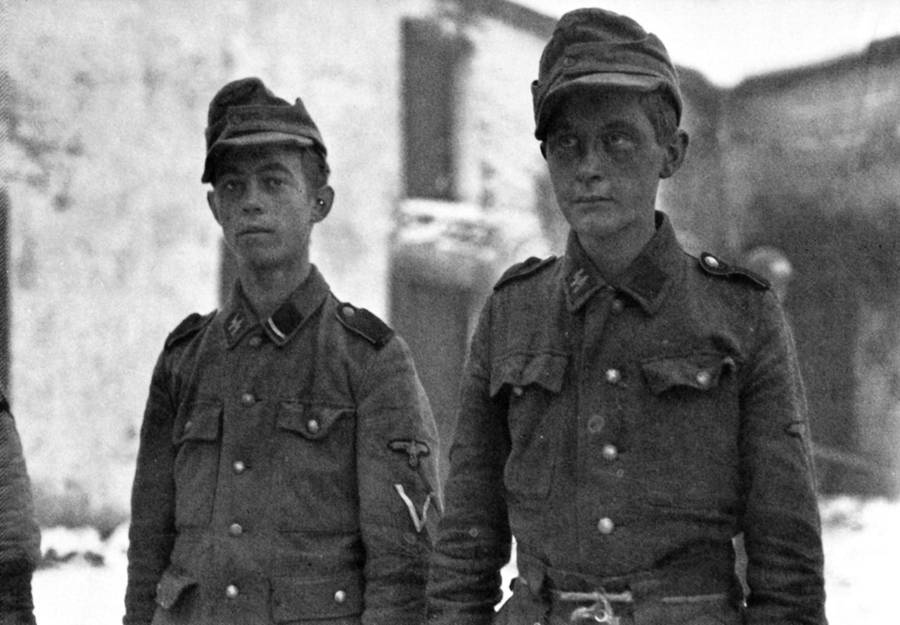
In the closing months of the war, the roads through Belgium filled with the shattered remnants of an army that had once marched with hymns and banners, now silent, starving, afraid. Among the prisoners taken by the advancing Allies were boys—some not yet fourteen—caught in uniforms too large for their thin shoulders, the last conscripts of a dying Reich.
They were Hitlerjugend, the Hitler Youth, drawn from schools and homes by promises of glory and the threat of shame. Raised beneath the swastika’s shadow, taught the catechism of hate and sacrifice, they drilled with wooden rifles and learned to sing of the Führer’s greatness before they knew how to shave. As Germany’s frontlines buckled and broke, these boys were given real weapons and sent into battle against tanks and grown men, into forests and fields that would never remember their names.
In Belgium, as the Allied columns rolled east, they came upon these children-soldiers, their faces streaked with mud and fear. Some wept openly, calling for mothers who could not come. Others stared blankly, spent of all belief. The older prisoners—veterans of other wars, other lies—looked at the boys and saw in them only the long shadow of madness, the final cruelty of a regime willing to devour its young to forestall the inevitable.
The Belgians watched, remembering the years of occupation, the parades, the shortages, the sudden disappearances. Yet even hatred soured in the presence of such ruin. The boys were herded into camps, fed what could be spared, their fates suspended between justice and mercy. Some would be sent home in time, others would linger, rootless, in the ruins of the world that had made them and abandoned them.
History would go on, indifferent. But for a moment in the spring of 1945, the old world and the new met in the faces of boys too young to have ever chosen the war they had been made to fight.
Navajo Riders Crossing the Canyon de Chelly in 1904, Arizona
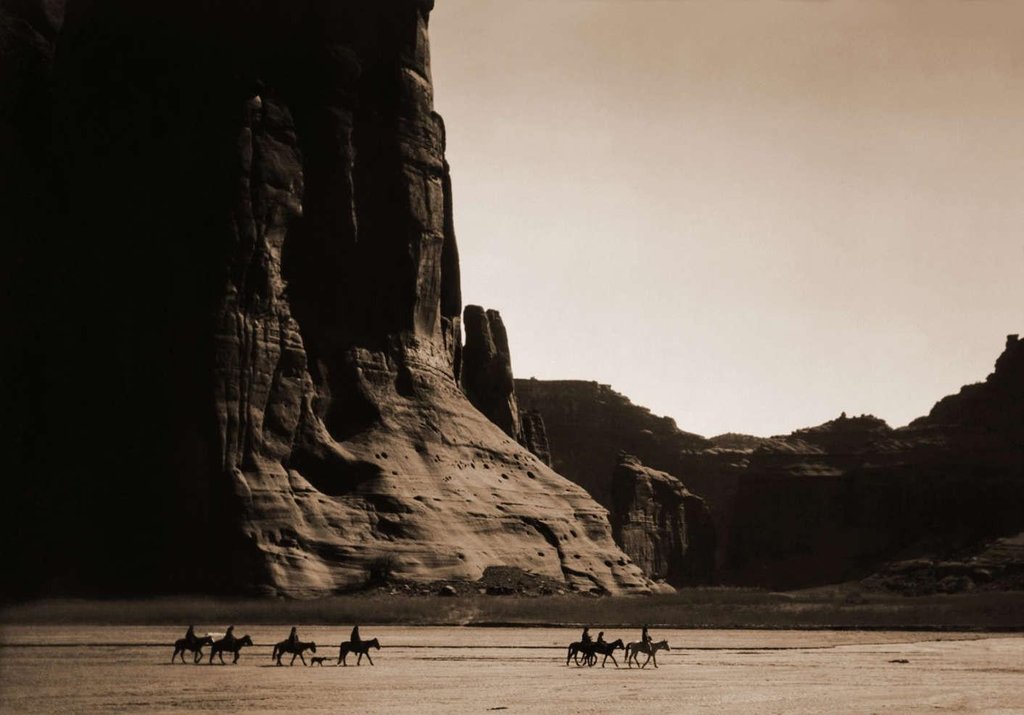
They rode as figures cut from the very stone, shaped by hard years and harder truths, trailing no expectation of comfort in the waking world. Each man bore within him a solitude as deep as the gorge itself, a silence honed by time and loss. Their faces were unreadable, mapped by winds and worry, their eyes fixed on some distant point beyond the far rim, where the land folded back on itself in red secrecy. Rifles rested easy across saddle horns; some men carried nothing but the lean memory of survival, a gaze steady and unflinching.
The horses moved with patient resolve, knowing the path, unhurried. The hush of hooves on sand was all that marked their passing. Overhead the canyon walls rose up, ancient and unmoved, bearing in their hides the petroglyph scars and ochre ghosts of those who had passed long before. The rock itself bore witness, unreadable, impassive. A raven traced slow circles against a sky pale with late sun, its cry falling unanswered into the deep.
For the Diné, the land was not to be loved or hated but endured. It was a thing absolute, indifferent as rain or fire. The canyon kept its own counsel. Each rider’s crossing was little more than a fleeting mark, a whisper in the earth soon swallowed by wind and shadow. Yet there was weight in it, the sense of riding not alone but in the company of all who had come before, and those yet to come, a silent communion that did not require words.
In that crossing, there was a silence that belonged to no man. The world hushed around them, the only music the small noises of living—creak of leather, jangle of reins, the sighing wind. They carried their stories within, not spoken but understood, each man’s burden a stone in the invisible cairn of memory. Perhaps, as night gathered along the canyon rim, the land itself would remember for them, holding in its quiet heart the hoofbeats, the passing shadows, the stubborn persistence of those who refused to vanish.
And so they rode, neither quickly nor slow, swallowed by the canyon’s red immensity, names unspoken, faces turned to the future, and behind them only the memory of dust, soon gone.
A Filipino survivor of the Manila massacre, shows where a Japanese officer tried to behead him, 1945
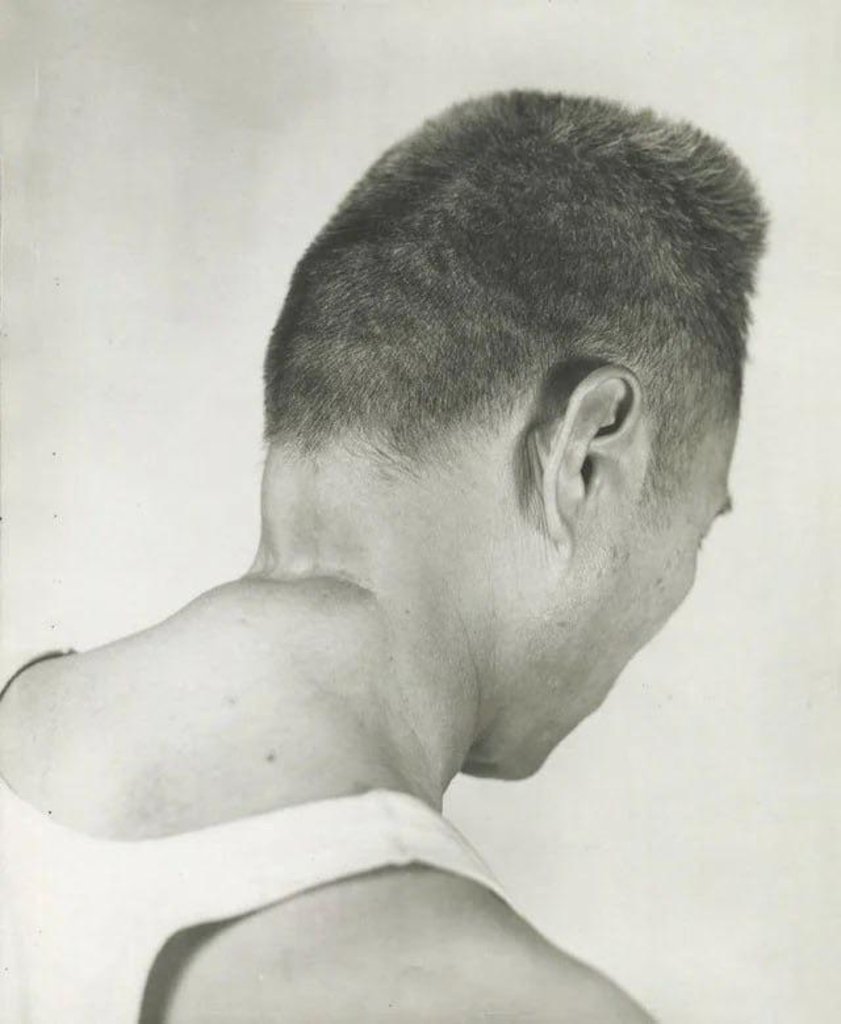
In the waning days of the Second World War, the city of Manila was unmade. The Americans advanced from the north and the Japanese, cornered and desperate, unleashed a savagery that knew no reason nor mercy. From February to March 1945, the city was delivered over to fire and sword. Men, women, children—none were spared. Churches became slaughterhouses. Homes became tombs. The rivers, once silver in the sun, ran black with blood.
The massacre was not the wild chaos of war but a method, a command, executed with grim devotion. Bayonet and rifle, rope and flame. And the sword—ancient, almost ceremonial—was brought down upon the necks of the bound and the pleading. In schools and hospitals, in alleyways and open courtyards, families knelt and waited for the steel. The city’s air was thick with smoke and the smell of burning flesh. It was said that Manila had become a cemetery with no headstones, a place where the living envied the dead.
Some survived. By luck or by the faltering hand of their executioners, by feigning death, by crawling beneath the bodies of kin. Among them, a man who would wear a scar across his neck for the rest of his days. He became both witness and relic, carrying on his skin the story of a city undone by men who had long ago set aside their humanity. The memory of that blade—the cold, precise anger of its descent—would outlast the rubble and the ruined churches.
The survivors bore their scars into the new world that followed. They rebuilt from ashes. They told their stories to anyone who would listen and to many who could not bear to. And still, in the old city, beneath the painted stone and glass, the bones of the dead rested uneasily, waiting for the day when the world would remember not just how Manila was lost, but how its people survived.