A mother and child in Hiroshima, four months after the atomic bombing. 1945
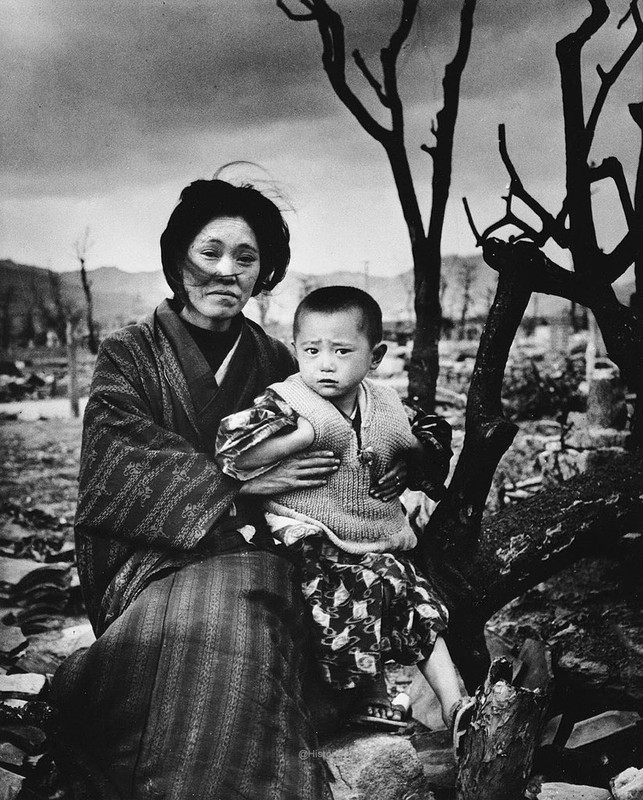
The air is cool, the kind that seeps into your bones, but it’s not the weather that makes her hold him so tightly. Her arms are wrapped around the boy in a way that’s half-embrace, half-shield — though against what’s already happened, no shield could have mattered.
Four months earlier, at precisely 8:15 a.m., the sky over Hiroshima tore open. In a fraction of a second, a flash hot enough to fuse metal and bone erased the morning as if someone had ripped the page from time itself. The blast wave flattened everything within miles. The firestorm that followed roared through what was left. And the radiation — invisible, silent — began rewriting the cells of every living thing it touched.
Now, the city is an alien landscape. Buildings stand as skeletal frames, jagged and hollow. Bridges lead to nowhere. The ground is littered with roof tiles that once covered entire neighborhoods. Even the trees are gone, their trunks vaporized or left as blackened stumps. The smell of charred stone and scorched earth still clings to the wind, carried from ruins that have yet to be cleared.
She picks her way through it, one foot at a time, clutching him close. Maybe she’s afraid to set him down in case the ground itself holds the poison of that day. Maybe it’s just that she can still feel the moment the bomb fell in her muscles — that split second when holding on was the only thing she could do.
The boy is quiet. Not sleeping, not crying, just watching over her shoulder. His small hand is curled into the fabric of her clothes like he knows that letting go is not an option. Around them, Hiroshima is both a city and a grave, its population cut from 350,000 to a silent fraction. Nearly 140,000 were dead by the end of that year, and the survivors carry not just the memory, but the marks on their skin and the uncertainty in their blood.
The ruins stretch in every direction, but she walks on — holding him as if he’s the last thing left in the world that’s still alive.
Soviet premier Joseph Stalin and Japanese foreign minister Yōsuke Matsuoka pose for a photo after signing the Neutrality Pact in Moscow April 13, 1941

On April 13, 1941, inside the Kremlin, Joseph Stalin and Japanese Foreign Minister Yōsuke Matsuoka stand arm-in-arm for the cameras. The pose is almost intimate, but the document they’ve just signed — the Soviet–Japanese Neutrality Pact — is not about friendship. It’s about survival in a world coming apart at the seams.
The Soviet Union is less than two years removed from the shock of the Nazi–Soviet Pact, which bought Stalin time in the west. Now, with Japan entrenched in its war in China and probing Soviet defenses in Mongolia and Siberia, Stalin needs the same breathing room in the east. The Red Army can’t afford a two-front war. The memory of the 1939 Battles of Khalkhin Gol — where Soviet and Japanese forces clashed brutally along the Manchurian border — is still fresh.
For Japan, the logic is different but just as cold. Their imperial ambitions point south toward the oil, rubber, and tin of Southeast Asia. Fighting the Soviets in the north would drain men and materiel they need for that expansion — and risk tangling with a military that had bloodied them before. Neutrality with Moscow means their Manchurian flank is secure while they turn their navy toward the Pacific.
Matsuoka, fresh from a visit to Berlin, believes the Tripartite Pact linking Japan, Germany, and Italy will deter American involvement. Stalin, ever the pragmatist, suspects war with Hitler is inevitable and wants Japan tied up elsewhere when that moment comes.
History would prove the cynicism justified. In June 1941, just two months after this photograph, Hitler would launch Operation Barbarossa, driving millions of German troops into Soviet territory. The pact with Japan held — barely — for four more years. Then, in August 1945, with Germany defeated and Japan reeling, the Soviet Union tore it up, declaring war and invading Manchuria in the final days before Tokyo’s surrender.
The photo freezes a moment when two rising powers, distrustful but pragmatic, set aside their differences not out of goodwill, but out of mutual necessity. In 1941, that was enough. In the end, it was only paper.
“Birmingham, Alabama” by Charles Moore. African-American teenagers/young adults being sprayed by a fireman’s hose in 1963

Birmingham in 1963 was a stronghold of segregation — a place where Jim Crow laws weren’t just enforced, they were defended with an almost religious zeal. The city’s segregation ordinances dictated where Black residents could live, work, eat, and even walk. Its mayor and police commissioner, Eugene “Bull” Connor, had built a reputation as one of the most unyielding defenders of the old order.
That spring, the Southern Christian Leadership Conference, along with local leaders like Fred Shuttlesworth, targeted Birmingham for a full-scale campaign to challenge segregation head-on. The plan was to fill the jails, choke the court system, and force national attention on a city that symbolized the violence of white supremacy. But as adult demonstrators were arrested and the ranks thinned, the movement turned to its youngest supporters.
The Children’s Crusade began in early May. Thousands of African-American schoolchildren and teenagers poured into the streets, marching toward downtown, singing freedom songs, and calling for integration. Bull Connor’s answer was to deploy police dogs and high-pressure fire hoses — weapons designed to intimidate and incapacitate.
The hoses, powered by hundreds of pounds of water pressure, were strong enough to strip bark from trees and peel flesh. When aimed at the young marchers, they sent bodies tumbling down the street, pinned people against walls, and left deep welts. This was not crowd control — it was punishment, meted out in full view of the press and the public.
Photographs and news footage of the scenes — teenagers slammed to the pavement, children clinging to one another as torrents of water hit them — were published and broadcast across the country. They bypassed political rhetoric and showed Americans, in unflinching clarity, what “law and order” meant in the segregated South.
The Birmingham campaign, and the national outrage it sparked, pushed President Kennedy to introduce sweeping civil rights legislation that summer. The events on those streets — the marches, the arrests, the fire hoses — became a turning point, proving that the brutality required to maintain segregation could not withstand the light of national scrutiny.
An American pioneer family takes a portrait in front of their little sod house on the prairie in Kansas, 1870.

t’s 1870, and the family standing in front of their home on the Kansas prairie is living at the edge of what Americans then called “the frontier.” Their house is not made of timber or stone but of earth itself — a sod house, built from thick, grass-covered slabs of prairie soil cut and stacked like bricks. It’s not a romantic choice. On much of the Great Plains, especially in newly settled Kansas, there simply aren’t enough trees to build with.
The Homestead Act of 1862 had flung open millions of acres of public land to anyone willing to claim it and work it for five years. Thousands of families — immigrants, Civil War veterans, and Easterners looking for a new start — poured westward to stake their claim. The price was grueling labor and isolation. Everything they needed, they had to haul in wagons across miles of open grassland or make themselves.
Life inside a sod house was as spartan as the outside suggested. Walls “sweated” during rainstorms, dirt fell from the ceiling, and insects and small animals were uninvited housemates. Winters were punishingly cold; summers could turn the interior into an oven. But sod houses were sturdy, fireproof, and — most importantly — within the reach of families who had little more than a team of oxen, a plow, and their own labor.
In the photograph, the family’s clothes are clean but plain, their posture formal. Photography was still an event, and moments like this were meant to show permanence — proof that they had come here to stay, to wrest a living out of a place where the horizon seemed endless. Behind their faces is a reality of windstorms, droughts, and grasshopper plagues that could erase months of work in a single day.
Kansas in 1870 was a meeting point between two worlds: the encroaching machinery of American settlement and the lands still inhabited — and contested — by Native nations. The very ground beneath this sod house had, only a few years before, been part of the open prairie controlled by the Cheyenne, Arapaho, and other Plains tribes. The push of homesteading, backed by federal land policies and enforced by military campaigns, was transforming that landscape forever.
This family’s sod house was more than shelter. It was a marker — a statement that they had arrived, claimed a patch of prairie, and intended to hold it, no matter how unforgiving the land or the weather might be.
Camp guards who were captured and beaten by prisoners on the day of liberation at concentration camp Buchenwald, April 1945.

It’s April 11, 1945, and the Third Reich is crumbling. Allied forces are pushing into Germany from every direction. In the heart of Thuringia, the gates of Buchenwald concentration camp swing open — not because the SS decided to surrender, but because the U.S. 6th Armored Division has arrived.
Buchenwald was one of the largest concentration camps on German soil, a sprawling complex where over 250,000 people from across Nazi-occupied Europe had been imprisoned since 1937. Tens of thousands never left alive — killed by execution, starvation, disease, or brutal labor. By April 1945, with the war lost, the SS had begun evacuating camps ahead of the advancing Allies, sending prisoners on death marches into the interior. But Buchenwald still held over 20,000 when liberation came.
Inside the barbed wire, the end didn’t come quietly. In the chaotic hours before and during liberation, some of the prisoners — many of them hardened by years of abuse and starvation — turned on their captors. Camp guards who had wielded absolute power only days earlier were now outnumbered, unarmed, and at the mercy of men they had beaten, humiliated, and condemned.
Several guards were captured, dragged into the open, and beaten — sometimes to death. The fury was not random. These were men who had personally carried out killings, overseen the selections, or enforced punishments so brutal they were etched into the prisoners’ memories. The violence in those moments was raw, fueled by years of degradation, loss, and the sudden collapse of a system that had promised prisoners no hope of survival.
American troops entering the camp encountered not just emaciated survivors and piles of corpses, but also these scenes of reversal — the powerless seizing a fleeting chance to punish the powerful. For the soldiers, the moral landscape was complex. The Geneva Conventions called for the protection of prisoners of war, but here the “prisoners” were the very architects and enforcers of mass murder.
By the end of that day, the camp was firmly under Allied control. Medical teams were brought in, food was distributed, and the surviving SS guards who hadn’t been killed by inmates were taken into custody for interrogation and trial. But for many of the liberated, the image of guards cowering where they once strutted was its own form of justice — swift, unbureaucratic, and born in the shadow of the crematoria.
The last photo taken of Hachikō, a Japanese Akita dog remembered for his unwavering loyalty to his owner.

It’s March 8, 1935, in Tokyo. A small crowd has gathered near Shibuya Station, not for a train arrival, but for a vigil of sorts. On the ground lies Hachikō, the aging Akita whose story has already become a local legend. His fur is patchy, his frame thin, the years and the streets having taken their toll. Yet even in his frailty, he is exactly where he has been almost every day for the past nine years — waiting.
Hachikō had belonged to Hidesaburō Ueno, a professor at the University of Tokyo. Every evening, the dog would meet him at Shibuya Station as he returned from work. Then, in 1925, Ueno died suddenly of a cerebral hemorrhage while lecturing, never coming home. Hachikō, only two years old at the time, returned the next day to the station. And the next. And the next. For nearly a decade, through scorching summers, bitter winters, and the chaos of a rapidly changing city, he kept his silent watch.
By the time this last photograph was taken, Hachikō had become more than a neighborhood curiosity. Newspapers had told his story. Strangers brought him scraps to eat. Schoolchildren learned of his loyalty as a moral lesson in devotion. In a Japan where modernity was rewriting daily life, Hachikō stood as a reminder of an older, simpler virtue — the unbreakable bond between companion and companion.
That final image captures him surrounded by mourners, some kneeling to touch him one last time. When he died that day, at the age of 11, it felt as though the whole city noticed. His body was preserved and displayed at the National Museum of Nature and Science. A bronze statue had already been erected in his honor outside Shibuya Station in 1934; on the day of its unveiling, Hachikō himself had been there, still waiting.
The spot where he stood for years is now one of Tokyo’s most famous meeting points, the statue a pilgrimage site for tourists and locals alike. But in 1935, on that cold March day, the loyalty that would make Hachikō an icon ended the only way it could — with him still keeping his vigil, long after the train he was waiting for had stopped coming.