
The Capture of Saddam Hussein, December 13, 2003
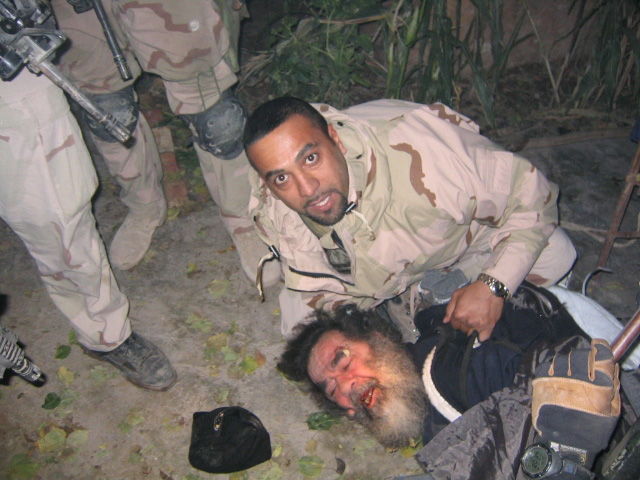
On December 13, 2003, deep in the rural farmland outside the town of Ad-Dawr near Tikrit, American forces found what months of intelligence hunting had been narrowing toward: a concealed underground hideout dug into a patch of earth behind a farmhouse. The military would later call it the “spider hole,” a cramped dirt chamber barely large enough for one man to lie down in. It was the end point of a manhunt that had consumed the attention of the U.S. military and intelligence community since Baghdad fell eight months earlier.
The operation began with a tip — one of many, but this one credible enough to focus on a very small number of locations where the former Iraqi leader might be hiding. Forces from the 4th Infantry Division and Special Operations teams conducted a rapid nighttime raid, blocking roads, sealing the perimeter, and moving methodically through the property. The operation was code-named Red Dawn, with its target sites labeled Wolverine and Wolverine 2, a nod to the 1984 film about insurgents resisting an occupying force — a layer of irony not lost on the people involved.
The discovery itself was almost anticlimactic. Under a small patch of dirt and debris lay a concealed opening covered by Styrofoam and a rug. When the lid was pulled back, the man inside offered no resistance. He emerged disheveled, thin, and unrecognizable to those who had last seen him as the commanding figure of a state. The weapons found nearby — including a pistol — were never used. He reportedly said only a few quiet words when captured.
For U.S. forces, the moment marked the symbolic end of a chapter. The initial invasion had toppled the regime with speed, but the insurgency was already taking shape across Baghdad, Fallujah, Mosul, and the Sunni Triangle. Finding the former Iraqi leader was seen as crucial to breaking the momentum of resistance, or at least removing a rallying point for loyalists. Whether it ultimately changed the course of the conflict remains debated, but its psychological impact was immediate. Images of a once-powerful ruler brought out of a hole in the ground signaled to Iraqis and the world that the old order was definitively broken.
Within hours, military spokesmen announced the news using a phrase that would echo through the coming days: “We got him.” It was meant to project closure, certainty, and triumph. But the reality was more complicated. The insurgency intensified in the year that followed. Iraq entered one of the most violent periods of its modern history. The capture removed a symbol but did not end the chaos.
Still, December 13, 2003 stands as one of the most defining moments of the post-invasion era — the night when one of the region’s most dominant figures, who had ruled Iraq for more than two decades, was found in a dirt chamber barely big enough for a mattress. It was the final unraveling of a dictatorship that had once reshaped the Middle East, now reduced to a dugout in the countryside, surrounded by the forces that had come looking for him since the day his government fell.
German children playing with stacks of worthless money during the height of hyperinflation in 1923.

In the summer of 1923, Germany’s paper money was so worthless that children stacked it like building blocks. Entire bundles of banknotes were treated the way kids today treat cardboard boxes: raw material for imagination. You did not guard this money. You did not save it. You barely bothered to count it. By the time these children finished their little construction project, the bills were probably worth less than the paper on which they were printed.
This was not an economic crisis in the ordinary sense. Hyperinflation in the Weimar Republic had become a kind of national fever dream, something so surreal that it almost defies modern comparison. Prices did not simply rise. They mutated. A loaf of bread that cost a few marks in 1919 cost millions by late 1923. When workers were paid, they rushed from factories to shops because their wages would lose buying power within hours. Housewives waited outside bakeries with wheelbarrows full of bills, not because bread was extravagantly expensive, but because the notes were extravagantly meaningless.
The origins of this catastrophe stretched back to the end of the First World War. Germany’s government, already battered by defeat, was crushed under the weight of reparations demanded by the Treaty of Versailles. With gold reserves depleted and tax revenues collapsing, leaders turned to the printing press. Every political crisis, every strike, every moment of unrest was answered with more paper money. The Reichsbank churned out marks by the trillions, each new batch diluting the value of the last.
By 1923, the currency was so devalued that even thieves ignored it. There are accounts of burglars stealing valuables but dumping piles of banknotes onto the floor because they were more trouble to carry than they were worth. Teachers assigned creative projects using real money because construction paper was more expensive.
And outside, kids made towers with stacks of notes once used to pay soldiers and bureaucrats. Their parents might have remembered the prewar world, a time when a single mark meant something. But to these children, money was not an economic tool. It was a toy.
This strange, innocent playtime sits at the intersection of deep political failure and the simple adaptability of childhood. The adults were living through one of the most chaotic economic collapses in modern history. The children were building forts.
Within a few months, the government introduced a new currency, stabilized the economy, and shut down the printing presses. But for a brief moment, in a country reeling from defeat and humiliation, German children played with money the way children elsewhere played with stones, sticks, and scraps of wood.
Nothing captures the absurdity of 1923 quite like that image: a nation’s financial system collapsing so dramatically that its youngest citizens used its currency as toys.
Judy Garland at age 46 in Copenhagen, March 1969.

By the time this photograph was taken in Copenhagen in March 1969, Judy Garland was only forty six, but she looked decades older. Not because of vanity or hard living alone, but because Hollywood had aged her on an industrial scale. The lines in her face were not simply the marks of time — they were the residue of a system that had extracted every ounce of energy, charisma, and vulnerability from her since she was thirteen.
Hollywood in the 1930s and 1940s ran on a brutal economic logic. Stars were investments, and investments had to perform. Garland was treated as an asset from the moment MGM realized that her voice could do things others could not. But she did not fit the visual mold of studio glamour, and they told her so constantly. She was not tall enough, thin enough, pretty enough, or photogenic enough. Every day of her early career came with notes — lose weight, fix your teeth, change your posture, rehearse until exhaustion. She was a child being molded to fit an adult fantasy.
Behind the scenes, the studio’s tools were chemical. Pills to wake her up. Pills to keep her thin. Pills to help her sleep. Pills to get her through sixteen hour shoots. By her mid teens she was already dependent on a pharmaceutical regimen created not by a doctor, but by the demands of production schedules. The industry that marketed her as eternally youthful was burning through that youth at a rate no human being could survive gracefully.
The stress only intensified as she got older. When her body inevitably pushed back — weight fluctuations, emotional strain, fatigue — MGM punished her for it. They suspended her, shamed her in the press, replaced her in films, and treated her as unreliable, never acknowledging that they had helped build the instability they fired her for. By her twenties she had already lived through enough breakdowns, comebacks, overdoses, and forced rest cures to fill a lifetime.
So when we see her here at forty six, sitting on a patterned sofa in a Copenhagen hotel, she carries all of that history in her face. The thinness of her frame, the tension in her jaw, the weary set of her eyes — they are not signs of ordinary aging. They are the accumulated cost of being turned into a product before she was old enough to understand what she was losing.
Her appearance in this moment speaks to what Hollywood once did to its brightest stars. It ground them down, sold the polished result to the public, and left the damage unacknowledged. Garland had been the centerpiece of an entire generation’s cinematic imagination. But the industry that profited from her talent never protected her from the consequences of its own exploitation.
And yet she sits here, still trying to offer something of herself, still talking animatedly, still carrying the unmistakable spark that made audiences love her. It is the face of a woman who lived through an entertainment system that burned out most of its stars — and somehow, impossibly, kept performing anyway.
Dwight Eisenhower cried upon recalling the sacrifices of the men who were killed or wounded on D-Day during a speech in 1952

Dwight Eisenhower was not a man known for public displays of emotion. The Supreme Commander of Allied forces in Europe had spent the war projecting steadiness, optimism, and an almost superhuman level of composure. But there were memories even he could not armor himself against. D-Day was chief among them.
In 1952, while speaking about the war, Eisenhower attempted to describe the young soldiers who stormed the beaches of Normandy. He spoke of the chaos of those opening minutes, of the men who pushed forward through gunfire, explosions, and a shoreline deliberately designed to kill them. As he talked, his voice began to strain. Then it gave out. The man who had overseen the liberation of Europe began to cry.
The weight behind those tears was enormous. On June 6, 1944, roughly 156,000 Allied troops landed in Normandy by sea and air. By the end of the day, around 10,000 Allied soldiers were casualties. More than 4,400 were confirmed dead. The Americans alone suffered over 2,500 dead on D-Day. Some of the first assault companies at Omaha Beach endured casualty rates approaching 90 percent. Eisenhower had known before dawn that many of these young men would not live to see nightfall. He signed the order anyway, because history left him no alternative.
But D-Day was only one piece of the human cost he carried. Over the full course of World War II, approximately 405,000 American service members were killed. That number—nearly half a million lives—hovered over every decision Eisenhower made. Each offensive he approved, each assault he authorized, came with the knowledge that a portion of those casualties would be his responsibility.
These were not abstractions to him. He had walked among the paratroopers of the 101st Airborne the night before the invasion, shaking hands with men who would be dead within hours. He visited Normandy shortly after the landings and saw the bodies himself. He later admitted that a commander never fully forgives himself for the lives lost under his orders.
So when Eisenhower cried in 1952, it was not a choreographed moment. It was a fracture—a moment where the memory of hundreds of thousands of fallen Americans, and the sight of so many young men on D-Day whom he had sent directly into hell, rose back up through the discipline of a lifetime.
In that vulnerable moment, the war hero and future president revealed something rare: even the strongest generals carry ghosts, and the cost of victory never fully fades.
A German soldier says farewell to his son before leaving for the front, c. 1940

The photograph shows a German soldier in 1940 lifting his young son, the boy’s hand resting on his father’s helmet in a gesture that feels both innocent and unbearably heavy. It is a quiet moment between a parent and child set against the machinery of a war that was about to engulf Europe. The soldier is already in uniform, already part of something larger than himself, yet here he looks like any father, trying to hold on to a moment of normal life before stepping into a future neither he nor his son could predict.
By 1940, Germany was entering the phase of the war that would later be remembered for its speed and its devastating early successes. Poland had fallen the previous autumn. Denmark and Norway had been invaded in April. France, Belgium, and the Netherlands were only weeks away from collapse. The entire nation was mobilized, and millions of men were being sent to fronts that stretched farther each month. For many families, this was the last time they would see each other.
The Nazi regime aggressively used imagery of soldiers as devoted fathers to humanize the war effort. Propaganda ministries understood the power of domestic scenes — a soldier kissing his wife goodbye, a child clinging to a parent. These were meant to show that the men marching off to fight were not faceless instruments of the state but ordinary Germans fulfilling what they were told was their duty. Yet photographs like this also reveal something the propaganda never intended: the deep uncertainty visible in the adult’s eyes. Leaving for the front was not a heroic adventure; it was a step toward an abyss.
Many of the soldiers who went to war in 1940 were veterans of World War I or sons of men who had fought in the trenches. They carried with them a cultural memory of the last conflict — its brutality, its scale, its trauma. The child in this photo had no such memory. For him, the war was abstract, something happening far away. For his father, it was a familiar danger returning with new ferocity.
Within a few years, Germany’s fortunes would reverse dramatically. The early victories of 1940 would give way to the disasters of Stalingrad, the relentless Allied bombing campaign, and the collapse of the Eastern and Western fronts. Many men photographed leaving home in scenes like this never returned.
This single image captures the collision between personal love and national catastrophe: a father trying to reassure his son, a child too young to understand what the uniform means, and a world on the edge of a conflict that would reshape the century.
US soldiers playing Xbox in Saddam Hussein’s Palace. 2003

Picture a palace built to project invincibility. Marble floors, gold trimmed ceilings, murals of a man who saw himself as the modern heir to Nebuchadnezzar. This was Saddam Hussein’s Al Faw Palace, a monument to state power in a regime that used architecture as propaganda. The building was not constructed for comfort. It was constructed to intimidate. Even the chandeliers looked like they were chosen more for their ability to impress a foreign dignitary than to illuminate a living room.
Into this space, this carefully curated theater of absolute rule, walked American infantrymen in sweat stained camo uniforms, rucks dumped in corners, M4s leaning against marble columns. They were nineteen, maybe twenty years old. And they carried with them the most mundane artifact of early 2000s American life: an Xbox.
This was not just a quirky scene. It was the culmination of an imperial collapse decades in the making. Saddam’s palaces, dozens of them, were not merely residences. They were the Baathist equivalent of Versailles, built by a government with a taste for grandeur and a deep insecurity about legitimacy. These structures were designed to constantly remind Iraqis who ruled them, in case the secret police had not done the job already.
By 2003, many of these palaces had become forward operating bases for the United States military. The Pentagon discovered that the buildings, while gaudy, were sturdy, defensible, and already wired with their own generators, which made them ideal for establishing command centers. So soldiers lived in these gilded spaces, sleeping where ministers once plotted, eating meals in halls where Saddam hosted foreign leaders, and plugging Xbox consoles into walls built for a dictator’s entertainment system.
There is something almost Roman about it. Occupying troops lounging in the conquered ruler’s villa, not because they wanted to mock him, but because it happened to be the most functional real estate in the area. Ancient empires did this with palaces and temples. The Americans did it with a Microsoft console and a stack of games bought at the PX.
These small cultural collisions reveal as much about the era as any diplomatic memo. The most technologically dominant superpower fought a lightning war, toppled a regime, and within weeks its soldiers were playing Halo in a palace meant to intimidate an entire nation. The symbolism was enormous, even if the soldiers themselves were not thinking in symbols. They were just passing the time between patrols.
It is a snapshot of a moment when global power, culture, technology, and history all intersected in one surreal room: Saddam’s presence lingering in the architecture while American troops blasted pixelated aliens on a screen powered by the palace’s own generator infrastructure.
A palace built to showcase unchecked authority became, for a few hours, a rec room for bored twenty year olds. History has a sense of irony that no political strategist could ever script.