
Japanese listening to the recorded radio broadcast of Emperor Hirohito announcing the surrender of Japan, August 1945
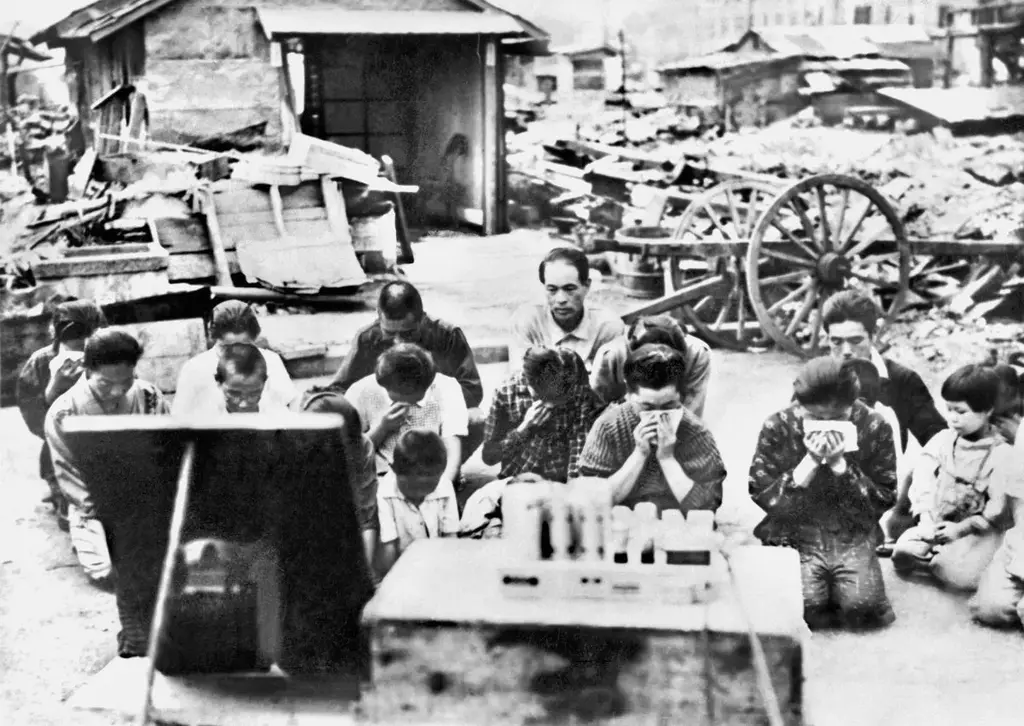
They had never heard his voice.
Think about that. An emperor—descended, according to tradition, from the sun itself—existed more as a mythic construct than a human figure. And suddenly, on an August day when the world seemed to be cracking open at the seams, his voice came through tinny speakers and battered radios, distorted by static and ceremonial language so archaic that even many native Japanese struggled to parse it.
People leaned in, straining to understand words they were trained not to question.
The broadcast didn’t land like modern news. It wasn’t “the war is over.” It was a rupture in a worldview. For years, every corner of Japanese society had been mobilized for a conflict described as existential and sacred, a struggle in which surrender was unthinkable. Schoolchildren had been taught that death before dishonor was the natural order of things. Civilians practiced with bamboo spears. Soldiers wrote death poems. The culture had been wound tight—so tight that the concept of defeat existed only in hypothetical space, a ghost story used to harden resolve.
Then comes the voice. Calm. Formal. Otherworldly. And telling them what their military and political leadership had never prepared them to hear: the empire would “endure the unendurable.”
In the rooms and courtyards and air-raid shelters where people listened, reactions fractured. Some froze. Some wept. Some wondered if they had misunderstood. Others felt a surreal sense of betrayal—because if the emperor himself said it was over, then the entire ideological scaffolding of the last generation had just collapsed in a single broadcast. The soldiers who had fought on shattered islands, the families who had lost everything, the children who had known nothing but war—all were suddenly realigning their understanding of the universe.
The language Hirohito used, that dense courtly Japanese—Gyokuon-hōsō, the “Jewel Voice Broadcast”—wasn’t just ceremonial; it was a buffer. A way to announce national catastrophe without saying it plainly. He never even used the word “surrender.” Instead, the message circulated through implication and euphemism, and the impact was somehow even sharper for it. Like being told the ground beneath you isn’t there, without anyone actually saying “you’re falling.”
Meanwhile, outside Japan, the rest of the world listened too, but through a completely different lens. For Americans, Soviets, British, Chinese—this was confirmation. For the Japanese, it was revelation. A cosmic pivot. Their god-emperor—who had always been presented as immutable—had just spoken like a mortal acknowledging limits.
And as the broadcast ended, radios crackled with silence. Not peace. Not relief. Something stranger, heavier. Millions of people sitting with the sudden understanding that the world they lived in at the beginning of that sentence was not the same one they inhabited at the end of it.
A saleswoman at a Moscow grocery store. Soviet Union, 1988.

On the surface, it’s a quiet, almost mundane scene: a woman in a white coat behind a counter, a mechanical scale, and a wall of cracked ceramic tiles. But this image sits at the crossroads of a collapsing system—captured in one of the most turbulent years in late Soviet history.
By 1988, perestroika (restructuring) and glasnost (openness) were reshaping every corner of Soviet life, but the reforms also exposed how brittle the economy truly was. Central planning—once touted as the engine of socialist abundance—was sputtering. Decades of inefficiencies, agricultural failures, and a heavy tilt toward military spending had pushed consumer goods to the bottom of the priority list.
Grocery stores like this one often became the stage where the contradictions of the Soviet system were most obvious. Even in Moscow, the capital and showcase city, shelves were frequently bare. Meat shortages were so common that people joked the butcher was the only worker who didn’t need to sharpen his knives—there was nothing to cut. Long lines formed at dawn. Some families kept “food maps,” notes about which shops occasionally received certain items, often tipped off by friends, neighbors, or sympathetic clerks.
The cracked tiles behind her are more than cosmetic decay—they reflect years of deferred maintenance across the country. The Soviet Union had impressive achievements in heavy industry and space exploration, but everyday consumer infrastructure lagged far behind. A store could go a decade without renovation; a broken fridge or counter could take months to replace. Shortages reached the point that by 1988, even the materials needed to repair store interiors were often inaccessible.
The scale in the foreground is the iconic Soviet mechanical trade scale, a fixture in almost every market and shop. Its presence is a reminder of how little the retail environment had changed since the 1960s; modern electronic equipment was rare, and even basic tools were built for durability, not precision or convenience.
Then there’s the expression of the woman behind the counter—fatigue, resignation, maybe boredom. Retail workers in the late Soviet period bore much of the public’s frustration. Customers blamed them for shortages they had no control over. Some clerks quietly held products “in reserve” for certain customers—an informal economy layered on top of the official one, born of scarcity and necessity.
1988 was also the beginning of something the Soviet leadership feared: open discontent over the economy. Strikes began in the coal mines. Newspapers exposed corruption previously kept hidden. People were asking where the goods were, why production plans were failing, and why the Soviet state—once a global superpower—couldn’t keep butter, soap, or sausage on its shelves.
This photograph freezes that moment: the late Soviet Union before the final unraveling, when the ideology was still officially intact but the everyday experience of ordinary citizens told a different story. A simple grocery store, a tired clerk, empty counters, and a system running out of time.
Some of the 300 to 500 people who tried to lynch a black teenager charged with raping a 14-year-old girl. The lynching was foiled when Tennessee National Guard troops shot and stabbed dozens of the attackers, four of them fatally, after tear gas proved ineffective (Shelbyville, 1934)

In Shelbyville, Tennessee, in 1934, a mob estimated at several hundred people gathered with a single purpose: to lynch a Black teenager accused of raping a 14-year-old white girl. It was a period when rumors alone could ignite collective violence, and when the machinery of Jim Crow justice often operated outside the courtroom. Lynch mobs had long been a tool of racial terror in the South—meant not only to punish but to intimidate, to broadcast dominance, and to reinforce the racial order through spectacle.
What makes this moment historically distinct is not the mob itself—such gatherings were frighteningly common—but what happened next. Tennessee National Guard troops were deployed to stop the lynching. Tear gas was tried first, but the mob refused to disperse. When the crowd pressed forward, soldiers fired into it and used bayonets as the confrontation escalated. Dozens were shot or stabbed; four men died. The Guard’s actions were extraordinary for the time. In an era when law enforcement officers often looked the other way—or even joined mobs—the use of state force to protect a Black defendant was rare and politically explosive.
The tension swirling around the case reflected the broader national climate. The early 1930s marked the beginning of a slow shift in public opinion regarding lynching. The Great Depression had destabilized social hierarchies, and civil rights groups—particularly the NAACP—were intensifying campaigns to pressure state and federal governments to intervene. Anti-lynching legislation was debated repeatedly in Congress, though consistently blocked by Southern lawmakers. Still, the visibility of the movement created incremental change: governors and military units were increasingly pressured to demonstrate that mob rule would not replace legal proceedings.
Photographs like this one reveal the human face of mob violence—men in work coats and hats, farmers, laborers, townspeople, some looking into the camera with curiosity, others with the certainty of a group that expects to get what it wants. The crowd is not masked; they are not hiding. In 1934, many white Southerners who participated in lynch mobs did so openly, believing their actions were socially sanctioned and morally justified.
The Shelbyville incident stands as one of the few documented cases where state forces stopped a lynching through lethal force. The teenager at the center of the storm survived the night, protected not by the justice system’s resolve but by the unusual decision of National Guard troops to confront the mob directly.
It was a flashpoint in the decades-long national struggle between the rule of law and the entrenched culture of racial violence—an early sign that the era of unchecked lynching, though far from over, was beginning to encounter resistance from institutions once complicit in its existence.
A French soldier in 1918, equipped with a helmet with chainmail to protect the eyes from shell fragments, stones, and other dangerous elements

The photograph shows a French soldier in 1918 wearing one of the more unusual pieces of battlefield equipment to emerge from the First World War: a steel Adrian helmet fitted with chainmail drapery designed to protect the face from shrapnel and flying debris. This peculiar-looking setup was part of a broader, desperate effort by armies to adapt to the unprecedented realities of industrialized warfare.
Trench fighting on the Western Front produced a scale of fragmentation injuries never before seen. Artillery was responsible for the overwhelming majority of battlefield wounds, and soldiers were far more likely to be hit by splinters of metal, wood, and stone than by bullets. When shells exploded against parapets or churned the earth in front of trenches, they propelled small, high-velocity fragments directly into exposed faces. Eyes in particular were extremely vulnerable. Military surgeons documented alarming numbers of permanent blinding injuries, prompting a push for improved facial protection.
The French Army responded by experimenting with additional defenses mounted on the Adrian helmet, introduced in 1915. One solution was the “maille protéctrice,” a curtain of chainmail suspended from the visor. The intent was not to stop bullets—no chainmail could do that—but to catch low-velocity debris, ricocheting fragments, and gravel blasted up by artillery bursts. It also reduced the risk of barbed wire cuts during raids or patrols.
These chainmail veils were not universally issued, and their practicality was debated. Soldiers often found them uncomfortable or obstructive, particularly in muddy or wet conditions. The mail could swing, snag, or impede the view of the lower battlefield. Some troops removed them altogether, while others kept them for specific tasks like trench sentry duty or engineering work near explosions.
Still, these hand-forged adaptations highlight the improvisational character of late-war equipment. By 1918, armies were racing to find solutions to threats that traditional military doctrine had never anticipated. The chainmail visor sits within a lineage of experimental gear—metal face masks, hardened goggles, splinter-proof spectacles—each reflecting the brutal learning curve of the Great War.
The image captures the strange hybrid appearance of soldiers caught between ancient and modern warfare: a medieval-style chainmail coif paired with a modern steel combat helmet, worn in a war shaped by machine guns, poison gas, and heavy artillery. It stands as a reminder of how quickly technology outpaced protection, and how armies struggled to shield the human body from a battlefield unlike anything the world had known before.
Joseph Stalin holding his daughter Svetlana Alliluyeva, Moscow, 1933

In 1933, Joseph Stalin was nearing the height of his power, ruling the Soviet Union with a mixture of ideological certainty, political paranoia, and increasingly oppressive state mechanisms. Yet within the walls of the Kremlin and his private dachas, a different aspect of his life played out: his role as a father to his young daughter, Svetlana Alliluyeva.
Svetlana was the only daughter of Stalin and his second wife, Nadezhda Alliluyeva, who had died the previous year under circumstances that were painful and politically sensitive. Her death deeply affected the household, and for a time, Svetlana became one of the few emotional anchors in Stalin’s private world. Those close to him later recalled that he showed her a tenderness rarely seen elsewhere in his life.
The early 1930s were a transformative and brutal period in Soviet history. The collectivization of agriculture had plunged the countryside into chaos, and the resulting famine devastated regions such as Ukraine and Kazakhstan. At the same time, Stalin’s consolidation of power accelerated, setting the stage for the purges and political terror that would soon define the late 1930s.
Against this backdrop, images and accounts of Stalin interacting affectionately with his daughter served a political purpose as well. They reinforced the idea of the leader as a paternal figure — firm but caring, both the architect of the nation’s direction and the guardian of its future generations. Soviet propaganda often leaned into this duality, presenting him as the “Father of Nations” while suppressing any hint of the harsh realities unfolding across the country.
Svetlana would later become one of the most fascinating figures to emerge from within Stalin’s inner circle. Her memoirs, published decades later after her defection to the West, painted a complex picture of growing up as the child of a man who was both emotionally distant and unexpectedly tender, both powerful and terrifying. Her recollections offer a rare window into the private side of a ruler whose public image was carefully constructed and relentlessly maintained.
A moment from 1933, showing a father with his young daughter, exists at the intersection of these contrasting worlds: personal affection set against sweeping political upheaval, domestic intimacy overshadowed by the machinery of a rapidly hardening totalitarian state.