American Soldiers Forcing German Civilians to Bear Witness (1945)
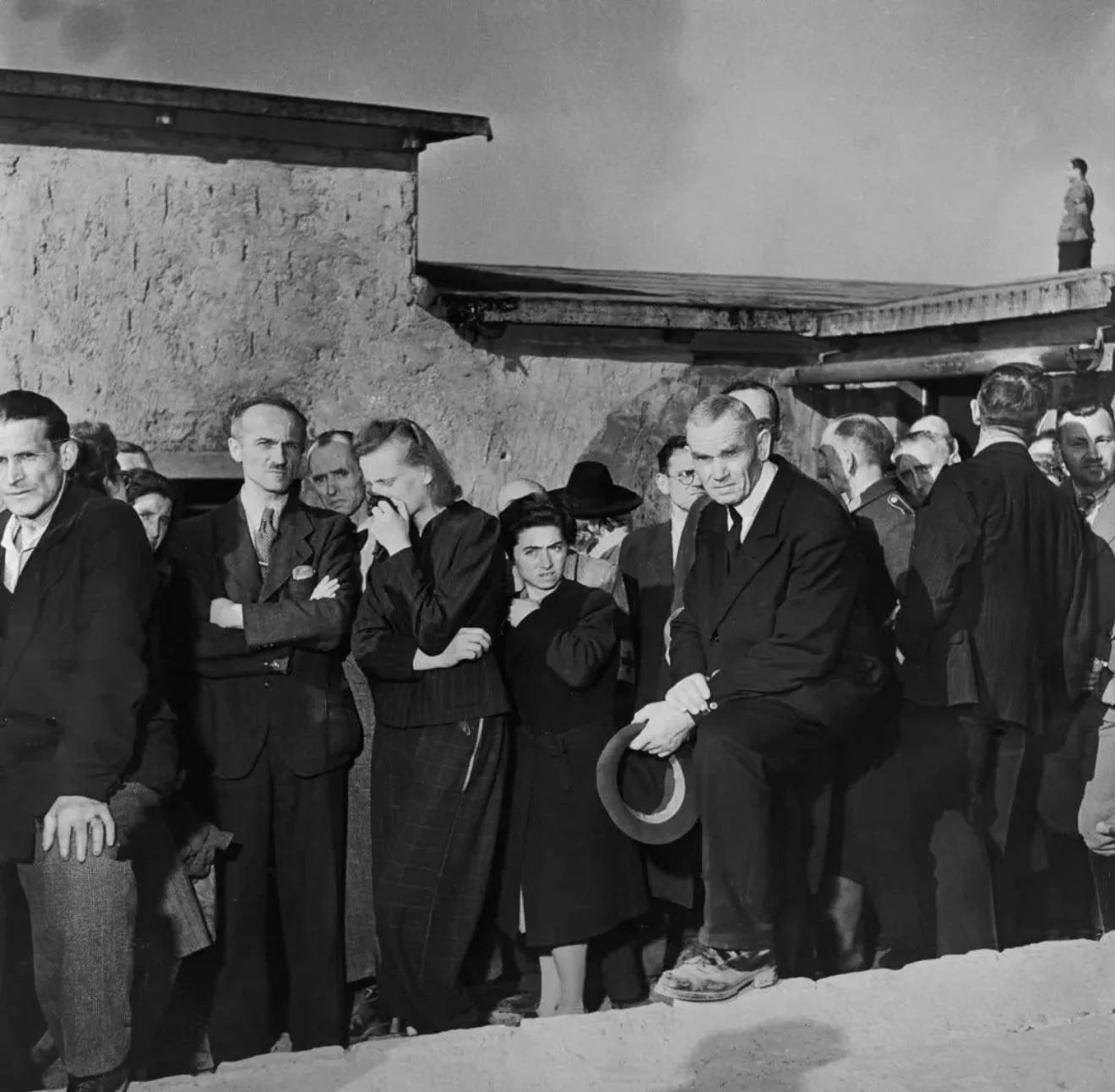
In the spring of 1945, Allied forces advancing through Germany encountered scenes that defied comprehension. Camps filled with bodies, survivors hanging on by threads, evidence of an extermination system that operated with grim efficiency.
Many German civilians insisted they had no idea what had been happening nearby. Whether this was genuine ignorance, willful blindness, or a survival instinct after defeat is a complicated question historians still debate.
The U.S. Army’s response was simple: you will look. Units marched local populations directly to the camps, forcing them to confront what had unfolded right in their national backyard.
For the soldiers, this wasn’t vengeance. It was documentation. It was making sure that the people who lived under the Reich could not pretend the Reich’s crimes were abstract or distant. These walks through the camps were an attempt to puncture the myth-making before it could even begin.
Auschwitz Guards Enjoying Leisure Time (1944)

Photos like this strike the modern viewer with a kind of moral whiplash. The guards at Auschwitz are laughing, relaxing, posing with instruments—human moments happening in a place built for mass death.
This is the unbearable contradiction: the people running the deadliest concentration camp in Europe could move effortlessly between bureaucratic murder and everyday leisure. One minute they were facilitating trains packed with Jews; the next they were eating cake or listening to music.
What makes this unsettling is that it destroys the comforting fantasy that history’s villains were somehow fundamentally different from everyone else. They weren’t aliens. They weren’t monsters in the biological sense. They were human beings who adapted to the environment the Nazi state created for them.
And that environment normalized the unthinkable. These images force us to grapple with how horrifyingly easy it can be for ordinary people to commit extraordinary evil when their world tells them it is acceptable, expected, or routine.
Oyster Shuckers in South Carolina (1912)

The early 20th-century United States was an industrial powerhouse—but much of that power came from the labor of children. In canneries, mines, mills, and farms, kids like Josie and Bertha, both six years old, reported for work while most children today would still be learning to tie their shoes.
Shucking oysters was a brutal job. The knives were sharp, the shells jagged, and infections common. These children often worked before dawn, standing for hours in cold, wet rooms that reeked of brine.
This image survives because of Lewis Hine, a photographer who used his camera like a legislative battering ram. His photos were ammunition in a national campaign to reform child labor practices.
It’s impossible to look at the small faces in this picture and not understand why those reforms eventually passed. The country had to confront that its “economic miracle” was being built on the hands of first-graders.
The Moment Hitler Declared War on the United States (December 11, 1941)

This is one of the great hinge moments of the Second World War. Hitler standing before the Reichstag, announcing a declaration of war against the United States—an act that no one forced him to make.
Japan had attacked Pearl Harbor days earlier, but their treaty with Germany did not require mutual declarations. Hitler made this choice on his own, believing that war with the U.S. was inevitable and that striking first would appear decisive.
In reality, it removed the last political obstacles that had kept America from entering the European conflict. With a single speech, Hitler handed Franklin Roosevelt exactly what he needed: a united American public willing to support full-scale war in both the Atlantic and Pacific.
Strategically, it was catastrophic. Germany now faced the industrial colossus of the United States—a nation capable of producing more ships, planes, guns, and fuel than the Axis could ever hope to match.
Frederick C. Branch Becomes the First African American Officer in the U.S. Marine Corps (1945)

The Marine Corps was famously resistant to integration. Even as World War II forced manpower shortages across the U.S. military, the Marines clung to a whites-only identity longer than any other branch.
Frederick C. Branch changed that. After excelling in officer training, he earned his commission at a time when Black Marines were still segregated at Montford Point, operating in separate units and often given limited roles compared to their white counterparts.
This photograph captures Branch’s wife pinning on his bars—a small, intimate moment set against the backdrop of a centuries-old institution being reshaped. It symbolizes not just personal achievement, but the slow cracking of a rigid barrier.
Branch’s legacy is larger than his rank. He opened the door for thousands of future Marines who would go on to serve in Korea, Vietnam, and beyond. His commission wasn’t just a milestone; it was a wedge driven into the walls of military segregation.