Left-wing Iranian students celebrate the victory of the Islamic Revolution with a picture of Ayatollah Khomenei. Iran, c.1979
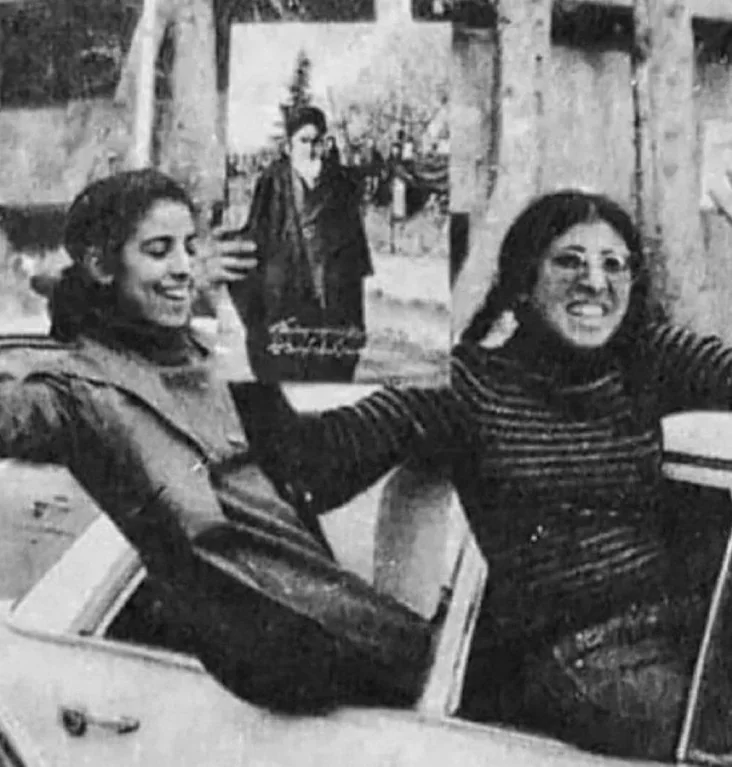
They look like college kids on any continent: leaning out of a car window, grinning, electric with the thrill of winning. But the photo catches them at a hinge-moment in history, when euphoria can be mistaken for clarity, and when those most filled with idealism are most vulnerable to the gravity of events already rolling downhill. These are left-wing student revolutionaries in Iran, circa 1979, celebrating the return of a cleric whose worldview was, in many ways, the antithesis of their own. They hold his portrait aloft like a lover’s face. Ayatollah Khomeini, austere and severe, embodies their hope for an Iran freed from the Shah, his secret police, his foreign patrons, and the economic brutality of rapid modernization. To these students, he looks like justice.
They aren’t fools. They are reacting to a monarchy that used torture as a form of punctuation, that shoved Western “progress” into their culture faster than society could metabolize it, and that hoarded wealth while the poor were told to be patient. Anger builds pressure, and when the relief valve blows, anything that promises dignity can be swept onto a pedestal. In that moment, a revolutionary movement is less about blueprints and more about momentum. The leftists imagine that once the Shah is gone, they can bargain, negotiate, nudge the revolution toward social justice, workers’ rights, democracy. They assume they are partners.
Revolutions are coalitions of convenience until they aren’t. The bearded clerics have organization, moral authority, and institutions that long predate Marxist reading groups. They have mosques acting as the original social network, and they speak in a language that resonates far beyond university campuses—into the bazaars, the villages, the hearts of the devout. Once in power, that infrastructure becomes something far more formidable than a temporary alliance. The students who celebrated may soon find their newspapers shuttered, their meetings raided, their professors jailed. Some will flee. Some will be imprisoned. A few will be shot.
That’s the strange irony of history’s pivot points: the faces beaming in the photograph are present at the birth of a new order, unaware that they are witnesses not to its empowerment, but to their own eclipse. They had won the struggle against the Shah. They just didn’t realize the next struggle—far more dangerous, far more decisive—was waiting around the corner.
Japanese soldiers waiting in line outside a “comfort station”. Occupied China, late 1930s

The line is orderly, almost polite. Helmets tucked under arms, rifles slung loosely, the men shuffle forward with the tense patience of soldiers awaiting something unavoidable. But the building they’re queued outside isn’t an armory, or a mess hall, or a barracks. It’s a so-called “comfort station,” one of many scattered across the territories Imperial Japan has just swallowed. The euphemism is grotesque. Behind those walls are captive women—Korean, Chinese, Filipino, Indonesian—forced into sexual slavery under military regulation. The empire keeps detailed paperwork, quotas, medical inspections. Bureaucracy is used to sanitize brutality.
In the late 1930s, the Japanese Army is storming across China with terrifying momentum. Entire cities are subjected to rape, massacre, and terror as a matter of policy. The military leadership fears its troops might destabilize or revolt without a controlled outlet for sexual violence, so they create one. The psychological calculus is cold: regimented abuse, they believe, keeps the war-machine functional. And so you get scenes like this—men in neat formation, waiting calmly to commit harm that will never appear in their letters home.
There’s a darkness in wartime that doesn’t require screaming battlefields or burning villages. Sometimes it’s found in the quiet, structured moments, where cruelty becomes routine. Everyone in line knows what waits behind the door. Everyone understands the women did not volunteer. They step forward anyway. A historian looking back sees not just the atrocities that erupt in sudden flame, but the ones that smolder—systematized, normalized, defended as “necessary.” Empires often justify their worst crimes not with rage, but with administrative paperwork and calm voices.
And outside, on a dusty street in occupied China, the line moves forward by one more soldier.
Orson Welles signaling for silence inside CBS’s radio studio while directing the infamous “War of the Worlds” radio show

Inside the CBS radio studio, it feels less like entertainment and more like a command center. Engineers lean over dials, actors hover near microphones with scripts trembling slightly in their hands, and the red “ON AIR” light glows like an omen. At the center of it all stands Orson Welles—young, intense, and impossibly confident. With one raised hand he demands silence, not rudely, but with the certainty of someone who knows the power of a single missed beat. His other hand clutches the script to “The War of the Worlds,” a broadcast that will soon convince parts of the American public that Martians have landed in New Jersey.
Radio is king in this era—an omnipresent voice in living rooms, kitchens, and cars. News bulletins interrupt dance music with reports of wars in Europe, factory strikes at home, fires, floods, and storms. Against this backdrop, Welles’ dramatization doesn’t feel like fiction to many listeners. It feels like another terrifying headline. Panicked phone calls flood police stations; some families pack their cars; a few clutch their children and pray. The idea that sound alone could ignite fear on a national scale is suddenly, unmistakably real.
In the studio, though, the mood is electric rather than frightened. Performers shift from calm newscaster voices to frantic eyewitness accounts with astonishing precision. Welles directs them like a conductor shaping a symphony of dread. Every pause, every crackle of static, every gasped report is crafted to feel authentic. There’s no visual to hide behind—only imagination, and Welles plays that instrument mercilessly.
Long after the broadcast ends and the country exhales, this moment will become legend: a testament to the raw influence of media and the fragile line between information and belief. But in the instant captured by the photograph, all that matters is silence, focus, and the next cue. Orson Welles raises his hand, and an entire nation leans toward the radio, listening for aliens in the static.
A shadow permanently cast of someone caused by the nuclear blast at Hiroshima.

The steps are empty. No body, no bones, no clothing—just a darkened silhouette burned into stone, frozen in the exact posture a person held at the instant the universe tore itself open. It’s called a “hibakusha shadow,” but the name barely hints at the horror behind it. When the atomic bomb detonated over Hiroshima, it unleashed temperatures hotter than the surface of the sun. Anything exposed to that flash—skin, cloth, wood—vaporized or bleached in an instant. Anything shielded by a human body left a darker imprint. A person who once sat here, maybe eating, maybe resting, ceased to exist in less time than it takes to blink. Their absence became their memorial.
Unlike ruins or wreckage, this shadow doesn’t show struggle. There’s no motion, no panic, no attempt to flee. It’s serene only because the blast allowed no time for anything else. The power released compressed life, death, and erasure into a single unthinkable moment. The stone steps around the silhouette are lighter, as if nature itself was overexposed. The figure—a dark reminder—marks the boundary between what was protected for a fraction of a second and what was annihilated entirely. It’s the closest thing history has to a negative photograph of a soul.
For survivors, these shadows became symbols far heavier than their silhouettes suggest. They are proof that the atomic age didn’t just kill; it erased. People weren’t buried or mourned traditionally—they vanished, leaving only outlines and memories. Cities can be rebuilt. Names can be listed. Monuments can be raised. But the shadows are silent witnesses that something happened here which normal language isn’t built to carry. They remain when everything else has been swept away, stubborn and mute, asking the unanswerable question: what does it mean to leave behind only the shape of your existence?
Students at Augustana College react to the not guilty verdict of O.J. Simpson’s murder trial. October 3rd, 1995

The room is packed tight—knees pulled to chests, elbows locked, students sitting cross-legged on institutional carpet. For weeks, televisions across America have been glued to one of the most surreal spectacles in modern legal history. Now, in this moment, the verdict drops. Not guilty. The reaction detonates instantly. Some students leap to their feet, shouting, clapping, triumph written across their faces. Others sit stunned, mouths half-open, fingers pressed to lips, trying to process what they just heard. A few look angry, betrayed, as if justice itself has slipped through their fingers.
Across the country, this verdict doesn’t just divide opinions—it slices along fault lines already running through American life. Race, policing, celebrity, domestic violence, the tabloid carnival of cable news… everything converges into one televised roller coaster. In Black communities, decades of police corruption, brutality, and wrongful convictions form the invisible courtroom around the actual courtroom. For many white Americans, this feels like the system breaking. For many Black Americans, it feels like the system finally blinking. Two experiences of justice, orbiting the same country on different trajectories.
The students in this photo weren’t in Los Angeles, but they might as well have been. Television brought the trial into living rooms, dorm lounges, and cafeterias. The defense team, the prosecution, the DNA evidence, the police misconduct, the glove—everyone became an expert. Cable networks dissected every second. Viewers weren’t spectators anymore; they were jurors in the court of public opinion.
This image captures not just a verdict, but the cultural weather of the 1990s—months of pressure released in a single announcement. It’s a portrait of a nation arguing with itself in real time, with no social media to diffuse or redirect the conversation. Just faces, voices, and raw reaction. The trial ends here, in this room, on this campus, in a roar of cheers and stunned silence. The debate, however, is just getting started.