The Vanishing Race, 1904
.jpg)
In 1904, photographer Edward S. Curtis captured an image he titled The Vanishing Race. It shows a small group of Navajo riders moving away from the camera, their horses following a narrow trail that winds off into the distance until it disappears into the horizon. You can’t see their faces—only their backs, framed by the vastness of the American West. The composition feels intentional, almost theatrical: the riders receding into the past, swallowed by the landscape. It’s easy to see why this photograph became one of Curtis’s most famous. It seemed to confirm, visually and poetically, a popular belief of the time—that Native Americans were a “dying race,” destined to fade away in the wake of U.S. expansion.
Curtis didn’t invent this narrative; he inherited it from a culture that had spent decades pushing it. By 1904, the reservation system, forced assimilation, and the suppression of Native languages and traditions had already altered Indigenous life beyond recognition. Boarding schools tried to strip Native children of their identity. Ceremonies and dances were outlawed. The buffalo herds that had sustained many Plains tribes were nearly wiped out. From the perspective of many white Americans, the “Indian Wars” were over, the frontier was closed, and the “vanishing” of Native peoples was seen not as a tragedy, but as the natural course of progress. Curtis’s title fit neatly into that worldview.
But the truth was far more complicated. The riders in The Vanishing Race weren’t disappearing—they were adapting, surviving, and carrying their culture forward under relentless pressure. The photograph’s quiet, elegiac tone may have resonated with white audiences who liked to romanticize Native Americans as noble relics of a bygone era, but for Indigenous communities, the reality was ongoing struggle. The “vanishing” wasn’t a natural fade into history; it was the result of deliberate policies aimed at erasing their way of life. The fact that Native nations still exist, speak their languages, and practice their traditions today is proof of how false that assumption was.
Viewed today, The Vanishing Race is a haunting image—but not for the reasons Curtis likely intended. It’s haunting because it freezes a moment in a long continuum of survival and resistance, framing it as an ending when it was anything but. The riders don’t vanish into the horizon; they move forward, unseen by the photographer’s lens, into a future that the prevailing culture of 1904 couldn’t imagine—and perhaps didn’t want to.
Students yell curses outside of Tuskegee High School after it had been integrated, Montgomery, Alabama, September 10, 1963
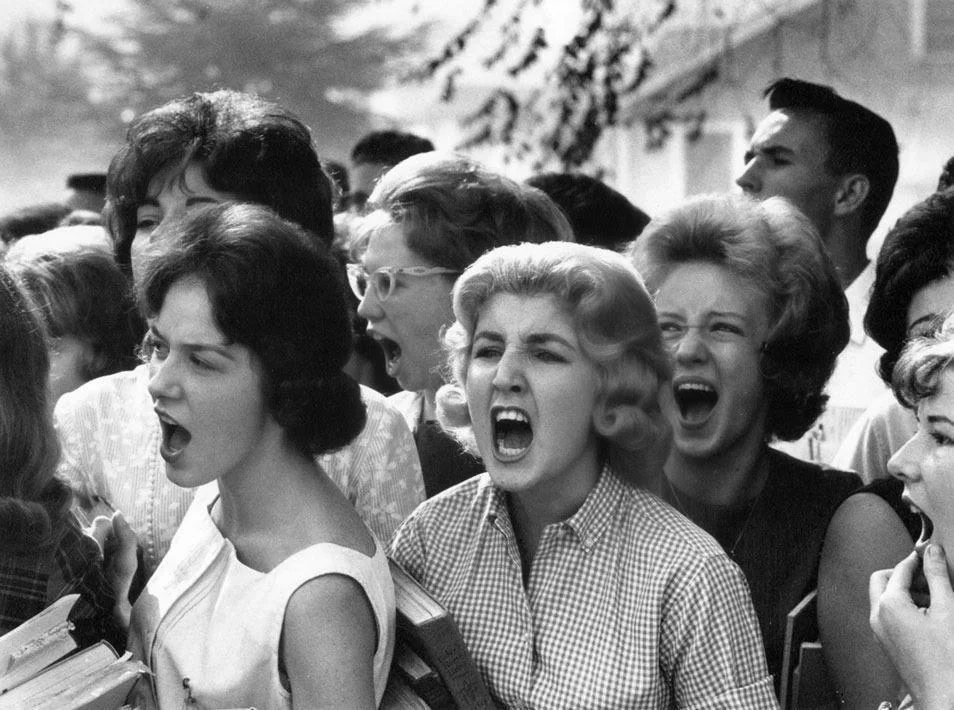
You can almost hear the scene before you see it. The humid Alabama air, thick with heat and tension, carries the sound of voices that are equal parts anger and fear. Outside Tuskegee High School, a crowd of teenagers—kids, really—are screaming curses at other kids. But these aren’t the kind of taunts you hear at football games or after-school scraps.
These are words meant to wound in ways that leave scars invisible to the eye. It’s September 10, 1963, and the United States is in the middle of an experiment that’s as audacious as it is overdue: integrating the schools of the Deep South. On the other side of those walls, Black students are walking into a building that was never meant for them, at least not in the minds of many who grew up here.
It’s tempting to think of this as an inevitable march toward progress, but on days like this, it didn’t feel inevitable. It felt dangerous. To the white students shouting on the lawn, the change wasn’t an abstract policy—it was personal. They had been raised in a culture where segregation wasn’t just a social norm; it was framed as a natural order, passed down like a family heirloom. The thought of Black students sharing their classrooms, their textbooks, even their drinking fountains, was like someone breaking into the vault of tradition and shattering everything inside. That kind of challenge doesn’t just provoke resistance—it provokes rage. And in 1963 Alabama, rage was never in short supply.
Look closer, though, and you realize these aren’t simply “bad kids” in the Hollywood sense. They are, in many ways, acting out the worldview they’ve been handed since birth. When you’re raised in an environment where authority figures—parents, teachers, pastors—tell you that integration is wrong, immoral, even dangerous, then standing outside a school and screaming racial slurs becomes, in their minds, a form of defending their way of life. The tragedy here is generational. Those curses being hurled aren’t just words—they’re echoes of decades of propaganda, passed from one mouth to another until they become as reflexive as breathing.
Inside, the atmosphere is entirely different. Every step a Black student takes down those halls is an act of defiance against a centuries-old system. Imagine being a teenager, carrying not just your books but the weight of a national moral struggle on your back. You know the crowd is out there. You know they’ll be there tomorrow. And you know that every mistake you make, every frown on your face, will be seized on as evidence that you don’t belong. These kids weren’t just learning algebra and history—they were learning how to endure hostility without breaking, how to keep walking forward when the people outside the window wanted them gone.
Moments like this are why the Civil Rights Movement can’t be reduced to soundbites and black-and-white photos. They were lived realities, measured in sweaty, nerve-wracked mornings and in the constant calculation of whether to speak up or stay quiet, whether to hold eye contact or look away. September 10, 1963, in Montgomery wasn’t a “turning point” in the conventional sense. It was one of thousands of small, grinding confrontations in which people had to decide—on both sides—what kind of country they were willing to live in. And as history tells us, progress wasn’t inevitable. It had to be fought for, one doorway at a time.
Japanese Prisoners of War at Guam bow their heads after hearing Emperor Hirohito make the announcement of Japan’s unconditional surrender. August 15th, 1945.
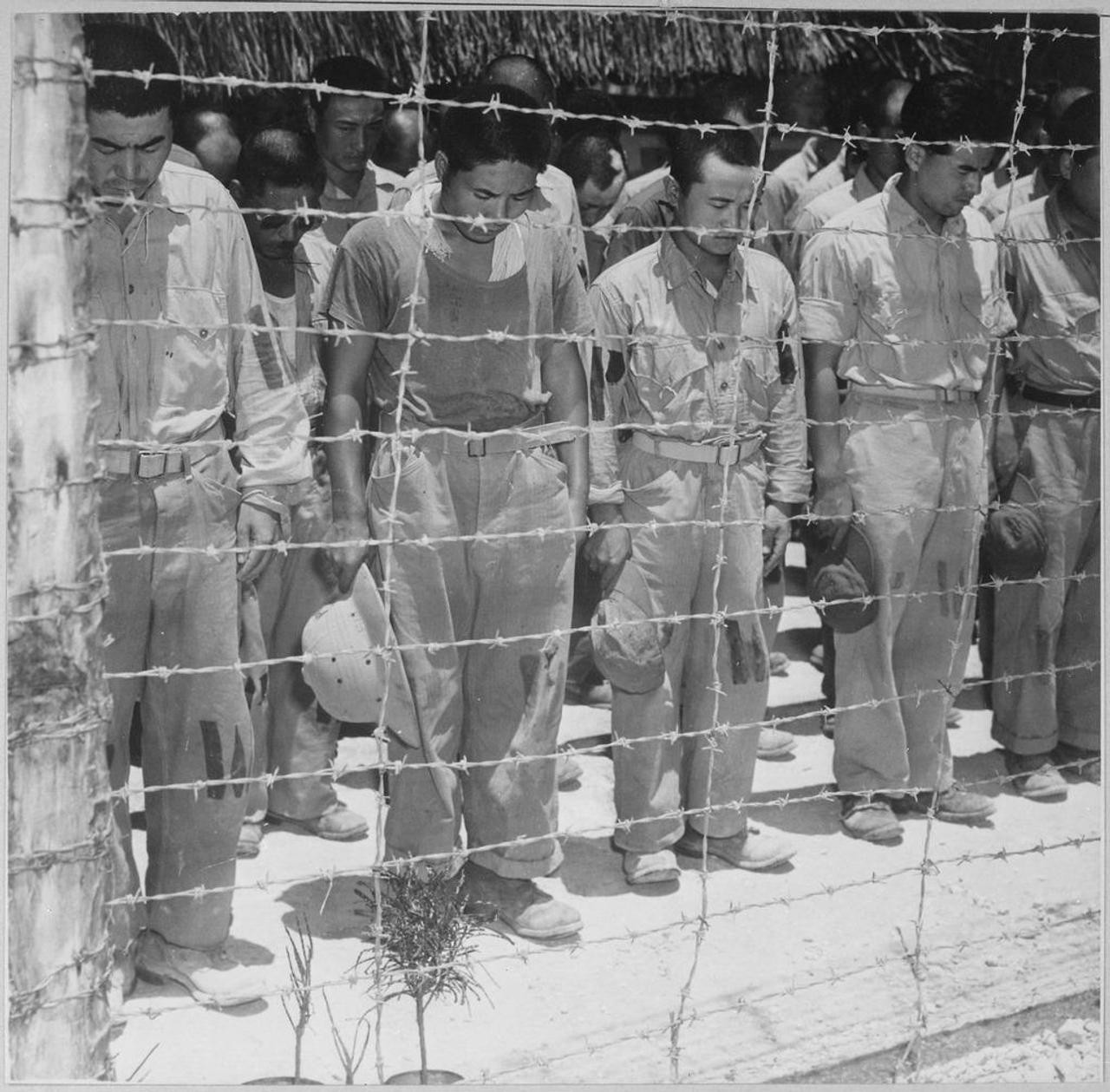
It’s August 15, 1945, on the island of Guam, and the war is about to end—not with gunfire, not with a final desperate charge, but with words spoken across the airwaves by a man most of these soldiers have never seen. The Japanese prisoners of war, held here after months or years of brutal fighting, stand in the tropical heat as a voice filters through the static of a loudspeaker. It is their Emperor, Hirohito, announcing Japan’s unconditional surrender. For men raised to believe the Emperor was a living deity, this is not just a military defeat—it’s the unraveling of the universe as they’ve known it.
The moment is strangely quiet. The prisoners lower their heads, not in obedience to the Americans guarding them, but in a reflexive gesture of grief, shame, and something harder to name. These are men who have been told since childhood that dying for the Emperor was the greatest honor imaginable, that surrender was worse than death. Now, the very figure they swore to serve unto death is telling them the fight is over. He speaks in language so formal and archaic that many of them may not grasp every word, but they understand the meaning all too well: the war they bled for, starved for, and watched their comrades die for has ended—not in victory, but in surrender.
You can’t overstate how psychologically devastating this was for many Japanese soldiers. The militarist indoctrination of the 1930s and ’40s didn’t just teach them tactics—it reshaped their entire moral framework. War wasn’t simply politics by other means; it was a sacred duty. To have the divine authority himself break the spell was like watching the sun fall out of the sky. Some men wept. Others clenched their jaws and stared at the ground. A few, perhaps, felt a flicker of relief—relief that they might live, relief that the endless cycle of fighting and dying was over. But for most, this was a moment of profound disorientation.
On Guam, surrounded by enemy guards and far from home, the prisoners must have felt the distance in a thousand ways. There would be no triumphant return, no parade through Tokyo streets. Many didn’t know if their families had survived the bombings, if their homes still stood. The war’s end was abstract—something announced by a faraway voice—but its consequences were intimate, immediate. These men would carry the weight of defeat not just in their uniforms, but in their very sense of self.
One final kiss before execution, 1953 : Julius and Ethel Rosenberg share one final kiss and sing “The Internationale” as they were being strapped to the electric chair.
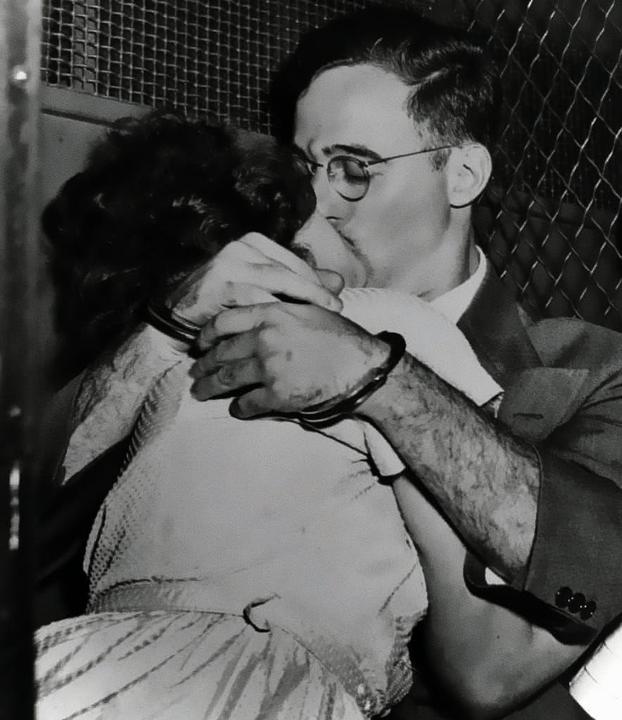
June 19, 1953. The death house at Sing Sing Prison is quiet except for the low murmur of guards and the hum of the machinery that will carry out the sentence. Julius and Ethel Rosenberg, the most famous married couple in America’s short history of espionage trials, are about to die in the electric chair. Convicted of passing atomic secrets to the Soviet Union, they have insisted on their innocence to the very end, refusing to name names, refusing to cooperate, refusing to bend. Now, in their last moments, they are led into the execution chamber together. Before the straps are fastened, they lean toward each other and share one final kiss—a brief, human gesture in the middle of a political hurricane.
It’s a kiss freighted with meaning. For some watching, it’s the last act of two traitors who had betrayed their country during its most vulnerable hour. For others, it’s the kiss of martyrs—victims of a Cold War paranoia that had reached fever pitch in the McCarthy era. To the Rosenbergs themselves, it may have been neither. It may have been something smaller, more private: the simple act of holding onto each other before the state took them apart forever. That’s the thing about moments like this—they are both intensely personal and historically monumental, existing on two levels at once.
And then, as they are strapped in, something else: they sing. “The Internationale,” the anthem of socialist and communist movements around the world, drifts out into the chamber. The song, banned in much of the West and embraced in the Soviet bloc, is as much a declaration as it is a farewell. They are telling the world—right up until the current surges—that they will die as they lived, defiant, unrepentant, and aligned with the cause they believed in. In that instant, the execution chamber is less a place of punishment than a political stage, and the Rosenbergs are determined to have the final word.
Outside the prison walls, the United States is deeply divided. Many see their execution as justice served, a necessary message to any would-be spies in an age where nuclear secrets are the currency of survival. Others see it as a dark overreach, the killing of two people on circumstantial evidence and in an atmosphere so poisoned by fear that a fair trial was impossible. The truth—messy, murky, and still debated today—was drowned out in the chants, the headlines, and the geopolitics of the early Cold War.
Breaker boys employed by the Pennsylvania Coal Company. 1911.
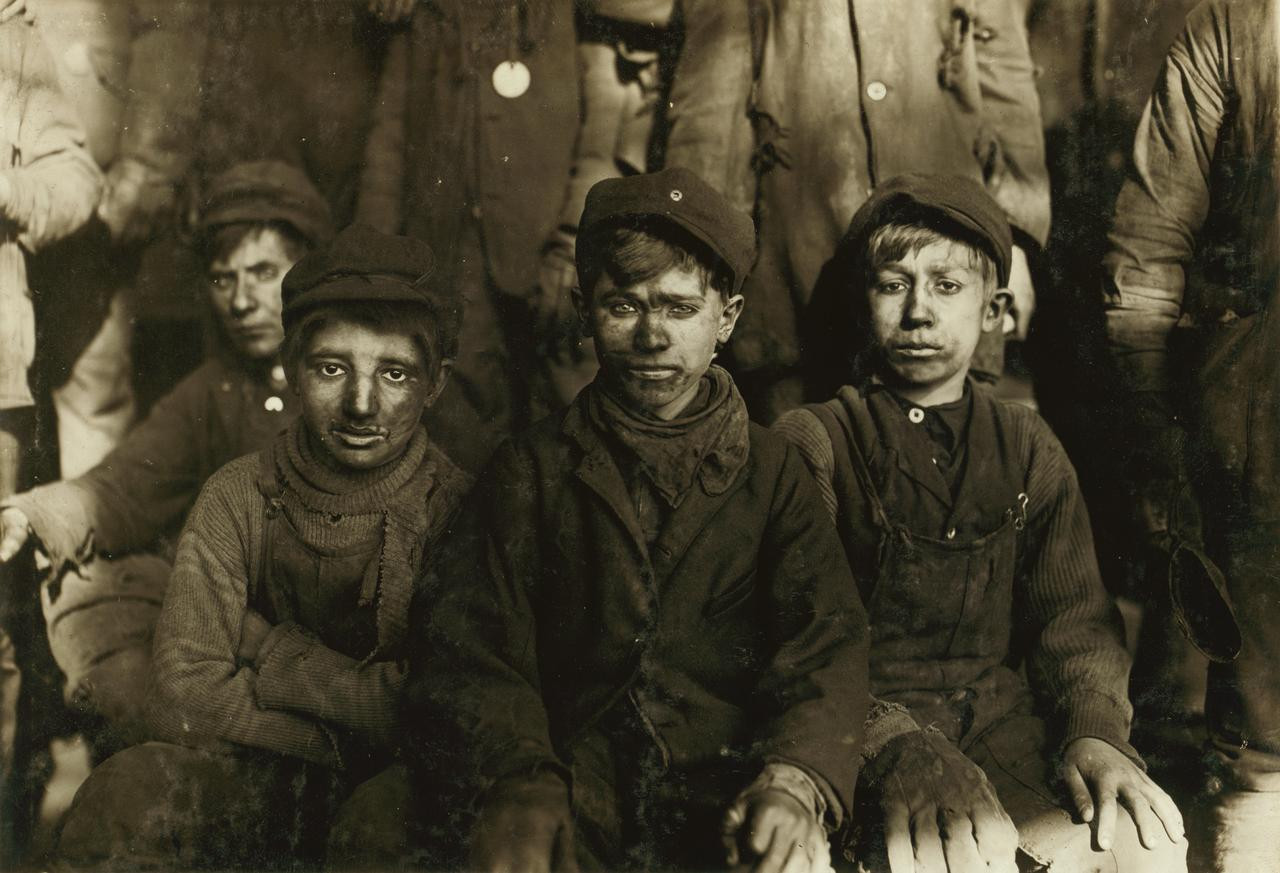
In 1911, in the coal towns of Pennsylvania, the term “breaker boy” didn’t need explaining. It was a job, a life, and for thousands of boys—some as young as eight—a sentence. These were the kids who spent their days hunched over chutes in the coal breakers, the massive, grimy buildings where freshly mined coal was crushed, sorted, and cleaned of impurities. Their job was to pick slate and rock from the speeding stream of black chunks before it moved on to be sold. No gloves, no masks, just bare hands and the constant grit of coal dust in the lungs. The Pennsylvania Coal Company employed many of them, paying wages that barely justified the toll it took on their bodies and futures.
The breaker was a sensory assault—deafening noise from the machinery, dust thick enough to turn daylight into gloom, and the unrelenting smell of coal and sweat. The boys sat on wooden planks over the chutes, legs dangling, bodies leaning forward for hours at a time. Miss a rock and you’d hear about it from the foreman. Reach too far or lose your balance, and you could end up injured, crushed, or worse. Fingers were often mangled, backs curved prematurely from the endless stoop. Yet this was considered “light” work compared to the men underground, and in many mining families, it was the natural first step for a boy before he was deemed old enough to enter the shafts himself.
The economic logic was cruelly simple: children were cheap labor. The company didn’t have to pay them much, they could be replaced easily, and their small hands and quick reflexes made them, in the eyes of the operators, well-suited for the job. But the real reason was deeper—poverty. These were the sons of miners, immigrants, and laborers who needed every possible wage-earner in the household just to keep food on the table. Education was a luxury, and the longer you stayed in school, the longer your family went without the income your labor could provide. For many, the choice was never theirs to make.
Photographers like Lewis Hine documented these boys, capturing their grimy faces, torn clothes, and expressions that seemed far older than their years. His images were not just records—they were weapons in the fight for labor reform. Looking at them now, it’s the eyes that stand out. Some stare into the camera with defiance, others with resignation. They knew this was their lot, at least for now. Childhood, in the modern sense of the word, had no place in the breakers. You grew up fast here, or you didn’t grow up at all.
Within a few years, public outcry—fueled by Hine’s photographs and the labor movement’s push—would help bring about child labor laws and compulsory education. But in 1911, those changes were still a distant hope. For the breaker boys of the Pennsylvania Coal Company, the future was measured not in years, but in shifts: one long, dust-choked day followed by another, until they were old enough to trade the breaker’s roar for the darkness of the mines below.