German child soldiers captured by the 6th U.S. Armored Division in Giessen, Germany. March 19, 1945.
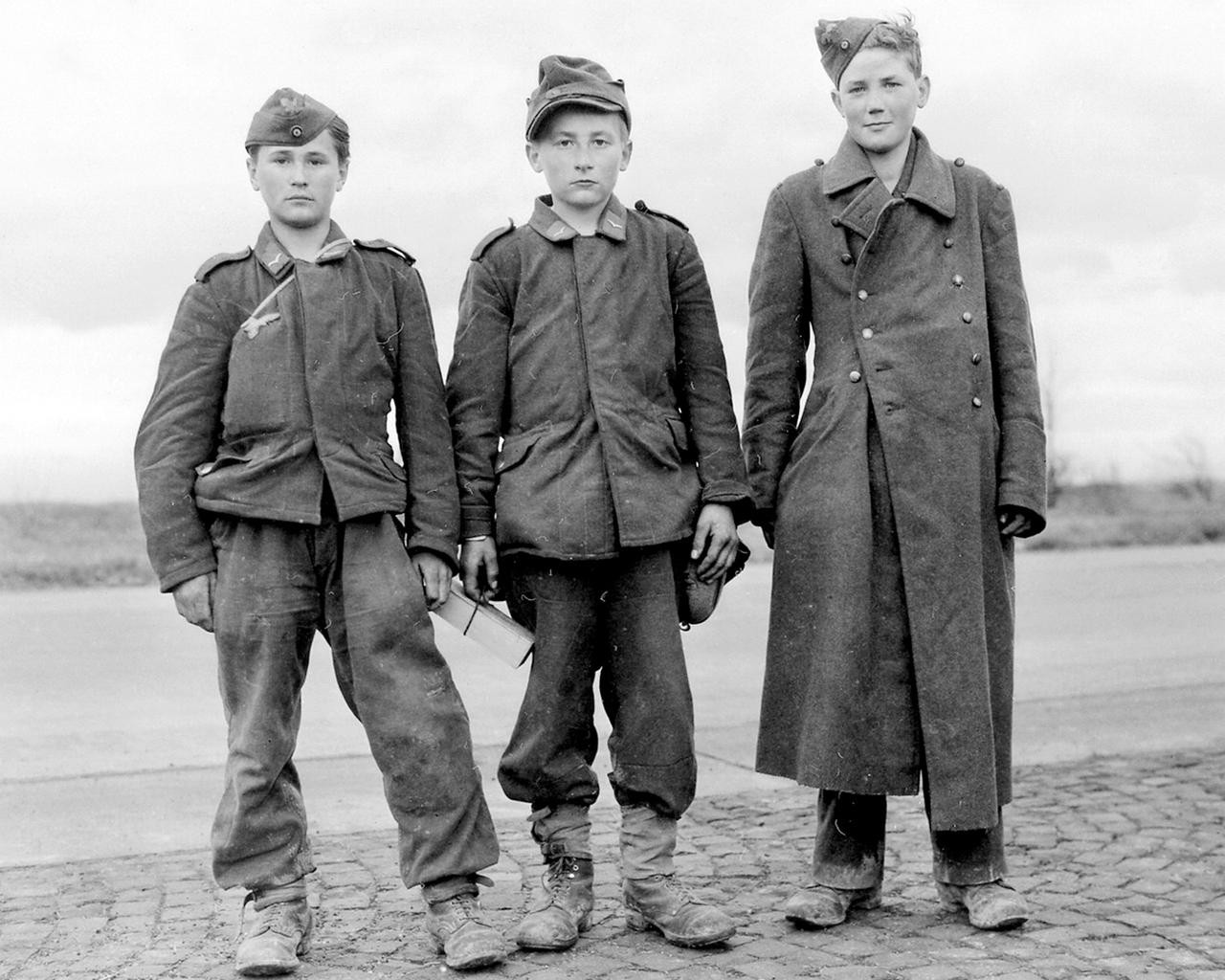
On March 19, 1945, in the central German city of Giessen, soldiers of the 6th U.S. Armored Division take custody of a group of prisoners who barely look old enough to shave. Some wear oversized uniforms. Some still have round faces, soft hands, and the stiff, unsure posture of adolescents trying to appear older than they are.
They are German child soldiers.
By this point in the war, the Western Front is no longer a contest—it’s a collapse. The Rhine has been crossed. American armored divisions are racing east, bypassing strongpoints, cutting supply lines, and rolling up what remains of the Third Reich’s ability to resist. Entire German units are surrendering without a fight.
But not all of them.
As manpower evaporates, the Nazi regime turns to its last reserves. Boys from the Hitler Youth—some as young as 12 or 13—are pulled from classrooms and sent into combat units. What began years earlier as a youth organization built on ideology, athletics, and loyalty to Hitler becomes, in the final months, a desperate manpower pool.
Giessen sits along the route of the American advance through Hesse, a region now absorbing the shock of armored columns, artillery barrages, and air superiority that Germany can no longer contest. Resistance here is often symbolic rather than strategic. Small units. Isolated roadblocks. Panzerfaust teams hiding behind rubble or hedgerows.
For boys trained to believe that surrender is treason, this is a lethal education.
The Hitler Youth had been conditioned for years with stories of sacrifice, last stands, and heroic death. They were told that Germany’s enemies were weak, decadent, and morally inferior. Now they are facing Sherman tanks, veteran infantry, and officers who have fought from Normandy through the Ardennes.
The result is tragic predictability.
Some of these boys fight. Some fire a single shot and run. Others freeze. When captured by the Americans, many are shocked to discover they are not beaten, executed, or abused. They are disarmed, searched, given cigarettes or food, and told—sometimes with translators, sometimes with gestures—that the war is over for them.
For U.S. soldiers, the scene is unsettling.
American troops have encountered young German soldiers before, but by March 1945 the age gap has become impossible to ignore. These prisoners are closer in age to siblings back home than to enemy combatants. Some can’t fully explain their unit or mission. Some still carry schoolbooks alongside ammunition.
The presence of child soldiers is not an accident of war. It is policy.
By late 1944, the Nazi leadership authorizes the Volkssturm, a national militia drawing from boys and old men. The regime’s logic is simple: total war demands total participation. In practice, it means placing children in front of tanks and calling it patriotism.
Giessen is one of countless places where this reality becomes visible.
The capture of these boys does not change the course of the war. Berlin will fall weeks later. Hitler will be dead by April’s end. But moments like this expose the final moral bankruptcy of the regime more clearly than any speech or document.
An ideology that promises a thousand-year Reich ends by handing rifles to children and telling them to die for ruins.
On March 19, 1945, the 6th U.S. Armored Division keeps moving east.
The boys do not.
More than a 100,000 Iranian women take to the street to protest against the newly formed Islamic government’s compulsory hijab ruling, 8 March 1979

Tehran, March 8, 1979. The revolution is barely a month old, the old regime already swept aside, the future supposedly up for grabs. And into the streets come the women—tens of thousands of them—moving through the capital with bare heads, uncovered hair, and a clarity of purpose that cuts through the fog of revolutionary slogans.
What they are protesting sounds deceptively simple: a ruling that women must wear the hijab in public. But nothing about this moment is simple. This isn’t a fringe group pushing back against a settled order. This is a mass demonstration—estimates often run well over 100,000—by women who believed, just weeks earlier, that they had helped overthrow a dictatorship in the name of freedom.
To understand why this moment matters, you have to rewind the tape just a little.
During the uprising against the Shah, Iranian women were everywhere. They marched, organized, treated the wounded, smuggled leaflets, and stood in the streets alongside men when bullets were flying. They came from different classes, ideologies, and religious commitments. Some wore headscarves. Many didn’t. What united them was the shared belief that the revolution meant choice—that the future would be negotiated, not dictated.
Then, almost immediately, the tone shifts.
Ayatollah Khomeini returns from exile in February. The provisional government begins taking shape. And within weeks, statements emerge suggesting that women should observe Islamic dress codes in workplaces and public institutions. Not long after, the message hardens. The hijab is no longer framed as a moral recommendation. It becomes compulsory.
The reaction is explosive.
On International Women’s Day—March 8—women flood the streets of Tehran and other cities. Some chant “Freedom is neither Eastern nor Western—it is universal.” Others shout, “We didn’t make a revolution to go backwards.” There are placards in Persian and French, appeals to equality, warnings about what comes next if this line is crossed.
This is not a Westernized elite protesting from the sidelines. Factory workers march beside university students. Secular feminists walk alongside religious women who believe faith and coercion are not the same thing. Many protesters emphasize that this is not about rejecting Islam—it’s about rejecting compulsion.
And here’s the key historical detail that often gets lost: at this point, nothing about the Islamic Republic is inevitable. The constitution hasn’t been finalized. Power structures are still fluid. The revolution is still molten.
Which is why this protest is so dangerous—to the new authorities.
Supporters of compulsory hijab quickly mobilize. Counter-demonstrators appear. Some heckle. Others threaten. There are reports of women being harassed, spat on, told to go home. Revolutionary Committees—still loosely organized—begin to side openly with those enforcing “proper” behavior.
The government response is telling. Officials issue half-clarifications and walk-backs. One day it’s “mandatory in offices.” The next day it’s “not compulsory, just advised.” But on the streets, the pressure is unmistakable. Armed men stand near protests. The implication doesn’t need to be spoken.
And slowly, over days, the protests lose momentum.
Not because the argument was lost—but because the balance of power was becoming clear.
Within a year, the hijab is legally enforced. By 1983, it is written into law with penalties attached. What began as a “cultural correction” hardens into a state mandate backed by fines, lashings, imprisonment.
Looking back, March 1979 feels like a hinge moment. A brief window where mass resistance existed before institutions locked into place. The women in the streets weren’t reacting late—they were reacting early, before the scaffolding of enforcement was fully built.
That’s what makes the images so striking. The confidence. The volume. The sense that history could still be pushed in another direction if enough people leaned at once.
Revolutions often sell themselves as clean breaks from the past. But in reality, they’re negotiations—messy, contested, full of internal contradictions. In Iran, one of the earliest and clearest signals of how those negotiations would end came not from a battlefield or a palace, but from a demand about women’s bodies.
By the end of March, the street belonged to someone else.
And the women who had helped bring down a monarchy learned, in real time, how quickly a revolution can decide who it’s actually for.
Frida Kahlo takes a family photo, wearing a 3-piece suit and holding a cane, 1924.

In 1924, Frida Kahlo stands in a family photograph dressed in a three-piece suit, tie neatly set, hair slicked back, one hand on a cane. It’s not a costume in the casual sense. It reads as deliberate. Composed. Almost confrontational in its calm.
She is not yet the Frida Kahlo of museum walls and tote bags. She is a teenager, still years away from the bus accident that will remake her body and, eventually, her art. At this moment, she is a student, politically curious, moving through Mexico City at a time when the country itself is still redefining what it means to be modern after revolution.
The suit matters.
In 1920s Mexico, clothing is not neutral. A young woman in tailored menswear is making a statement whether she intends to or not. Gender expectations are rigid. Public presentation is policed by custom long before it’s enforced by law. For a daughter to appear in a family portrait dressed like this is not just fashion—it’s a signal.
The cane adds another layer. On one level, it can be read as playful, even theatrical, an accessory borrowed from masculine imagery of authority and swagger. On another level, it foreshadows the physical reality that will come to define much of her adult life. Even before the accident, Kahlo lived with the aftereffects of childhood polio, which left one leg weaker and thinner. The cane is not only style. It is also truth.
What makes the photograph powerful is not rebellion for rebellion’s sake. It’s the lack of apology. Kahlo is not smirking. She’s not signaling irony. She looks straight into the camera with a steadiness that suggests she understands exactly how she is being seen—and is fine with that.
This is early evidence of something that will become central to her life and work: the refusal to let identity be simplified. Kahlo would later play with traditional Tehuana dresses, elaborate jewelry, and hyper-feminine presentation. Here, she does the opposite. The point is not masculinity versus femininity. The point is control.
Control over how she appears. Control over how she is categorized. Control over the story her body and clothing are allowed to tell.
Family photographs are usually about conformity. They are visual proof that everyone fits where they’re supposed to fit. This image does the reverse. It freezes a moment where Kahlo is already stepping slightly out of frame, testing the boundaries of what is acceptable, and doing it in a way that is quiet, not loud. Personal, not performative.
Years later, Kahlo would turn herself into one of the most recognizable visual identities in modern art. But that identity did not arrive fully formed. You can see its early architecture here: a young woman using clothing, posture, and gaze to assert that she will not be neatly filed into anyone else’s categories.
It’s not just a family photo.
It’s a preview.
The governor of Heilongjiang province, Li Fanwu, falls victim to the Cultural Revolution in 1966.

In 1966, the Cultural Revolution does not begin with tanks or declarations of war. It begins with accusations. With posters. With slogans. With the sudden realization that past loyalty offers no protection against the political needs of the present.
Li Fanwu, the governor of Heilongjiang province, learns this the hard way.
He is not an outsider to the Communist system. He is not a counterrevolutionary in the conventional sense. He is a veteran of the Chinese Communist Party, a man who survived earlier purges, Japanese occupation, civil war, and the brutal consolidations of power that followed 1949. By the mid-1960s, he represents exactly what the Party once needed: experienced administrators who could turn revolutionary chaos into functioning governance.
But by 1966, that skill set has become a liability.
The Cultural Revolution is launched in part to reassert ideological purity, but also to break the influence of entrenched Party officials who have accumulated authority, institutional memory, and—most importantly—independent judgment. Mao Zedong frames this as a struggle against “capitalist roaders,” a deliberately vague term that can be applied to almost anyone with power.
Provincial leaders like Li Fanwu are prime targets.
Heilongjiang is strategically important: a massive northeastern province bordering the Soviet Union, rich in resources and heavy industry. Stability there matters. Which, paradoxically, makes its leadership suspect. Stability suggests bureaucracy. Bureaucracy suggests hierarchy. Hierarchy suggests deviation from revolutionary zeal.
When the Red Guards mobilize, rank dissolves overnight.
Li Fanwu is dragged into public “struggle sessions,” where accusation replaces evidence and humiliation becomes policy. He is forced to bow, sometimes beaten, often paraded before crowds. Placards hang from his neck listing crimes that are ideological rather than factual: bourgeois tendencies, insufficient loyalty, deviation from Mao Thought.
This is not justice. It is ritual.
Struggle sessions are designed to do several things at once. They terrorize the accused. They bond the accusers through shared violence. And they send a message to anyone watching: survival now depends on visibility of obedience, not past service.
What makes Li Fanwu’s case emblematic is how unexceptional it is. This is happening across China, from village schoolteachers to senior military officers. The Cultural Revolution does not discriminate by achievement. In fact, achievement often accelerates destruction. The higher you climbed, the harder you fall.
By late 1966, Li Fanwu is dead. Officially, his death is later described as suicide. Like many deaths during the Cultural Revolution, the label obscures more than it explains. Whether by direct violence, sustained abuse, or the psychological weight of total erasure, the system has finished with him.
And that’s the point.
The Cultural Revolution is not only about punishing enemies. It is about erasing the idea that experience, competence, or history grant legitimacy. The revolution must always be renewed, and renewal requires sacrifice—preferably visible, preferably public, preferably symbolic.
A provincial governor broken in front of students and factory workers sends a powerful signal: no one is untouchable.
For the next decade, China will pay the price. Administrations collapse. Expertise is purged. Fear replaces governance. Entire sectors—education, science, medicine—are hollowed out because knowing too much becomes dangerous.
Li Fanwu is one name among millions, but his story captures the deeper logic of the Cultural Revolution. This is not chaos by accident. It is chaos as a tool. A deliberate dismantling of authority so that power flows upward, uncontested, and unquestioned.
In 1966, Heilongjiang loses its governor.
China loses something much harder to replace.
Newly engaged John F. Kennedy & Jacqueline Bouvier – Cape Cod, July 4th 1953

The photograph feels quiet, almost deceptively so. John F. Kennedy sits forward, barefoot, mid-thought. Jacqueline watches him—not posing, not smiling for the camera, but observing. It looks domestic, unfinished, like a moment that wasn’t meant to last longer than a few seconds.
And that’s what makes it historically revealing.
This image comes from the brief interval when John and Jacqueline Kennedy exist between categories. He is no longer just a congressman, not yet a senator of consequence. She is no longer simply Jacqueline Bouvier, not yet Jackie Kennedy as the country will come to know her. The engagement is new. The future is ambitious but still theoretical.
America, meanwhile, is standing on a hinge.
In 1953, the Second World War is close enough to still define adulthood. Kennedy’s back injuries come directly from it. His authority, his credibility, his sense of destiny all trace back to the PT-109 incident in the Pacific. That war made him possible as a political figure. But the next war—the Cold War—is already reshaping the country in quieter, more pervasive ways.
Eisenhower has just taken office. McCarthyism is cresting. Television is beginning to flatten politics into images and personalities rather than speeches and party machinery. The presidency is about to become visual.
Kennedy senses this before most of his peers.
What the photo captures is not power, but preparation. Kennedy leans forward the way men do when they are thinking out loud, testing ideas, narrating futures to themselves. Jacqueline listens the way someone does when they understand that what’s being said matters, even if it isn’t polished yet. She is already functioning as something more than a spouse—she is a witness, a filter, an interpreter.
Historically, that matters.
Jacqueline Kennedy’s later influence—on culture, aesthetics, diplomacy, and memory—did not emerge by accident. She was steeped in history, fluent in symbolism, and acutely aware that nations tell stories about themselves through objects, images, and rituals. That sensibility will later help recast the American presidency as something closer to a court than an office.
But here, none of that has been formalized.
The setting is Hyannis Port, the Kennedy family compound, which functions less like a home and more like an incubator. Conversations here are political even when they pretend not to be. Futures are discussed casually, as if assuming success makes it more likely. Kennedy men grow up surrounded by expectation, and this image shows John in his natural environment—thinking, performing informally, rehearsing leadership without an audience.
This is also a reminder of how young they both are.
Kennedy is thirty-six. Jacqueline is twenty-three. The presidency is still seven years away. The Cuban Missile Crisis, the civil rights confrontations, Berlin, Vietnam—none of it has happened yet. The burdens that will age them prematurely are still invisible.
That’s why the photograph feels suspended.
It shows two people before myth hardens them into symbols. Before the marriage becomes strategic. Before the administration becomes historic. Before tragedy freezes their faces into a permanent national memory.
In historical terms, this is the last calm frame before acceleration.
Once Kennedy enters the Senate later in 1953, momentum builds fast. By the end of the decade, he is running for president in a country that increasingly values youth, charisma, and televised confidence. Jacqueline will become part of that transformation—not as decoration, but as architecture.
This image matters because it reminds us that history is not inevitable when you’re living inside it.
At this moment, Kennedy could still fail. He could still stall. The story could still veer off course.
The photo catches them right before that possibility disappears.