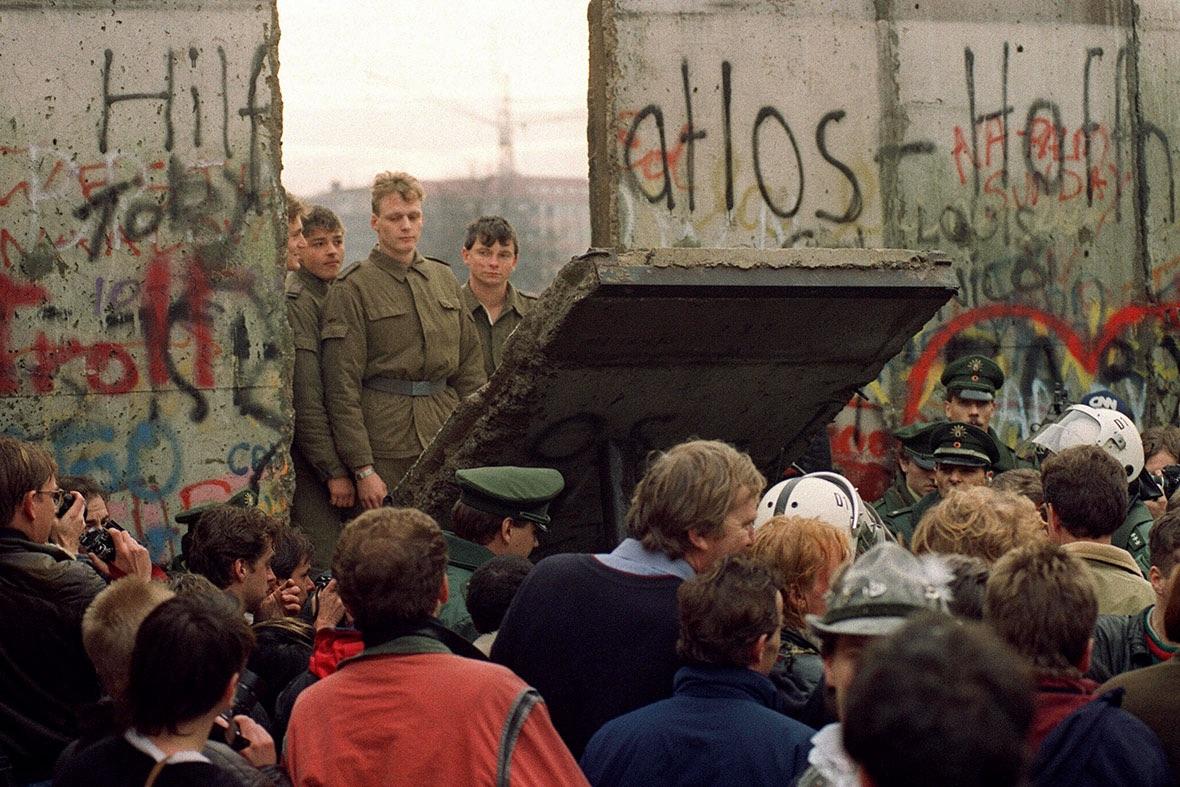
The Berlin Wall comes down. November 9, 1989
On November 9, 1989, the Berlin Wall did not fall because of a dramatic military assault or a carefully planned revolution. It fell because the system holding it up had already decayed—and that night, the decay finally surfaced.
The Wall itself was a product of postwar panic. After World War II, Germany became the central fault line of the Cold War. Berlin, deep inside the Soviet-controlled zone, was split between East and West. By the late 1950s, East Germany faced a crisis: millions of its citizens—especially young and skilled workers—were fleeing west through Berlin. The state was bleeding itself dry.
In August 1961, the solution was brutal and immediate. Overnight, borders closed. Streets were severed. Families were separated without warning. What began as barbed wire quickly became concrete, guard towers, and kill zones. The official line called it “anti-fascist protection.” In practice, it was a prison wall built to keep citizens in, not enemies out.
For nearly three decades, the Wall held—not because it inspired loyalty, but because escape was deadly. It became one of the most fortified borders on Earth, enforced by soldiers trained to treat civilians as threats. The Cold War’s abstract ideological struggle was made tangible in Berlin, measured in yards of concrete and orders to shoot.
By the 1980s, however, the world propping up the Wall was changing. The Soviet Union no longer had the will to crush dissent the way it once had. Under Mikhail Gorbachev, reforms like glasnost and perestroika attempted to loosen the system without destroying it. Instead, they exposed how fragile it had become.
Eastern Europe began testing boundaries. Poland’s Solidarity movement endured. Hungary opened its border with Austria. East Germans increasingly fled by detouring around the Wall through neighboring countries. The East German state was losing control, even if it hadn’t yet admitted it.
That collapse came into view on November 9.
At a press conference intended to explain new travel rules, an East German official misspoke. Asked when the regulations would take effect, he replied: “Immediately.” It wasn’t true—but it was broadcast live. Within hours, crowds gathered at checkpoints, asking calmly but insistently to cross.
The guards had no instructions for this scenario. Violence risked catastrophe. Turning people away only swelled the crowds. Eventually, gates opened. Once one crossing gave way, the Wall was finished. People climbed the concrete that had defined their lives. Soldiers stood aside, unsure whether they were witnessing a crime or the end of their world.
The fall of the Berlin Wall revealed something unsettling: even the most intimidating systems can collapse without a battle. This border—engineered, armed, and backed by a superpower—fell because the state behind it could no longer command belief or obedience.
Samurai of the Satsuma clan, members of the Satchō Alliance, fighting for the Imperial side during the Boshin War period.

By the late 1860s, the samurai of Japan were living through a contradiction that could not last. For centuries, they had been the military backbone of a rigid feudal order, sworn to lords, bound by ritual, and legitimized by tradition. But the world was intruding—steamships in Japanese harbors, Western cannon pointed at coastal cities, treaties signed under duress. The old system was still standing, but it was already obsolete.
The Satsuma clan sat at the center of this tension.
Based in southern Kyūshū, Satsuma had long been semi-independent, wealthy, and militarily capable. Unlike many domains that clung desperately to the Tokugawa shogunate, Satsuma’s leadership understood something unsettling: the shogunate could no longer protect Japan from foreign domination. If Japan was going to survive as a sovereign state, the political order that had governed it since the early 1600s would have to be dismantled—by force if necessary.
This realization produced an unlikely coalition. Satsuma joined with its traditional rival, the Chōshū domain, forming what became known as the Satchō Alliance. The goal was simple but radical: overthrow the Tokugawa shogunate and restore governing authority to the emperor. This was not nostalgia. The emperor was a symbol—useful, ancient, and politically unifying—but the real objective was to clear away the old system so something new could be built in its place.
The resulting conflict, the Boshin War (1868–1869), was less a civil war in the classic sense and more a violent transition of eras. Samurai fought samurai. Loyalty fractured. Men trained in swordsmanship found themselves facing rifles and artillery imported from the West. The Satsuma forces, despite their traditional appearance, were often among the most modernized on the battlefield. They embraced Western weapons, drilling techniques, and logistics while still wearing the visual markers of an older Japan.
That combination mattered.
While Tokugawa loyalists often fought to preserve hierarchy and precedent, Satsuma samurai fought with a forward-looking desperation. They weren’t just defending an emperor; they were trying to prevent Japan from becoming another carved-up colony. The irony is unavoidable: the men fighting to end the samurai order were samurai themselves.
Victory came quickly. By 1869, the shogunate collapsed. The emperor was restored to power. The Meiji era began. And with it came reforms that would have been unthinkable a generation earlier—centralized government, conscription armies, industrialization, and the formal abolition of the samurai class.
The Satsuma samurai won the war that erased their own way of life.
Within a decade, swords were banned from public wear. Stipends were eliminated. Samurai became bureaucrats, officers, or relics. Some resisted, most famously in the Satsuma Rebellion of 1877—led by former imperial hero Saigō Takamori—where the last large samurai army was annihilated by the modern state it helped create.
The Boshin War, and the role of the Satsuma clan within it, marks one of history’s sharpest turning points. It wasn’t the triumph of tradition over change, or progress over the past. It was the moment when an elite warrior class recognized that survival required self-destruction—and chose it anyway.
Young lady overcome with emotion at seeing Elvis Presley in concert, Philadelphia, 6 of April 1957

By April of 1957, Elvis Presley was no longer just a popular singer. He was a cultural event—volatile, polarizing, and unsettling in a way America hadn’t quite learned how to process yet.
The country was still formally buttoned-up. Public emotion was meant to be restrained. Teenagers were supposed to be polite, grateful, and quiet. Music, especially for young people, was expected to stay safely contained—pleasant, controlled, and ideally forgettable. Elvis shattered that arrangement almost by accident.
He didn’t look like previous stars. He moved too much. His voice slid between tenderness and rawness in a way that felt intimate, even invasive. To adults raised on crooners and big bands, this wasn’t just noise—it was a threat to order. To teenagers, especially young women, it felt like permission. Permission to feel something intensely, publicly, without apology.
The concert in Philadelphia on April 6, 1957, happened right in the middle of this cultural collision. By then, Elvis had already been denounced from pulpits, censored on television, and accused of corrupting youth. The controversy only amplified the effect. Seeing him in person wasn’t just entertainment—it was transgressive. You weren’t supposed to react like that. Which made reacting like that irresistible.
What’s striking about moments like this isn’t the hysteria itself, but what it reveals. The emotion on display wasn’t manufactured by marketing alone. It came from a generation that had grown up in the long shadow of World War II, in homes shaped by conformity and emotional restraint. Suddenly, here was a figure who embodied release—movement instead of stillness, desire instead of discipline.
For many young women in particular, this kind of reaction wasn’t about romance in the narrow sense. It was about recognition. Elvis sang to them, not over them. He made feeling loud. And in a society that often treated young women’s inner lives as something to be managed or dismissed, that mattered.
Adults at the time dismissed these scenes as mass hysteria. Moral weakness. Teenagers losing control. But history has a way of reclassifying moments like this. What looked like chaos was actually a shift—one of the first visible cracks in a rigid postwar culture. Youth identity was forming in real time, and music was becoming the vehicle.
Within a decade, everything would be different. Fashion, gender norms, politics, protest, and music itself would all accelerate away from the world that tried to suppress reactions like this one. The screaming, the tears, the physical overwhelm—they weren’t signs of something breaking down.
They were signs of something waking up.
Oscar “Zeta” Acosta Fierro photographed after finding fame following the release of the book ‘Fear & Loathing in Las Vegas’. He would disappear in May 1974, aged 39.

Oscar “Zeta” Acosta didn’t become famous the way most public figures do. He didn’t polish himself for the spotlight, didn’t soften his edges, didn’t try to become legible to the culture consuming him. Fame arrived sideways, almost accidentally, after Fear & Loathing in Las Vegas turned him into a character larger than his real, already oversized life.
By the time the book appeared in 1971, Acosta had already lived several lives. He was a Chicano activist, a lawyer for the poor, a political radical, a man constantly at war with authority—and with himself. He represented East Los Angeles defendants no one else would touch. He ran for sheriff and district attorney not because he expected to win, but because he wanted to expose the system from the inside. He drank hard, wrote harder, and treated institutions as things to be challenged, not respected.
Hunter S. Thompson didn’t invent Acosta. He amplified him.
In Fear & Loathing, Acosta became “Dr. Gonzo,” a towering, chaotic presence who seemed to embody the unfiltered id of the American counterculture. For readers, Gonzo was wild, hilarious, and frightening—a force of nature. But the transformation came with a cost. Acosta, the real man, was now trapped inside someone else’s myth. His politics, his intellect, and his legal work were overshadowed by the caricature of excess.
After the book’s success, Acosta found himself famous but untethered. He struggled to reconcile the serious revolutionary he believed himself to be with the drug-fueled outlaw the public expected. His writing grew darker. His anger sharpened. The line between performance and identity eroded. Thompson thrived in the chaos of fame. Acosta seemed to be consumed by it.
By the early 1970s, he was increasingly disillusioned. The Chicano movement was fracturing. The broader counterculture was commercializing. Nixon had been reelected. The revolution, if it had ever been real, appeared to be losing. Acosta talked often about escape, about Mexico, about disappearing entirely. Unlike many who make such declarations, he meant it.
In May 1974, Oscar Acosta crossed into Mexico and vanished. There were rumors—drug deals gone wrong, political assassinations, suicide, a staged disappearance. No body was ever recovered. No definitive explanation emerged. He was 39 years old.
What lingers isn’t just the mystery of how he died, but the discomfort of how he lived. Acosta didn’t fit cleanly into American narratives. He wasn’t a martyr or a clown, a hero or a cautionary tale. He was brilliant, self-destructive, principled, reckless, compassionate, and furious—often all at once. The culture that briefly celebrated him had little use for that kind of complexity once the party ended.
Oscar “Zeta” Acosta didn’t just disappear geographically. He slipped out of a story that no longer had room for him as a real person. What remains is a warning embedded in countercultural history: that being turned into a symbol can be its own kind of erasure, and that sometimes the most radical act left is simply refusing to be found.
Kaw-U-Tz, a young Caddo Indian woman, photo by George B. Cornish, 1906. The Caddo were indigenous to present day Louisiana and Texas.

In 1906, when this photograph of Kaw-U-Tz was taken, the Caddo Nation was already living in the long aftermath of displacement. The image looks quiet, almost intimate, but it exists inside a century of upheaval that had largely stripped the Caddo of their land, their political autonomy, and much of the world that had defined them for generations.
The Caddo were not a marginal people in North American history. Long before European contact, they were builders, farmers, and traders, organized into complex societies across what is now East Texas, Louisiana, Arkansas, and Oklahoma. They cultivated corn, beans, and squash, built permanent villages, and maintained trade networks that stretched hundreds of miles. When the Spanish and French arrived, they encountered a people accustomed to diplomacy, ceremony, and structure—not a scattered or primitive culture, but a stable one.
That stability did not survive contact.
Disease arrived first, hollowing out communities before sustained colonization even began. Then came land pressure, treaties signed under coercion, and the gradual erosion of sovereignty. By the nineteenth century, the Caddo were pushed steadily westward, ultimately forced into Indian Territory, present-day Oklahoma. Removal fractured families, collapsed economies, and compressed a once expansive homeland into a fraction of its former size.
By the time Kaw-U-Tz sat for this photograph, the Caddo were navigating a new kind of threat—not outright warfare, but assimilation. The United States no longer needed armies to dismantle Native nations. It used schools, land allotment, Christianization, and bureaucracy. Traditional governance was undermined. Communal lands were divided and sold. Children were sent to boarding schools designed to erase language and identity.
Photography played a complicated role in this moment. Images like this were often presented to white audiences as documents of a “vanishing race,” reinforcing the idea that Native cultures were fading remnants rather than living, adapting peoples. The irony is unavoidable: the camera froze Native individuals in time at the very moment their communities were fighting hardest to endure.
Kaw-U-Tz does not appear vanishing. She appears present. Her gaze is steady, her posture deliberate. The beadwork and clothing reflect continuity, not nostalgia. This is not a person unaware of modernity, but someone existing alongside it, whether invited or not. The photograph captures a tension common to Native portraits of the era: dignity framed by a system intent on reducing that dignity to artifact.
What often gets lost in images like this is that people like Kaw-U-Tz were not passive witnesses to history. They married, raised children, spoke their language, practiced ceremony when possible, and adapted where necessary. Survival itself became an act of resistance. The Caddo Nation did not disappear. It reorganized, persisted, and remains today.
Seen from a distance, this photograph can feel timeless. In reality, it is anchored to a very specific moment—when Native identity was being documented even as it was being systematically constrained. Kaw-U-Tz stands at that intersection, not as a symbol of loss, but as evidence of continuity under pressure.
The power of the image is not that it shows a past that is gone. It shows a people still here, looking forward from inside a century that was already trying to forget them.