Mother Searching for Her Son among Returning POWs, Friedland, Germany, Oct. 1955
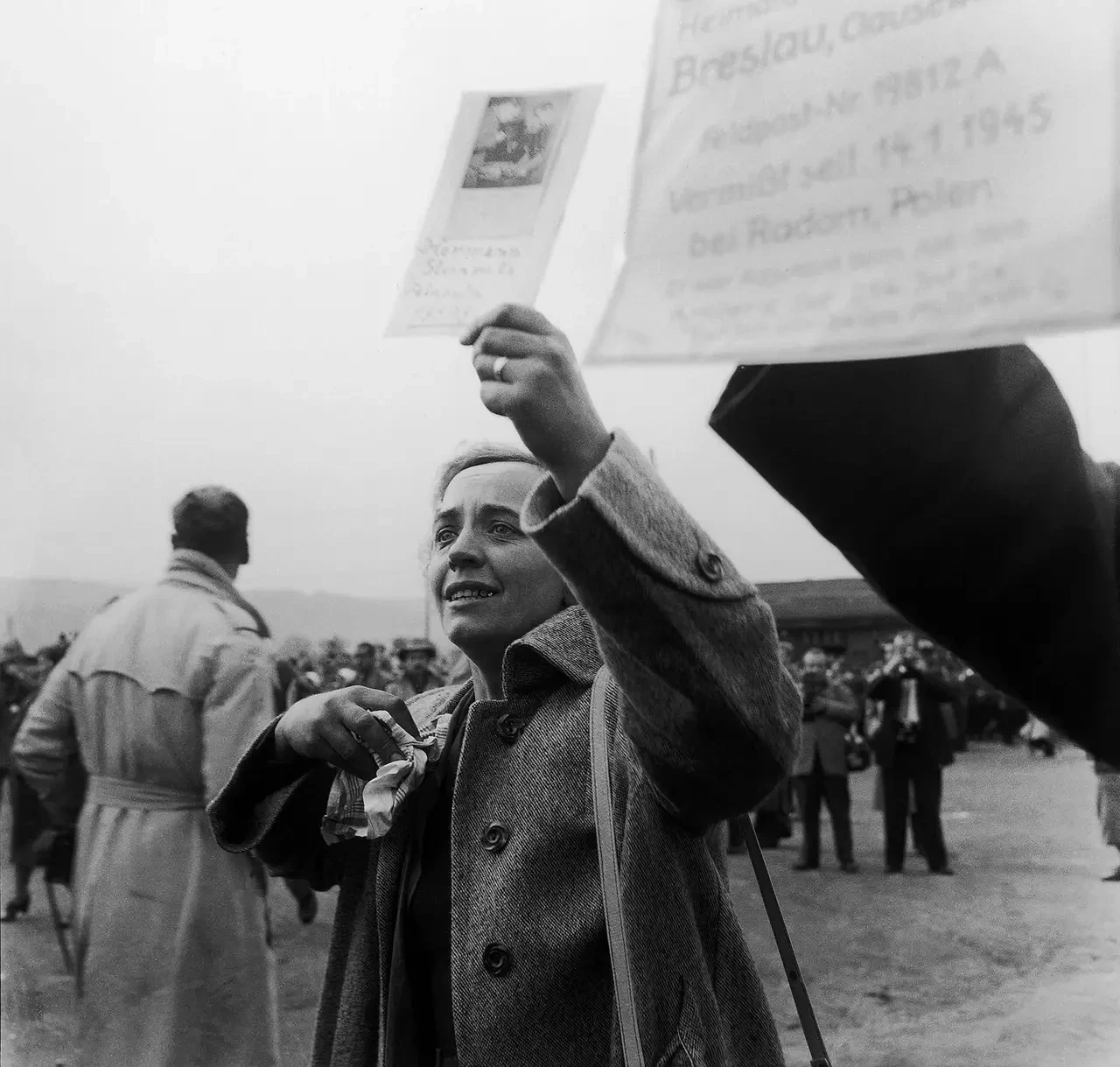
A transit camp where the Second World War was still unfolding ten years after it had supposedly ended. The woman in the photograph holds up a small portrait — a younger face preserved in paper — scanning the crowd of returning prisoners, searching for a past that might still exist.
Germany surrendered in May 1945, but for millions of German soldiers the war did not truly stop. It simply shifted from battlefields to captivity. While the Western Allies released most prisoners relatively quickly, the Soviet Union followed a different path. After suffering more than twenty million dead and immense destruction, Soviet leadership treated German prisoners as a form of reparations — a labor force to rebuild what the war had destroyed.
Roughly three million German soldiers were taken into Soviet captivity and transported east across a devastated continent into camps stretching from Ukraine to Siberia. They cleared rubble from ruined cities, built railways, worked mines, and cut timber in remote regions. Conditions were often severe — chronic food shortages, disease, and brutal winters. Hundreds of thousands died. Many simply vanished into distance and bureaucracy, their fates unknown.
For families in postwar Germany, the uncertainty created a strange national limbo. There were no death notices, no final confirmation — only absence. Wives did not know whether they were widowed. Parents waited years for sons who might already be dead. Children grew up knowing their fathers only through fading photographs. The word Heimkehrer — “homecomer” — entered everyday language, reflecting how deeply the return of prisoners dominated public life.
Friedland became one of the central stages of this waiting. Established in 1945 near the borders of the occupation zones, the camp processed refugees, displaced persons, and eventually returning prisoners of war. By the 1950s it had become a symbolic gateway where loss might suddenly turn into reunion.
The turning point came in 1955 when West German Chancellor Konrad Adenauer traveled to Moscow to negotiate the release of the remaining German prisoners. In the tense early years of the Cold War — with West Germany newly aligned with NATO — the Soviet Union agreed to release the last large groups still held in its camps.
Nearly a decade after the war’s end, trains began delivering thousands of survivors home.
Their return triggered scenes of extraordinary emotion. Families gathered with photographs taken ten years earlier, trying to match those images to the men stepping off the trains. The returning prisoners often bore little resemblance to the young soldiers who had left — aged, thin, sometimes physically or psychologically broken. Children no longer recognized fathers. Entire lives had unfolded in their absence.
The woman in Friedland represents this moment of collision between memory and reality. The photograph in her hand shows a man frozen before defeat and captivity. The faces before her have been reshaped by hunger, labor, and time.
By 1955, West Germany itself was transforming rapidly during its Wirtschaftswunder, the economic miracle that was rebuilding cities and industry at remarkable speed. Yet the return of these prisoners forced the country to confront the unfinished consequences of the war. The past had not remained buried in 1945 — it was stepping off trains, worn and changed.
Friedland became a place where geopolitics and personal history met — where the vast forces of war, ideology, and diplomacy were reduced to individual reunions, each one a reminder that for millions, the Second World War had taken ten years to truly end.
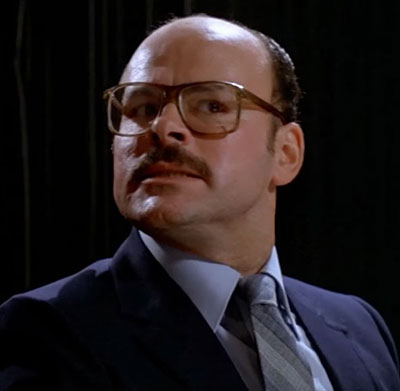
SS physician Eduard Krebsbach, 52, looks at a camera moments before his execution by hanging. 1947

A man stands at the edge of the postwar reckoning, looking calmly toward the camera. His name is Eduard Krebsbach, an SS physician whose career represents one of the most disturbing intersections of medicine and mass murder in the Nazi system.
Krebsbach had been a doctor — trained to heal, sworn to preserve life. Under the Third Reich, that role was inverted. He became part of the machinery of systematic killing that defined the concentration camp system, where medical authority was used not to save but to destroy.
He served as a physician at several Nazi camps, including Mauthausen, one of the regime’s most brutal concentration camps. There, the boundaries between medical practice and execution disappeared entirely. Camp doctors selected prisoners for death, supervised extermination procedures, and developed methods of killing that could be carried out with clinical efficiency. The language of medicine — diagnosis, treatment, procedure — masked what was, in reality, organized murder.
Krebsbach became notorious even within this system. He played a central role in thousands of deaths and was directly responsible for killing hundreds of prisoners through injections of gasoline and phenol into the heart — a method designed to cause immediate death. Around 900 prisoners were murdered by such injections under his supervision. Witnesses later described him as a man who carried out these killings with enthusiasm, earning a reputation among survivors and prosecutors alike as a “sadist of the worst sort.”
The use of physicians in the camp system reflected a broader Nazi worldview. The regime framed its racial ideology in medical terms — society was described as a body, certain populations as diseases, and extermination as a form of treatment. Doctors became instruments of this vision, giving scientific language and institutional authority to policies of mass murder. In this environment, individuals like Krebsbach did not operate on the margins; they were central to how the system functioned.
When the Third Reich collapsed in 1945, the Allied powers began an unprecedented effort to prosecute those responsible for the crimes of the Nazi state. Beyond the well-known Nuremberg trials, hundreds of proceedings targeted camp personnel, administrators, and medical staff who had participated in atrocities.
Krebsbach was captured, tried by a U.S. military tribunal, and convicted for his role in mass killings at the camps. The testimony against him detailed not only the scale of the murders but the deliberate, methodical way they were carried out. The court sentenced him to death.
His execution took place at Landsberg Prison, a site that had itself passed through multiple chapters of German history — once the place where Adolf Hitler had been imprisoned after the failed Beer Hall Putsch in 1923, and after the war, a center for holding and executing convicted Nazi war criminals. Between 1945 and 1951, hundreds were imprisoned there, and many were executed by hanging.
The photograph captures a final moment in that long chain of events. The man facing the camera is no longer a physician, no longer an agent of state power, but a condemned criminal awaiting the consequence imposed by the victorious powers. The image reflects the larger postwar effort to impose accountability for crimes that had previously seemed beyond the reach of justice.
Krebsbach’s story illustrates how the structures of modern institutions — medicine, bureaucracy, science — can be transformed when placed in service of ideology. His execution was part of the broader attempt to confront that reality, to establish that participation in such systems, even under the authority of the state, would not place individuals beyond responsibility.
U.S. Marine Private First Class Paul E. Ison running through Japanese fire at ‘Death Valley’ on Okinawa on May 10, 1945.

A U.S. Marine, Private First Class Paul E. Ison, moves forward through what the Marines had begun calling “Death Valley,” a stretch of ground so exposed, so violently contested, that survival often depended on speed, luck, and sheer momentum.
To understand the moment captured here, you have to see Okinawa as it was in the spring of 1945 — not simply another island in the Pacific, but the doorway to Japan itself.
By early 1945 the war in Europe was ending. Nazi Germany was collapsing. But in the Pacific, the conflict was intensifying. American strategy had been advancing steadily across the ocean through a brutal campaign of island-hopping — Guadalcanal, Tarawa, Saipan, Iwo Jima — each battle bringing U.S. forces closer to the Japanese mainland. Okinawa was different from all that came before. It was not just a military target; it was part of Japan’s defensive shield, only about 350 miles from the home islands. Whoever controlled Okinawa would control airfields and staging grounds for the planned invasion of Japan.
The Japanese command understood exactly what was at stake. Rather than attempting to repel American forces at the beaches, they prepared a defense in depth — a network of fortified positions, tunnels, caves, and hidden artillery built into the island’s rugged southern terrain. The strategy was simple and ruthless: bleed the Americans, inflict maximum casualties, and make the cost of invasion so high that the United States might reconsider continuing the war.
American forces landed on April 1, 1945 — Easter Sunday — encountering surprisingly light resistance at first. The real battle waited inland. As Marines and Army units pushed south, they collided with heavily fortified Japanese defensive lines anchored on ridges and escarpments. Every advance meant crossing open ground under concentrated machine gun, mortar, and artillery fire.
Places like “Death Valley” emerged from this reality. These were not official geographic names but the language of soldiers trying to describe landscapes defined by constant danger — stretches of exposed terrain swept by enemy fire, where movement itself became a life-threatening act. To cross such ground meant running forward while artillery exploded nearby, while hidden guns searched for targets, while the terrain offered little protection.
The photograph captures one such moment. Private First Class Ison runs low, rifle in hand, body angled forward, carrying everything required to survive — weapon, ammunition, pack — while moving through a space where hesitation could mean death. It is a moment defined by motion, urgency, and the physical reality of twentieth-century industrial warfare.
The Battle of Okinawa became the largest and bloodiest battle of the Pacific War. It lasted nearly three months. More than 12,000 Americans were killed and tens of thousands wounded. Japanese military losses were staggering — well over 100,000 dead. The civilian population of Okinawa was caught in the catastrophe, suffering enormous casualties amid bombardment, forced displacement, and the collapse of the island’s infrastructure.
The battle also revealed the increasingly desperate tactics of Japan’s defense. Kamikaze attacks intensified, with waves of suicide aircraft targeting the U.S. fleet offshore, sinking or damaging dozens of ships. On land, Japanese forces fought from fortified positions with extraordinary tenacity, often choosing death over surrender. The ferocity of the resistance shaped American expectations about what an invasion of Japan itself might require.
For U.S. planners, Okinawa became a warning. If an island this size, defended with such determination, could produce such losses, what would the invasion of the Japanese home islands cost? The experience helped shape the decisions that would follow later that summer.
But in May 1945, none of that broader strategic calculation mattered to the individual Marine moving through “Death Valley.” What existed was the immediate environment — the weight of equipment, the sound of gunfire, the knowledge that the next few seconds might determine survival.
This image captures a single figure within a vast historical struggle — one moment in a battle that represented both the climax of the Pacific War and a preview of the immense violence that still threatened the world in 1945.
Land Rush! On April 22nd, 1889, large areas of what is now Oklahoma were officially opened up for homestead settlement. At high noon, thousands of pioneers raced from the territory’s borders into pristine land, claiming lots on a first come, first serve basis

On April 22, 1889, the United States staged one of the most dramatic episodes of westward expansion: the Oklahoma Land Run. Large areas of what had been called the “Unassigned Lands” were officially opened for homestead settlement, and the rules were brutally simple—at high noon, people waiting at the borders could surge forward and claim a parcel on a first-come, first-served basis.
This didn’t come out of nowhere. For decades, the federal government had been forcing Native nations out of the Southeast and into what it labeled Indian Territory through policies like Indian Removal. Treaties promised that these lands would remain Native. But as railroads expanded, cattle trails cut through the region, and white settlement pressure grew, those promises were steadily undermined.
By the 1880s, calls to open Indian Territory to non-Native settlement were rising. “Boomers” organized campaigns pushing into the region illegally, arguing the land should be available to homesteaders. At the same time, federal policy was shifting toward breaking up tribal land bases through allotment—replacing communal ownership with individual plots and making “surplus” land available for sale to settlers. The Land Run became one of the clearest signals that the government was moving from “Indian Territory as a permanent homeland” toward “Indian Territory as the next frontier.”
The legal mechanism that made the run possible was the Homestead system: if you could claim land and meet the requirements—living on it and improving it—you could eventually gain title. That promise, plus the belief that this was a once-in-a-lifetime shot at ownership, drew enormous crowds. Estimates vary, but tens of thousands of people gathered along the boundary lines—farmers, laborers, merchants, families in wagons, men on horseback, and people on foot—each trying to be the first to a good claim.
At noon, a signal went out and the border exploded into motion. It wasn’t a neat, heroic race. It was chaos—dust, shouting, collisions, broken wagons, exhausted animals, and frantic navigation across unfamiliar prairie. People used landmarks, crude maps, or pure guesswork to find a spot worth fighting for. Some aimed for farmland, others for townsites where they believed fortunes would be made overnight.
And even “first come, first served” wasn’t really true. Plenty of people cheated. So-called “Sooners” slipped in early and hid out, marking claims before the official start. Others manipulated paperwork, bribed officials, or bullied weaker claimants off a plot after the fact. The result was a wave of disputes—arguments, fistfights, court battles, and occasional shootings—because when the rules are fast and the prize is land, the line between opportunity and theft gets blurry in a hurry.
Almost immediately, towns appeared as if conjured out of the ground. Oklahoma City and Guthrie famously swelled from empty prairie into bustling settlements within hours, packed with tents, makeshift businesses, and speculators trying to buy and sell claims. The Land Run became a symbol of American expansion—one of those scenes that looks like destiny from far away but up close feels like a scramble powered by policy, desperation, and ambition.
It also came with a cost that doesn’t show up in the romantic version. The opening of these lands accelerated the erosion of Native sovereignty in the region and set the stage for further land runs and continued dispossession. April 22, 1889 wasn’t just a dramatic race; it was a turning point in how the United States transformed Indian Territory into the state of Oklahoma—through law, pressure, and the unstoppable momentum of settlement.
Queen Genepil, The Last Queen Of Mongolia. 1920

In 1920, Mongolia was living through the final moments of a political and cultural world that had endured for centuries. The woman in this photograph — Queen Genepil, often described as the last queen of Mongolia — existed at the intersection of an ancient monarchy and the revolutionary forces that would soon sweep it away.
Her story cannot be separated from the collapse of empires across Asia in the early twentieth century.
For centuries, Mongolia had existed under the shadow of larger powers, most recently the Qing dynasty of China. When the Qing Empire collapsed in 1911, Mongolia seized the opportunity to declare independence and established a theocratic monarchy under the Bogd Khan, a spiritual and political ruler who combined religious authority with royal power. The state that emerged blended Buddhist tradition, nomadic aristocracy, and ancient steppe political structures.
Queen Genepil entered this world as a consort within the Bogd Khan’s royal court. By 1920, Mongolia’s monarchy still maintained the symbols and rituals of traditional rule — elaborate ceremonial dress, court hierarchy, and religious authority — but its political foundations were already fragile. The country had become a strategic prize caught between competing forces: Chinese warlords seeking control, White Russian troops fleeing the Bolshevik Revolution, and rising Mongolian revolutionaries influenced by Soviet ideology.
The Mongolia of Genepil’s time was therefore not stable or secure. It was a nation suspended between worlds — between empire and independence, between religious monarchy and modern revolution.
The crisis reached its peak in the years around this photograph. In 1919, Chinese forces reoccupied Mongolia, attempting to end its autonomy. Soon after, the Russian anti-Bolshevik commander Baron Roman von Ungern-Sternberg invaded, driving out the Chinese and briefly restoring the monarchy through military force. His rule was violent, chaotic, and short-lived. By 1921, Mongolian revolutionaries backed by Soviet Russia overthrew both Ungern’s forces and the old order.
This revolution fundamentally reshaped Mongolia’s political system. Although the Bogd Khan remained a symbolic figure until his death in 1924, real power shifted to a Soviet-aligned revolutionary government. When he died, the monarchy itself was abolished, and the Mongolian People’s Republic was established — one of the world’s first socialist states.
With that transformation, the royal court to which Genepil belonged disappeared. The elaborate titles, ceremonial roles, and traditional hierarchy that had defined Mongolian rule for generations were dismantled. Members of the aristocracy and religious elite faced repression, exile, or execution in later decades as the new regime consolidated power and sought to eliminate remnants of the old system.
The image of Queen Genepil therefore represents more than an individual portrait. It captures a moment just before a civilizational shift — the final phase of Mongolia’s traditional monarchy, rooted in Buddhist authority and steppe aristocracy, standing on the brink of revolutionary transformation.
Within a few years of this photograph, the political and social world that produced her would cease to exist, replaced by a radically different vision of the state shaped by twentieth-century ideology, geopolitics, and revolution.