
Joseph Kittinger jumping from his balloon up 102,000 feet in August 16, 1960
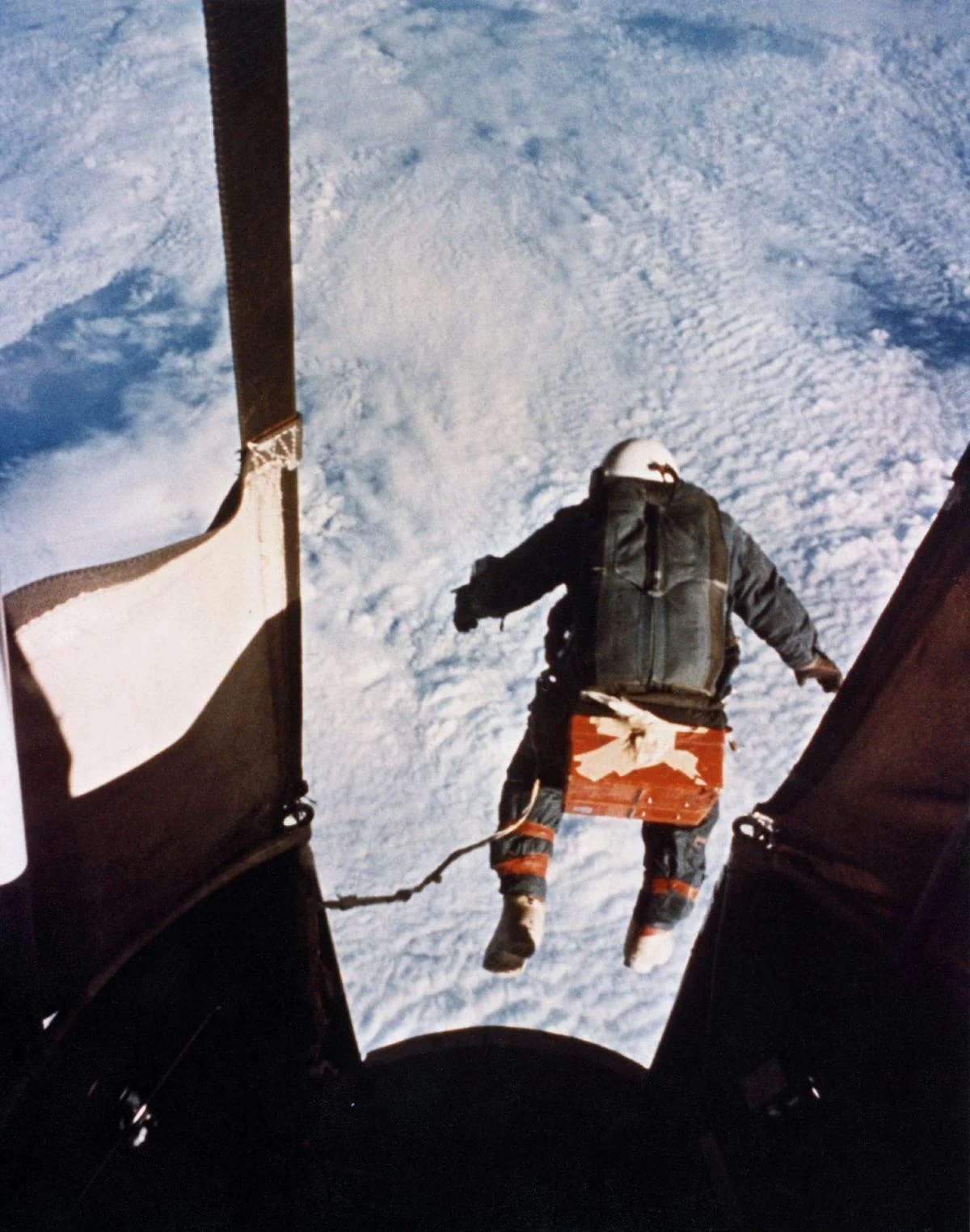
There’s no ground beneath him.
No aircraft. No safety net. Just a small capsule hanging above the Earth—and the edge of space.
On August 16, 1960, U.S. Air Force pilot Joseph Kittinger climbed to 31,300 meters (over 102,000 feet) in a helium balloon as part of Project Excelsior.
The goal wasn’t spectacle. It was survival.
At the time, no one really knew what would happen to a human body falling from that height. Could a pilot eject safely from extreme altitude? Would they spin out of control? Would they even remain conscious?
Kittinger was there to find out.
By the time he reached altitude, the sky above him was black. The curve of the Earth was visible below. The air was so thin it might as well not have existed.
Inside the capsule, everything was deliberate. Every movement controlled. Because outside, there was no margin for error.
His right glove had already failed during the ascent, causing his hand to swell painfully in the near vacuum. He chose not to report it, knowing the mission might be aborted.
So he continued.
When it was time, he opened the hatch and stood on a small platform.
Below him: silence, distance, and a drop that would take him over four minutes to complete.
No dramatic countdown. No hesitation that anyone could see.
He simply stepped off.
At first, there was no sensation of falling—just acceleration. The air was too thin to feel like wind. He picked up speed quickly, eventually exceeding 600 miles per hour.
For a moment, he entered a violent spin, his body rotating fast enough to risk blackout. But the drogue chute deployed and stabilized him.
Then, gradually, as he dropped into denser atmosphere, the fall began to feel real.
Air. Resistance. Speed becoming something you could sense.
His main parachute deployed at around 18,000 feet.
And just like that, he was a man descending back to Earth.
He landed safely in the New Mexico desert.
The entire jump lasted just over four minutes.
What he proved in that time changed how high-altitude pilots—and later astronauts—could survive emergency ejections.
But in that moment at the edge of space, none of that was guaranteed.
It was just one man, standing alone, choosing to step into something no one had ever fully experienced before.
Picture of Franz Reichelt before he jumped off the Eiffel Tower while trying to test out his parachute suit invention. He would not survive and his death would be captured on film.

Before Franz Reichelt became the man who stepped off the Eiffel Tower, he was something far more ordinary—and far more relatable: a tailor with an idea he couldn’t let go of.
He wasn’t reckless. Not at first.
He was methodical. Patient. Convinced.
Reichelt spent years designing what he believed would be a breakthrough: a wearable parachute suit. At a time when aviation was still new and dangerous, pilots had almost no way to save themselves if something went wrong. His idea was simple in theory—why not make the parachute part of the pilot’s clothing? Something always worn. Something automatic.
No fumbling. No delay. Just survival.
On paper, it made sense.
He stitched together heavy fabric into a kind of coat that could unfold midair into a canopy. Early versions were bulky and awkward, but he kept refining them, chasing that perfect balance between weight, surface area, and drag. Too small, and it wouldn’t slow a fall. Too large, and it became impossible to wear.
He tested it the only way he could at the time: with dummies.
From windows. From ledges. From increasing heights.
The results were inconsistent.
Sometimes the suit would partially open. Sometimes it wouldn’t deploy at all. Sometimes it simply wasn’t enough.
But belief doesn’t die easily when you’ve invested years into it.
Reichelt didn’t see failure. He saw progress. Adjustments. Variables to tweak.
And there was encouragement, too. Authorities in Paris were interested enough to grant him permission to conduct a more official test. Originally, it was understood he would use a dummy again. That’s what everyone expected.
But somewhere along the way, Reichelt’s confidence crossed a line.
He began to believe that the only real test was a human one.
That the suit would work—had to work—if worn as intended.
Standing there before the attempt, he wasn’t thinking of himself as a daredevil. He believed he was on the edge of something important—something that could save lives.
That’s what makes the story so haunting in hindsight.
Because before the fall, there’s no panic in the photos. No visible doubt. Just a man holding onto an idea that hadn’t failed him completely yet.
Not a stuntman. Not a madman. Just someone who believed, right up until the end, that he was about to prove everyone wrong.
The Japanese Balloon Bomb (1940’s)

At first glance, it didn’t look like a weapon.
It looked strange. Fragile. Almost harmless.
A giant paper balloon drifting across the sky, carried by the wind.
But during World War II, Japan launched thousands of these across the Pacific Ocean in a quiet, experimental attempt to attack the United States mainland.
They were called Fu-Go balloon bombs.
Each one was carefully engineered—made from paper and glue, filled with hydrogen, and guided not by a pilot, but by the jet stream. Attached underneath was a system of sandbags and explosives designed to keep the balloon at a steady altitude as it traveled thousands of miles.
No steering. No control. Just wind and patience.
It was a weapon that relied entirely on nature to do its job.
Most of them disappeared into the ocean or landed harmlessly in remote areas. Some were never found at all.
But a few made it through.
In 1945, one of these balloons landed in Oregon. A group of civilians found it—curious, confused, unaware of what it was.
It exploded.
Six people were killed, including five children.
They were the only civilians on the U.S. mainland killed by enemy action during the war.
An Italian family of immigrants entering US (1910s)

A man carrying everything he owns over his shoulder. A woman holding a child close, steady and protective. Another child just barely in frame, already being pulled along into something they don’t understand yet.
This is what arrival looked like for millions of immigrants in the early 1900s.
Not a fresh start. Not a clean slate.
More like stepping into the unknown with no safety net.
The journey to get here was already a test. Weeks at sea, packed tightly with strangers, dealing with sickness, exhaustion, and the constant uncertainty of what would happen when they arrived. Many came with little more than a few belongings, some food, and whatever money they could carry.
And then they reached America.
For many, that meant passing through places like Ellis Island. Lined up. Inspected. Asked questions in a language they often didn’t speak. Officials deciding, sometimes in minutes, whether they could stay or be sent back.
A wrong answer. A sign of illness. Even something as small as hesitation could change everything.
Families were separated in those moments.
Some never made it through together.
For those who did, the next chapter wasn’t easier—it was just different.
The man in this photo would have to find work quickly, often taking whatever was available. Long hours. Dangerous conditions. Low pay. Jobs that others didn’t want.
The woman would be responsible for holding the family together in a place that felt unfamiliar in every way—language, customs, expectations. Finding food, managing what little they had, raising children in a world that didn’t quite feel like home.
And the children would grow up in between.
At home, one language. Outside, another.
At home, one set of values. Outside, pressure to adapt.
Learning quickly that fitting in often meant leaving parts of themselves behind.
There’s no moment here where everything suddenly becomes better.
This is just the beginning of a long, uncertain process—one that would take years to stabilize, if it ever fully did.
All they really have in this moment is each other… and the belief that the risk was worth it.
Children at a German American Bund camp stand at attention as the American flag and the Bund youth flag are lowered in a sundown ceremony in Andover, N.J., July 21, 1937.

It looks structured. Orderly. Almost familiar.
Children standing in formation. Flags being lowered. A ceremony at sundown.
If you didn’t know the context, it could pass for any youth camp in America.
But this was a German American Bund camp in Andover, New Jersey, in 1937.
And the children standing at attention weren’t just learning discipline or teamwork.
They were being introduced to an ideology.
The German American Bund was founded in 1936, but its roots go back earlier, to groups like the Friends of New Germany, which openly supported Nazi Germany after Adolf Hitler came to power in 1933. The Bund positioned itself as a patriotic American organization, claiming loyalty to the United States while also promoting Nazi ideals, anti-Semitism, and admiration for Hitler.
Under the leadership of Fritz Julius Kuhn, the Bund grew quickly, organizing rallies, publishing propaganda, and establishing a network of camps across the country. These camps were often presented as summer retreats for German-American families, but they also served a deeper purpose.
They were places where ideology could be taught in a controlled environment.
Children attended these camps much like they would attend any youth program—spending time outdoors, participating in activities, and forming friendships. But woven into those experiences were lessons about identity, loyalty, and belief systems aligned with Nazi Germany.
Uniforms, drills, songs, and ceremonies were all part of that structure.
The camps mirrored, in many ways, the Hitler Youth programs in Germany, adapted for an American setting. Instead of rejecting American identity outright, the Bund tried to blend the two—presenting Nazism as something that could coexist with American patriotism.
That’s why images like this feel so contradictory.
The American flag is there.
But so is the Bund’s flag.
By the late 1930s, the Bund had tens of thousands of members and drew large crowds to events, including a rally at Madison Square Garden in 1939 that filled the arena with supporters.
But its influence didn’t last.
Public opinion in the United States began to shift as news of Nazi aggression in Europe became harder to ignore. Investigations into the Bund revealed financial corruption and deeper ties to Nazi Germany than the organization had publicly admitted.
In 1939, Fritz Kuhn was convicted of embezzlement and sent to prison. When the United States entered World War II in 1941, the Bund quickly collapsed. Its leaders were arrested or detained, and its operations were shut down.
The camps closed.
The rallies ended.
And the version of normal that had been built inside places like this disappeared almost as quickly as it had formed.
But for the children who stood in moments like this, the experience didn’t just vanish.
It was something they had lived through—absorbed during a time when they were still forming their understanding of the world around them.
A reminder that even in places that look ordinary, history can take shape in ways that aren’t immediately visible.