A Civil Rights Protester Facing Police Dogs (1960s)
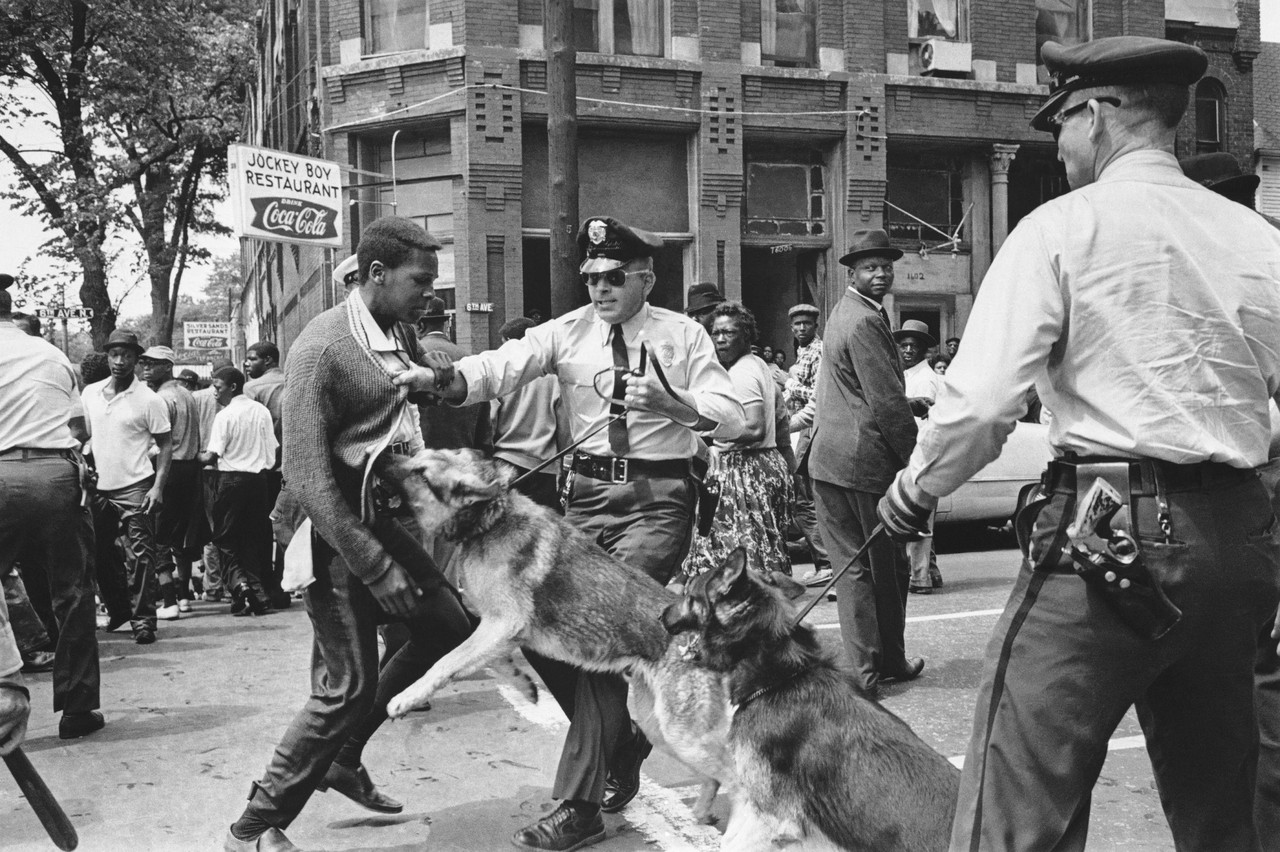
Birmingham, Alabama. 1963.
By this point, the Civil Rights Movement had already been grinding forward for years—sit-ins, boycotts, court cases—but it kept running into the same wall. Laws might shift on paper, but in places like Birmingham, the system held firm. Segregation wasn’t just policy. It was enforced in the streets, in schools, in jobs, in the daily choreography of life.
Birmingham wasn’t chosen by accident. It was one of the most rigidly segregated cities in America, and its leadership was known for meeting protest with force. That made it a target. The strategy was deliberate: bring national attention to a place where the response would be predictable, and in that predictability, expose something the rest of the country could no longer ignore.
Public Safety Commissioner Eugene “Bull” Connor controlled the police and fire departments. He had already shown what he was willing to do. When demonstrations escalated that spring, his response wasn’t subtle. High-pressure fire hoses. Mass arrests. And dogs.
The dogs weren’t new. Police dogs had been used before—for tracking, for control—but here they were deployed in broad daylight, against unarmed protesters, many of them teenagers. The intent wasn’t just to disperse a crowd. It was to create a spectacle of deterrence. Something visible. Something that would send a message about what happens when the existing order is challenged.
The protesters understood this going in. Many had been trained in nonviolent resistance—how to endure, how not to retaliate, how to hold position even when confronted with physical force. That discipline wasn’t instinctive. It was practiced. Rehearsed. Because the entire strategy depended on contrast: force on one side, restraint on the other.
And then moments like this happened.
A young man steps forward—or maybe he’s just caught in the movement of the crowd—and suddenly the abstract becomes immediate. The dog lunges. The officer tightens the leash. There’s no buffer anymore between policy and consequence. It’s all compressed into a single, physical interaction.
This is where the strategy pays off, and where it becomes dangerous. Because the system is still operating exactly as designed. The police are maintaining order as they define it. The tools they’re using are sanctioned. The chain of command is intact.
But the image that results doesn’t reinforce authority—it challenges it.
Photographs like this didn’t stay in Birmingham. They moved. Through newspapers, across the country, into living rooms where people who had never set foot in Alabama suddenly had to confront what enforcement looked like in practice. Not as an idea. Not as a debate. But as a series of undeniable moments.
The federal government had been cautious up to this point, balancing legal change with political reality. But images like this narrowed that space. They made neutrality harder to maintain. Within months, pressure intensified. By 1964, the Civil Rights Act would pass, dismantling the legal framework of segregation.
That outcome wasn’t inevitable when this photograph was taken.
At the time, it was just another confrontation in a long series of confrontations. Another attempt to assert control. Another test of whether the movement could sustain itself under pressure.
But history tends to crystallize around images like this—not because they are unique, but because they capture a system revealing itself in a way that can’t be explained away.
Authority, resistance, and the moment where the balance between them becomes visible to everyone watching.
Children Playing in the Streets of London During the Blitz (1940–41)
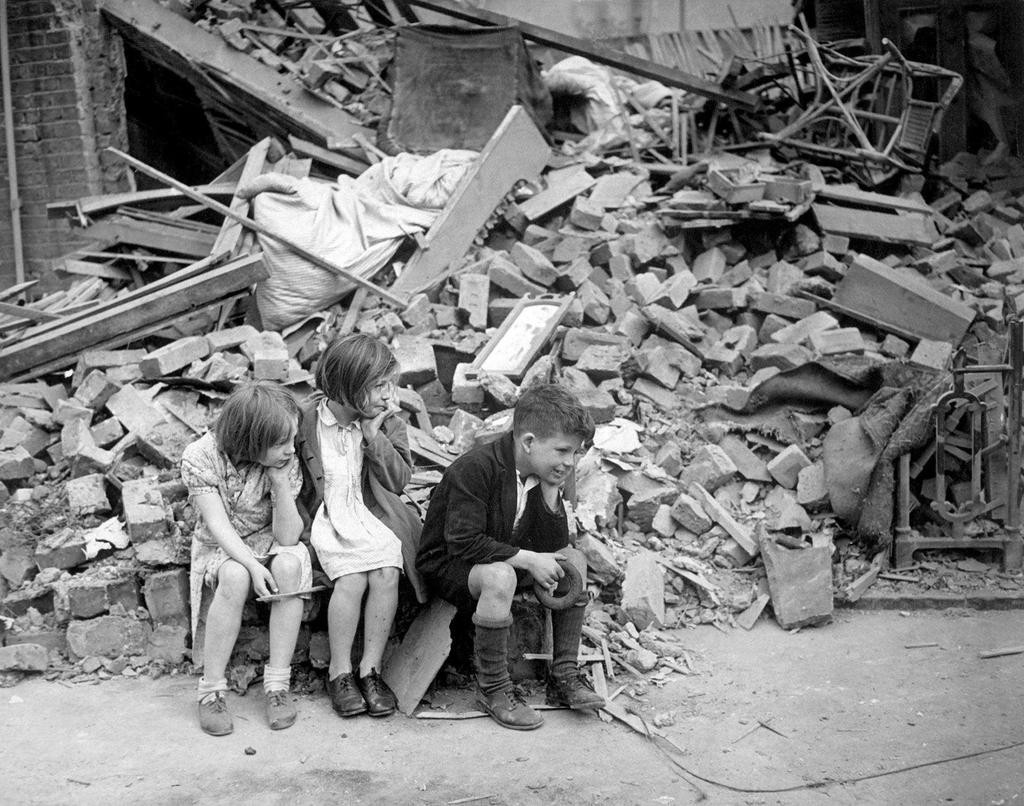
London, 1940.
The bombing didn’t come once. It came night after night.
Beginning in September, German aircraft targeted the city in sustained waves, aiming to break industrial capacity and civilian morale at the same time. Docks, railways, factories—those were the official targets. But in a city as dense as London, the line between infrastructure and everyday life didn’t really exist. Homes went with them. Streets went with them.
By the end of that first year, tens of thousands of buildings had been destroyed. Entire neighborhoods were reduced to rubble. Fires burned for days. The skyline itself changed, not gradually, but in bursts of violence that left gaps where familiar landmarks used to be.
And yet, the city didn’t empty out.
That’s the part that stands out in photographs like this. Not the destruction—you expect that—but the presence of children moving through it as if it were just another environment to navigate.
They climb over broken bricks. They run through streets that, only weeks earlier, had doors, windows, and routines attached to them. The debris becomes part of their world, not because it’s safe, but because there’s no alternative. Life doesn’t pause long enough for a safer version to appear.
The government had prepared, at least in part. Evacuation programs moved hundreds of thousands of children out of London to the countryside. But not everyone left. Some families chose to stay. Others had no real option. So childhood continued in place, reshaped by circumstance.
At night, many of those same children would sleep in Underground stations—entire platforms filled with blankets, families packed together, the sound of trains replaced by the distant rhythm of bombs overhead. It became routine. You learned where to go, how to settle in, how to wake up and return to the surface when it was over.
By day, the city reassembled itself as best it could. Shops reopened if they still had walls. Buses ran along altered routes. Schools functioned when they could. And in between all of that, children found ways to play.
It wasn’t defiance in the dramatic sense. It was something more basic. Adaptation.
Children don’t carry the same framework adults do. They don’t measure risk in the same way. They absorb their environment quickly, normalize it, and then build within it. A pile of rubble becomes something to climb. An empty lot becomes a space to run. The boundaries shift, but the instinct to play remains.
For adults, the same scene reads differently. Every broken wall represents loss—someone’s home, someone’s life interrupted. Every open space used to be something else. But for the children moving through it, the past version of that space isn’t always the dominant reference point. What matters is what’s there now.
That contrast is what gives the image its tension.
The Blitz was designed, in part, to break the population—to make daily life untenable, to force a kind of psychological collapse. But what emerged instead was something more complicated. Not invulnerability, not indifference, but a steady recalibration of normal.
Bombing becomes part of the schedule. Shelter becomes part of the routine. Ruins become part of the landscape.
And in the middle of that, children still play.
American soldiers at a mass in Cologne Cathedral (1945)
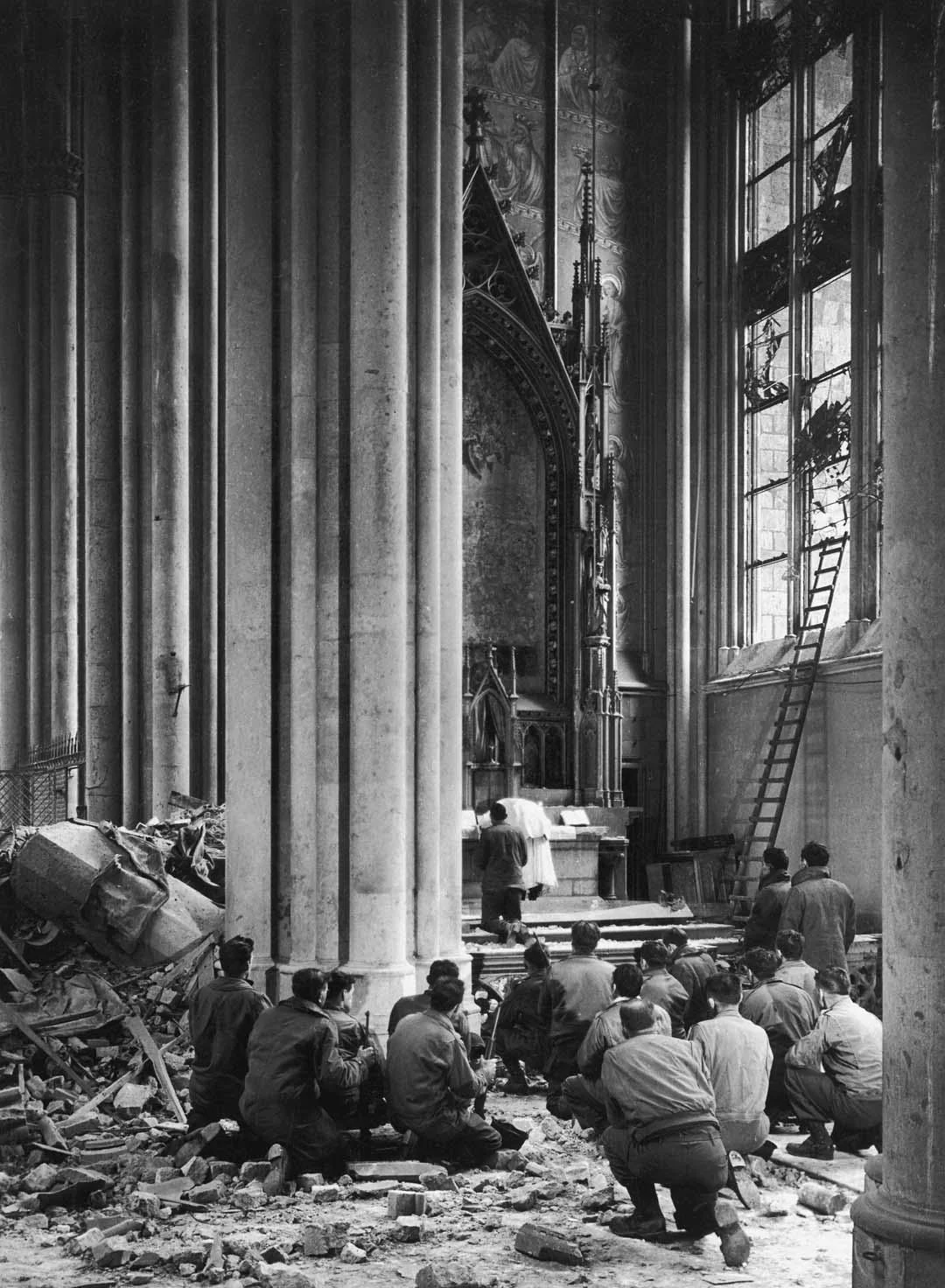
Cologne, 1945.
The cathedral is still standing.
That fact alone is almost hard to process when you understand what the city around it looked like at this point in the war. Cologne had been bombed relentlessly—over 250 air raids. By the time American forces moved in, much of the city was reduced to rubble. Entire neighborhoods flattened. Infrastructure gone. Civilian life shattered.
And yet, in the middle of that destruction, the cathedral remained.
Damaged, yes. Windows blown out. Stone scarred. Debris piled up along the edges. But the structure itself held. The same building that had taken over six centuries to complete had outlasted one of the most destructive bombing campaigns in history.
Now, inside that space, something unexpected is happening.
American soldiers—men who, only days or weeks earlier, had been advancing through German territory under fire—are kneeling in prayer. Helmets off. Heads lowered. Weapons set aside, at least for the moment.
This isn’t a victory parade. It’s not a ceremony of conquest.
It’s a mass.
That detail matters, because it shifts the meaning of the scene. These soldiers aren’t just occupying a city. They’re stepping into a space that predates the conflict by centuries—a space that has seen empires rise and fall, wars come and go, and still remains tied to something older than any of it.
The irony is difficult to ignore. The same war that brought them here is the reason the cathedral looks like this—glass shattered, light filtering through broken frames, rubble still lining the floor. The physical evidence of destruction is everywhere. And yet, the ritual continues as if that destruction hasn’t fully erased what the building represents.
For the soldiers, the context is immediate. They’ve crossed the Rhine. They’ve pushed into one of Germany’s oldest cities. The war in Europe is nearing its end, but it isn’t over yet. There are still pockets of resistance. Still uncertainty about what comes next.
And in the middle of that, they kneel.
It’s not necessarily about religion in the abstract. It’s about pause. About stepping out of the forward momentum of war—just long enough to acknowledge something beyond it.
The cathedral, even in its damaged state, creates that pause. The scale of it. The history embedded in its walls. The sense that this place has endured things far worse than the moment currently unfolding inside it.
Outside, the city is a landscape of collapse.
Inside, there’s still structure. Still ritual. Still the idea that something can continue, even after everything around it has been broken apart.
And that contrast—between destruction and continuity, between war and stillness—is what defines the image.
Not a clean ending. Not a resolution.
Just a moment where the machinery of war slows down, and something older, quieter, and more persistent takes its place—even if only for a little while.
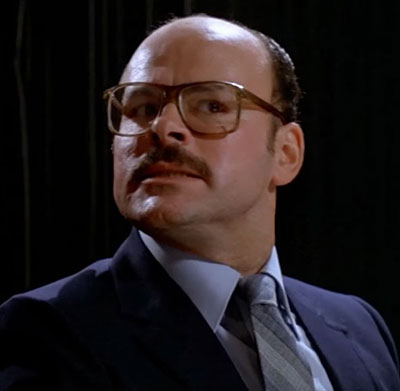
Green Beret Captain Richard Flaherty (standing at 4’9” and weighing 97 pounds) stands next to 6’6” Pfc. Nipps, 1971.
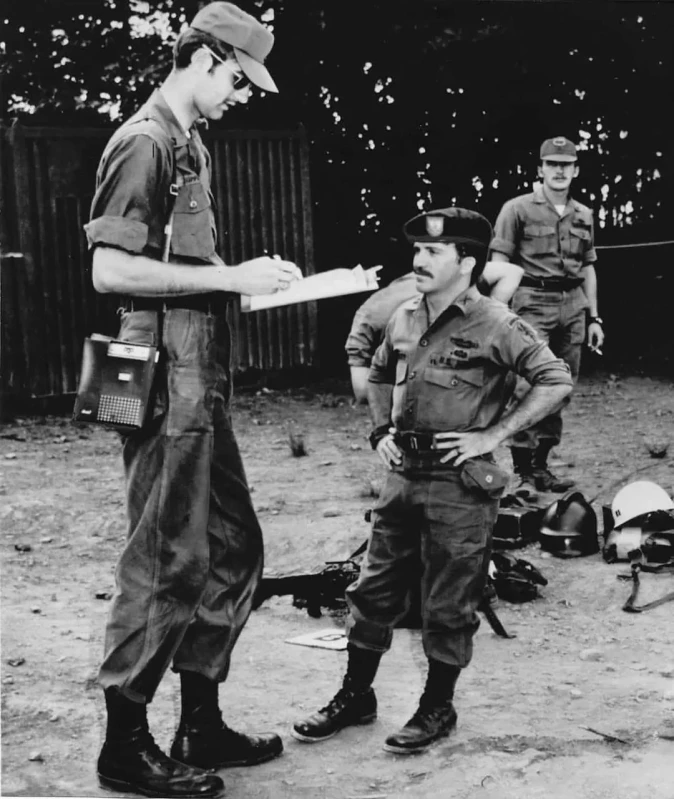
1971.
Two soldiers stand side by side, and the contrast is immediate.
On one side, a private who looks like he was built for the role—6’6”, broad, the kind of physical presence the military traditionally values. On the other, a man who looks like he shouldn’t be there at all. Captain Richard Flaherty stands just 4’9”, 97 pounds. In most contexts, he’d be overlooked. In this one, he outranks everyone around him.
That’s not an accident. It’s the result of a system that, at least in certain corners, had begun to value something other than size.
The Green Berets were designed for a different kind of war. Not mass formations. Not conventional battles. Their work centered on unconventional warfare—training local forces, operating behind enemy lines, navigating environments where adaptability mattered more than raw physical dominance.
Vietnam was that kind of war.
Dense terrain. Fragmented front lines. Small units operating in isolation. The kind of conflict where the ability to think, improvise, and communicate could matter more than how much space you take up in a photograph.
Flaherty’s presence in that world wasn’t just unusual—it was a challenge to assumptions. The military had standards, physical requirements, expectations about what an officer should look like. He didn’t meet them in any traditional sense. And yet, he made it through training that was designed to filter out all but the most capable.
That tells you something about the nature of that training—and about him.
Because Special Forces selection isn’t built around appearance. It’s built around endurance, problem-solving, mental resilience. The ability to operate under stress, to lead in uncertain conditions, to function when the situation doesn’t follow a script.
Standing next to Pfc. Nipps, the contrast becomes almost symbolic. Two different versions of what a soldier can be. One immediately recognizable. The other forcing you to reconsider what actually matters.
And in 1971, that question wasn’t theoretical.
The war had already stretched on longer than expected. Conventional advantages—firepower, technology, numbers—hadn’t produced the kind of decisive outcome military planners were used to. The conflict demanded a different approach, and units like the Green Berets were part of that adjustment.
Flaherty fits into that shift.
Not because of his size, but in spite of it.
He represents a version of military effectiveness that isn’t immediately visible. Something that doesn’t announce itself at a glance. You have to look past the obvious to see it.
And that’s what the photograph does. It forces that second look.
The initial reaction is about scale—the difference between the two men. But the longer you stay with it, the more that difference starts to lose its importance. Rank, role, capability—those aren’t determined by height.
In a war that constantly disrupted expectations, even something as basic as what a soldier “should” look like wasn’t immune.
And here, in a single frame, that disruption becomes visible.
Migrant Farm Labourer With His Children On The Road In Texas
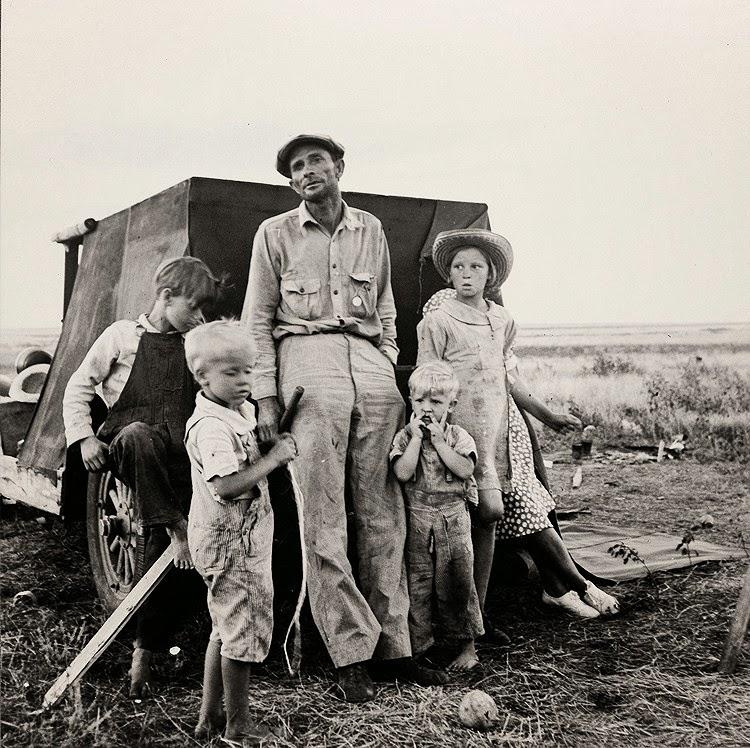
Texas, 1930s.
The road doesn’t lead anywhere in particular. It just continues.
That’s the defining feature of this moment—not movement toward something, but movement because staying put is no longer an option. By the time this photograph is taken, millions of Americans have already been displaced. Farms failing. Crops collapsing. Soil turning to dust and blowing away in storms that black out the sky.
The Great Depression isn’t just an economic event out here. It’s physical. It reshapes the land first, and then the people on it.
This man is part of that shift.
A migrant laborer, moving with his children, carrying what he can. There’s no permanent home behind him anymore, and nothing guaranteed ahead. Just the possibility of work—seasonal, uncertain, temporary. Cotton fields. Harvests. Whatever is available.
The car behind them isn’t really transportation in the modern sense. It’s storage. Shelter. A way to hold together the few possessions that haven’t been left behind yet. Everything else—land, stability, routine—has already been stripped away.
The children reflect that instability in different ways.
One leans into the vehicle, half-turned away, already withdrawn. Another stands close, holding something small in his hands, focused on it like it might anchor him. The youngest looks unsettled, not quite understanding the scale of what’s happening, but feeling it anyway. And the girl, standing off to the side, watches with a kind of awareness that suggests she’s starting to piece it together.
They’re not posing. They’re pausing.
The father stands at the center, not in control of the situation, but still responsible for it. That’s the tension. He’s expected to provide direction, but the conditions around him don’t offer many choices. The system that once made that role possible—land ownership, steady work, predictable seasons—has broken down.
And yet, the expectation remains.
So he stands there, holding the group together as best he can, even if “holding together” now means something very different than it used to.
This isn’t an isolated case. It’s part of a much larger movement. Hundreds of thousands of families traveling across states, following rumors of work, competing for wages that barely sustain them. Camps forming along the edges of fields. Entire communities existing in a state of transition, never fully settling.
The federal government is only beginning to respond at this point. Programs are emerging—relief efforts, work projects—but they don’t reach everyone, and they don’t move fast enough to match the scale of displacement.
So families like this operate in the gap.
Between collapse and recovery. Between what used to exist and whatever might come next.
The photograph captures that gap in a single frame.
No clear destination. No resolution. Just a moment on the road, where everything that matters is present, and nothing is certain.